June 16, 2026
Global Energy Markets Navigate Historic Supply Chain Disruption
Global energy security dynamics have entered uncharted territory as traditional supply chains undergo fundamental restructuring. The liquefied petroleum gas (LPG) sector exemplifies this transformation, where decades-established trade routes now face unprecedented stress tests. Market participants across multiple continents are implementing emergency protocols that may permanently alter commercial relationships and strategic partnerships, particularly affecting Asia LPG imports from the Americas.
This supply chain reconfiguration extends beyond immediate crisis management. Industrial consumers, government procurement agencies, and terminal operators are discovering that flexibility and diversification represent more than temporary adjustments—they constitute essential survival mechanisms in an increasingly volatile geopolitical landscape.
When big ASX news breaks, our subscribers know first
Strategic Infrastructure Adaptations Across Multiple Hemispheres
Terminal Capacity Utilization Reaches Critical Thresholds
North American export infrastructure has absorbed unprecedented demand volumes following Middle Eastern supply disruptions. US Gulf Coast terminals recorded 48.4 million barrels of ready-for-sale propane inventory as of March 27, 2026, representing near-maximum operational capacity according to Energy Information Administration data.
Export terminal fees have surged to record levels, with propane reaching $273.525 per metric ton and butane achieving $240.09 per metric ton on March 19, 2026. These pricing levels reflect both infrastructure constraints and urgent market demand from Asia LPG imports from the Americas, creating ripple effects throughout the global energy landscape.
Market analysts emphasise that existing American terminals operated close to capacity limitations before geopolitical disruptions began. This infrastructure bottleneck creates fundamental limitations on volume expansion possibilities, regardless of pricing incentives or contractual arrangements.
Alternative Sourcing Networks Emerge Rapidly
Key Supply Route Developments:
- Canadian propane exports establishing dedicated Asian shipping schedules
- Norwegian LPG terminals redirecting volumes toward Pacific markets
- Argentine producers negotiating long-haul contracts despite extended transit periods
- Mexican Gulf facilities exploring increased throughput capabilities
Transit time differentials create complex logistics calculations. Traditional Middle Eastern routes required approximately 14 days to reach Asian destinations, while Western Hemisphere alternatives demand 25-40 days depending on origin points. These extended shipping periods necessitate strategic inventory planning and working capital adjustments across receiving markets, particularly affecting how companies manage oil price rally analysis.
Volume Displacement Analysis Reveals Market Transformation Scale
Unprecedented Supply Redistribution Metrics
Recent data demonstrates the magnitude of global LPG trade pattern shifts:
| Supply Region | Historical Share (2025) | Current Volume (March 2026) | Percentage Change |
|---|---|---|---|
| West Asia | 48% (1.54M bpd) | 419,000 bpd | -73% |
| United States | 39% (1.26M bpd) | Projected 1.8M bpd | +14% |
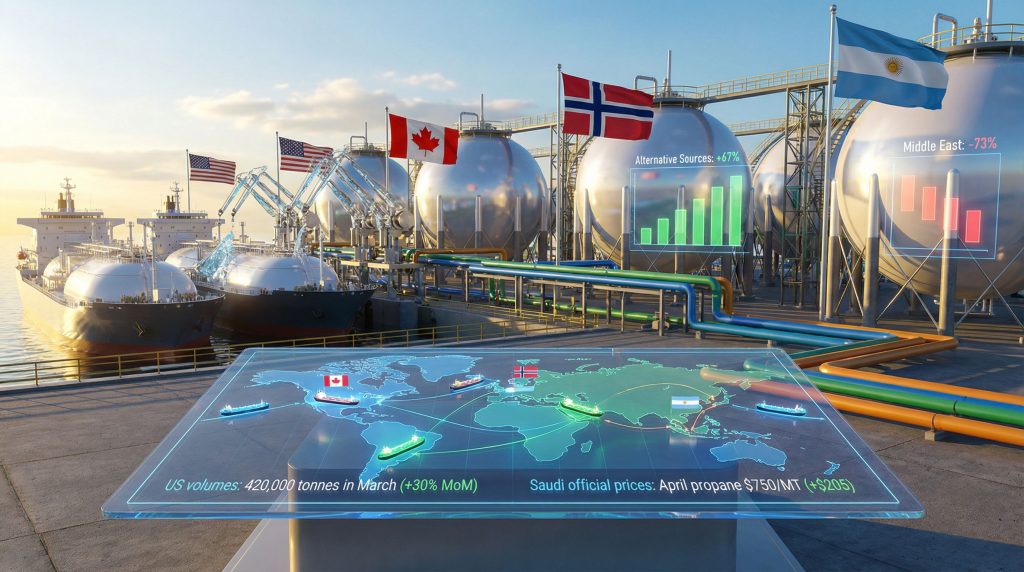
| Alternative Sources | 13% | 450,000 bpd | +67% |
This redistribution represents more than temporary market adjustment. The 73% reduction in West Asian exports—from traditional levels exceeding 1.5 million barrels per day to current levels below 420,000 bpd—has triggered structural changes in procurement strategies across multiple importing nations.
Price Discovery Mechanisms Under Extreme Stress
Market pricing has experienced historic volatility levels. Spot premiums reached $250 per metric ton above Saudi contract prices on March 30, 2026—a record differential according to Argus pricing agency data. These premiums reflect more than supply scarcity; they demonstrate the premium Asian importers place on supply security regardless of cost considerations, particularly in light of tariffs and oil stagnation.
Saudi Aramco's official selling price adjustments for April 2026 underscore market stress:
- Propane: $750/MT (+$205/MT, representing +37.7% monthly increase)
- Butane: $800/MT (+$260/MT, representing +48.1% monthly increase)
Asian Import Strategy Diversification Accelerates
India's Multi-Continental Procurement Framework
India has implemented the most aggressive diversification strategy among major Asian importers. March 2026 data reveals significant sourcing shifts:
Indian LPG Import Metrics:
- US volumes: 420,000 tonnes (+30% month-over-month, +56% from January 2026)
- Long-term contracted volumes: 2.2 million tonnes annually from US Gulf Coast
- Alternative suppliers now active: Argentina, Canada, Norway, alongside reduced Gulf allocations
Three major Indian state-owned enterprises coordinate these procurement efforts: Indian Oil Corporation (IOC), Bharat Petroleum Corporation Limited (BPCL), and Hindustan Petroleum Corporation Limited (HPCL). This coordinated approach enables economies of scale while managing supply risk across multiple geographic sources.
Indian demand patterns demonstrate supply situation complexities. Energy consultancy analysis indicates gradual improvement despite persistent shortages, with long-haul cargoes arriving from Argentina and the United States. Recovery projections suggest Indian LPG demand losses may narrow by approximately 70,000 bpd beginning in April 2026.
Chinese Industrial Response Mechanisms
China's propane dehydrogenation (PDH) sector illustrates industrial demand adjustment under supply constraints. These facilities convert propane into propylene—a critical building block for polyethylene and polypropylene plastics production.
PDH Facility Utilisation Analysis:
- Pre-conflict baseline: 60-65% capacity utilisation
- Current operations: Reduced to 55-60% capacity
- Primary constraint: Feedstock shortages rather than demand weakness
- Strategic approach: Reduced run rates while maintaining operational capability
This operational adjustment reflects sophisticated margin management rather than panic responses. PDH operators face dual pressure from elevated feedstock costs (higher LPG prices) and competitive product pricing pressures as multiple facilities reduce output simultaneously, creating interconnections with broader WTI/Brent market update trends.
Transportation Economics Drive Strategic Decisions
Geographic Distance Impact Assessment
Comparative Transit Analysis:
| Route | Distance (Nautical Miles) | Transit Period | Cost Implications |
|---|---|---|---|
| West Asia to Asia | 9,000-10,000 | 14 days | Baseline cost structure |
| US Gulf to Asia | 12,000-13,000 | 30+ days | 16-26 additional inventory days |
| Argentina to Asia | 18,000+ | 35-40 days | Maximum carrying cost burden |
| Canada to Asia | 11,500-12,500 | 25-28 days | Moderate cost premium |
Extended transit periods create cascading financial implications. At current spot premiums of $250 per metric ton, additional carrying costs approximate $6-8 per ton weekly in financing charges plus storage fees. These calculations exclude potential currency hedging requirements and marine insurance adjustments for extended voyages.
Strategic Chokepoint Considerations
Geopolitical uncertainty surrounding the Strait of Hormuz adds complexity to routing decisions. Traditional West Asian shipments depend on this strategic waterway, while Western Hemisphere alternatives utilise either Panama Canal routing or Cape of Good Hope passages—each carrying distinct risk profiles and cost structures.
Market participants emphasise that current geopolitical tensions affect not only immediate supply availability but also long-term procurement planning. Energy security considerations now weigh equally with cost optimisation in strategic sourcing decisions, particularly regarding Asia LPG imports from the Americas.
Industrial Downstream Consequences Multiply
Petrochemical Sector Demand Destruction
Regional steam crackers have reduced operations significantly due to feedstock constraints. March 2026 demand destruction estimates include:
Steam Cracker Impact Timeline:
- March 2026: 135,000 bpd reduction
- April 2026 projection: Additional 35,000 bpd decline
- May 2026 forecast: Further 11,000 bpd decrease
These reductions represent strategic capacity management rather than permanent facility shutdowns. Operators maintain capability for rapid production restoration when supply chains normalise, but current margin pressures make reduced utilisation economically rational.
Household Energy Security Implications
Residential LPG markets face distinct challenges beyond industrial applications. Indian cooking gas demand declined approximately 205,000 bpd in March 2026, directly affecting household budgets and energy security for millions of families, creating parallels with US oil production decline impacts.
Price transmission mechanisms mean higher LPG costs translate directly into increased cooking fuel expenses. Distribution networks experience additional stress managing supply irregularities while maintaining consistent household access across diverse geographic regions.
The next major ASX story will hit our subscribers first
Infrastructure Investment Patterns Shift Permanently
North American Export Capacity Expansion Requirements
Current crisis conditions highlight infrastructure investment needs across multiple regions. US export projections suggest April 2026 volumes may reach 2.7 million bpd total, with approximately 1.8 million bpd destined for Asian markets.
These volume levels approach infrastructure capacity limits, suggesting investment opportunities in:
- Additional terminal capacity at US Gulf Coast locations
- Storage infrastructure expansion for inventory management during high-demand periods
- Loading facility upgrades to handle larger vessel sizes efficiently
- Pipeline connectivity improvements linking production regions with export terminals
Asian Import Terminal Adaptations
Receiving infrastructure across Asian markets requires modifications to accommodate changed supply patterns:
Terminal Upgrade Requirements:
- Storage capacity increases for longer supply cycles between deliveries
- Berth scheduling optimisation for diverse vessel sizes and frequencies
- Quality specification systems adapted for multiple crude sources with varying specifications
- Inventory management technology supporting just-in-time delivery under extended lead times
Long-Term Market Structure Evolution
Strategic Supply Security Framework Development
Crisis response mechanisms are evolving into permanent policy frameworks. National energy policies increasingly emphasise diversification mandates, moving beyond traditional cost optimisation toward supply security prioritisation.
Contract structures are adapting to multi-source realities. Long-term agreements now incorporate flexibility provisions allowing volume redistribution among multiple suppliers based on geopolitical conditions and availability metrics, reflecting broader OPEC production impact considerations.
Regional cooperation mechanisms are emerging for emergency supply sharing. Asian importers explore coordination opportunities that could provide mutual support during future supply disruptions while maintaining competitive procurement strategies.
Investment Capital Reallocation Trends
Current market conditions are redirecting investment flows toward strategic infrastructure development:
Investment Priority Areas:
- Western Hemisphere production capacity expansion to serve Asian demand growth
- Inter-regional shipping infrastructure optimised for longer-distance cargo movements
- Alternative energy transition acceleration in markets experiencing chronic LPG supply uncertainty
- Strategic storage facilities enabling counter-cyclical inventory management
Furthermore, analysts observe that these investment patterns represent fundamental shifts in energy capital allocation. Traditional financing models based on proximity and established trade relationships are giving way to security-focused investment criteria that prioritise diversification over cost minimisation.
Recovery Scenario Planning and Market Positioning
Multiple Recovery Pathway Assessment
Scenario Timeline Analysis:
| Scenario | Duration | Market Impact | Structural Changes |
|---|---|---|---|
| Immediate Resolution | 2-3 months | Rapid price normalisation | Limited permanent change |
| Extended Conflict | 12+ months | Permanent market share redistribution | New trade relationships established |
| Gradual Normalisation | 6-12 months | Measured capacity restoration | Hybrid supply strategies persist |
Each scenario pathway presents distinct implications for market participants. Immediate resolution would trigger rapid price corrections but might not fundamentally alter diversification strategies already implemented. Extended conflict scenarios could permanently reshape global LPG trade geography.
Competitive Positioning Analysis
Long-term market dynamics depend on several critical factors:
Competitive Advantage Determinants:
- Cost competitiveness of alternative suppliers relative to traditional sources
- Reliability perception among Asian buyers regarding Western Hemisphere suppliers
- Infrastructure investment pace in both supply and demand regions
- Geopolitical risk assessment integration into procurement strategy development
Western Hemisphere suppliers face strategic opportunities to establish permanent market positions in Asian markets previously dominated by Middle Eastern exporters. Success depends on demonstrating cost competitiveness and supply reliability over extended periods rather than crisis-driven temporary arrangements.
Strategic Investment and Trading Considerations
Portfolio Diversification Imperatives
Market participants across the supply chain are implementing strategic changes that extend beyond immediate crisis management:
For Asian Energy Importers:
- Portfolio diversification becomes permanent strategy rather than emergency response
- Contract flexibility provisions increase in importance for managing supply uncertainty
- Regional cooperation mechanisms enhance collective supply security capabilities
For Western Hemisphere Suppliers:
- Market share expansion opportunities in Asian markets previously inaccessible
- Infrastructure investment requirements for sustained growth capability
- Price realisation improvements through geographic market diversification
For Global Trading Entities:
- Risk management frameworks adapted for increased volatility and geographic complexity
- Logistics optimisation systems handling multiple supply routes simultaneously
- Market intelligence capabilities covering expanded geographic scope
This transformation in Asia LPG imports from the Americas represents more than temporary market adjustment. Current developments are establishing new commercial relationships, investment patterns, and strategic frameworks that will influence global energy trade for years beyond immediate crisis resolution.
Additionally, market research indicates that Asian countries are fundamentally restructuring their energy procurement strategies, moving away from over-reliance on traditional Middle Eastern suppliers toward a more balanced approach incorporating American and other Western sources.
This analysis reflects dynamic market conditions and strategic adaptations occurring across the global LPG supply chain. Market participants should continuously monitor these developments for strategic planning purposes, as both immediate supply situations and long-term structural changes continue evolving rapidly.
Looking for Investment Opportunities in Global Energy Markets?
Discovery Alert's proprietary Discovery IQ model delivers instant notifications on significant ASX mineral and energy discoveries, helping investors capitalise on market-moving announcements before the broader market reacts. Explore how major discoveries have generated exceptional returns throughout history and begin your 14-day free trial to position yourself ahead of evolving global energy dynamics.