May 21, 2026
Global Energy Markets Face Unprecedented Supply Pressures Amid Evolving Sanctions Landscape
Energy markets worldwide navigate increasingly complex dynamics as supply management strategies clash with evolving geopolitical frameworks. The implementation of U.S. sanctions Venezuela oil import restrictions has created significant ripple effects throughout global commodity networks, demonstrating how regulatory mechanisms designed for specific foreign policy objectives generate unintended consequences throughout energy value chains.
Traditional approaches to commodity flow regulation through policy instruments create multi-layered effects across interconnected global systems. Market participants observe how these restrictions influence not only direct trade relationships but also broader oil price movements across international markets.
The intersection of diplomatic tools and energy infrastructure reveals fundamental tensions between short-term political objectives and long-term market stability. Contemporary analysis suggests that energy-focused sanctions create asymmetric impacts that often contradict their intended strategic purposes, particularly when abundant global supply conditions persist.
When big ASX news breaks, our subscribers know first
Understanding the Strategic Framework Behind Energy Sanctions Policy
The Economic Logic of Resource-Based Sanctions
Energy sanctions represent sophisticated policy instruments that leverage commodity dependencies to achieve geopolitical objectives. These mechanisms operate through multiple transmission channels, affecting production, transportation, financing, and technology transfer across entire supply chains.
Historical analysis reveals consistent patterns in how resource-based sanctions affect global markets. Furthermore, the broader US‑China trade war impact demonstrates similar dynamics across multiple commodity sectors.
Market fragmentation creates price differentials between sanctioned and non-sanctioned suppliers, whilst supply route diversification shifts traditional trade flows toward alternative channels. In addition, technology transfer restrictions limit long-term production capacity development, and financial system isolation complicates payment mechanisms and trade financing.
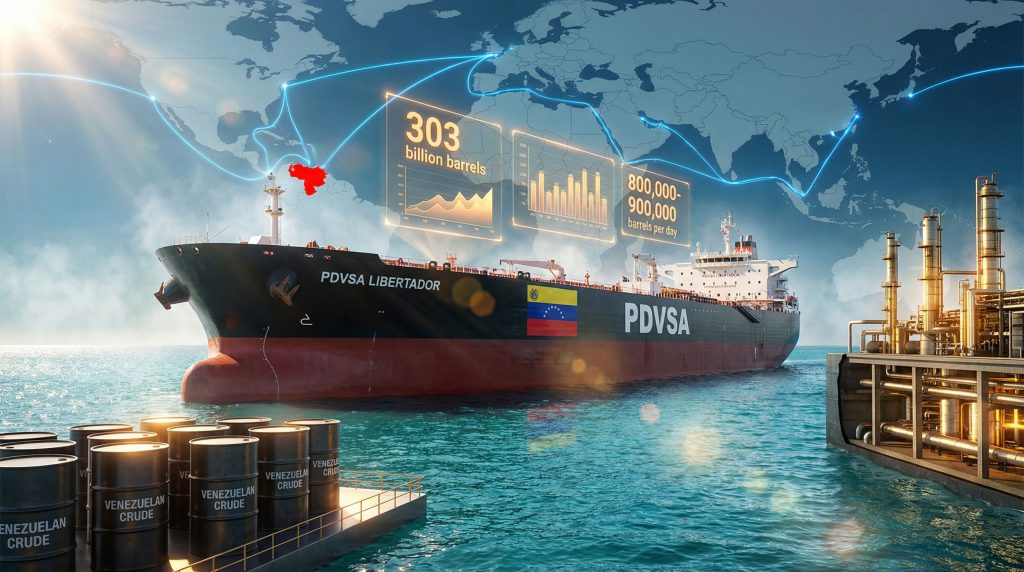
Venezuela's energy sector demonstrates these dynamics clearly. The country maintains 303 billion barrels of proven oil reserves, representing the world's largest documented crude oil deposits. However, current production estimates range between 800,000-900,000 barrels per day, a dramatic decline from the 3.2 million barrels daily peak achieved in 2013.
| Country | Sanctions Period | Production Impact | Reserve Access |
|---|---|---|---|
| Iran | 2011-present | -50% peak capacity | Limited technology |
| Russia | 2014-present | -15% export capacity | Financing restrictions |
| Venezuela | 2019-present | -75% peak output | Infrastructure decay |
Venezuela's Position in Global Oil Supply Chains
Venezuelan crude oil possesses unique characteristics that complicate simple substitution strategies. The majority of Venezuelan production consists of heavy crude with high sulfur content, requiring specialized refining infrastructure optimised for processing complex hydrocarbons.
U.S. Gulf Coast refineries invested billions developing coking capacity specifically designed for Venezuelan heavy crude processing. These facilities cannot easily switch to lighter crude alternatives without significant operational modifications and economic penalties.
Processing yield differentials between heavy and light crude create substantial economic incentives for maintaining Venezuelan supply relationships. Heavy crude processing yields higher volumes of valuable refined products, whilst existing infrastructure investments represent sunk costs exceeding $50 billion.
Alternative heavy crude sources from Canada and Mexico involve higher transportation costs, and quality specifications for Venezuelan crude match refinery optimisation parameters perfectly.
Current Sanctions Architecture and Policy Evolution
Post-2019 Sanctions Framework Development
The comprehensive sanctions regime targeting Venezuela's energy sector evolved through multiple phases, beginning with entity-specific designations and expanding to sectoral restrictions affecting entire industries. The U.S. sanctions Venezuela oil import restrictions framework represents one of the most comprehensive energy-focused sanctions programmes implemented in recent decades.
Primary sanctions mechanisms include asset freezing for designated Venezuelan government entities, transaction prohibitions involving U.S. persons and PDVSA, secondary sanctions threatening non-U.S. companies engaging in restricted activities, and licensing requirements for humanitarian and specific commercial activities.
The U.S. Treasury Department's Office of Foreign Assets Control (OFAC) maintains detailed guidance documents outlining compliance requirements and penalty structures. According to the Treasury Department, violations can result in civil penalties reaching millions of dollars, with criminal prosecutions for willful violations.
January 2026 Policy Statements and Market Implications
Recent policy statements suggest potential modifications to existing sanctions frameworks, though specific implementation details remain unclear. Trump administration officials indicated willingness to facilitate U.S. energy company involvement in Venezuelan infrastructure rehabilitation.
Analysts estimate infrastructure reconstruction costs at approximately $10 billion annually, requiring sustained capital commitments over multiple years. Jefferies research emphasises that successful rehabilitation depends on political stability guarantees and U.S. government backing for private investments.
"The potential for increased Venezuelan production hinges entirely on capital availability, which requires both political stability and likely guarantees from the U.S. government to attract necessary private investment."
Timeline of Key Policy Developments:
| Date | Policy Action | Market Impact |
|---|---|---|
| January 2019 | PDVSA designation | Immediate supply disruption |
| August 2019 | Sectoral sanctions expansion | Secondary market effects |
| October 2023 | Limited licence modifications | Marginal price adjustments |
| January 2026 | Rehabilitation statements | Speculative position building |
U.S. Energy Security Implications of Import Restrictions
Domestic Refining Capacity and Heavy Crude Dependencies
U.S. refineries process approximately 16 million barrels daily of crude oil, with Gulf Coast facilities accounting for roughly half of national capacity. These refineries invested extensively in coking and hydrotreating equipment optimised for heavy, sour crude processing.
Strategic Petroleum Reserve (SPR) considerations add complexity to Venezuelan sanctions impacts. The SPR currently maintains approximately 370 million barrels of emergency crude stocks, though specific grades and quality specifications remain classified.
Recent European Union energy trade data reveals shifting patterns in transatlantic commodity flows. Consequently, these changes reflect broader market adjustments to sanctions enforcement and alternative supply arrangements.
U.S. Crude Oil Exports to EU:
• 2024: 1.91 million barrels daily average
• 2025: 1.73 million barrels daily average
• Year-over-year decline: 9.4% or 180,000 barrels daily
U.S. LNG Exports to EU:
• 2024: 45.14 million tons
• 2025: 72.24 million tons
• Year-over-year increase: 60% or 27.1 million tons
Economic Impact Analysis on Energy Price Volatility
Current crude price environment reflects oversupply conditions despite ongoing sanctions enforcement. WTI crude trades near $59.34 per barrel, while Brent crude maintains levels around $64.13 per barrel, indicating relatively stable market conditions.
Price volatility measurements suggest sanctions create limited premium effects when global supply remains abundant. However, the potential for an oil rally under tariffs could change this dynamic significantly.
Margin compression analysis for U.S. LNG exporters reveals critical price thresholds. Historical margins of $4+ per mmBtu during 2021-2024 have compressed to current margins of $4 per mmBtu in early 2026, with curtailment thresholds below $4 per mmBtu spread between Henry Hub and TTF.
Energy research from MST Marquee indicates that U.S. LNG operations achieved outstanding profitability since late 2021. Nevertheless, margins have normalised as new export capacity comes online and European gas prices stabilise, creating parallels with broader natural gas trends affecting the sector.
Global Market Response to Sanctions Enforcement
Third-Country Adaptation Strategies
China maintains significant Venezuelan crude import volumes despite U.S. sanctions, with flows estimated above 400,000 barrels daily through various mechanisms. Chinese companies utilise complex trading structures and specialised vessel fleets to maintain supply relationships.
Floating storage levels reached record highs according to Kpler tracking data, with oil inventories on tankers at their highest levels since April 2020. This development suggests oversupply conditions rather than supply constraints from sanctions enforcement.
Indian refiners increasingly source alternative crude supplies to replace sanctioned volumes. Ecuador provides substitute heavy crude with similar processing characteristics, whilst Middle Eastern producers offer longer-term supply contracts.
Furthermore, Russian crude continues flowing despite separate sanctions regimes, and African producers expand market share in Asian refineries. These developments demonstrate how markets adapt to regulatory restrictions through alternative supply arrangements.
Shadow Fleet Operations and Enforcement Challenges
Maritime enforcement represents the most visible aspect of sanctions implementation. Vessel tracking systems monitor suspicious tanker movements, while insurance restrictions limit coverage for sanctions-exposed activities.
Lloyd's of London and major marine insurers refuse coverage for Venezuelan crude shipments, forcing traders toward alternative insurance arrangements often provided by state-backed insurers in China and Russia.
Flag state regulatory arbitrage allows vessel owners to avoid enforcement through strategic reflagging. For instance, Liberia and Marshall Islands maintain strict compliance standards, whilst Panama implements selective enforcement depending on beneficial ownership.
Russian flag registration is increasingly utilised for sanctions-exposed activities, and Iranian registry provides alternatives for completely sanctioned operations. Recent enforcement actions demonstrate escalating legal consequences, with U.S. federal courts imposing substantial penalties exceeding $100 million for repeat violations.
Investment Flow Disruption in Energy Infrastructure
Capital Allocation Impact Assessment
Foreign direct investment in Venezuelan energy infrastructure declined approximately $15 billion since 2019 sanctions implementation. This figure represents both suspended projects and withdrawn capital from existing operations.
Technology transfer restrictions prevent Venezuelan operators from accessing advanced drilling and refining equipment. OFAC maintains detailed lists of prohibited technologies, including enhanced oil recovery systems, deepwater drilling equipment, refinery upgrading technology, and pipeline construction materials.
Major international oil companies wrote down Venezuelan asset values significantly. ConocoPhillips received a $2 billion arbitration award for expropriated assets, whilst Chevron maintains limited operations under specific OFAC licences.
European companies completely withdrew from Venezuelan projects, though Asian national oil companies maintain presence through joint ventures. These patterns illustrate how U.S. sanctions Venezuela oil import restrictions create lasting structural changes in global investment flows.
Alternative Investment Destination Analysis
Capital previously allocated toward Venezuelan projects shifted to alternative jurisdictions offering similar geological characteristics and political stability. Guyana's offshore development accelerated dramatically, with ExxonMobil-led consortia discovering over 11 billion barrels of recoverable resources.
Production capacity expansion targets 1.3 million barrels daily by 2028. Brazil's pre-salt developments attracted increased investment as companies sought heavy crude alternatives, with Petrobras expanding production capacity through technology partnerships.
U.S. shale production responded to supply gaps through increased drilling activity, though economics remain challenging at current price levels. Permian Basin operators focus on efficiency improvements rather than aggressive expansion.
The next major ASX story will hit our subscribers first
Long-Term Economic Consequences and Market Restructuring
Supply Chain Adaptation and Infrastructure Investment
Refinery configuration changes represent the most significant long-term consequence of sustained Venezuelan sanctions. U.S. Gulf Coast facilities invested in alternative crude sourcing arrangements, though complete substitution remains economically inefficient.
Trading house risk management evolved substantially to address sanctions compliance requirements. Major commodity traders implemented comprehensive compliance systems costing tens of millions annually, with dedicated legal teams monitoring regulatory developments.
Insurance premium adjustments reflect heightened sanctions exposure across energy markets. Marine insurance rates increased 15-25% for sanctions-adjacent routes, whilst political risk coverage excludes sanctions-related losses.
Trade finance institutions demand enhanced due diligence procedures, and project finance structures require explicit government guarantees. These changes demonstrate lasting impacts beyond direct trade restrictions.
Hypothetical Sanctions Removal Scenarios
Economic modelling suggests complete sanctions removal could restore Venezuelan production to 1.8-2.2 million barrels daily within three to five years, assuming sustained capital investment and political stability.
Market impact analysis indicates potential price depression from rapid Venezuelan production increases. Short-term oversupply could pressure prices below $50 per barrel, followed by medium-term market rebalancing through demand growth and natural decline.
Investment requirements for full production restoration exceed $50 billion over five years, requiring coordinated efforts from international oil companies, service providers, and financial institutions. However, the OPEC production impact would need careful consideration in any restoration scenario.
Geopolitical Realignment and Energy Diplomacy
Russia-China-Venezuela energy cooperation frameworks demonstrate how sanctions enforcement creates alternative alliance structures. These partnerships utilise non-dollar payment systems and technology transfer arrangements outside traditional Western frameworks.
OPEC+ production coordination faces challenges from sanctions-affected members. Venezuela's limited production capacity reduces its influence within the organisation, whilst Iran similarly operates under constraints.
According to Al Jazeera analysis, U.S. hemispheric energy security doctrine emphasises regional supply chain integration through partnerships with Canada, Mexico, and Brazil. This approach seeks to reduce dependence on geopolitically volatile suppliers whilst maintaining market access.
Frequently Asked Questions About Venezuelan Oil Sanctions
What specific activities require OFAC licences?
Any transactions involving Venezuelan government entities, PDVSA, or their subsidiaries require specific authorisation. This includes crude oil purchases, equipment sales, technical services, and financial transactions. General licences provide limited exceptions for humanitarian activities and specific commercial arrangements.
How do secondary sanctions affect non-U.S. companies?
Foreign companies engaging in prohibited activities face potential U.S. market exclusion, asset freezing, and transaction restrictions. Secondary sanctions apply to any entity that materially assists sanctioned activities, regardless of location or nationality.
What penalties apply for sanctions violations?
Civil penalties can reach twice the value of underlying transactions, with minimum penalties of $250,000 per violation. Criminal prosecutions for willful violations carry potential prison sentences and unlimited fines.
How frequently are sanctions policies reviewed?
OFAC conducts ongoing assessments of sanctions effectiveness and policy objectives. Modifications typically occur through updated guidance, new licence categories, or revised designation criteria rather than wholesale policy changes.
Market Forces Versus Policy Objectives: Balancing Competing Priorities
Cost-Benefit Analysis of Current Sanctions Framework
Economic analysis reveals mixed results from Venezuelan sanctions implementation. While policy objectives include pressure on Venezuelan government structures, market consequences extend far beyond intended targets.
Effectiveness measurements consider multiple factors including political impact on Venezuelan government decision-making, economic costs to U.S. refiners and consumers, geopolitical consequences for regional energy security, and market efficiency impacts on global crude oil allocation.
Market efficiency implications demonstrate how restricted trade flows create suboptimal resource allocation. Refineries operate below optimal capacity utilisation whilst alternative crude sources involve higher transportation and processing costs.
Energy Transition Considerations
Long-term energy transition trends complicate traditional sanctions policy frameworks. Declining global oil demand projections suggest reduced strategic importance for specific crude oil sources over time.
Renewable energy expansion and electrification trends may diminish petroleum product dependencies that currently make sanctions effective. Policy makers must consider whether short-term sanctions objectives align with long-term energy system evolution.
Investment allocation toward clean energy technologies offers alternative development pathways for resource-dependent economies, potentially reducing the strategic importance of hydrocarbon sanctions as policy tools.
Venezuelan crude oil sanctions demonstrate the complex interplay between geopolitical objectives and market realities. Whilst policy tools effectively restrict specific trade flows, global energy markets adapt through alternative supply chains and trading mechanisms. The ultimate effectiveness of U.S. sanctions Venezuela oil import restrictions depends on sustained political will, international cooperation, and careful consideration of unintended economic consequences across interconnected energy systems.
Could You Be Missing the Next Major Energy Discovery?
Discovery Alert's proprietary Discovery IQ model delivers real-time alerts on significant ASX mineral discoveries, including critical energy metals and resources, instantly empowering subscribers to identify actionable opportunities ahead of the broader market. Begin your 30-day free trial today and position yourself to capitalise on the next wave of energy sector discoveries whilst complex geopolitical dynamics create new investment opportunities across global commodities markets.