May 22, 2026
Global Energy Markets Face Unprecedented Volatility in 2026
The intersection of geopolitical maneuvering and energy security has reached a critical inflection point as Trump's Venezuela gambit reshapes strategic positions across Latin America. With global oil markets experiencing heightened sensitivity to political developments, investors are recalibrating risk assessments for emerging market exposures while energy infrastructure becomes increasingly weaponised in international relations.
Market participants are witnessing a fundamental shift in how geopolitical events translate into commodity price movements, with traditional hedging strategies proving inadequate against the complexity of modern interventionist policies. Furthermore, the current landscape demonstrates how quickly established supply chains can be disrupted when foreign policy objectives align with resource extraction opportunities.
When big ASX news breaks, our subscribers know first
Understanding the Economic Warfare Framework Behind Modern Sanctions
The application of comprehensive economic pressure represents a sophisticated evolution beyond traditional diplomatic tools, targeting specific vulnerabilities within state-controlled energy sectors. Current strategies employ multi-layered approaches that simultaneously restrict capital access, technology transfers, and international market participation.
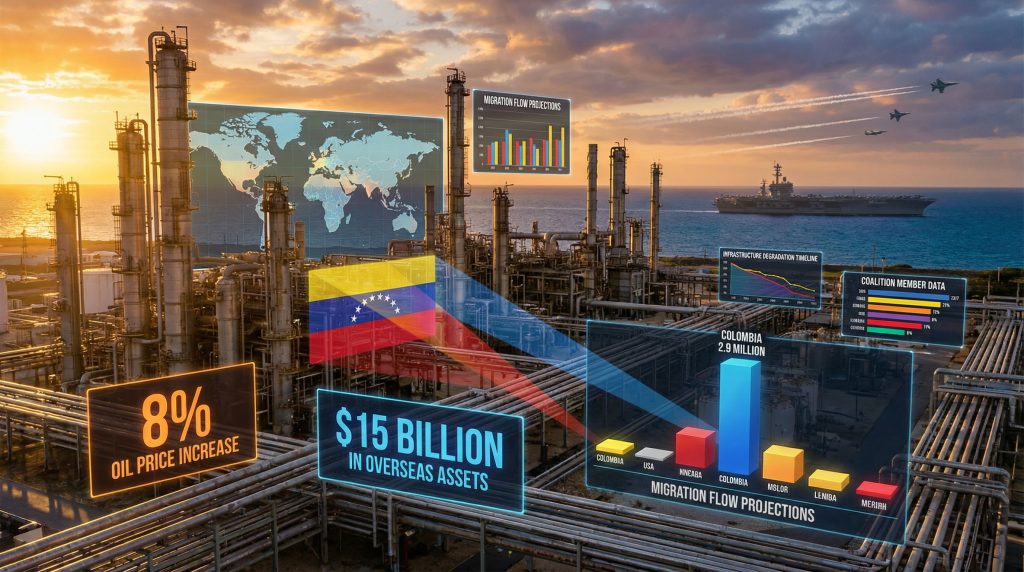
Financial isolation mechanisms have proven particularly effective against petroleum-dependent economies, where revenue concentration creates systemic vulnerabilities. The freezing of approximately $15 billion in overseas assets demonstrates how modern sanctions can immediately constrain government operations while maintaining plausible deniability regarding humanitarian impacts.
Banking restrictions affecting oil revenue collection represent perhaps the most devastating component of economic warfare strategies. By limiting access to international financial networks, these measures force target nations into increasingly disadvantageous barter arrangements or reliance on sanctioned financial institutions.
Technology Transfer Limitations and Infrastructure Degradation
The restriction of technology transfers creates long-term structural damage to petroleum infrastructure that extends far beyond immediate political objectives. Modern oil extraction and refining operations require continuous technological upgrades, particularly in aging facilities where equipment replacement becomes critical for maintaining production capacity.
Supply chain disruptions for refining equipment have created cascading effects throughout Venezuelan petroleum operations. Without access to specialised components for maintenance and modernisation, production capacity has declined by an estimated 75% from peak levels recorded in the late 1990s.
Key infrastructure elements facing critical degradation include:
- Refining capacity at Puerto La Cruz and Paraguana complexes
- Pipeline networks connecting Orinoco Basin production fields
- Export terminal facilities at Jose and Maracaibo ports
- Power generation systems supporting drilling and processing operations
- Water treatment facilities essential for enhanced oil recovery
Regional Coalition Dynamics and Diplomatic Leverage
The revival of multilateral pressure mechanisms represents a significant departure from unilateral intervention strategies that characterised previous decades. Regional coalition-building provides political legitimacy for economic measures while distributing the costs of enforcement across multiple jurisdictions.
The Lima Group's coordination across 12 Latin American nations creates a comprehensive framework for diplomatic isolation that extends beyond bilateral U.S. relationships. This approach leverages regional concerns about migration flows and economic stability to build consensus for intervention policies.
Coalition member commitments encompass multiple dimensions of pressure:
- Diplomatic recognition of opposition leadership structures
- Border security cooperation to manage refugee flows exceeding 4.7 million displaced persons
- Intelligence sharing regarding government financial activities and asset holdings
- Economic coordination on sanctions enforcement and compliance monitoring
Migration Crisis as Strategic Leverage
The humanitarian dimension of economic pressure creates powerful incentives for regional cooperation, as neighbouring countries face direct consequences from failed state scenarios. Colombia alone hosts approximately 2.9 million Venezuelan refugees, with associated annual costs exceeding $2.1 billion for social services and infrastructure.
| Destination Country | Current Refugee Population | Annual Economic Impact | Projected Growth Rate |
|---|---|---|---|
| Colombia | 2.9 million | $2.1 billion | 15-20% annually |
| Brazil | 800,000 | $800 million | 25% annually |
| Peru | 1.5 million | $1.2 billion | 18% annually |
| Ecuador | 450,000 | $600 million | 22% annually |
Energy Infrastructure as Geopolitical Battleground
Petroleum infrastructure represents both the primary target and ultimate prize in contemporary resource conflicts, where control over production facilities determines long-term economic outcomes. The systematic degradation of Venezuelan capabilities creates opportunities for external actors while simultaneously complicating post-conflict reconstruction efforts.
Production capacity analysis reveals the extensive damage created by prolonged underinvestment and maintenance failures. Venezuelan oil output has declined from peak production of 3.5 million barrels per day in 1997 to current levels below 800,000 barrels per day, representing a collapse of approximately 77%.
Critical Infrastructure Vulnerabilities
The concentration of Venezuelan petroleum infrastructure in geographically constrained areas creates strategic vulnerabilities that extend beyond immediate production concerns. The Paraguana Peninsula houses approximately 65% of national refining capacity within a single complex, while the Lake Maracaibo basin contains the majority of easily accessible reserves.
Power generation systems supporting petroleum operations face particular stress due to cascading infrastructure failures across the national electrical grid. Frequent blackouts affecting drilling operations have reduced extraction efficiency while accelerating equipment deterioration in harsh tropical environments.
Water treatment facilities essential for enhanced oil recovery have suffered extensive damage, limiting the technical options available for maximising extraction from mature fields. Without access to modern water injection systems, reservoir pressure maintenance becomes increasingly difficult.
Financial Markets Respond to Escalating Uncertainty
Investor sentiment reflects deep uncertainty about intervention outcomes, with traditional risk indicators showing contradictory signals across different asset classes. Moreover, the tariffs' market impacts demonstrate how quickly geopolitical developments can reshape sector allocations and risk premiums.
Defense sector equities have surged approximately 8% following military deployment announcements, while broader emerging market indices declined 3% on regional stability concerns. The immediate market reaction demonstrates how quickly geopolitical developments translate into investment decisions.
Energy company valuations reflect competing scenarios ranging from asset recovery opportunities to prolonged regional instability affecting global supply chains. However, analysts note that US-China trade impacts continue to overshadow regional developments in broader market sentiment.
Investment Opportunity Analysis
High-Potential Recovery Scenarios:
- ExxonMobil asset claims valued at approximately $13.6 billion from previous expropriations
- Upstream exploration rights in Orinoco Basin heavy oil reserves
- Refining infrastructure reconstruction projects requiring $50-75 billion investment
- Pipeline and transportation network modernisation opportunities
Risk Mitigation Considerations:
- Political risk insurance products showing premium increases of 150-200%
- Joint venture structures with regional partners to distribute exposure
- Phased investment approaches tied to measurable stability metrics
- Currency hedging strategies for operations in volatile economic environments
Oil Price Dynamics and Supply Chain Adjustments
Global petroleum markets demonstrate complex reactions to supply disruption scenarios, with initial price spikes of 8% followed by strategic reserve releases and alternative production adjustments. Furthermore, the oil price trade dynamics reveal how geopolitical tensions influence commodity trading patterns.
OPEC+ coordination mechanisms provide stabilising influence through production adjustments that partially offset Venezuelan supply losses. Saudi Arabia and UAE spare capacity of approximately 2.5 million barrels per day creates flexibility for managing short-term disruptions.
U.S. strategic petroleum reserve releases totaling 50 million barrels over six months provide additional market stability while supporting domestic refiners dependent on heavy crude inputs similar to Venezuelan grades.
Alternative Supply Sources
| Producer | Spare Capacity | Grade Compatibility | Transport Costs |
|---|---|---|---|
| Saudi Arabia | 1.5 million bpd | Medium | $3-4 per barrel |
| UAE | 1.0 million bpd | Light-Medium | $4-5 per barrel |
| Iraq | 500,000 bpd | Heavy | $6-7 per barrel |
| Canada | 300,000 bpd | Heavy | $8-10 per barrel |
The next major ASX story will hit our subscribers first
International Response and Counter-Pressure Strategies
Russian and Chinese strategic responses encompass multiple dimensions beyond economic support, including military cooperation and diplomatic protection through international institutions. These counter-measures reflect broader geopolitical competition for influence in the Western Hemisphere.
Russian naval presence in Caribbean waters represents a direct challenge to traditional U.S. maritime dominance, with deployment of advanced surface vessels and submarine capabilities. "This deployment signals Moscow's commitment to challenging American hegemony in its traditional sphere of influence," according to recent Pentagon assessments.
Chinese economic engagement continues through alternative financial systems that bypass traditional banking networks subject to sanctions. Belt and Road Initiative infrastructure investments totaling approximately $20 billion provide sustained economic support while advancing broader strategic objectives.
Technology Transfer and Military Support
Advanced defense systems including S-400 surface-to-air missiles create significant tactical challenges for potential military operations while demonstrating commitment to Venezuelan government survival. These deployments represent escalatory responses that raise operational costs and risks for intervention scenarios.
Cyber warfare capabilities targeting critical U.S. infrastructure provide asymmetric response options that extend conflict implications beyond immediate regional boundaries. Power grid vulnerabilities and financial system dependencies create potential targets for retaliation.
Long-Term Market Structure Implications
The success or failure of comprehensive economic warfare strategies will establish important precedents for future resource conflicts and intervention policies. Market participants must consider scenarios ranging from rapid regime change to prolonged instability affecting broader regional development.
Successful intervention could unlock substantial investment opportunities while establishing new models for resource extraction partnerships. However, reconstruction requirements may exceed $200 billion over the first decade, creating sustained capital demands that challenge traditional project financing approaches.
Energy Transition Considerations
The timing of potential Venezuelan asset recovery coincides with accelerating global energy transition challenges that may limit long-term petroleum demand. Investors must balance immediate opportunity assessments against evolving regulatory environments and consumer preferences.
Carbon pricing mechanisms and environmental regulations create additional complexity for large-scale petroleum infrastructure investments, particularly in jurisdictions with aggressive climate policies. The economic viability of heavy oil projects faces increasing scrutiny under evolving sustainability frameworks.
Risk Assessment and Portfolio Positioning
Contemporary geopolitical risks require sophisticated analytical frameworks that extend beyond traditional country risk assessments to encompass regional stability and supply chain resilience. In addition, Trump's Venezuela gambit demonstrates how quickly established investment assumptions can be challenged by policy shifts and military developments.
Investors should consider diversified exposure strategies that balance potential opportunities against downside protection through various hedging mechanisms. Furthermore, the US economy tariffs impact suggests that currency volatility, political risk insurance, and sector rotation strategies become essential tools for managing exposure to evolving situations.
Key Risk Factors for Portfolio Management:
- Regional contagion effects spreading to Colombia and Brazil
- Energy price volatility affecting broader commodity positions
- Currency devaluation risks in Latin American markets
- Infrastructure damage limiting post-conflict recovery potential
- International legal challenges affecting asset recovery claims
What's Next for Trump's Venezuela Gambit?
The ultimate resolution of current tensions will significantly influence investment strategies and market positioning across emerging markets, energy sectors, and defense industries. "This gambit represents the most significant test of interventionist policies since the Iraq invasion," notes political risk analysts.
Consequently, careful monitoring of developments remains essential for maintaining appropriate risk-adjusted returns in increasingly complex geopolitical environments. The precedent set by Trump's Venezuela gambit may reshape how future administrations approach resource-rich nations experiencing political instability.
Furthermore, the international community's response to these actions will determine whether similar strategies become normalised tools of foreign policy or face sustained multilateral opposition. Market participants must prepare for scenarios ranging from rapid resolution to prolonged regional conflict affecting global supply chains.
This analysis is based on publicly available information and market data. Investment decisions should be based on comprehensive due diligence and professional financial advice. Past performance does not guarantee future results, and all investments carry inherent risks that may result in loss of principal.
Looking to Capitalise on Geopolitical Energy Market Shifts?
Discovery Alert's proprietary Discovery IQ model delivers real-time alerts on significant ASX mineral discoveries, helping investors navigate volatile energy and commodity markets by identifying actionable opportunities ahead of broader market movements. Begin your 30-day free trial today and understand why major mineral discoveries can generate substantial returns by exploring Discovery Alert's dedicated discoveries page, showcasing historic examples of exceptional market outcomes.