August 6, 2026
Global Energy Security Under Siege: Market Mechanics Behind the Crisis
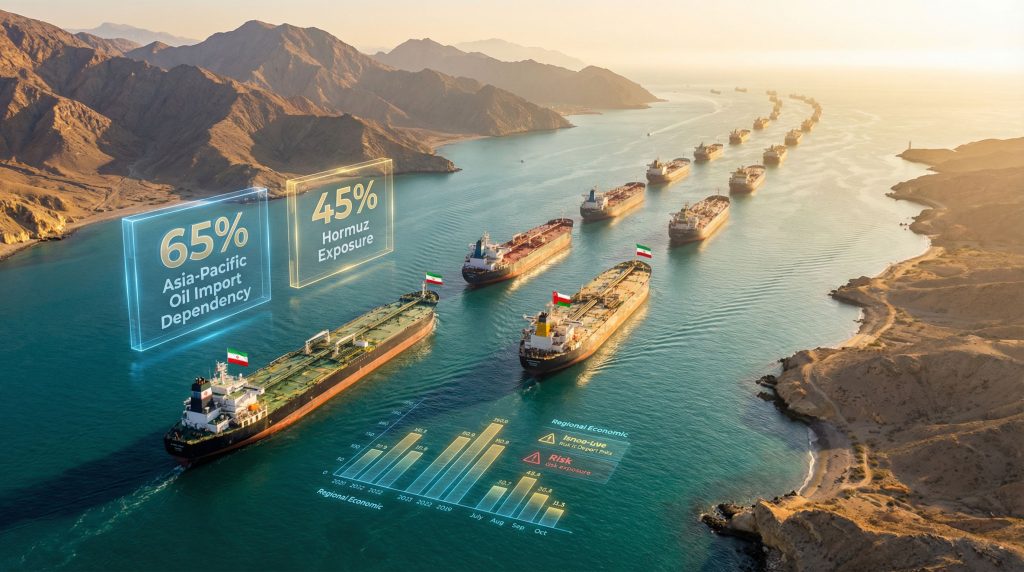
Global energy markets operate as interconnected systems where disruptions in one region create cascading effects across multiple continents. The vulnerability of critical infrastructure points becomes most apparent during periods of geopolitical tension, when market forces amplify initial disruptions through complex feedback mechanisms. The current Strait of Hormuz tanker squeeze demonstrates how transportation bottlenecks, insurance market responses, and supply chain consolidation combine to transform localised conflicts into systemic economic challenges affecting millions of consumers worldwide.
The current crisis demonstrates how modern energy systems depend on narrow geographic corridors that concentrate risk in ways previous generations could not have anticipated. When these chokepoints face operational constraints, the economic consequences extend far beyond simple supply shortages, creating structural shifts in global trade patterns and pricing mechanisms.
When big ASX news breaks, our subscribers know first
Understanding Critical Maritime Infrastructure Vulnerabilities
The world's most significant energy transportation corridor handles approximately 21 million barrels per day of crude oil and liquefied natural gas exports, representing roughly 25% of global petroleum trade. This concentration creates inherent systemic risk that extends beyond immediate shipping concerns.
Recent tracking data from Kpler and Vortexa systems indicates that vessel traffic through this critical waterway declined dramatically during the March 2026 crisis. Furthermore, only one or two mid-sized vessels transited on March 3, 2026, representing an operational near-freeze of normal commercial activity.
Geographic Constraints and Physical Limitations
The strategic waterway measures approximately 54 kilometres wide at its broadest point and 38 kilometres at its narrowest section. The deepest navigation channel restricts vessel passage to less than 300 metres in certain areas, creating inherent chokepoint vulnerabilities for maritime transit.
Navigation requires specialised procedures, with most vessels mandating experienced pilots for safe transit. Very Large Crude Carriers (VLCCs) carrying 2 million barrels each must navigate with minimal draft margins, making the route vulnerable to any security incidents or operational disruptions.
The waterway operates through two designated shipping lanes, each 3 nautical miles wide, separated by a 2-nautical-mile buffer zone. This configuration accommodates two-way traffic under normal conditions but becomes severely constrained during crisis periods.
Alternative Route Analysis and Infrastructure Dependencies
Pipeline alternatives include the Petroline, SUMED, and Baku-Tbilisi-Ceyhan systems, though these possess limited capacity compared to maritime transportation volumes. The infrastructure constraints mean that pipeline bypasses cannot accommodate the full volume typically handled by sea transport.
| Alternative Route | Daily Capacity | Current Utilisation | Bottleneck Factors |
|---|---|---|---|
| Petroline System | 4.8 million bpd | 85% | Terminal limitations |
| SUMED Pipeline | 2.5 million bpd | 70% | Suez Canal dependency |
| Baku-Tbilisi-Ceyhan | 1.2 million bpd | 90% | Regional security |
Tanker Market Dynamics During Crisis Periods
The freight rate for supertankers on the Middle East-to-China route reached a record high of more than $420,000 per day as of March 2, 2026. For comparative context, average supertanker rates globally reached $280,900 during the same period, indicating extreme regional premiums of approximately 50% above global averages.
Fleet Availability Constraints
Bloomberg reporting identified only between six and a dozen supertankers available for booking in the Persian Gulf capable of loading crude oil. This represents approximately a 95%+ reduction in available capacity, calculated from industry norms of 100+ VLCCs typically available for prompt booking globally.
Each supertanker requiring two days to load means the 6-12 available vessels could theoretically handle only one day's worth of normal outbound Persian Gulf oil production. The loading time constraints create additional bottlenecks beyond simple vessel availability.
Market Concentration Effects
South Korean shipping company Sinokor has achieved unprecedented control over substantial portions of the world's supertankers for immediate booking. Furthermore, Bloomberg analysis indicates that Sinokor, along with Mediterranean Shipping Company, controlled almost all VLCCs available for hire to load oil from the U.S. Gulf Coast.
This market concentration creates pricing power over major alternative export routes, demonstrating how primary supply chain disruption generates secondary effects through consolidation mechanisms. The concentration affects not only regional routes but global shipping capacity allocation.
Insurance Market Withdrawal Mechanisms
War risk coverage operates as a distinct insurance product separate from standard marine insurance. When underwriters withdraw this coverage, shipowners must either accept uncompensated risk or refrain from transit. The economics become binary: with $420,000 daily freight rates, a single successful attack creates losses exceeding typical insurance premiums by orders of magnitude.
For a $100 million vessel, daily operational costs might total $50,000, making the risk profile fundamentally uninsurable at normal premium levels. Insurance providers have not declared formal embargos; rather, they have priced out war risk coverage by withdrawing the product entirely.
Regional Economic Impact Assessment
Freight Cost Translation to Consumer Prices
At $420,000 per day for a 10-12 day Middle East-to-Asia voyage, round-trip freight costs total approximately $4.2-5.0 million per voyage. For a 2-million-barrel VLCC cargo, this translates to approximately $2.10-2.50 per barrel in freight costs alone.
With Brent crude trading around $81.40 per barrel on March 4, 2026, freight costs represent 2.6-3.1% cost adders to crude prices. This represents a significant margin impact in refined product economics, particularly when considering broader us tariffs and inflation dynamics affecting global trade.
Regional Pricing Spread Dynamics
The Brent-Dubai spread reached multi-year highs during the March 2026 crisis, indicating severe regional supply imbalances. Brent crude (North Sea benchmark) and Dubai crude (Persian Gulf benchmark) typically trade within $0.50-2.00 per barrel of each other.
Multi-year high spreads suggest divergences of $3.00-5.00+ per barrel, reflecting premiums for non-Persian Gulf supplies as buyers avoid transit-constrained oil. This bifurcation represents fundamental market segmentation rather than temporary volatility.
Manufacturing Sector Vulnerabilities
Asian refineries optimised for Persian Gulf crude feedstock face dual pressures: higher feedstock freight costs and potential supply unavailability forcing them toward costlier alternative crudes. A typical refinery margin on crude-to-gasoline processing ranges $3-8 per barrel.
When freight costs add $2-2.50 per barrel and alternative crudes command $3-5 per barrel premiums, refinery margins compress from profitable ranges into negative territory. Consequently, this mechanism necessitates production cuts, explaining why Asian refiners began considering crude processing reductions during the March 2026 crisis.
How Do Production Shutdowns Impact Global Markets?
Critical Timeline Factors
JPMorgan analysts indicated that vessel shortage becomes the binding constraint on production within 21 days of disruption. This reframes the crisis from supply shortage to logistics catastrophe with production consequences.
The 21-day threshold reflects economic calculations where continued production becomes unviable when export logistics collapse. Production facilities themselves become economically unviable when maritime infrastructure constraints prevent export capacity utilisation.
Current Production Impact
Iraq, OPEC's second-largest producer, has already shut in as much as 1.5 million barrels daily in production due to the Persian Gulf situation. Iraqi officials indicate further shut-ins could bring the total to 3 million barrels daily, approximately equal to Iraq's entire export volumes of 3.2-3.4 million barrels daily.
JPMorgan analysts estimate production shut-ins could reach 4.7 million barrels daily by the 18th day of disruption, with Iraq suspending all oil exports within three days. Additionally, Kuwait has only 14 days of storage capacity remaining, further highlighting the opec production impact on global supply chains.
Strategic Response Mechanisms
Government Intervention Thresholds
Strategic petroleum reserve deployment considerations become critical when production shut-ins approach 3-5 million barrels daily. The International Energy Agency estimates global supply overhang at approximately 3 million barrels daily, meaning significant production shut-ins could quickly eliminate surplus capacity.
Emergency response protocols through the IEA require member country coordination, though bilateral supply agreements may activate more rapidly during acute disruptions. The timing and scale of strategic reserve releases can significantly influence market psychology and pricing dynamics.
Alternative Energy Acceleration
Infrastructure investment priorities shift during extended crises, with alternative energy transition timing potentially accelerating beyond previous projections. Regional refining capacity optimisation becomes economically attractive when traditional supply routes face persistent disruption.
Port and terminal capacity adjustments may receive expedited development timelines, particularly for facilities capable of handling alternative crude sources or increased pipeline throughput capacity. However, the trade war oil impact complicates these strategic responses.
The next major ASX story will hit our subscribers first
Long-Term Market Structure Evolution
Transportation Route Diversification
Energy security paradigm shifts include diversification strategies for oil importing nations, with alternative supply route development receiving strategic priority. Pipeline capacity expansion projects gain economic viability when maritime transportation faces sustained risk premiums.
Strategic partnership realignments reflect geographic realities where secure supply routes command premium valuations over traditional cost-optimisation approaches. Regional energy independence becomes economically justified when traditional supply chains face systematic disruption.
Fleet Ownership Concentration
Tanker fleet ownership concentration creates market structure vulnerabilities that extend beyond individual crisis periods. When major shipping companies control substantial portions of available capacity, they gain pricing power that persists beyond immediate disruptions.
Russian vessel sanctions have removed approximately 50-70 vessels from available-for-hire pools, contributing to overall capacity constraints. Seasonal maintenance typically removes 5-10% of global fleet capacity, compounding availability during crisis periods.
What Are the Risk Transmission Mechanisms?
Currency and Monetary Policy Implications
Central banks face inflation targeting challenges when energy transportation costs spike dramatically. Interest rate adjustment pressures emerge when freight cost increases translate directly into consumer price inflation across multiple economic sectors.
Currency stability considerations become critical for energy importing nations facing sudden increases in import costs. The 2.6-3.1% freight cost adder to crude prices represents systematic inflationary pressure beyond temporary commodity volatility, particularly relevant for the broader tariffs' market impact analysis.
Supply Chain Vulnerability Mapping
Single point of failure risks become apparent when critical infrastructure handles disproportionate shares of global trade flows. Geographic concentration dangers extend beyond energy transportation to include chemical feedstocks, liquefied natural gas, and refined products.
Infrastructure interdependency mapping reveals how transportation constraints create production constraints, which generate inventory drawdowns. Ultimately, this forces demand destruction or supply substitution at significantly higher costs.
Future-Proofing Energy Security Architecture
The current crisis reveals fundamental vulnerabilities in global energy transportation systems that require structural solutions beyond temporary market adjustments. Alternative transportation route development, renewable energy transition acceleration, and strategic partnership framework evolution represent necessary adaptations to persistent geopolitical risk factors.
Market psychology during crisis periods demonstrates how perception of supply security can create economic effects equivalent to actual supply disruption. The Strait of Hormuz tanker squeeze illustrates how modern energy markets amplify localised disruptions through complex financial and logistical mechanisms.
Understanding these transmission mechanisms becomes essential for policymakers, investors, and industry participants seeking to navigate increasingly volatile global energy markets. The integration of transportation logistics, insurance markets, and production economics creates systemic vulnerabilities that extend far beyond traditional supply and demand analysis.
For investors monitoring these developments, the current situation exemplifies the broader oil price stagnation analysis framework that interconnects geopolitical risks with market fundamentals. Moreover, the ongoing tensions affecting key shipping routes continue to shape global energy security considerations.
"The current Strait of Hormuz tanker squeeze represents more than a temporary supply disruption – it fundamentally exposes the fragility of our global energy infrastructure and the cascading economic consequences of concentrated maritime chokepoints," according to industry analysts tracking the situation.
Investment Disclaimer: This analysis contains forward-looking statements and market speculation. Energy market investments involve substantial risks, including complete loss of capital. Past performance does not guarantee future results. Readers should conduct independent research and consult qualified financial advisors before making investment decisions. Geopolitical risk factors and infrastructure dependencies can create rapid and unpredictable market movements that may not align with historical patterns or analytical projections.
Looking to Capitalise on Energy Market Disruptions?
Discovery Alert's proprietary Discovery IQ model delivers real-time alerts on significant ASX mineral discoveries, including energy and critical resource opportunities that could benefit from current market volatility. With energy security concerns driving unprecedented demand for alternative supply chains and resource diversification, subscribers gain actionable insights into emerging discoveries before broader market recognition creates price momentum.