July 25, 2026

Understanding Global Energy Supply Chain Dependencies
The intricate web of global petroleum logistics reveals fundamental vulnerabilities that extend far beyond regional conflicts. When examining energy security through a macroeconomic lens, the interconnected nature of supply chains demonstrates how localized disruptions can cascade through international markets with multiplicative effects. This systemic risk becomes particularly pronounced when considering the geographic concentration of critical infrastructure chokepoints that facilitate global energy trade. Recent developments involving Strait of Hormuz fuel hikes South Africa experienced demonstrate these transmission mechanisms in practice.
The Strait of Hormuz as a Critical Chokepoint
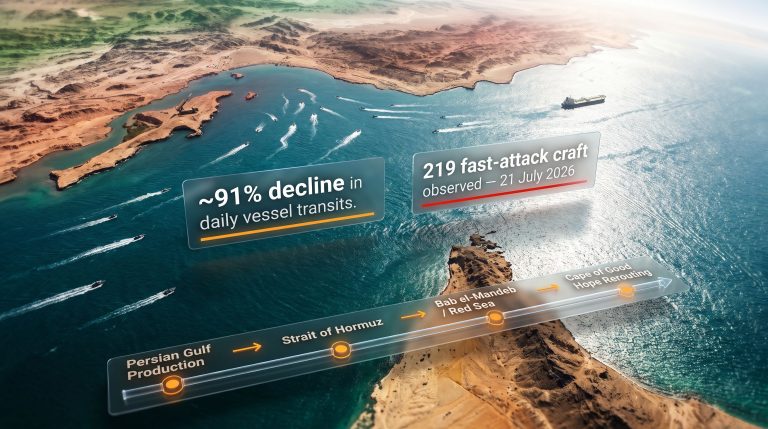
The narrow waterway separating Iran and Oman represents one of the most significant vulnerabilities in global energy infrastructure. This strategic passage, measuring approximately 34 miles at its widest point, accommodates roughly 21 million barrels of crude oil and petroleum products daily, representing approximately 21% of global petroleum liquids traded internationally as of 2025.
The geographic constraints of this maritime corridor create an irreplaceable bottleneck in global energy logistics. Ships traversing the waterway follow established traffic separation schemes, with large tankers unable to utilize alternative routing economically. This structural dependency means that one-third of all seaborne traded oil and roughly one-quarter of global LNG trade must pass through this confined space.
Historical precedents demonstrate the immediate market transmission of Strait-related risks. During the 2019 tanker attacks in the Gulf of Oman, Brent crude prices increased 4-6% in single trading sessions, illustrating how quickly geopolitical tensions translate into commodity price volatility. Similarly, the 2022 Russian oil embargo period saw crude price fluctuations averaging 15-25% month-over-month as markets reassessed supply security and transit risks through key chokepoints.
South Africa's Petroleum Import Structure
South Africa's energy import profile reveals a complex dependency structure that amplifies global price transmission mechanisms. The country operates approximately 650,000-750,000 barrels per day of crude oil refining capacity across major facilities, yet domestic crude production remains minimal, creating substantial import dependency for both crude feedstock and finished petroleum products.
The nation sources crude oil from multiple regions including West Africa, the Middle East, and Asia-Pacific suppliers, creating supply diversification that theoretically reduces vulnerability to single-region disruptions. However, this geographic spread cannot eliminate exposure to global price shocks that affect all sourcing regions simultaneously.
Furthermore, South African farmers have been grappling with rising diesel costs as harvest seasons approach, highlighting the direct impact of global fuel price volatility. South Africa's strategic petroleum reserves, managed through the Central Energy Fund, maintain capacity estimates ranging between 4-6 weeks of national consumption. This limited buffer capacity constrains the country's ability to weather extended supply disruptions without implementing demand rationing or alternative sourcing arrangements at premium costs.
What Are the Immediate Economic Transmission Mechanisms?
The pathway from global crude price shocks to domestic South African fuel costs operates through multiple amplification channels that compound the initial price impact. Understanding these transmission mechanisms reveals why emerging markets like South Africa experience disproportionate effects from international energy market volatility.
Fuel Price Formation in South African Markets
South Africa's petroleum pricing methodology creates rapid pass-through of international cost fluctuations to domestic consumers. The Central Energy Fund employs a monthly adjustment formula incorporating international crude oil prices, currency exchange rates, freight costs, and domestic handling expenses. This regulatory framework permits swift transmission of global price movements to retail pump prices within 1-2 month adjustment cycles.
Currency sensitivity amplifies crude price impacts significantly. A 1% depreciation of the South African Rand against the US Dollar typically increases fuel prices by approximately 0.6-0.8%, given that crude oil trades internationally in dollar-denominated contracts. This creates a multiplicative effect where crude price increases coincide with currency weakness, producing compound cost escalation.
Consequently, the recent oil price rally has contributed to significant pressure on South African fuel markets. The fuel levy structure adds additional complexity to price formation. South Africa applies specific levies of approximately R3.91 per litre for petrol and R3.86 per litre for diesel, representing substantial fixed costs that become proportionally more significant during low crude price periods and less burdensome during high price environments.
Cross-Sector Inflationary Pressures
Transportation costs typically represent 15-25% of total supply chain expenses for goods in emerging markets, making fuel price increases directly visible in logistics and distribution costs. Commercial freight operators implement fuel surcharges within 2-4 weeks of significant price movements, creating rapid transmission of energy costs throughout the economy.
Agricultural sector exposure proves particularly acute, with diesel fuel representing 20-30% of mechanised farming operational costs in southern Africa. Fertiliser price correlations with crude oil further compound agricultural input cost pressures, as nitrogen-based fertiliser production requires substantial energy inputs. This dual exposure creates amplified cost pressures on food production systems.
Manufacturing sectors experience varying degrees of energy cost sensitivity. Energy-intensive industries including chemicals, steel, and cement face energy costs representing 15-40% of production expenses depending on specific subsector characteristics. These cost increases cannot be easily absorbed without affecting output pricing or margin compression.
Why Do Geopolitical Shocks Disproportionately Affect Emerging Markets?
Emerging market economies face structural vulnerabilities that amplify external price shocks beyond the direct commodity cost impact. These amplification mechanisms operate through currency, fiscal, and monetary policy channels that developed economies can often better absorb or offset.
Exchange Rate Amplification Effects
The South African Rand exhibits significantly higher volatility than developed market currencies during risk-off periods. Monthly volatility indices typically range 2-4% for Rand/Dollar movements, compared to 0.5-1.5% for major developed currency pairs. This enhanced volatility creates additional uncertainty for import cost planning and pricing strategies.
Currency risk premiums compound during commodity stress periods. The Rand typically trades at a 200-400 basis point premium relative to developed market currencies, reflecting emerging market risk characteristics. During geopolitical tensions affecting energy markets, this premium often expands as capital flows seek safer haven assets.
Moreover, the impact of Strait of Hormuz fuel hikes South Africa has experienced demonstrates how oil price movements can create cascading effects across emerging economies. Import parity pricing mechanisms automatically incorporate exchange rate movements into domestic fuel costs. South African fuel prices adjust to import parity levels, meaning currency depreciation immediately translates to higher domestic energy costs without any offsetting currency appreciation benefits that oil-exporting developed economies might experience.
Fiscal and Monetary Policy Constraints
South Africa's government debt-to-GDP ratio of approximately 68-72% constrains fiscal space for counter-cyclical interventions during external price shocks. Unlike developed economies with broader fiscal capacity, emerging markets face limited ability to implement temporary fuel subsidies or other demand-supporting measures without compromising debt sustainability.
The South African Reserve Bank's inflation targeting framework, maintaining a 3-6% target range with 4.5% midpoint, creates policy dilemmas during supply-driven inflation episodes. Conventional monetary tightening cannot address supply-side price pressures effectively while potentially exacerbating economic contraction through higher borrowing costs.
In addition, recent OPEC production impact decisions have influenced global oil market dynamics. Emerging market central banks face additional constraints from currency stability considerations. Interest rate adjustments must balance inflation control with exchange rate stability, creating more complex policy trade-offs than developed market central banks typically encounter during energy price shocks.
How Should Monetary Authorities Respond to External Price Shocks?
Central bank policy responses to supply-driven inflation create fundamental dilemmas that challenge conventional monetary policy frameworks. The nature of external price shocks requires differentiated policy approaches compared to demand-driven inflationary pressures.
Central Bank Policy Dilemma Framework
Supply-side inflation originating from energy price increases cannot be effectively controlled through traditional demand-side monetary policy tools. Policy rate increases during supply shocks risk creating economic contraction without addressing underlying cost pressures, potentially leading to stagflationary conditions.
Core versus headline inflation divergence becomes critical during energy price episodes. Central banks must communicate whether policy responses target broad price indices or exclude volatile energy components, as this distinction significantly affects market expectations and policy credibility.
Forward guidance strategies require careful calibration during geopolitical uncertainty periods. Central banks cannot provide definitive policy trajectories when external price drivers remain unpredictable, necessitating conditional guidance frameworks that maintain policy flexibility. However, concerns about oil price stagnation have also emerged in recent policy discussions.
Financial Stability Risk Assessment
Banking sector exposure to transport and logistics companies creates secondary financial stability risks during sustained fuel price increases. Commercial lending portfolios concentrated in transport-dependent sectors may experience elevated default rates if businesses cannot adjust pricing rapidly enough to offset cost increases.
Household debt service capacity faces pressure from higher transport costs combined with potential interest rate increases. Consumer spending patterns typically adjust toward essential goods during fuel price stress, affecting discretionary spending and broader economic activity levels.
Corporate sector cash flow stress testing reveals varying resilience across industries. Companies with limited pricing power or fixed-price contracts experience margin compression, while those with flexible pricing mechanisms or energy hedging strategies demonstrate greater resilience.
What Are the Long-Term Strategic Implications?
Extended periods of energy price volatility create structural economic pressures that influence long-term strategic planning and investment allocation. These implications extend beyond short-term price management to fundamental questions about economic resilience and diversification strategies.
Energy Transition Acceleration Drivers
Sustained high petroleum prices strengthen the economic case for renewable energy investments by improving relative cost competitiveness. Solar and wind power projects become more attractive when conventional energy costs remain elevated over extended periods, potentially accelerating transition timelines.
Electric vehicle adoption economics improve substantially during high fuel price environments. The total cost of ownership calculations for electric vehicles become more favourable when conventional fuel costs increase, particularly in markets with stable electricity pricing structures.
Furthermore, countries across the region are now facing energy transition challenges that require strategic planning. Grid modernisation requirements intensify as countries seek energy independence through domestic renewable resources. Infrastructure investments in transmission, storage, and smart grid technologies become strategic priorities for reducing import dependency vulnerabilities.
Economic Resilience Building Framework
Supply chain diversification strategies gain prominence as single-source dependencies prove costly during geopolitical tensions. Countries and companies increasingly prioritise multiple sourcing relationships even when such arrangements carry higher normal-period costs, viewing this as insurance against supply disruptions.
Regional value chain integration opportunities emerge as countries seek to reduce exposure to distant geopolitical conflicts. Southern African Development Community energy cooperation frameworks become more strategically important for regional supply security and cost management.
Additionally, recent reports indicate that extreme hikes are expected in the coming months, reinforcing the need for strategic planning. Macroeconomic stability enhancement measures require reassessment of foreign exchange reserve adequacy ratios and strategic stockpile optimisation.
Strait of Hormuz fuel hikes South Africa continues to experience highlight the critical importance of building economic resilience against external shocks. Countries may need to maintain higher reserve levels and longer-duration emergency supplies to weather extended external price shock periods effectively.
Disclaimer: This analysis contains forward-looking assessments based on current market conditions and historical patterns. Actual economic outcomes may vary significantly from projected scenarios. Investors and policymakers should consider multiple risk factors when making strategic decisions based on geopolitical and commodity market developments.
Looking to Capitalise on Energy Market Volatility?
Discovery Alert's proprietary Discovery IQ model delivers real-time alerts on significant ASX mineral discoveries, including critical battery metals and energy commodities that benefit from supply chain disruptions and geopolitical tensions. Take advantage of immediate investment opportunities by exploring Discovery Alert's historic discoveries and begin your 14-day free trial today to position yourself ahead of market movements.