May 22, 2026
Global Energy Transitions and Strategic Metal Dependencies
The worldwide shift toward renewable energy and electric transportation has fundamentally altered strategic metal demand patterns, creating vulnerabilities that extend far beyond traditional commodity market dynamics. Industrial economies increasingly depend on concentrated supply sources for critical materials, with aluminum emerging as particularly susceptible to geopolitical disruptions due to its energy-intensive production requirements and geographic concentration of efficient smelting facilities.
Contemporary conflicts demonstrate how regional tensions can rapidly transform global industrial supply chains, forcing manufacturers and policymakers to reassess long-held assumptions about material security. The intersection of energy costs, transportation logistics, and political stability creates cascading effects that ripple through manufacturing sectors worldwide, highlighting structural weaknesses in globalised commodity flows.
When big ASX news breaks, our subscribers know first
Understanding Current Aluminum Supply Chain Vulnerabilities
The aluminum industry confronts unprecedented disruption patterns as Middle Eastern conflicts demonstrate the fragility of concentrated production systems. Regional facilities across the Gulf Cooperation Council countries account for approximately 8-10% of global primary aluminum production capacity, according to International Aluminum Institute data, with major smelting operations concentrated in the UAE, Saudi Arabia, and Qatar.
Current market disruptions have created significant inventory displacement, with approximately 6 million tons of primary aluminum now stranded in Middle Eastern facilities due to transportation restrictions. This volume represents roughly 10% of annual global production, creating immediate supply pressure across international markets.
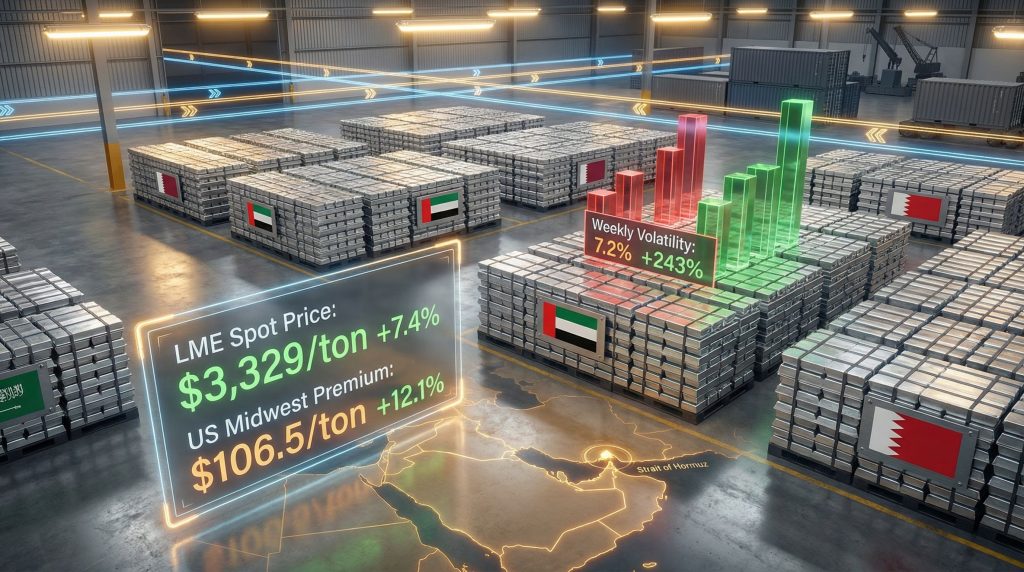
Recent aluminum price increase due to Iran conflict developments have pushed London Metal Exchange futures to $3,316 per ton, representing a 2.69% daily gain and contributing to weekly advances of approximately 7%. These price movements reflect both immediate supply constraints and forward-looking risk assessments by market participants.
Furthermore, the current situation has highlighted how US aluminum tariffs compound supply chain challenges for North American consumers facing reduced import availability.
Critical Supply Chain Chokepoints
Industrial aluminum distribution relies heavily on maritime transportation networks that become vulnerable during regional conflicts. Key vulnerability factors include:
• Inventory Threshold Pressures: Exchange inventories remain at historically low levels, providing minimal buffer capacity
• Alternative Routing Limitations: Limited port infrastructure for handling diverted aluminum shipments
• Quality Specification Challenges: Regional producers maintain specific alloy compositions required by downstream manufacturers
• Contract Fulfillment Risks: Long-term supply agreements face force majeure conditions during extended disruptions
Regional Production Facility Response Strategies
Gulf region aluminum smelters have implemented various operational modifications to manage supply chain disruptions and security concerns affecting their facilities. These adaptations reflect industry-wide challenges in maintaining production continuity during periods of geopolitical instability.
Production facilities across the Persian Gulf region have reported disruptions to deliveries and operational schedules, though specific facility responses vary based on individual risk assessments and contractual obligations. The complexity of aluminum smelting operations requires careful management of shutdown and restart procedures to prevent equipment damage.
Operational Risk Management Protocols
Large-scale aluminum smelting facilities employ sophisticated risk management frameworks during periods of uncertainty:
- Controlled Production Scaling: Gradual reduction of electrolytic cell operations to preserve equipment integrity
- Inventory Positioning: Strategic placement of finished goods in secure storage facilities
- Transportation Diversification: Development of alternative shipping routes and logistics partnerships
- Contract Management: Implementation of force majeure provisions where warranted by security conditions
Aluminum Price Dynamics and Market Response Patterns
Current aluminum market pricing reflects multiple interacting factors beyond immediate supply disruptions, including forward-looking risk assessments and inventory positioning strategies by industrial consumers. However, the complexity of pricing mechanisms extends beyond aluminum markets, as oil price dynamics demonstrate similar vulnerability patterns during geopolitical tensions.
Table: Current Aluminum Market Performance Indicators
| Metric | Current Level | Weekly Change | Significance |
|---|---|---|---|
| LME Aluminum Futures | $3,316/ton | +7.0% | Highest since 2022 |
| US Midwest Premium | $106.5/ton | +12.1% | Record high reached |
| European Premiums | Surged significantly | Not specified | Supply tightness indicator |
| Market Volatility | Elevated | 243% increase | Risk premium expansion |
The US Midwest premium reached a record high of $106.5 per ton, reflecting intense competition for available aluminum supplies in North American markets. This premium level indicates that physical delivery costs have increased substantially compared to financial contract prices, demonstrating real supply tightness rather than speculative positioning.
Price Discovery Mechanisms During Supply Disruptions
Aluminum pricing during supply crises involves complex interactions between financial and physical markets:
• Spot Market Premiums: Reflect immediate availability and transportation costs
• Forward Curve Adjustments: Incorporate expected duration of supply disruptions
• Regional Arbitrage Opportunities: Price differentials create incentives for alternative sourcing
• Inventory Financing Costs: Working capital requirements increase during uncertainty periods
Market analysts suggest that sustained disruptions could drive aluminum prices above $4,000 per ton, representing a significant escalation from current levels. This projection reflects both supply constraint mathematics and historical precedent from previous geopolitical disruptions.
Geographic Premium Divergence and Regional Market Dynamics
Different regional markets experience varying degrees of supply pressure based on historical trade relationships, alternative sourcing options, and existing inventory positions.
European aluminum markets face particular challenges due to established supply relationships with Gulf producers. European premiums have surged during the current crisis, though specific magnitude data remains limited. The European market's vulnerability stems from both geographic proximity to disrupted supply sources and established commercial relationships developed over decades.
North American aluminum buyers encounter compounded challenges from existing trade policies and reduced import availability. The domestic market premium structure reflects both immediate supply tightness and longer-term strategic considerations about supply chain resilience.
Regional Supply Dependency Analysis
Table: Regional Market Exposure to Supply Disruptions
| Region | Primary Vulnerability | Alternative Sources | Response Timeline |
|---|---|---|---|
| Europe | Historical trade ties | West Africa, Iceland | 3-6 months |
| North America | Tariff complications | Canada, domestic | 1-3 months |
| Asia-Pacific | Transportation costs | Australia, China | 2-4 months |
| Latin America | Limited exposure | Regional production | 1-2 months |
Regional premium differences reflect fundamental supply chain economics rather than speculative trading patterns. Areas with stronger historical connections to disrupted supply sources experience more pronounced price adjustments, while regions with diversified sourcing maintain relative stability.
In addition, these market dynamics intersect with broader energy transition impacts on critical mineral demand patterns.
Strategic Industry Restructuring Scenarios
Extended supply disruptions may accelerate existing trends toward supply chain regionalisation and strategic material security initiatives across major consuming economies.
The aluminum industry's response to current disruptions will likely unfold across distinct timeframes, each characterised by different adaptation mechanisms and investment priorities.
Short-Term Market Adjustments (0-6 months)
Immediate responses focus on utilising existing capacity and inventory resources:
• Exchange Inventory Utilisation: Drawing down London Metal Exchange and regional warehouse stocks
• Capacity Optimisation: Increasing production rates at unaffected smelting facilities
• Premium Recalibration: Adjusting delivery costs to reflect transportation and risk factors
• Contract Flexibility: Negotiating temporary modifications to supply agreements
Medium-Term Structural Changes (6-18 months)
Intermediate responses involve infrastructure and capacity adjustments:
- Alternative Trade Routes: Developing new shipping corridors and port facilities
- Regional Capacity Expansion: Accelerating utilisation at facilities in stable jurisdictions
- Strategic Inventory Building: Accumulating buffer stocks for supply security
- Technology Integration: Implementing advanced logistics and tracking systems
Long-Term Industry Evolution (18+ months)
Permanent structural changes may reshape global aluminum markets:
The current crisis demonstrates that concentrated supply chains create systemic vulnerabilities that extend far beyond immediate commercial considerations, potentially driving fundamental changes in industry structure and investment allocation.
Long-term adaptations include geographic diversification of production capacity, enhanced supply chain resilience investments, and regional self-sufficiency initiatives that reduce dependence on potentially unstable supply sources.
The next major ASX story will hit our subscribers first
Chinese Production Capacity and Global Market Rebalancing
China's aluminum industry represents approximately 55-60% of global production volume, positioning Chinese facilities as potentially critical for offsetting regional supply disruptions. However, several constraints limit China's ability to rapidly increase exports and fill global supply gaps.
Chinese aluminum producers face regulatory caps on output expansion, environmental compliance requirements, and domestic demand priorities that may limit export availability. The Chinese aluminum industry is actively considering responses to prolonged disruptions, particularly regarding semi-fabricated aluminum products where global manufacturing capacity could become affected.
Furthermore, understanding China market challenges provides insight into potential supply response limitations.
Chinese Market Intervention Constraints
Regulatory Framework Limitations:
- Production Caps: Government-imposed limits on new smelting capacity development
- Environmental Standards: Strict compliance requirements limiting rapid output increases
- Energy Allocation: Power supply constraints in key production regions
- Export Economics: Currency fluctuations and trade policy considerations
Domestic Demand Priorities:
- Infrastructure Requirements: Ongoing domestic construction and manufacturing needs
- Quality Specifications: Alignment between Chinese output and international consumer requirements
- Transportation Economics: Shipping cost differentials compared to traditional supply sources
The potential for Chinese producers to plug emerging supply gaps exists primarily in semi-fabricated aluminum products, where processing capacity and technical expertise align with global market needs.
Industrial Consumer Adaptation Strategies
Major aluminum-consuming industries have implemented diverse risk management approaches to navigate supply uncertainty and price volatility associated with geopolitical disruptions.
Table: Sector-Specific Response Strategies
| Industry | Primary Strategy | Implementation Timeline | Risk Management Focus |
|---|---|---|---|
| Automotive | Strategic inventory expansion | 3-6 months | Long-term contract protection |
| Aerospace | Supply source diversification | 6-12 months | Quality specification maintenance |
| Packaging | Regional sourcing shifts | 1-3 months | Spot market flexibility enhancement |
| Construction | Material substitution analysis | 3-9 months | Alternative material evaluation |
Procurement Strategy Evolution
Industrial consumers are adapting procurement approaches through multiple mechanisms:
• Contract Structure Modifications: Incorporating force majeure protections and price adjustment mechanisms
• Inventory Strategy Changes: Building strategic buffers whilst managing working capital requirements
• Supplier Relationship Development: Establishing relationships with geographically diverse producers
• Material Specification Flexibility: Evaluating alternative alloys and compositions where feasible
Energy Market Correlations and Cost Structure Impacts
Aluminum smelting requires substantial electricity inputs, making the industry particularly sensitive to energy price fluctuations that frequently accompany geopolitical tensions and regional conflicts.
Energy represents 30-40% of aluminum smelting operational costs, creating direct correlation between regional energy prices and production economics. Gulf region producers traditionally benefit from access to low-cost natural gas and oil-based power generation, providing competitive advantages that become compromised during supply disruptions.
Energy-Aluminum Price Correlation Mechanisms
Several factors amplify the relationship between energy costs and aluminum pricing:
- Direct Production Economics: Electricity cost increases flow directly through to smelting margins
- Regional Energy Dependencies: Facilities relying on disrupted energy supplies face operational challenges
- Currency Exchange Effects: Energy price volatility impacts exchange rates affecting trade competitiveness
- Alternative Energy Premium: Backup power sources typically command higher costs than primary energy supplies
Investment Implications and Market Valuation Considerations
Current supply chain disruptions highlight structural vulnerabilities that may influence longer-term capital allocation decisions across the aluminum value chain and related industries.
Companies with geographically diversified production footprints and established alternative supply relationships may command premium valuations during periods of regional instability. Investment priorities are shifting toward supply chain resilience rather than pure cost optimisation.
Consequently, understanding the broader tariff market impact becomes crucial for evaluating investment scenarios.
Infrastructure Investment Priorities
Strategic Capacity Development:
- Geographic Diversification: New smelting capacity in politically stable regions
- Transportation Infrastructure: Enhanced port facilities and alternative shipping capabilities
- Raw Material Security: Vertical integration strategies and strategic stockpiling facilities
- Technology Advancement: Improved recycling capabilities and energy efficiency systems
Market Valuation Framework:
- Supply Chain Resilience Premium: Companies with diversified sourcing command higher valuations
- Operational Flexibility Value: Ability to adjust production and sourcing rapidly
- Contract Portfolio Strength: Long-term agreements with creditworthy counterparties
- Geographic Risk Distribution: Exposure to multiple stable jurisdictions rather than concentration
Future Market Structure Evolution and Strategic Implications
Current disruptions may accelerate existing trends toward supply chain regionalisation and strategic autonomy in critical industrial materials, fundamentally altering global aluminum trade patterns.
Emerging Market Structure Trends
Regional Trade Integration:
- Intra-Regional Trade Growth: Increased aluminum flows within geographic trade blocs
- Technology Investment Acceleration: Advanced recycling and processing capability development
- Policy Coordination Enhancement: Government involvement in strategic material security initiatives
- Supply Chain Resilience Standards: Industry adoption of geographic diversification requirements
Long-Term Strategic Implications:
The intersection of geopolitical risk and industrial commodity dependence demonstrates how regional conflicts can permanently reshape global trade relationships and industrial investment patterns. Current aluminum price increase due to Iran conflict represent not merely temporary disruptions but potential catalysts for structural industry transformation.
Market participants must develop analytical frameworks that account for sustained volatility whilst positioning for eventual stabilisation under potentially different competitive dynamics. Industrial consumers and investors alike require strategies that balance immediate supply security with longer-term market positioning as industry structure undergoes potential permanent evolution.
Risk Assessment and Strategic Outlook
The current crisis reveals how quickly geopolitical developments can transform global commodity markets, particularly for materials with concentrated production sources and energy-intensive processing requirements.
Scenario Planning Considerations:
• Duration Uncertainty: Conflict resolution timelines remain highly unpredictable
• Escalation Risks: Potential for expanded geographic impact on production facilities
• Infrastructure Damage: Possible long-term capacity impacts from facility disruptions
• Policy Response Evolution: Government intervention in strategic material markets
Current price premiums reflect both immediate supply constraints and market expectations of extended uncertainty rather than rapid resolution. This suggests that aluminum market participants are pricing in sustained disruption scenarios rather than temporary volatility.
The aluminum industry's experience during this crisis will likely establish precedents for risk management practices, supply chain design principles, and strategic planning approaches across industrial commodity sectors facing similar geographic concentration risks.
According to recent analysis from Mining.com, aluminum price increase due to Iran conflict has resulted in the metal's biggest weekly gain since 2024, reflecting both immediate supply concerns and longer-term market restructuring expectations.
However, as Reuters reports indicate, the risks to Western aluminum supply continue to rise as regional conflicts potentially escalate, creating sustained pressure on global aluminum markets.
The aluminum price increase due to Iran conflict therefore represents a critical inflection point for global industrial commodity markets, demonstrating how regional geopolitical developments can rapidly transform established trade relationships and supply chain structures across multiple industry sectors.
Disclaimer: This analysis contains forward-looking assessments and scenario projections based on current market conditions and geopolitical developments. Aluminum markets remain subject to rapid changes based on conflict resolution, policy interventions, and alternative supply source development. Readers should conduct independent research and consult qualified professionals before making investment or procurement decisions based on this analysis.
Concerned About Supply Chain Disruptions Affecting Your Investments?
Discovery Alert's proprietary Discovery IQ model delivers real-time alerts on significant ASX mineral discoveries, helping subscribers identify actionable opportunities when global commodity markets face uncertainty and price volatility. Stay ahead of market developments and explore historic discovery returns to understand how major mineral discoveries can provide strategic portfolio diversification during periods of geopolitical disruption.