July 24, 2026
The Phosphate, the Atlantic, and the Power Vacuum: Why Western Sahara Is North Africa's Most Consequential Unresolved Dispute
Territorial disputes rarely persist for half a century without deeper structural reasons than sovereignty alone. When a conflict outlasts colonial administrations, Cold War alliances, and multiple generations of diplomatic frameworks, it usually means that the underlying resource geography, strategic positioning, and great-power competition are too valuable for any party to concede. Western Sahara fits this description precisely. Its longevity is not a failure of imagination — it is a reflection of just how much is at stake.
The renewed US pressure on Algeria over Western Sahara, most recently crystallised in a high-level diplomatic meeting in May 2026, is the latest chapter in a dispute that has been reshaping North African geopolitics for decades. However, understanding why Washington is applying pressure now — and why Algeria's response is more nuanced than it once was — requires examining the full architecture of competing interests underneath the diplomatic surface.
When big ASX news breaks, our subscribers know first
What Makes Western Sahara Worth Fighting Over
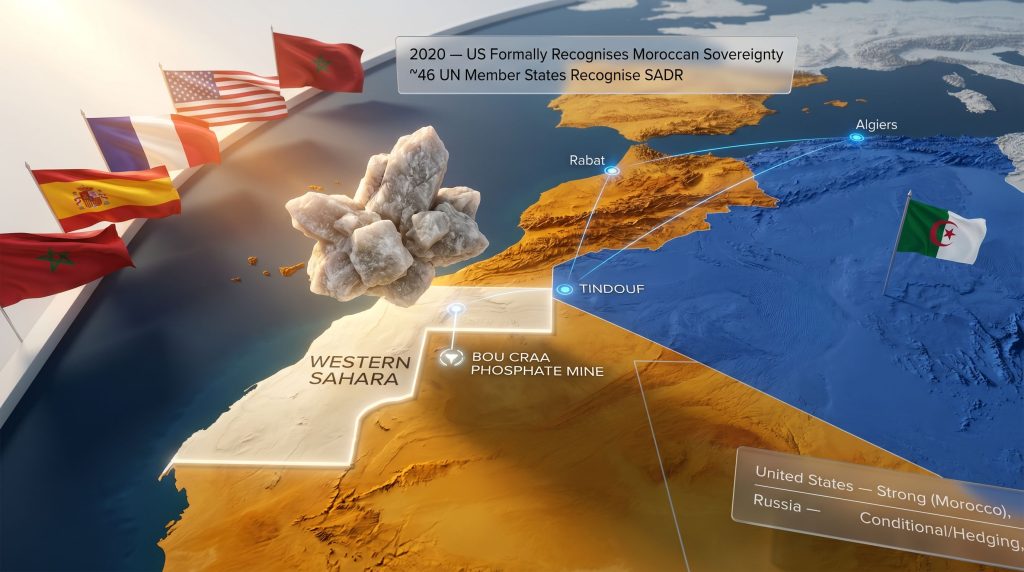
Western Sahara occupies roughly 266,000 square kilometres of Atlantic-facing desert territory on the northwestern tip of the African continent. Under international law, it remains classified as a non-self-governing territory, meaning its final political status has never been formally resolved. Morocco administers approximately 80% of the territory, while the Polisario Front controls a narrow eastern buffer zone adjacent to Algeria and Mauritania.
The Sahrawi Arab Democratic Republic (SADR), proclaimed by the Polisario Front as the legitimate government of the territory, is recognised by roughly 46 UN member states and holds full African Union membership — yet it remains unrecognised by the United States and the vast majority of Western governments. This dual-legitimacy paradox is at the heart of why every proposed settlement framework collapses: self-determination and territorial integrity are legally and politically irreconcilable in this context.
The Resource Dimension: Why Is This More Than a Sovereignty Debate?
The strategic weight of Western Sahara extends well beyond symbolism. Several overlapping resource interests make control over the territory a genuinely high-stakes economic proposition:
-
Phosphate reserves: The Bou Craa mine, located in Moroccan-controlled Western Sahara, is one of the largest phosphate deposits on Earth. Phosphates are the foundational input for nitrogen fertilisers, meaning that whoever controls Bou Craa holds significant leverage over global food production supply chains. Morocco already controls an estimated 70% of the world's known phosphate reserves when Western Sahara is included in its territorial calculations, a concentration with no parallel in any other critical mineral category. This dynamic closely mirrors broader phosphate project development trends being closely watched internationally.
-
Fishing rights: The Atlantic coastline carries some of the most productive fisheries in the world. Access to these waters has been the subject of contentious EU-Morocco agreements that have faced legal challenges precisely because of the territory's disputed status.
-
Hydrocarbon potential: While no major commercial extraction has occurred, offshore exploration has identified potential hydrocarbon deposits along the Atlantic shelf, adding a longer-term energy dimension to the dispute.
-
Maritime positioning: The territory's Atlantic frontage provides strategic depth for any power seeking to project influence across transatlantic trade routes and the approaches to the Strait of Gibraltar.
"Western Sahara sits at the intersection of food security, Atlantic maritime strategy, and critical mineral concentration. It is not a legacy colonial dispute awaiting administrative resolution — it is an active competition for geopolitical advantage in one of the world's most resource-dense frontier territories."
How the International Consensus Around Morocco Was Built
Morocco first formalised its position in 2007 by proposing a limited autonomy plan under its own sovereignty as an alternative to the full independence demanded by the SADR and supported by Algeria. For years, this proposal attracted polite acknowledgment but little active endorsement from Western powers. That changed decisively in December 2020.
The Trump administration's decision to formally recognise Moroccan sovereignty over Western Sahara represented a fundamental reordering of the diplomatic baseline. The recognition was not delivered in isolation — it came as part of the Abraham Accords framework, in which Morocco agreed to normalise relations with Israel in exchange for US recognition of its territorial claim. This transaction established a precedent: sovereignty recognition as a tradeable diplomatic currency.
The cascade that followed reshaped the international alignment map:
| Country | Position on Western Sahara | Year of Shift |
|---|---|---|
| United States | Formal recognition of Moroccan sovereignty | 2020 |
| Israel | Normalisation with Morocco, implicit alignment | 2020 |
| Spain | Endorsed autonomy plan as most serious and credible basis | 2022 |
| France | President Macron described autonomy plan as the only basis for settlement | 2024 |
| Russia | Signalled conditional support if acceptable to all UN Security Council members | 2025 |
Algeria's response to France's realignment was immediate and pointed. Algiers recalled its ambassador from Paris and suspended cooperation on the deportation of Algerian nationals from French territory — a significant bilateral lever given the scale of Algerian migration to France. The move illustrated how deeply France's endorsement cut into Algeria's strategic calculations.
UN Security Council Resolution 2797: What It Does and Doesn't Do
Resolution 2797 is frequently cited as the anchor of the current diplomatic push. It endorses a negotiated political solution and references Morocco's autonomy proposal as a framework for discussion. However, several important distinctions are worth noting:
- The resolution does not formally recognise Moroccan sovereignty over the territory
- It does not override the UN's own foundational principle of self-determination for non-self-governing territories
- It does lend institutional legitimacy to the autonomy approach as a starting framework for talks
- The difference between "referencing" and "endorsing" a proposal carries significant weight in diplomatic interpretation
Algerian President Abdelmadjid Tebboune's public acknowledgment that Resolution 2797 is gaining traction — while conspicuously avoiding criticism of Morocco's autonomy plan — represents a measurable shift in Algeria's rhetorical posture, even if it falls well short of a policy reversal.
US Pressure on Algeria Over Western Sahara: The May 2026 Diplomatic Escalation
In May 2026, US Presidential Advisor for Arab and African Affairs Massad Boulos held a direct meeting with Algerian Ambassador to Washington Sabri Boukadoum. The encounter was framed publicly as a recognition of Algeria's constructive engagement with the UN process, while simultaneously conveying Washington's clear message that the time for a definitive resolution had arrived, anchored in the framework established by Resolution 2797.
The diplomatic language used — specifically praising Algeria's engagement — is a deliberate technique in coercive diplomacy. Rather than applying public pressure that would generate domestic political costs for Tebboune's government, Washington chose an approach designed to offer Algeria a face-saving pathway toward engagement. Furthermore, this strategy reflects broader US-China trade war dynamics, where Washington increasingly seeks to consolidate diplomatic leverage across multiple theatres simultaneously.
Washington's Two-Track Strategic Logic
The US approach to the Western Sahara impasse operates along two parallel lines:
Track 1: Consolidating the Moroccan position
- Maintaining the 2020 sovereignty recognition as settled US policy
- Coordinating European alignment to create multilateral consensus
- Framing Morocco's autonomy plan as the only practically viable settlement framework
Track 2: Drawing Algeria toward the process
- Avoiding public humiliation that would lock Algiers into a defensive posture
- Positioning Algerian participation as consistent with UN frameworks rather than a capitulation
- Exploring whether a broader Morocco-Algeria rapprochement could be structured as a regional stability dividend, given both countries' importance to counterterrorism cooperation in the Sahel and European energy security
Algeria's leverage in this equation is real but diminishing. As Europe accelerates diversification away from both Russian and Algerian gas dependence following the post-2022 energy crisis, Algiers holds fewer economic cards than it once did.
Why Algeria Cannot Easily Shift Its Position
Algeria's resistance to any framework that legitimises Moroccan sovereignty is not simply diplomatic stubbornness — it is structurally embedded in its political identity:
- Algeria's independence movement was itself a protracted anti-colonial struggle, making solidarity with self-determination causes a foundational ideological commitment
- The Polisario Front was partly built with Algerian material and political support, meaning abandonment of its cause would require acknowledging a fundamental foreign policy reversal
- An estimated 100,000 to 170,000 Sahrawi refugees live in the Tindouf camps in southwestern Algeria, creating a humanitarian and domestic political entanglement that cannot be dissolved by diplomatic repositioning alone
- Algeria's military establishment, which retains significant political influence, has historically been among the hardest-line voices on Western Sahara
Russia's Receding Diplomatic Shield
For decades, Algeria counted on Russian veto power at the UN Security Council as a reliable backstop against resolutions that could legitimise Moroccan sovereignty. That structural guarantee has now weakened considerably.
In a 2025 briefing, Russian Foreign Minister Sergey Lavrov indicated that Moscow could support Morocco's autonomy plan under the condition that it achieved consensus acceptance among all UN Security Council members. The conditional framing matters — Russia has not abandoned Algeria, but it has signalled that its support is negotiable rather than unconditional.
This shift almost certainly reflects Russia's broader geopolitical recalibration following its international isolation after the 2022 invasion of Ukraine. Maintaining relationships across both sides of the Morocco-Algeria divide serves Russian interests in North Africa at a time when Moscow has limited diplomatic resources to spare on causes that no longer yield strategic dividends.
For Algeria, even a cautiously hedging Russia represents a fundamentally less reliable partner than the automatic diplomatic cover it previously enjoyed. The multilateral backstop that allowed Algiers to resist Western pressure for decades has now developed visible cracks. Consequently, these shifts in mining geopolitics are increasingly shaping how resource-rich disputed territories attract global attention.
Military Escalation: The Polisario Front's Counterproductive Strategy
On 5 May 2026, the Polisario Front claimed responsibility for a rocket strike targeting the Moroccan city of Es-Smara in the south of the contested territory. Moroccan authorities confirmed the strike landed near both a civilian area and a prison facility, resulting in at least one civilian injury. The attack drew condemnation from the United Nations, the European Union, and the United States.
UN Personal Envoy for Western Sahara Staffan de Mistura responded by calling for renewed negotiations and warning that sustained military escalation risks undermining the entire framework for a political solution.
The timing and context of the attack reveal a strategic paradox:
| Period | Ceasefire Status | Conflict Activity | International Response |
|---|---|---|---|
| 1991 to 2020 | UN-brokered ceasefire active | Minimal armed activity | Diplomatic stalemate |
| 2020 to present | Ceasefire collapsed November 2020 | Increasing skirmishes, 2026 Es-Smara rocket strike | Growing Western condemnation of Polisario |
Military escalation by the Polisario Front is presumably intended to demonstrate that the conflict cannot be quietly resolved through Western-aligned diplomacy. However, in practice, each attack consolidates Western sympathy for Morocco's position and gives European and American officials additional justification for framing the autonomy plan as a stability-preserving compromise. The escalation paradox is real: Polisario military action intended to force the issue may be accelerating exactly the international consensus it seeks to prevent.
Algeria does not formally control the Polisario Front, but its logistical and political support is widely acknowledged by analysts and Western governments. When the Polisario acts, Algeria absorbs a portion of the diplomatic blowback — particularly when condemnations arrive from partners whose relationships Algiers is simultaneously trying to preserve.
The next major ASX story will hit our subscribers first
Reading Algeria's Signals: Three Scenarios for What Comes Next
President Tebboune's rhetorical shift — acknowledging Resolution 2797's momentum without openly criticising Morocco's autonomy framework — is best understood as a controlled trial balloon rather than a policy change. The domestic political risks of any visible softening remain substantial.
Three distinct trajectories are plausible from Algeria's current position:
Scenario 1: Gradual Engagement
Algeria enters UN-facilitated negotiations under a framework that references autonomy without formally endorsing Moroccan sovereignty. Algiers reframes this as consistent with its self-determination principles by emphasising procedural legitimacy over outcome endorsement. This is the scenario Washington is clearly engineering.
Scenario 2: Tactical Flexibility Without Formal Policy Change
Algeria maintains its public opposition while quietly reducing material support to the Polisario Front, allowing the conflict to de-escalate organically. This approach preserves Algiers' ideological position for domestic audiences while pragmatically reducing international friction. It is politically safer than Scenario 1 but produces slower results.
Scenario 3: Hardline Retrenchment
Domestic political pressure, military opposition, or a further Polisario military escalation forces Tebboune to publicly reaffirm Algeria's maximalist self-determination position. This scenario becomes more likely if US pressure on Algeria over Western Sahara is perceived domestically as coercive rather than collaborative.
The Deeper Rivalry: Morocco vs. Algeria Beyond Western Sahara
It would be analytically incomplete to treat Western Sahara as an isolated territorial dispute. The conflict functions as the highest-profile expression of a structural rivalry between two states competing for North African and sub-Saharan African influence across multiple dimensions simultaneously.
Algeria severed formal diplomatic relations with Morocco in 2021. By 2023, President Tebboune was publicly describing the bilateral relationship as having reached a permanent breaking point. The two countries have no functioning diplomatic channel, making third-party mediation the only available mechanism for any kind of engagement. This rivalry also has profound implications for global supply chains, particularly given Morocco's dominant share of world phosphate reserves.
The rivalry extends across:
- Defence procurement: Both countries have significantly expanded military spending in recent years, with Algeria ranking among Africa's largest defence budgets
- Sahel influence: Both Rabat and Algiers compete for relationships with governments across the Sahel, a competition complicated by instability in Mali, Burkina Faso, and Niger
- Energy pipeline politics: The Trans-Saharan Gas Pipeline project and broader African energy infrastructure competition place Morocco and Algeria on opposite sides of regional economic architecture debates
- African Union positioning: The SADR's AU membership creates a permanent structural fault line within the continental body, with Algeria championing the SADR's status and Morocco having rejoined the AU in 2017 while contesting SADR's legitimacy
The Alignment Map as It Stands
| External Power | Morocco Alignment | Algeria Alignment |
|---|---|---|
| United States | Strong (2020 recognition) | Diplomatic engagement only |
| France | Strong (Macron 2024 endorsement) | Currently strained |
| Spain | Moderate to strong (2022 shift) | Neutral |
| Russia | Conditional/Hedging | Historically strong, now weakening |
| China | Neutral, economic engagement | Economic engagement |
| African Union | Divided | Supportive of self-determination |
Frequently Asked Questions
What is the US specifically requesting from Algeria regarding Western Sahara?
Washington is urging Algeria to engage constructively with UN-facilitated negotiations and to treat Morocco's autonomy proposal as a legitimate basis for discussion. The US is not demanding that Algeria formally endorse Moroccan sovereignty, but it is applying consistent pressure on Algiers to move away from its unconditional backing of the Polisario Front's full independence position. Renewed US-led talks in Madrid have lent further momentum to this diplomatic push, though significant challenges remain.
Has the US imposed any formal sanctions on Algeria over Western Sahara?
No formal sanctions have been applied. US pressure on Algeria over Western Sahara has operated exclusively through diplomatic channels, including high-level envoy meetings, public statements endorsing the UN resolution framework, and coordination with European allies who share Washington's broad position.
Why does Algeria continue supporting the Polisario Front?
Algeria's support is rooted in its own anti-colonial history and in a foreign policy tradition that has treated self-determination as a non-negotiable principle since independence. There are also strategic considerations: a Polisario-governed Western Sahara would create a friendly buffer state on Algeria's western flank and constrain Moroccan regional dominance.
What does the Bou Craa phosphate mine represent strategically?
Bou Craa is one of the world's largest individual phosphate deposits. Because phosphates underpin global fertiliser production, control over the mine carries food security implications that extend far beyond the territory itself. For instance, the Ammaroo phosphate project in Australia illustrates the global scramble to develop alternative phosphate sources precisely because of how geopolitically concentrated existing reserves are. It is a material factor in why Morocco treats its Western Sahara claim as non-negotiable, and why external powers with interests in food supply chains pay close attention to the dispute's outcome.
Could this rivalry escalate into direct military conflict between Morocco and Algeria?
Direct military confrontation remains unlikely given mutual deterrence dynamics and international pressure on both parties to avoid escalation. However, the collapse of the 1991 ceasefire in November 2020 and the subsequent pattern of Polisario attacks have introduced a level of military activity that increases the risk of miscalculation. Both countries have expanded defence spending materially in recent years, raising the structural stakes if diplomatic channels remain closed. Washington's efforts to mend this rift are explored in depth by Euronews analysis covering whether the US can ultimately succeed in resolving the dispute.
Key Data Reference
| Data Point | Detail |
|---|---|
| UN member states recognising SADR | Approximately 46 |
| Countries formally recognising Moroccan sovereignty | United States and Israel |
| Year of US recognition | 2020 |
| Year Algeria severed ties with Morocco | 2021 |
| Es-Smara rocket attack date | 5 May 2026 |
| Estimated Sahrawi refugees in Tindouf | 100,000 to 170,000 |
| Morocco's autonomy plan first proposed | 2007 |
| Morocco's estimated share of global phosphate reserves (including Western Sahara) | Approximately 70% |
This article contains forward-looking analysis and scenario projections based on current diplomatic and geopolitical developments. Readers should note that international relations are inherently unpredictable and that actual outcomes may differ materially from any scenarios described. Nothing in this article constitutes policy advice or a definitive forecast of diplomatic outcomes.
Want To Be First When Critical Mineral Discoveries Hit the ASX?
Western Sahara's phosphate reserves highlight just how consequential critical mineral control has become — and Discovery Alert's proprietary Discovery IQ model ensures subscribers receive real-time alerts the moment significant ASX mineral discoveries are announced, turning complex data across 30-plus commodities into clear, actionable opportunities. Explore how historic discoveries have generated substantial returns on Discovery Alert's dedicated discoveries page, and begin your 14-day free trial today to position yourself ahead of the broader market.