May 18, 2026

The global fuel shortage represents one of the most significant challenges facing modern economies as structural imbalances reshape energy market dynamics. Disruptions in one region create cascading effects across multiple continents, forcing governments and market participants to confront scenarios that stress-test established economic frameworks. Understanding these macro-level forces requires examining how energy crises evolve from localised supply constraints into systemic challenges.
Supply-Side Disruptions Reshape Global Energy Architecture
Production capacity constraints across major oil-producing regions have created vulnerability points extending far beyond immediate extraction limitations. Transportation chokepoints, particularly critical maritime corridors, function as leverage points where relatively small disruptions generate outsized market impacts. Furthermore, the OPEC production impact demonstrates how coordinated production decisions influence global supply availability.
Strategic petroleum reserve systems, designed as emergency buffers during previous decades, now face limitations that highlight the scale of current challenges. Historical data from the International Energy Agency shows emergency reserves can only provide temporary relief. According to IEA analysis, member countries maintain reserves equivalent to 90 days of net imports, but this capacity becomes insufficient during prolonged production losses.
The economic multiplier effects of energy supply disruptions operate through complex transmission mechanisms. Manufacturing sectors experience immediate input cost pressures, whilst transportation and logistics networks face service capacity reductions. Academic research indicates that severe energy disruptions typically reduce GDP growth by 0.5-2% per quarter, with effects varying based on economic diversification.
Price Transmission and Market Clearing Mechanisms
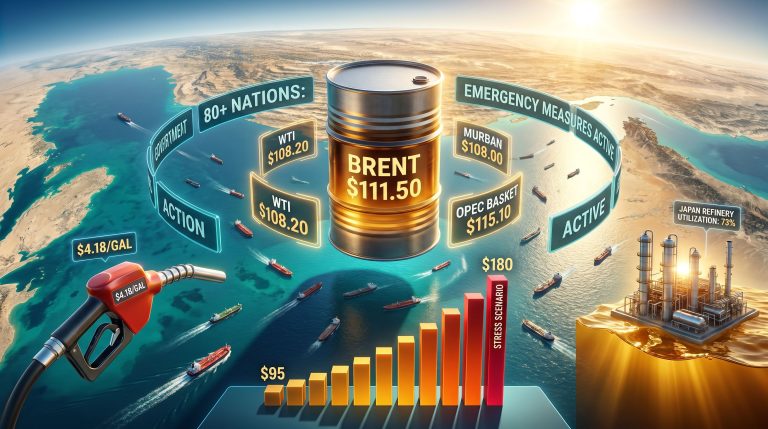
Global energy markets exhibit sophisticated price discovery mechanisms that reflect both immediate supply constraints and forward-looking risk assessments. The recent oil price rally illustrates how external factors compound supply-side pressures to create significant price volatility across benchmark pricing systems.
According to U.S. Energy Information Administration data, WTI typically trades at a discount to Brent crude, with spreads ranging from -$2 to +$3 per barrel under normal market conditions. However, inversions occur during specific supply disruption scenarios, indicating unusual market stress when traditional arbitrage relationships break down.
Currency effects amplify regional disparities in energy affordability, particularly affecting import-dependent economies with weaker currencies. These purchasing power variations create uneven demand destruction patterns, where some regions experience severe rationing whilst others maintain consumption through higher prices.
| Economic Indicator | Impact Assessment | Recovery Timeline |
|---|---|---|
| Refinery margins | Severe compression | 3-6 months |
| Currency stability | Variable by region | 6-12 months |
| Trade flows | Significant disruption | 12-18 months |
| Investment patterns | Structural shifts | 2-3 years |
When big ASX news breaks, our subscribers know first
Administrative Controls vs. Market-Based Demand Management
Governments face fundamental choices between administrative rationing systems and price-driven demand reduction mechanisms. Economic literature demonstrates that both approaches carry significant costs, with the primary difference being distribution of economic impacts rather than their magnitude. Administrative controls create artificial scarcity perceptions whilst requiring substantial enforcement infrastructure.
Historical precedent from the 1973 Arab oil embargo provides insight into rationing effectiveness. According to EIA analysis, U.S. administrative rationing during 1973-1974 implemented through the Emergency Allocation and Price Control Act achieved consumption reductions of approximately 7-10%. However, it proved difficult to enforce due to compliance challenges and economic inefficiencies.
Contemporary examples of demand management vary significantly across regions and economic development levels. In addition, the relationship between oil price movements and policy responses demonstrates how external trade pressures influence domestic energy security measures.
Price elasticity of demand varies substantially across different petroleum products and time horizons. Academic research indicates short-term gasoline demand elasticity of -0.2 to -0.3, meaning a 10% price increase reduces consumption by 2-3% in the short term. Long-term elasticity ranges from -0.6 to -1.0, suggesting more substantial demand responses over extended periods.
Strategic Reserve Coordination and International Response
International Energy Agency emergency response protocols represent the most developed framework for coordinated supply disruption management. The system requires member countries to maintain strategic reserves equivalent to 90 days of net imports, with emergency responses triggered by supply disruptions exceeding 7% of daily consumption.
Emergency response effectiveness depends on both coordinated release scale and underlying supply constraint duration. The 2011 Japan earthquake demonstrated successful coordination when IEA members released 60 million barrels of oil to stabilise markets during a 10-day emergency response window. However, prolonged disruptions strain system capacity.
Demand restraint measures within the IEA framework include acceleration of public transport use, reduced highway speed limits, car-free days, work-from-home policies, and enhanced fuel efficiency standards. These interventions aim to reduce consumption without resorting to formal rationing, though effectiveness varies significantly based on implementation quality.
"The International Energy Agency framework demonstrates that coordinated international responses can stabilise markets during acute crises, but their effectiveness diminishes during prolonged supply disruptions that exceed strategic reserve capacity."
Sectoral Impact Analysis: Economic Winners and Losers
The transportation and logistics sectors experience immediate and severe impacts from energy supply constraints. Cost inflation affects both passenger and freight operations, with service capacity reductions creating secondary effects across dependent industries. Airlines face particularly acute pressures due to limited fuel substitution options.
Manufacturing sectors encounter input cost pressures that vary based on energy intensity and ability to pass costs through to consumers. Energy-intensive industries including steel, aluminium, and petrochemicals face margin compression. Consequently, the timeline for manufacturing adjustments typically spans 3-6 months as companies optimise production schedules.
Agricultural sectors face unique vulnerabilities through fertiliser shortages and mechanisation constraints. Petroleum-derived fertilisers represent critical inputs for food production, with shortages creating food security risks that manifest over medium-term time horizons of 6-12 months. The interaction between energy costs and food prices creates potential for social instability.
Energy transition acceleration emerges as a potential long-term beneficiary of sustained high fossil fuel prices. Investment flows toward renewable energy infrastructure typically accelerate during energy crises. However, these benefits materialise over 1-3 year time horizons and may not offset short-term economic disruptions.
Investment Implications and Asset Repricing
Energy security premiums are being repriced across multiple asset classes, with traditional energy infrastructure gaining renewed investment interest alongside accelerated clean energy deployment. Furthermore, energy exports challenges highlight how regional export capabilities face increasing pressure from global demand imbalances.
Fixed-income markets reflect inflation expectations through yield curve adjustments and inflation-protected security premiums. Central banks face policy constraints in stagflationary environments where energy-driven inflation coincides with economic growth pressures. The effectiveness of monetary policy tools becomes limited when inflation originates from supply constraints.
Commodity markets demonstrate increased volatility and correlation across energy and non-energy products. Moreover, natural gas trends illustrate how different energy sectors experience varying price pressures based on regional supply-demand dynamics.
Alternative investment strategies increasingly focus on energy infrastructure, storage capacity, and supply chain resilience. Private equity and infrastructure funds redirect capital toward projects that enhance energy security, whilst real estate markets reflect changing preferences for energy-efficient properties.
The next major ASX story will hit our subscribers first
Macroeconomic Scenarios and Recovery Pathways
Economic modelling of energy crisis scenarios typically considers multiple recovery pathways with varying timelines and structural impacts. Base case projections often assume 6-month supply restoration with gradual price normalisation. However, these timelines extend when underlying geopolitical tensions remain unresolved.
Stress case scenarios examine extended disruption periods requiring structural demand adjustment across multiple sectors. These projections indicate potential GDP impacts of 2-4% annually during severe disruption phases, with recovery periods extending 12-24 months beyond supply normalisation. The economic scarring effects include reduced investment and employment disruption.
Optimistic recovery scenarios depend on alternative supply activation and rapid market clearing mechanisms. These pathways require coordinated policy responses, strategic reserve deployment, and accelerated development of substitute energy sources. However, physical constraints of energy infrastructure limit the speed at which alternative supplies can replace disrupted production.
Financial market recovery patterns typically lead physical market normalisation by several months. This creates opportunities for systematic investment strategies that capitalise on the time differential between financial and physical market adjustments, according to global energy market analysis.
Long-term Structural Changes in Energy Economics
The global fuel shortage accelerates fundamental shifts in energy market structure that extend beyond immediate crisis resolution. Investment priorities permanently shift toward supply security and diversification, with traditional cost optimisation strategies supplemented by resilience considerations. These changes create lasting premiums for domestic energy production.
Regulatory frameworks evolve to address vulnerabilities exposed during supply crises, including enhanced strategic reserve requirements and supply diversity mandates. These regulatory changes impose additional costs on energy systems but provide insurance value against future disruptions. The balance between efficiency and resilience becomes a central policy consideration.
Technology adoption patterns accelerate in directions that enhance energy security, including distributed generation, storage systems, and demand response capabilities. Market mechanisms develop to price these security benefits explicitly, creating new revenue streams for technologies that provide supply resilience rather than merely cost reduction.
Consumer behaviour modifications persist beyond immediate crisis periods, with lasting changes in transportation patterns and energy consumption habits. These behavioural adaptations reduce long-term demand for traditional energy sources whilst increasing willingness to pay premiums for reliable supplies, as detailed in recent fuel security assessments.
Disclaimer: This analysis contains forward-looking projections and scenario assessments that involve inherent uncertainties. Energy market dynamics are influenced by numerous factors including geopolitical developments, technological changes, and policy decisions that cannot be predicted with certainty.
Ready to Capitalise on Energy Market Volatility?
Discovery Alert's proprietary Discovery IQ model delivers real-time alerts on significant ASX mineral discoveries, helping investors identify opportunities in energy and commodity sectors before broader market recognition. With global energy markets experiencing unprecedented volatility, positioning yourself ahead of major resource discoveries has never been more critical—begin your 14-day free trial today and gain the market edge needed to navigate these challenging times.