June 12, 2026
How Global Gold Investment Demand Patterns Transformed in 2025
The precious metals landscape experienced fundamental restructuring in 2025, with institutional allocation strategies shifting toward systematic gold positioning amid persistent monetary uncertainty. Asset managers worldwide recalibrated their approach to portfolio construction, elevating gold from tactical crisis-response tool to strategic long-term holding. This transformation reflected deeper concerns about currency stability, sovereign debt sustainability, and the limitations of traditional fixed-income investments in an era of sustained inflationary pressures.
The magnitude of this shift became evident through quantitative analysis of global gold investment demand 2025 patterns. Professional fund managers increasingly incorporated precious metals allocations as portfolio insurance mechanisms rather than speculative positions. Furthermore, this represented evolution from crisis-driven buying toward systematic risk management frameworks designed for long-term wealth preservation.
When big ASX news breaks, our subscribers know first
Record-Breaking Investment Activity Drives Market Transformation
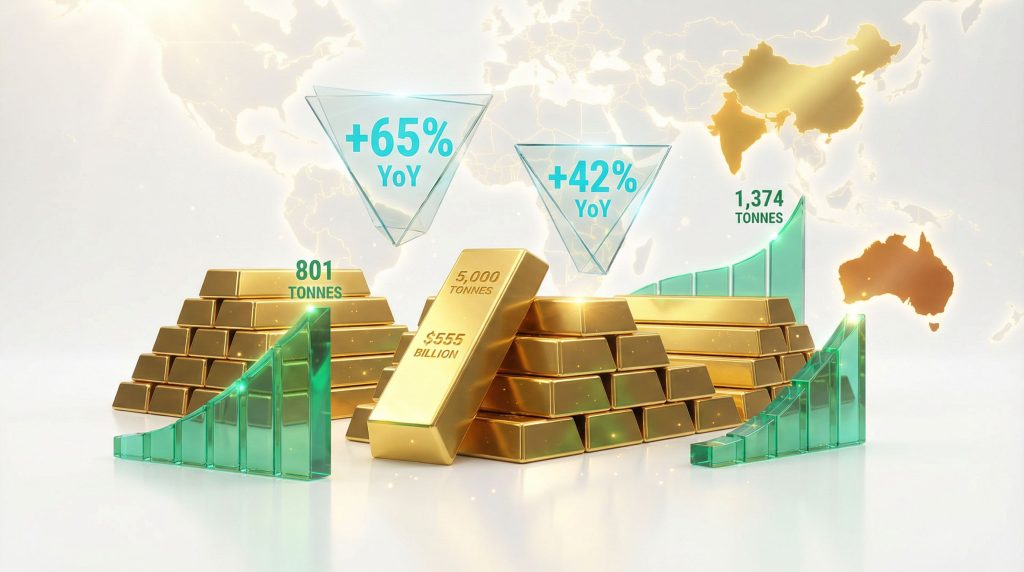
Investment-grade gold consumption reached unprecedented levels in 2025, with global demand exceeding 5,002 tonnes for the first time in recorded history. This milestone represented approximately $555 billion in market value. Consequently, it demonstrated the scale of capital allocation toward precious metals during a period of heightened economic uncertainty.
Investment demand specifically contributed 2,175 tonnes to total consumption, establishing a new historical benchmark for gold investment demand 2025 activity. This figure encompassed multiple investment vehicles, including physical bullion ownership, exchange-traded fund participation, and institutional allocation strategies across developed and emerging market economies. Moreover, this reflected the record gold prices 2025 had achieved.
Multiple Investment Channels Drive Unprecedented Participation
The surge in gold investment demand 2025 encompassed diversified asset classes rather than concentration in single investment vehicles. Exchange-traded funds attracted 801 tonnes of capital inflows globally. Furthermore, this represented a dramatic reversal from previous years characterised by net outflows from gold-backed investment products.
Physical bullion ownership through bars and coins reached 1,374 tonnes, valued at approximately $154 billion. This preference for tangible asset ownership reflected growing scepticism toward financial system complexity. Additionally, it demonstrated desire for direct control over wealth preservation mechanisms during uncertain economic periods.
The combination of ETF inflows and physical purchases demonstrated sophisticated investor behaviour. Participants utilised multiple channels based on liquidity requirements, storage considerations, and portfolio allocation objectives. This trend aligned with broader gold market performance throughout the year.
Institutional Recognition of Gold's Strategic Portfolio Role
Professional investment managers fundamentally reconsidered gold's position within modern portfolio theory frameworks. Rather than treating precious metals as temporary crisis response mechanisms, institutional investors increasingly incorporated systematic allocations. However, this approach was based on correlation analysis, risk-adjusted return optimisation, and long-term wealth preservation strategies.
This evolution reflected recognition that traditional 60/40 stock-bond portfolio construction faced structural challenges. These challenges emerged in environments characterised by simultaneous equity market volatility and fixed-income real return compression. Gold's negative correlation with financial assets during stress periods validated its role as genuine portfolio diversification tool.
Central Bank Reserve Diversification Strategies Continue Despite Moderation
Official sector institutions accumulated 863 tonnes during 2025, maintaining their position as significant gold investment demand 2025 contributors. This occurred despite falling below the 1,000+ tonne acquisition levels recorded between 2022 and 2024. This sustained purchasing reflected ongoing monetary policy diversification initiatives, particularly among emerging market central banks implementing de-dollarisation strategies.
The moderation from peak accumulation periods suggested potential stabilisation of central bank demand at elevated baseline levels. In addition, this indicated strategic positioning for long-term reserve composition rather than tactical responses to immediate economic pressures.
Emerging Market Leadership in Official Sector Accumulation
Central bank purchasing patterns revealed systematic efforts to reduce dependency on dollar-denominated reserve assets. Emerging market monetary authorities demonstrated particular intensity in gold accumulation. This reflected concerns about currency volatility, geopolitical tensions, and the need for truly neutral reserve assets immune to sanctions or monetary policy interference.
The strategic nature of these purchases became evident through consistent quarterly accumulation patterns. These patterns occurred rather than episodic buying concentrated during crisis periods. This behaviour suggested structural demand support for gold investment demand 2025 trends extending into future market cycles.
Regional Investment Patterns Reshape Global Demand Distribution
Asia-Pacific Markets Lead Investment Acceleration
China's physical bar and coin demand increased 28% year-over-year, demonstrating exceptional investment intensity despite elevated price levels. This growth reflected retail investor expansion driven by domestic economic uncertainties. Furthermore, it highlighted cultural affinity for tangible asset ownership during periods of financial system stress.
The magnitude of Chinese participation in gold investment demand 2025 patterns exceeded global averages. This positioned the market as a primary driver of worldwide precious metals consumption. Retail investors demonstrated preference for physical ownership over financial instruments, suggesting deep-seated concerns about counterparty risk and systematic financial stability.
India's investment demand grew 17% despite historically high gold prices, illustrating remarkable demand elasticity within traditional gold-consuming cultures. The combination of cultural wealth preservation practices and modern economic hedging strategies created sustained purchasing power. This enabled absorption of higher unit costs through portfolio reallocation from alternative asset classes.
Together, China and India accounted for more than half of global bar and coin demand. Consequently, this established Asia-Pacific as the dominant regional force in gold investment demand 2025 activity.
Western Market Re-engagement Through Financial Instruments
Developed market investors demonstrated renewed interest in gold exposure through exchange-traded fund participation, contributing 801 tonnes to global ETF inflows. This represented a significant directional reversal from previous years characterised by systematic outflows from gold-backed investment products.
The preference for ETF structures in Western markets reflected institutional investor requirements for:
- Cost efficiency compared to physical storage and insurance obligations
- Liquidity enabling tactical position adjustments
- Regulatory compliance within fiduciary investment frameworks
- Tax optimisation through capital gains treatment
- Integration with existing portfolio management systems
This renewed institutional engagement signalled recognition of gold's portfolio diversification benefits during periods of elevated market correlation. Moreover, it occurred during traditional asset class underperformance.
Australian Market Demonstrates Global Trend Acceleration
Australian gold investment patterns exemplified global trends with notable intensity. Local bar and coin demand increased 35% to reach 15 tonnes annually. The December quarter alone recorded 45% quarterly growth to 5.3 tonnes. This acceleration demonstrated sustained investor confidence in precious metals as long-term strategic holdings.
| Investment Vehicle | 2025 Volume | Growth Rate | Market Significance |
|---|---|---|---|
| Australian Bars/Coins | 15 tonnes | +35% annually | Q4 growth of 45% |
| Australian ETF Holdings | 52 tonnes | +9.4 tonnes addition | Record $1 billion value increase |
| Total Australian Consumption | 11% growth | Despite 22% jewellery decline | Strategic vs. consumer divergence |
ETF holdings expanded by 9.4 tonnes to reach 52 tonnes, representing a record value increase of approximately $1 billion. This growth occurred despite total ETF demand remaining below 2020 pandemic-era peaks. However, it indicated fundamental shifts in investor motivation toward strategic portfolio positioning rather than crisis-response behaviour.
Investment Vehicle Preferences Reveal Sophisticated Allocation Strategies
Physical Bullion Ownership Drives Retail Participation
The preference for tangible gold assets reached 1,374 tonnes worth $154 billion, representing significant retail investor engagement with physical precious metals ownership. This trend reflected growing distrust of financial system complexity. In addition, it demonstrated desire for direct control over wealth preservation mechanisms.
Physical ownership patterns varied significantly by region, with Asian markets demonstrating strong cultural affinity for bars and coins. Meanwhile, Western investors utilised fractional ownership platforms and digital storage solutions to access physical gold exposure without direct custody requirements.
Exchange-Traded Fund Innovation Expands Institutional Access
Professional fund managers increasingly incorporated ETF-based gold exposure within systematic asset allocation frameworks. The 801 tonnes of global ETF inflows represented institutional recognition of gold's correlation characteristics. Furthermore, it highlighted risk-adjusted return potential within diversified portfolio construction.
Technology integration enhanced ETF accessibility through:
- Digital platforms enabling fractional ownership
- Automated rebalancing systems
- Real-time pricing transparency
- Regulatory compliance frameworks
- Integration with robo-advisory services
These innovations expanded the potential investor base beyond traditional precious metals enthusiasts. Consequently, they incorporated gold investment demand 2025 activity within mainstream portfolio management practices.
Supply-Demand Dynamics Create Structural Market Support
Mining Production Capacity Constraints
Global mine production reached 3,672 tonnes in 2025, representing peak output levels despite unprecedented investment demand pressures. This supply constraint created structural price support throughout the year. Moreover, it had implications extending into future market cycles as exploration and development timelines limit short-term capacity expansion.
The gap between surging gold investment demand 2025 levels and constrained primary supply growth highlighted potential supply-demand imbalances. These imbalances were capable of sustaining elevated price environments over extended periods. This situation supported the gold price forecast 2025 predictions.
Recycling Market Response Limitations
Secondary supply through recycling increased modestly by 3% despite strong price incentives for existing holders to liquidate positions. This limited recycling response suggested widespread investor intention to maintain gold positions rather than realise gains. Furthermore, this reinforced structural demand support.
The reluctance to recycle despite elevated prices indicated fundamental shifts in gold ownership psychology. Holders viewed precious metals as permanent portfolio components rather than trading vehicles. This behaviour contributed to the gold price record highs observed throughout the year.
The next major ASX story will hit our subscribers first
Economic Environment Analysis: Inflation and Currency Concerns
Persistent Inflationary Pressures Drive Alternative Asset Allocation
Sustained inflationary environments across major economies reinforced gold's traditional purchasing power protection characteristics. Investors increasingly viewed precious metals allocation as essential portfolio insurance against currency debasement risks. These risks stemmed from expansionary monetary policies.
Real interest rate calculations remained challenged by inflation dynamics. This maintained gold's competitive position relative to yield-bearing assets throughout 2025. Furthermore, this environment created sustained favourable conditions for gold investment demand 2025 patterns independent of tactical market timing considerations.
Currency Stability Concerns Accelerate Portfolio Diversification
Ongoing fiscal expansion across developed economies heightened concerns about long-term currency stability. This drove systematic allocation toward assets perceived as immune to monetary policy manipulation. Gold's role as monetary alternative gained prominence within institutional portfolio construction frameworks.
The combination of quantitative easing programmes, elevated government debt levels, and geopolitical tensions created structural support. This support extended to precious metals allocation strategies beyond cyclical economic cycles. Understanding the gold & stock market relationship became increasingly important for investors.
Investment Strategy Evolution: From Tactical to Strategic Positioning
Professional Portfolio Allocation Guidelines Transform
Investment advisors increasingly recommend 5-10% gold allocations as standard portfolio construction practice rather than tactical crisis positioning. This represents fundamental evolution from emergency response buying toward systematic long-term wealth preservation strategies.
Modern portfolio theory applications incorporating gold's correlation characteristics during various market regimes validated permanent allocation strategies. These strategies served risk management and return optimisation purposes.
Institutional Adoption Patterns Indicate Structural Demand
Pension funds, endowments, and sovereign wealth funds expanded gold exposure through diversified vehicle types. This suggested sustained institutional demand independent of retail investor sentiment cycles. Professional adoption provided structural market support extending beyond individual investor psychology.
The integration of gold investment demand 2025 patterns within institutional asset allocation frameworks indicated recognition of precious metals' role. This role addressed modern portfolio challenges including correlation risk, currency exposure, and inflation protection requirements.
Technology Integration Expands Gold Investment Accessibility
Digital Platform Development Reduces Barriers
Technological innovations expanded gold investment accessibility through digital platforms offering fractional ownership, automated rebalancing, and integrated custody solutions. These developments broadened the potential investor base beyond traditional precious metals specialists.
Fintech integration enabled:
- Micro-investment capabilities for retail participants
- Automated dollar-cost averaging programmes
- Real-time portfolio allocation monitoring
- Educational resources for new precious metals investors
- Integration with existing brokerage and advisory platforms
Blockchain and Custody Innovation
Distributed ledger technologies enhanced gold investment transparency through verifiable ownership records and improved custody solutions. These innovations addressed traditional concerns about authenticity, storage costs, and ownership verification within precious metals markets.
Market Psychology and Investor Behaviour Analysis
Safe-Haven Hierarchy During Uncertainty Periods
Gold's performance relative to traditional safe-haven assets reinforced its position as ultimate portfolio insurance during systematic stress periods. Correlation analysis with government bonds, currencies, and other defensive assets validated gold's unique risk characteristics within multi-asset portfolios.
The sustained nature of gold investment demand 2025 activity suggested structural rather than cyclical factors. This implied evolved investor perception of precious metals' strategic value proposition extending beyond temporary market disruptions.
Long-term Wealth Preservation Strategy Integration
Investment professionals increasingly positioned gold within multi-generational wealth preservation frameworks rather than short-term tactical allocation strategies. This evolution reflected recognition of currency and monetary system risks requiring diversification beyond traditional financial assets.
The scale and persistence of 2025 investment demand indicated structural transformation in how investment professionals approach portfolio construction during periods of elevated systematic risk.
Future Implications for Gold Investment Demand Patterns
Baseline Demand Level Establishment
The 2025 investment surge may represent establishment of new baseline demand levels rather than cyclical peak activity. Structural factors including monetary policy uncertainty, geopolitical tensions, and institutional adoption suggest sustained elevated interest. This interest extends to precious metals allocation strategies throughout various market conditions.
Portfolio Construction Evolution
Modern portfolio theory applications increasingly incorporate gold's diversification characteristics as permanent allocation components. These serve as alternatives to temporary crisis responses. This evolution has significant implications for both precious metals markets and broader investment strategy development.
The combination of ongoing geopolitical uncertainties, monetary policy challenges, and institutional adoption patterns indicates important trends. Gold demand reached unprecedented levels, suggesting that gold investment demand 2025 levels may represent sustainable rather than exceptional market conditions. This fundamentally transforms precious metals' role within investment portfolio construction frameworks for the foreseeable future.
Ready to Capitalise on the Next Major Gold Discovery?
Discovery Alert's proprietary Discovery IQ model delivers real-time alerts on significant ASX mineral discoveries, instantly empowering subscribers to identify actionable opportunities ahead of the broader market. Begin your 14-day free trial today and secure your market-leading advantage whilst gold investment demand continues reaching unprecedented levels.