August 14, 2026
Understanding Global Helium Market Concentration and Its Economic Risks
Modern industrial systems operate through intricate webs of specialized supply chains, where single points of failure can cascade through entire economic sectors. The global helium market represents a particularly stark example of concentration risk, where geographic clustering and byproduct economics create systemic vulnerabilities that extend far beyond the commodity itself. Furthermore, tariff‐driven disruptions in global trade patterns can exacerbate these existing vulnerabilities.
When big ASX news breaks, our subscribers know first
Why Single-Source Dependencies Create Systemic Market Failures
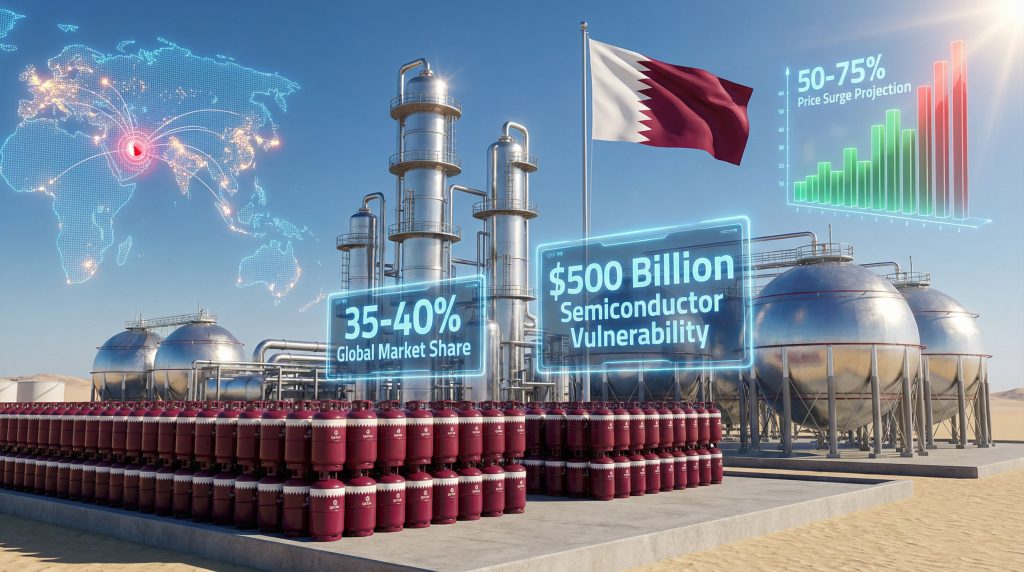
Qatar's dominance in global helium markets stems from its position as a liquefied natural gas powerhouse, where helium shortage Qatar scenarios become inevitable when LNG operations face disruption. According to the Deutsche Rohstoffagentur, Qatar controls approximately 40% of globally traded helium exports, creating what economists term capacity concentration risk.
This concentration emerged through decades of market evolution. The United States historically dominated global helium production through the Federal Helium Reserve, but market liberalization and the closure of the Amarillo Helium Refinery shifted supply dynamics toward international producers. Qatar's Ras Laffan Industrial City became a critical node in this transformed landscape, leveraging natural gas processing infrastructure to extract helium as a profitable byproduct.
Economic theory identifies several factors that amplify concentration risks:
• Geographic clustering reduces diversification benefits
• Byproduct economics subordinate helium supply decisions to primary commodity markets
• High barriers to entry limit rapid capacity expansion during shortages
• Specialized transport infrastructure creates additional bottlenecks
The 2013-2014 helium shortage demonstrated these dynamics when U.S. Federal Helium Reserve drawdown coincided with global production changes, triggering spot price volatility exceeding 200%. Similarly, China's 2010-2011 rare earth export restrictions showed how single-source dependencies can trigger rapid price escalation across multiple downstream industries.
The Economics of Helium as an LNG Byproduct
Qatar's helium production operates under fundamentally different economic principles than primary commodity extraction. When QatarEnergy halted LNG production on March 2, 2026, helium supply automatically ceased—not due to helium market conditions, but because the primary revenue driver faced force majeure circumstances.
This byproduct structure creates asymmetric pricing dynamics where helium availability depends entirely on LNG production economics. The Ras Laffan Industrial City processes natural gas from the North Dome/South Pars field, using cryogenic separation technology that naturally yields helium during LNG processing.
Revenue model analysis reveals critical vulnerabilities:
• Primary Product (LNG): Price-setting driven by global energy demand
• Secondary Product (Helium): Production dependent on LNG operational decisions
• Cost Structure: Helium extraction economically viable only when LNG production operates
• Force Majeure Impact: Legal relief from performance obligations affects both products simultaneously
The force majeure declaration issued March 4, 2026, triggered specific contractual and financial mechanisms across LNG supply chains, with cascading effects on helium availability. Insurance and hedging mechanisms activated automatically, while risk allocation shifted between producers and consumers according to predetermined contractual frameworks.
What Industries Face the Greatest Economic Impact from Helium Shortages?
Semiconductor Manufacturing: The $500 Billion Vulnerability
The semiconductor industry's helium shortage Qatar exposure represents one of the most critical supply chain vulnerabilities in modern technology manufacturing. Global semiconductor markets, valued at approximately $574 billion in 2023 and projected to reach $810 billion by 2030, depend heavily on helium for advanced manufacturing processes.
In addition, concerns about US tariffs and inflation compound these supply chain risks, as semiconductor companies must navigate both input material shortages and potential cost increases from trade policy changes.
| Industry Sector | Annual Helium Consumption | Economic Risk Level | Substitution Feasibility |
|---|---|---|---|
| Semiconductors | 25% of global supply | Critical | Very Limited |
| Medical (MRI) | 20% of global supply | High | Moderate |
| Aerospace/Defense | 15% of global supply | High | Limited |
| Research Labs | 10% of global supply | Medium | Good |
Advanced semiconductor manufacturing requires helium for multiple critical applications:
• Cryogenic Cooling Systems: Helium refrigeration maintains wafer temperatures at -30°C to -100°C during photolithography
• Thermal Management: Superior thermal conductivity (5x better than nitrogen) essential for sub-7nm process nodes
• Inert Processing Atmospheres: Chemical inertness prevents oxidation during metal deposition
• Leak Detection: Mass spectrometry using helium provides unmatched sensitivity for vacuum chamber integrity
Taiwan Semiconductor Manufacturing Company, Samsung Electronics, and SK Hynix operate the world's most advanced fabrication facilities, with combined capacity representing over 60% of global leading-edge chip production. These facilities typically maintain only 2-4 week helium inventory buffers, compared to 8-12 weeks for other bulk gases.
Economic impact calculations reveal staggering potential losses:
• Fab Utilization Economics: Advanced fabs operate at 85-95% capacity utilization
• Revenue Impact: 10% production reduction represents $1.5-2 billion quarterly revenue loss per major manufacturer
• Market Share Implications: Production delays directly affect competitive positioning in rapidly evolving technology markets
The semiconductor equipment industry has responded by accelerating helium recycling system development, with current technology recovering 60-80% of helium at installation costs of $2-5 million per fabrication facility.
Healthcare Infrastructure Disruptions
Medical imaging infrastructure faces severe helium shortage Qatar impacts through magnetic resonance imaging system dependencies. The global MRI market, valued at $7.2 billion in 2023 and projected to reach $11.8 billion by 2030, relies entirely on liquid helium for superconducting magnet operation.
MRI System Helium Requirements:
• Consumption per System: 1,500-2,000 liters liquid helium per refill
• Refill Frequency: Every 2-6 weeks depending on magnet design
• Annual Consumption: 200-400 liters liquid helium equivalent per active scanner
• Global Installed Base: Approximately 40,000-50,000 MRI units worldwide
Critical Healthcare Insight: Each non-functional MRI scanner eliminates approximately 20-30 daily patient examinations, representing $15,000-25,000 in daily revenue loss and potentially life-threatening diagnostic delays for emergency cases.
Clinical disruption cascades through multiple healthcare levels:
• Diagnostic Delays: Cancer screening, neurological assessment, cardiac evaluation postponement
• Surgical Planning: Complex procedures requiring MRI guidance face indefinite delays
• Emergency Medicine: Stroke diagnosis and trauma assessment capabilities reduced
• Regional Healthcare Systems: Rural areas with single MRI facilities face complete imaging service loss
Alternative imaging technologies cannot fully substitute for MRI capabilities, particularly in soft tissue analysis, brain imaging, and cardiac assessment. CT scans provide different diagnostic information while requiring radiation exposure, making them unsuitable for many applications requiring repeated imaging.
Aerospace and Defense Implications
Space launch industries and defense applications represent 15% of global helium consumption, with no practical substitutes for critical applications. The commercial satellite deployment market, valued at over $400 billion annually, depends on helium for rocket pressurization systems and cryogenic fuel handling.
Rocket Launch Industry Helium Applications:
• Tank Pressurization: Helium maintains fuel tank pressure during rocket flight
• Cryogenic Systems: Liquid oxygen and hydrogen handling requires helium purging
• Ground Support Equipment: Launch pad operations use helium for safety systems
• Satellite Propulsion: Ion thrusters and attitude control systems require ultra-pure helium
SpaceX, Blue Origin, and United Launch Alliance have implemented helium recycling systems, but launch schedule delays become inevitable when supply constraints exceed inventory buffers. Each delayed satellite launch represents $150-300 million in direct costs and cascading impacts on telecommunications, GPS, and earth observation services.
How Do Geopolitical Events Amplify Commodity Market Volatility?
The Iran-Qatar-US Triangle: Macro-Economic Analysis
Regional conflict spillover effects demonstrate how geopolitical tensions transform localized events into global commodity disruptions. The escalating Middle East conflict that triggered Qatar's production halt illustrates complex interactions between regional security dynamics and global supply chains.
Furthermore, geopolitical risk in mining extends beyond helium to affect Australia's critical minerals reserve planning and resource security strategies.
Force majeure declarations carry specific legal and economic implications:
• Contract Law: Parties receive legal relief from performance obligations
• Insurance Mechanisms: Political risk and business interruption coverage activates
• Risk Premium Adjustments: Commodity pricing incorporates geopolitical uncertainty
• Supply Chain Reorganization: Alternative sourcing arrangements accelerate
Historical precedents show similar patterns across various commodities. The 1990-1991 Gulf War disrupted multiple resource flows, while the 2014 Russia-Ukraine conflict affected rare gas supplies to European industrial users. Each event demonstrated how regional conflicts can restructure global commodity markets permanently.
Strait of Hormuz: The $2 Trillion Chokepoint Effect
The closed Strait of Hormuz creates compounding logistics challenges beyond simple transportation delays. This maritime chokepoint typically handles 20% of global petroleum liquids transit, with specialized helium containers following similar shipping routes.
Container logistics complications include:
• Specialized Equipment Circulation: ISO containers designed for cryogenic helium transport face geographic concentration
• Route Diversification Costs: Alternative shipping paths increase transit times by 7-14 days
• Port Capacity Constraints: Backup routes through alternative ports create bottlenecks
• Container Repositioning: Return logistics for empty specialized containers face identical route limitations
Economic multiplier effects extend beyond direct shipping costs. Each day of transit delay represents inventory carrying costs, while extended supply uncertainty forces customers to increase buffer stocks when available, amplifying demand pressure on limited supplies.
What Are the Long-Term Market Restructuring Implications?
Price Discovery Mechanisms During Supply Shocks
Helium shortage Qatar scenarios reveal fundamental differences between spot market and contract pricing mechanisms during supply disruptions. Unlike liquid commodity markets with extensive futures trading, helium markets operate primarily through long-term supply contracts with limited spot market depth.
Additionally, the potential for a broader global market recession could compound these supply chain disruptions by reducing industrial demand while simultaneously limiting companies' ability to invest in alternative supply sources.
Current market structure creates pricing asymmetries:
• Contract Pricing: 70-80% of helium trades through annual contracts with formula pricing
• Spot Market: Limited liquidity concentrated among industrial gas distributors
• Price Discovery: Shortage premiums emerge through informal networks rather than transparent exchanges
• Allocation Systems: Non-price rationing becomes primary distribution mechanism during shortages
Industry experts project helium prices could surge 50-75% within 90 days, with semiconductor fabrication facilities implementing emergency allocation protocols that prioritise highest-value production runs. This represents a fundamental shift from normal market operations, where price signals guide allocation decisions.
Market Psychology Insight: Inventory hoarding behaviours amplify supply shortages as consumers increase buffer stock targets, creating artificial demand spikes that persist beyond physical supply recovery.
Strategic Reserve Economics and Government Intervention
National helium reserve policies vary significantly across major consuming countries, with different approaches to strategic stockpiling and supply security. The United States maintains the Federal Helium Reserve in Texas, while other countries rely primarily on commercial inventories and import diversification.
Strategic reserve economic justification includes:
• National Security Applications: Defence and aerospace programs require guaranteed supply access
• Critical Infrastructure Protection: Healthcare and semiconductor manufacturing represent economic security priorities
• Market Stabilisation: Government reserves can moderate price volatility during disruptions
• Import Independence: Domestic strategic reserves reduce foreign supply dependency
Public-private partnership models for supply security show promising results in other critical materials. The U.S. Defense Production Act provides frameworks for government-industry cooperation, while European Union critical raw materials initiatives demonstrate multilateral approaches to supply security enhancement.
The next major ASX story will hit our subscribers first
How Will Global Supply Chains Adapt to Reduce Qatar Dependency?
Alternative Production Economics: North America and Russia
Helium shortage Qatar events accelerate investment in alternative production sources, particularly North American helium projects that extract from nitrogen-rich natural gas streams. These projects operate under different economic models than Qatar's LNG-byproduct structure.
Comparative cost analysis reveals key differences:
• Primary Production Economics: North American projects target helium as primary product
• Capital Requirements: Greenfield helium plants require $200-500 million investment
• Production Costs: Primary helium production costs $4-8 per thousand cubic feet versus $1-3 for LNG byproduct
• Supply Reliability: Dedicated helium production offers greater supply security
Russia's helium production potential from Siberian natural gas fields represents significant untapped capacity, but geopolitical tensions limit Western market access. This creates opportunities for other regions to capture market share through capacity expansion.
Investment timeline projections:
• Development Phase: 3-5 years from project approval to production
• Capacity Expansion: Existing facilities can increase output within 12-18 months
• Infrastructure Development: Pipeline and processing infrastructure requires 2-4 years
• Supply Diversification: Meaningful Qatar dependency reduction requires 5-8 years
Technological Innovation Responses
Helium conservation and recycling technology development accelerates during supply shortages, with research and development investment focusing on efficiency improvements and alternative processes.
Current technological advancement areas:
• Recycling Efficiency: Advanced systems achieve 90-95% helium recovery rates
• Process Optimisation: Semiconductor manufacturing reduces helium consumption per wafer
• Alternative Technologies: Research into helium-free cooling systems for specialised applications
• Purification Methods: Improved separation techniques recover helium from low-concentration sources
Patent landscape analysis shows increasing activity in helium-efficient technologies, with semiconductor equipment manufacturers, industrial gas companies, and research institutions filing applications for conservation methods. This intellectual property development creates competitive advantages for companies developing helium-alternative processes.
What Investment Opportunities Emerge from Supply Chain Disruptions?
Helium Exploration and Production Companies
Helium shortage Qatar scenarios create significant investment opportunities for companies developing alternative helium sources. Pure-play helium exploration and production companies experience dramatic market capitalisation increases during supply disruption periods.
Investment thesis components:
• Supply-Demand Imbalance: Growing industrial demand versus concentrated supply creates long-term opportunity
• Price Realisation: Primary helium producers capture full price increases unlike LNG byproduct operations
• Strategic Value: Companies controlling helium resources gain premium valuations
• Government Support: National security considerations drive policy support for domestic production
North American helium projects offer particular investment appeal due to:
• Resource Base: Proven helium-rich natural gas reservoirs in Colorado, Wyoming, and Saskatchewan
• Infrastructure Advantages: Existing pipeline and processing infrastructure reduces development costs
• Political Stability: Regulatory environment supports resource development
• Market Access: Proximity to major consuming industries reduces transportation costs
Risk-adjusted return profiles vary significantly:
• Development Stage Projects: High risk, high reward potential with 5-10x return possibilities
• Production Stage Companies: Lower risk, steady cash flow generation from operating assets
• Infrastructure Plays: Pipeline and processing companies benefit from increased throughput
Industrial Gas Company Strategic Positioning
Major industrial gas companies including Air Liquide, Linde, and Air Products and Chemicals face both challenges and opportunities from helium shortage Qatar developments. Market share redistribution becomes possible when traditional supply chains face disruption.
Strategic positioning opportunities:
• Supply Chain Integration: Vertical integration strategies reduce dependency on external suppliers
• Customer Relationships: Long-term contracts with major consumers provide revenue stability
• Geographic Expansion: Alternative supply source development creates competitive advantages
• Technology Investment: Recycling and conservation technology development enhances service offerings
Merger and acquisition activity typically accelerates during commodity supply disruptions, as companies seek to secure supply sources and expand market presence. Helium-adjacent sectors including cryogenic equipment manufacturing and specialty gas distribution become attractive acquisition targets.
Economic Recovery Scenarios and Timeline Projections
Best-Case Resolution: 6-Month Market Normalisation
Optimistic recovery scenarios assume rapid Middle East conflict resolution and immediate Qatar production restart, but even best-case timelines involve extended market adjustment periods.
Economic assumptions for rapid recovery:
• Conflict Resolution: Diplomatic settlement achieved within 60-90 days
• Production Restart: Qatar LNG operations resume within 30 days of conflict end
• Logistics Normalisation: Strait of Hormuz reopens immediately upon conflict resolution
• Container Repositioning: Specialised helium transport equipment returns to normal circulation patterns
Even under optimistic scenarios, container repositioning costs and logistics restart timelines create 3-6 month adjustment periods. Empty ISO containers must return to Qatar, whilst global distribution networks require rebalancing after alternative supply arrangements.
Market memory effects persist beyond physical recovery:
• Risk Premium Pricing: Helium contracts incorporate geopolitical risk premiums
• Inventory Policy Changes: Consumers maintain higher buffer stock levels
• Supply Chain Diversification: Alternative supplier relationships continue development
• Technology Investment: Conservation and recycling investments proceed regardless of Qatar recovery
Extended Disruption: 18-Month Structural Adjustment
Prolonged helium shortage Qatar scenarios force permanent market structure changes, with implications extending far beyond the immediate crisis period.
Structural adjustment scenarios involve:
• Permanent Market Share Loss: Qatar's 40% global market share redistributes to alternative suppliers
• Investment Acceleration: Alternative production projects receive expedited development
• Price Structure Evolution: Helium transitions from byproduct to primary commodity pricing
• Technology Adoption: Conservation and recycling become standard industry practices
Capital reallocation patterns favour companies and regions developing Qatar alternatives. North American helium projects, European supply diversification initiatives, and Asian recycling technology development receive increased investment flows.
Long-term pricing implications:
• Structural Price Increase: Helium prices stabilise 25-40% above pre-crisis levels
• Contract Term Changes: Longer-term agreements with diversified supplier bases
• Geographic Premiums: Regional price differentials emerge based on supply security
• Application Prioritisation: High-value applications receive preferential supply allocation
Policy and Regulatory Response Framework
Government Intervention Mechanisms
Helium shortage Qatar scenarios trigger various government intervention mechanisms designed to protect national economic interests and maintain critical industry operations.
Strategic commodity release protocols:
• Reserve Drawdown: Government stockpiles provide temporary market stabilisation
• Allocation Priorities: Critical applications receive preferential supply access
• Price Monitoring: Regulatory oversight prevents excessive price exploitation
• Industry Coordination: Government-facilitated supply sharing arrangements
International cooperation frameworks become essential during global supply disruptions. According to industry analysis, bilateral agreements between major consuming and producing countries, multilateral commodity cooperation initiatives, and international organisation coordination help manage crisis impacts.
Regulatory changes to reduce single-source dependencies:
• Strategic Reserve Requirements: Mandatory inventory levels for critical industries
• Supply Chain Transparency: Disclosure requirements for import dependencies
• Domestic Production Incentives: Tax and regulatory advantages for alternative supply development
• Research and Development Support: Government funding for conservation and alternative technologies
Corporate Risk Management Evolution
Supply chain stress testing requirements emerge as standard practice following major disruption events, with environmental, social, and governance implications for commodity-dependent industries.
Risk management framework evolution:
• Scenario Planning: Companies model various disruption scenarios and response strategies
• Supply Chain Mapping: Detailed documentation of dependency relationships and alternative sources
• Inventory Optimisation: Balance between carrying costs and supply security objectives
• Supplier Diversification: Multiple source strategies reduce single-supplier dependencies
Insurance market adaptations for commodity supply disruptions include new product offerings covering business interruption from supply chain events, political risk insurance for international sourcing, and parametric products that pay based on objective supply disruption triggers rather than specific loss calculations.
Recent reports indicate that global helium shortages may become increasingly likely due to geopolitical factors, highlighting the importance of comprehensive risk management strategies.
ESG implications include:
• Supply Chain Responsibility: Companies face scrutiny over single-source dependencies
• Stakeholder Impact: Investors and customers evaluate supply security as governance issue
• Reporting Requirements: Enhanced disclosure of supply chain risks and mitigation strategies
• Sustainability Integration: Long-term planning incorporates resource availability and geopolitical stability
Systemic Lessons for Global Commodity Markets
The Qatar Helium Crisis as Economic Case Study
The helium shortage Qatar situation provides valuable insights for understanding concentrated commodity supply chains and their vulnerabilities. This case study illustrates how specialised industrial inputs create systemic risks that extend far beyond their immediate market value.
Key lessons for commodity market analysis:
• Concentration Risk Assessment: Markets with >30% single-source concentration face systemic vulnerability
• Byproduct Economics: Secondary commodity supply depends entirely on primary product production decisions
• Geopolitical Integration: Regional conflicts can restructure global commodity markets permanently
• Technology Forcing: Supply disruptions accelerate conservation and alternative technology development
These patterns repeat across multiple commodity markets, from rare earth elements to semiconductor materials, creating opportunities for proactive risk management and investment strategy development.
Policy recommendations for supply security enhancement:
• Strategic Reserve Systems: Government stockpiles for critical materials with limited substitutes
• Supply Chain Transparency: Mandatory disclosure of concentration risks in critical supply chains
• Alternative Source Development: Public-private partnerships for supply diversification initiatives
• International Cooperation: Multilateral frameworks for managing global supply disruptions
Investment strategy adjustments for commodity-dependent sectors should incorporate supply chain risk as a fundamental analysis component, with premium valuations for companies developing supply security advantages and discount factors for those exposed to concentration risks.
The Qatar helium crisis ultimately demonstrates how seemingly narrow industrial supply chains connect to broad economic systems, creating both risks and opportunities for investors, policymakers, and industry participants who understand these complex relationships.
Disclaimer: This analysis contains forward-looking statements and market projections that involve inherent risks and uncertainties. Commodity markets are subject to rapid changes based on geopolitical events, supply and demand dynamics, and other factors beyond predictive modelling. Investors should conduct independent research and consult qualified advisors before making investment decisions based on commodity market analysis.
Considering Opportunities in Critical Resource Supply Chains?
Discovery Alert's proprietary Discovery IQ model delivers real-time alerts on significant mineral discoveries across the ASX, helping investors identify actionable opportunities in critical resource sectors before broader market recognition. With global supply chain vulnerabilities creating new investment themes in strategic materials and alternative resource development, explore Discovery Alert's discoveries page to understand how major mineral discoveries can generate substantial returns during periods of supply uncertainty.