August 6, 2026
The concentration of natural gas production in a handful of global facilities has created a structural weakness that financial markets are now confronting in real-time. When infrastructure interdependencies combine with geopolitical instability, the resulting supply shocks reveal how deeply embedded energy assumptions have become in economic planning across multiple sectors and regions. The current global LNG supply crisis demonstrates just how vulnerable international energy systems have become to concentrated production disruptions.
Understanding the Scale: Why Natural Gas Shortages Eclipse Oil Market Disruptions
The fundamental architecture of global energy markets has shifted dramatically over the past two decades, with natural gas consumption expanding at twice the rate of oil demand according to Energy Institute data. This growth differential reflects deliberate policy choices where governments prioritised natural gas as a transitional fuel between coal and renewable energy sources, creating demand structures that proved vulnerable to supply disruption.
Current Crisis Metrics:
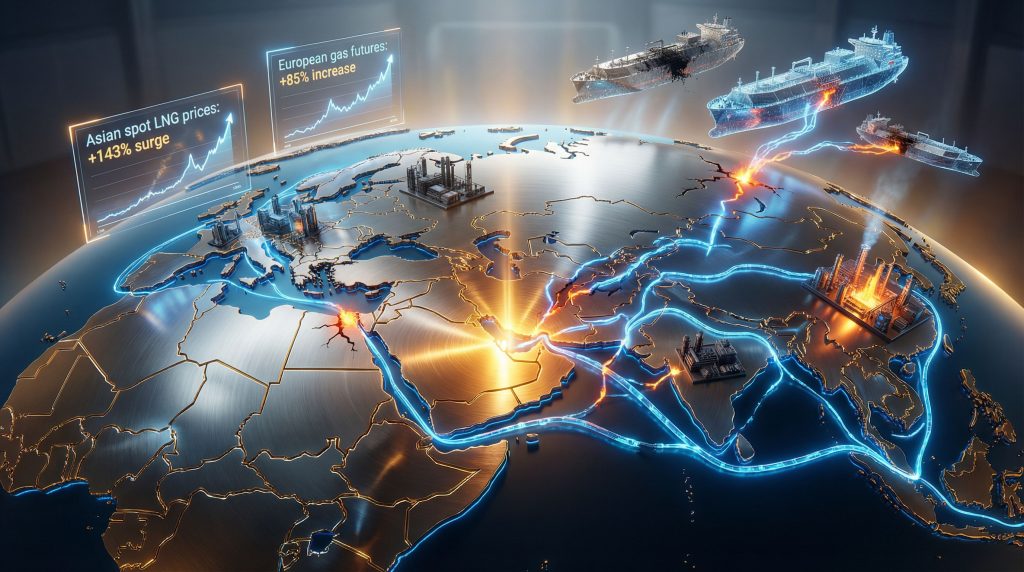
- Asian LNG spot prices: +143% increase since late February 2026
- European gas futures: +85% surge over the same period
- Global LNG capacity affected: Over 20% of worldwide supply offline
- Economic transmission channels: Power generation, industrial processes, fertiliser production, heating systems
The price volatility in gas markets has exceeded oil market movements by substantial margins, despite oil reaching $100 per barrel. Furthermore, this disparity indicates that natural gas shortages represent a more severe economic constraint than crude oil availability, fundamentally altering traditional energy security calculations. The US natural gas forecast suggests these disruptions will have lasting implications for North American markets as well.
Infrastructure Inflexibility Creates Systematic Vulnerabilities
Unlike crude oil markets, which benefit from diverse transportation routes, flexible refining capacity, and extensive storage infrastructure, natural gas requires specialised facilities at every stage of the value chain. LNG operations depend on cryogenic liquefaction plants, specialised shipping vessels operating at -161°C, and regasification terminals that can reconvert LNG to gaseous form for pipeline distribution.
This infrastructure specificity means that when supply disruptions occur, alternative routing options are extremely limited. The global LNG carrier fleet represents less than 1% of total shipping capacity but handles the majority of international gas trade, creating bottlenecks that cannot be easily substituted during crisis periods.
Regional Market Fragmentation:
| Region | Primary Suppliers | Price Benchmark | Supply Vulnerability |
|---|---|---|---|
| Asia-Pacific | Qatar (15%+ share), Australia | USD/MMBtu spot | Extremely high |
| Europe | Multiple sources post-2022 | TTF futures | High |
| North America | Domestic production | Henry Hub | Low |
When big ASX news breaks, our subscribers know first
What Triggered This Unprecedented Supply Shock?
The transformation from anticipated LNG oversupply to acute shortage occurred within a four-week period following geopolitical escalation in the Persian Gulf region. The speed of this reversal demonstrates how concentrated production geography intersects with regional tensions to create systemic market disruption.
Qatar Force Majeure Declaration
On March 24, 2026, QatarEnergy declared force majeure on LNG delivery contracts affecting buyers across Italy, China, Belgium, and South Korea. This declaration followed damage to Qatar's South Pars/North Field infrastructure, which represents over 15% of global LNG production capacity. The assessment indicates repair timelines extending several years, creating long-term supply constraints beyond immediate operational issues.
Australian Production Suspension
Separately, Santos suspended operations at its Barossa gas field feeding the Darwin LNG facility, removing an additional 3.7 million tons of annual capacity from global markets. While characterised as routine equipment replacement requiring several weeks, the timing coincided with Qatar disruptions to compound supply shortfalls.
Timeline of Crisis Development:
- Pre-February 2026: Market consensus forecasted LNG oversupply conditions
- February 28, 2026: Regional military action triggers infrastructure targeting
- Early March 2026: Qatar production facilities sustain damage requiring extended repairs
- March 23, 2026: Santos announces Barossa field suspension
- March 24, 2026: QatarEnergy force majeure declaration formalises supply disruption
- March 25, 2026: Asian LNG prices document +143% increase from baseline levels
This sequence illustrates how geopolitical trade tensions, previously treated as tail events in energy planning, can rapidly cascade through physical infrastructure to create market-wide supply constraints.
Why Are Gas Markets More Vulnerable Than Oil Markets?
The structural differences between oil and gas markets create asymmetric vulnerabilities during supply disruptions. Oil benefits from approximately 90 days of strategic reserves globally, flexible refining capacity that can process different crude grades, and transportation networks spanning pipelines, tankers, rail, and trucking options.
Limited Storage and Transportation Options
Natural gas storage is constrained by physical properties requiring either underground geological formations or expensive LNG storage tanks. Unlike crude oil, which can be stored in conventional tanks and moved through multiple transportation modes, gas requires continuous flow through pipelines or specialised cryogenic systems for LNG transport.
The global LNG infrastructure consists of approximately 50 liquefaction facilities worldwide, with new construction requiring 3-7 year development timelines. Consequently, this creates supply inelasticity where demand increases cannot be met through rapid capacity expansion, unlike oil refining where throughput can often be increased through operational optimisation.
Regional Price Segmentation Effects
LNG markets operate as distinct regional ecosystems rather than a unified global commodity market. Asian buyers typically pay 15-20% premiums to European prices due to transportation costs and distance factors. During shortage conditions, this segmentation intensifies as buyers compete for limited cargo availability rather than benefiting from global price arbitrage.
Market Structure Comparison:
| Factor | Oil Markets | Gas Markets |
|---|---|---|
| Storage flexibility | High (tank farms globally) | Low (specialised facilities) |
| Transportation options | Multiple (pipeline, tanker, rail, truck) | Limited (pipeline, LNG vessel) |
| Processing infrastructure | ~700 refineries globally | ~50 LNG plants globally |
| Price integration | Global benchmarks | Regional segmentation |
| Supply response time | Weeks to months | Years for new capacity |
How Are Countries Adapting Their Energy Strategies?
Coal Resurgence in Asia-Pacific
Asian economies are pragmatically reverting to coal-fired power generation despite previous environmental commitments. This represents a rational response where immediate energy security outweighs longer-term climate objectives, highlighting the fragility of energy transition assumptions when supply constraints emerge. However, coal supply challenges may limit how effectively countries can execute this strategy.
Countries with available coal infrastructure can activate these facilities within weeks, providing immediate alternatives to scarce natural gas supplies. This contrasts sharply with renewable energy alternatives, which require months or years for meaningful capacity additions and remain dependent on weather conditions for output reliability.
European Strategic Constraints
European Union members face more limited adaptation options due to decommissioned coal infrastructure and political commitments preventing rapid reversal of environmental policies. This creates strategic vulnerability where energy security depends increasingly on external LNG supplies during a period of global LNG supply crisis.
The policy constraint means European economies may face higher energy costs for extended periods, potentially affecting industrial competitiveness and consumer welfare more severely than regions with greater fuel flexibility. Meanwhile, gas crisis concerns continue to mount as supply disruptions persist.
The crisis reveals a fundamental tension between environmental policy objectives and energy security requirements, with immediate economic necessities taking precedence over longer-term climate commitments.
What Are the Broader Economic Implications?
Fertiliser Production Crisis
Natural gas serves as both energy source and chemical feedstock for ammonia-based fertiliser production, consuming approximately 28-35% of production costs. Supply shortages threaten agricultural input availability, potentially triggering food price inflation across global markets through a multiplier effect where energy costs cascade through food security systems.
The fertiliser industry operates on thin margins and long-term contracts, making it particularly vulnerable to rapid input cost increases. Production curtailments have already been reported in energy-intensive fertiliser facilities, with potential impacts extending to agricultural seasons months in advance.
Industrial Competitiveness Reshuffling
Energy-intensive industries including steel, aluminium, chemicals, and glass manufacturing face fundamental cost structure changes. The crisis accelerates existing trends where production migrates toward regions with more secure or affordable energy access, potentially permanently altering global industrial geography.
European manufacturers, already disadvantaged by higher energy costs following the 2022 crisis, now confront additional competitive pressures as Asian competitors secure preferential LNG access or revert to cheaper coal alternatives. For instance, natural gas price trends show how rapidly markets can shift, affecting industrial planning.
Inflationary Transmission Mechanisms
Gas price increases transmit through multiple economic channels simultaneously:
- Direct consumer impact: Heating and electricity costs for households
- Industrial cost escalation: Manufacturing input price increases
- Transportation effects: Gas-to-liquids fuel alternatives pricing
- Agricultural cost inflation: Fertiliser and processing energy costs
- Service sector adjustments: Secondary price increases across energy-dependent services
This broad transmission means gas supply constraints create more pervasive inflationary pressure than oil market disruptions, which primarily affect transportation and petrochemical sectors.
How Might This Crisis Reshape Global Energy Markets?
Accelerated Infrastructure Investment
The crisis may catalyse investment in alternative LNG supply infrastructure, particularly in regions previously considered marginal for development. However, the 3-7 year timeline for new liquefaction facilities means short-term supply constraints will persist regardless of immediate investment announcements.
Projects in the United States, Canada, Australia, and emerging suppliers like Mozambique and Tanzania may receive accelerated development timelines and improved financing conditions. In addition, energy transition security considerations now override purely economic return calculations.
Strategic Reserve Development
Countries may reassess strategic gas storage capabilities similar to strategic petroleum reserves, driving investment in underground storage facilities and long-term supply contracts. This could fundamentally alter market dynamics by creating buffer capacity during future disruption events.
The development of strategic gas reserves faces technical challenges including storage duration limits and the high costs of maintaining LNG in cryogenic conditions, potentially favouring underground natural gas storage in suitable geological formations.
Geopolitical Energy Alliance Formation
Supply vulnerability may accelerate formation of energy security partnerships, potentially reshaping international trade relationships around energy access rather than traditional economic considerations. These alliances could include:
- Buyer consortiums for collective LNG procurement
- Strategic supply agreements between producer and consumer nations
- Infrastructure sharing arrangements for LNG terminals and storage
- Emergency supply protocols for crisis response coordination
The next major ASX story will hit our subscribers first
Long-term Market Structure Evolution
The global LNG supply crisis represents a fundamental shift from assumptions of abundant supply driving down prices toward a new paradigm where supply security commands premium pricing. Markets that appeared to be moving toward renewable energy dominance may instead experience extended fossil fuel dependency as supply security takes precedence over environmental objectives.
This evolution suggests that energy market participants, policymakers, and investors must recalibrate planning assumptions to account for supply vulnerability as a permanent feature rather than a temporary disruption. Furthermore, the crisis demonstrates how quickly market fundamentals can reverse when geopolitical risks intersect with concentrated production infrastructure. Reports suggest that longer-term LNG disruptions could reshape global energy markets permanently.
Investment Implications:
- LNG infrastructure development companies may see accelerated project timelines
- Alternative energy storage technologies could benefit from increased strategic interest
- Coal mining operations in regions with available capacity face unexpected demand revival
- Agricultural technology firms addressing fertiliser alternatives may attract investment
- Energy efficiency solutions across industrial and residential sectors gain strategic importance
The transformation of energy market assumptions from oversupply concerns to shortage management represents one of the most rapid reversals in commodity market sentiment. Consequently, the implications extend far beyond energy sectors into food security, industrial policy, and international economic relationships.
This analysis is based on market conditions and publicly available information as of March 2026. Energy markets remain highly volatile, and readers should consult qualified financial advisors for investment decisions related to energy sector exposure.
Ready to Capitalise on Energy Market Disruptions?
Discovery Alert's proprietary Discovery IQ model delivers real-time alerts on significant ASX mineral discoveries, instantly empowering subscribers to identify actionable opportunities in critical energy transition minerals ahead of the broader market. Begin your 14-day free trial today and secure your market-leading advantage during these unprecedented global energy transformations at discoveryalert.com.au.