May 16, 2026
The Evolution of Global Metal Storage: How Exchange Expansion Reshapes Supply Chain Infrastructure
The commodity trading landscape undergoes continuous transformation as exchanges compete for market share across production-heavy regions. Metal storage infrastructure development reflects broader shifts in global supply chains, regulatory frameworks, and trading patterns that extend far beyond simple warehouse approvals. Furthermore, CME aluminium storage sites in Taiwan and Hong Kong represent a strategic expansion that could reshape regional market dynamics. Understanding these dynamics requires examining how exchange-sponsored storage networks create competitive advantages, influence pricing mechanisms, and reshape regional market access for producers and consumers alike.
Modern commodity exchanges operate sophisticated warehouse networks that serve multiple strategic purposes: physical delivery fulfillment, inventory management, and regional market penetration. The recent focus on Asian storage expansion reflects fundamental changes in global metal production patterns, where approximately two-thirds of aluminum output originates from Asian facilities. This geographic concentration creates both opportunities and challenges for exchange operators seeking to optimize their storage infrastructure positioning.
When big ASX news breaks, our subscribers know first
Strategic Infrastructure Development in Asian Metal Markets
Regional Storage Network Optimisation
The development of comprehensive storage networks across Asian markets represents a calculated response to shifting production patterns and trade flows. Taiwan and Hong Kong emerge as strategically significant locations due to their proximity to major production centers, established logistics infrastructure, and favourable regulatory environments for bonded storage operations.
Taiwan's Kaohsiung port offers distinct advantages for metal storage operations, including deep-water port access, established industrial infrastructure, and regulatory frameworks supporting international commodity trading. The facility's integration potential with existing storage networks creates opportunities for inventory management efficiency and cost optimisation across multiple warehouse locations.
Warehouse operators pursuing multi-location strategies can leverage geographic diversification to optimise inventory distribution, reduce transportation costs, and enhance delivery flexibility for regional market participants. C. Steinweg and Pacorini Global Services represent established operators with demonstrated expertise in managing LME-approved facilities, bringing operational knowledge and infrastructure capability to new exchange approvals.
Regulatory Framework Analysis
Bonded storage mechanisms enable sophisticated inventory management strategies that differentiate aluminium contracts from other commodity delivery systems. Unlike duty-paid warehouse structures, bonded storage allows international traders to maintain inventory without immediate tariff obligations, reducing capital requirements and enhancing participation from regional market participants.
The regulatory coordination required for bonded warehouse operations involves multiple governmental agencies, exchange oversight bodies, and international trade protocols. Taiwan and Hong Kong provide established regulatory frameworks for international commodity storage, with demonstrated capability for handling complex cross-border inventory management requirements.
Exchange representatives conducting facility inspections assess both physical infrastructure capabilities and regulatory compliance frameworks. This dual evaluation ensures that approved facilities meet technical storage standards while operating within acceptable regulatory parameters for international commodity trading.
Market Dynamics and Inventory Distribution Patterns
Current Market Structure Analysis
| Exchange System | Asian Inventory | Global Market Share | Primary Locations |
|---|---|---|---|
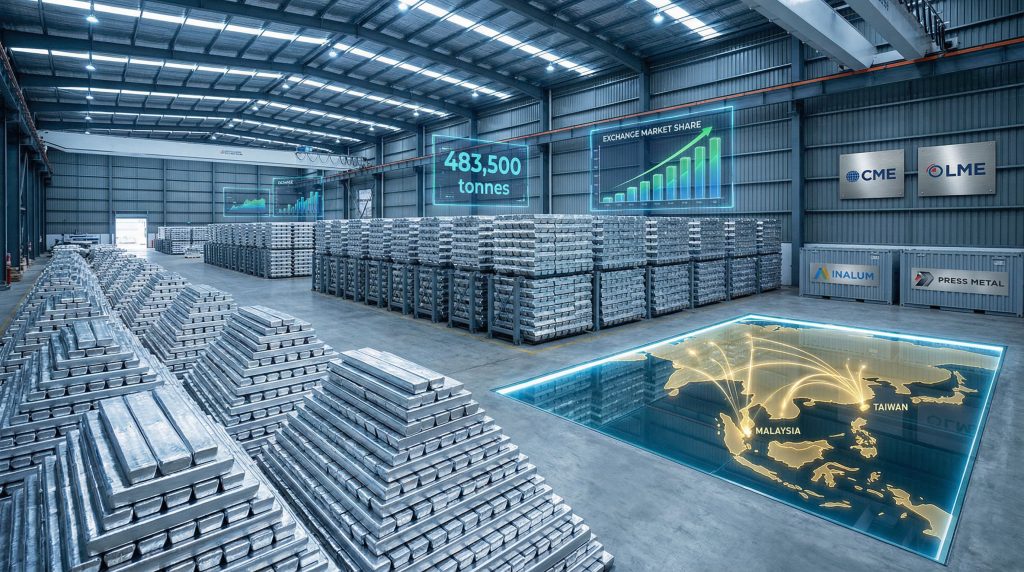
| LME Network | 483,500 tonnes | 80.6% trading volume | Malaysia, Singapore, Hong Kong |
| CME Comex | 3,834 tonnes | 1.2% trading volume | Malaysia, Singapore, South Korea |
| Shanghai Futures | Regional focus | 18.2% trading volume | Mainland China |
The dramatic inventory reduction in CME Comex facilities, declining approximately 80 percent since April 2025, creates strategic urgency for infrastructure expansion. Most remaining inventory concentration in Asian locations suggests that regional storage accessibility directly influences contract viability and trading liquidity. Consequently, Exchange-Traded Commodities benefit from enhanced storage infrastructure that improves market access.
Brand approval mechanisms create additional market structure complexities. Indonesian producer Inalum and Malaysian company Press Metal operate under Comex-approved status, providing these suppliers with enhanced market access through exchange-certified storage networks. This brand certification system creates supplier-level incentives for supporting warehouse expansion initiatives.
Trading Volume Correlations with Storage Infrastructure
Historical trading volume patterns demonstrate clear relationships between storage accessibility and contract adoption. Comex aluminium futures, launched in 2019, achieved modest trading traction beginning in 2023, with volumes reaching 1.6 percent of global activity that year, expanding to 1.9 percent in 2024 before moderating to 1.2 percent in 2025.
These fluctuating participation rates reflect market confidence in contract viability, physical delivery accessibility, and competitive positioning relative to established LME contracts. In addition, market volatility hedging strategies become more effective when supported by reliable storage networks. Storage network expansion aims to enhance contract utility by providing reliable delivery infrastructure in production-proximate locations.
The LME maintains dominant positioning with 80.6 percent of global aluminium futures trading volume, supported by extensive warehouse networks and decades of market development. Shanghai Futures Exchange captures 18.2 percent market share, primarily serving domestic Chinese trading requirements through regionally focused storage infrastructure.
Hong Kong's Strategic Position in Metal Trading Infrastructure
Warehouse Development and Market Adoption
Hong Kong's emergence as a regional storage hub follows systematic infrastructure development initiated by LME warehouse approvals throughout the previous year. More than a dozen facilities received regulatory approval, though initial utilisation remained limited due to high rental costs and space constraints affecting operational economics.
Recent market developments demonstrate how profitability thresholds drive inventory accumulation patterns. LME copper stocks in Hong Kong recently exceeded 10,000 tonnes following Chinese delivery profitability improvements, illustrating how economic incentives influence physical storage utilisation regardless of regulatory approval status.
The absence of aluminium inventory in Hong Kong LME warehouses, despite facility approvals, suggests that similar profitability-driven adoption patterns will likely influence CME facility utilisation. Henry Bath and GKE Metal Logistics applications for Hong Kong aluminium storage represent strategic positioning for anticipated market development rather than immediate inventory requirements.
Multi-Exchange Storage Strategy Implementation
Warehouse operators increasingly pursue multi-exchange approval strategies to optimise facility utilisation and diversify revenue streams. GKE Metal Logistics' simultaneous application for lead storage approval alongside aluminium demonstrates commodity diversification approaches that maximise infrastructure investment returns. Moreover, CME aluminium storage sites in Taiwan and Hong Kong provide operators with enhanced geographic diversification opportunities.
Geographic diversification across multiple exchange networks provides warehouse operators with enhanced business stability, reduced regulatory concentration risk, and improved client service capabilities. Operators with approvals across LME, CME, and potentially Shanghai Futures Exchange systems can offer comprehensive storage solutions for international trading participants.
Cross-exchange arbitrage opportunities create additional value streams for sophisticated warehouse operators. Inventory management across multiple exchange-approved facilities enables operators to optimise storage allocation based on seasonal demand patterns, regional price differentials, and contract-specific inventory requirements.
Supply Chain Efficiency and Market Access Enhancement
Transportation Cost Optimisation
Storage infrastructure development in production-proximate locations generates measurable transportation cost reductions for regional producers and consumers. Taiwan and Hong Kong provide strategic geographic positioning relative to major Indonesian, Malaysian, and Chinese production facilities, reducing shipping distances and associated logistics costs.
Bonded storage capabilities enable inventory pre-positioning strategies that optimise supply chain timing and reduce working capital requirements. Producers can establish inventory buffers in regional storage facilities without immediate duty obligations, enhancing supply chain flexibility and reducing delivery timeline pressures.
Integration with existing transportation infrastructure, including deep-water port facilities and established shipping routes, creates operational efficiencies that reduce per-tonne handling costs and improve inventory turnover rates for warehouse operators and trading participants. Furthermore, data-driven mining operations benefit from enhanced storage infrastructure connectivity.
Regional Producer Market Access
Enhanced storage infrastructure accessibility provides regional producers with improved market access opportunities and delivery option flexibility. Indonesian and Malaysian aluminium producers benefit from reduced transportation costs and simplified delivery logistics through regionally positioned storage facilities.
Brand-approved suppliers gain additional advantages through exchange-certified storage networks. Press Metal and Inalum, operating under Comex approval status, can utilise expanded storage networks to enhance their market presence and delivery capabilities across regional trading centres.
Hedging strategy enhancement represents another significant benefit for regional producers. Accessible storage infrastructure enables more sophisticated risk management approaches, allowing producers to optimise inventory positioning based on market conditions and pricing opportunities across multiple delivery locations.
Investment Implications and Warehouse Operator Business Models
Revenue Stream Diversification
Multi-exchange warehouse approvals create diversified revenue opportunities for storage operators through multiple income streams: storage fees, handling charges, insurance services, and inspection coordination. Operators with approvals across LME and CME systems can optimise facility utilisation based on seasonal demand patterns and contract-specific inventory requirements.
Long-term contract structures with exchange systems provide revenue stability and predictable cash flows that support infrastructure investment decisions. Warehouse operators typically negotiate multi-year agreements with exchange authorities, creating business model stability that justifies facility upgrade investments and operational capacity expansion.
Value-added services represent emerging revenue opportunities for sophisticated warehouse operators. Digital inventory tracking, quality assurance protocols, and automated reporting systems create premium service offerings that command higher storage fees and enhance client relationships.
Capital Allocation and Infrastructure Investment
Warehouse facility approvals require substantial capital investments for infrastructure upgrades, technology systems, and regulatory compliance capabilities. Operators must assess long-term market development potential against immediate investment requirements when pursuing new exchange approvals.
Facility upgrade requirements typically include specialised handling equipment, environmental control systems, security infrastructure, and digital inventory management capabilities. These investments create barriers to entry that protect established operators while requiring careful financial planning for expansion initiatives.
Geographic expansion strategies must balance market development potential against operational complexity and regulatory requirements. Operators expanding across multiple jurisdictions face increased compliance costs and operational coordination challenges that require sophisticated management systems.
The next major ASX story will hit our subscribers first
Technology Integration in Modern Storage Operations
Digital Inventory Management Systems
Contemporary warehouse operations rely on sophisticated digital tracking systems that provide real-time inventory visibility, automated reporting capabilities, and seamless integration with exchange trading systems. These technology platforms enable precise inventory management and reduce operational errors that could affect exchange compliance.
Blockchain-based inventory tracking represents emerging technology applications in commodity storage operations. These systems provide immutable inventory records, enhanced security protocols, and improved transparency for trading participants accessing storage facilities.
Automated quality assurance protocols utilise advanced testing equipment and digital documentation systems to maintain product specifications and exchange compliance requirements. These systems reduce manual inspection requirements while improving accuracy and regulatory compliance consistency.
Real-Time Market Connectivity
Modern warehouse operations require sophisticated connectivity with exchange trading systems to support real-time inventory allocation, delivery scheduling, and settlement coordination. These systems enable seamless integration between physical storage operations and financial market activities.
Price discovery mechanisms benefit from enhanced inventory transparency and real-time availability data. Warehouse operators providing detailed inventory information support more efficient market pricing and reduce information asymmetries that can distort trading patterns. However, CME aluminium storage sites in Taiwan and Hong Kong require sophisticated technological infrastructure to compete effectively with established networks.
Settlement system integration enables automated delivery processing and reduces operational delays that could affect contract fulfillment. These capabilities become increasingly important as trading volumes grow and market participants demand enhanced operational efficiency.
Competitive Landscape Analysis and Strategic Positioning
Exchange Competition Dynamics
Storage infrastructure expansion represents competitive positioning strategies designed to capture market share from established exchange networks. CME's Asian warehouse development directly challenges LME's regional dominance while providing enhanced service offerings for regional market participants.
Shanghai Futures Exchange maintains domestic market focus with storage infrastructure concentrated in mainland China. This regional specialisation creates opportunities for international exchanges to serve cross-border trading requirements through geographically diversified storage networks. In addition, industry evolution trends suggest increasing demand for diversified storage options.
Market fragmentation across multiple exchange systems creates both opportunities and challenges for trading participants. Enhanced storage accessibility improves market access while increased complexity requires more sophisticated trading and risk management approaches.
Is Regulatory Harmonisation Creating New Opportunities?
Coordination between exchange authorities and regional governmental agencies creates opportunities for regulatory harmonisation that could simplify cross-border trading operations. Standardised storage requirements and unified approval processes would reduce operational complexity for warehouse operators and trading participants.
Trade agreement developments may influence storage infrastructure requirements and cross-border inventory management protocols. Operators must monitor regulatory developments that could affect facility operations and compliance requirements across multiple jurisdictions.
International cooperation initiatives between exchange authorities could create standardised warehouse certification processes that simplify multi-exchange approvals and reduce duplicative regulatory requirements for storage operators. Furthermore, understanding the global mining landscape becomes crucial for operators planning regional expansions.
Future Outlook and Market Development
The approval of CME aluminium storage sites in Taiwan and Hong Kong represents a significant milestone in the evolution of Asian commodity trading infrastructure. This development reflects broader market forces driving geographic diversification in exchange-approved storage networks, enhanced regional producer access, and competitive positioning strategies among major commodity exchanges.
These developments position Taiwan and Hong Kong as emerging hubs within the global aluminium trading ecosystem, providing enhanced market access for regional producers and improved delivery options for international trading participants. The success of these facilities will likely influence future storage network expansion strategies and competitive dynamics across the Asian commodity trading landscape.
According to recent reports, these strategic approvals represent part of CME's broader Asian expansion strategy, aimed at challenging the London Metal Exchange's regional dominance through enhanced storage accessibility and improved delivery infrastructure.
Disclaimer: This analysis is based on publicly available information and industry observations. Market conditions, regulatory requirements, and competitive dynamics may change rapidly in commodity markets. Readers should conduct independent research and consult appropriate professionals before making investment or business decisions related to commodity storage infrastructure or exchange-traded contracts.
Looking to Capitalise on Metal Market Infrastructure Changes?
Discovery Alert's proprietary Discovery IQ model delivers real-time alerts on significant ASX mineral discoveries, instantly empowering subscribers to identify actionable opportunities ahead of the broader market. Begin your 14-day free trial today and secure your market-leading advantage in commodity investments.