May 16, 2026
The Geopolitics of Chokepoints: Why the World's Most Critical Waterway Is Now a Diplomatic Battleground
When energy strategists model worst-case scenarios for global supply disruption, a single variable consistently dominates the analysis: the operational status of the Strait of Hormuz. Not because the waterway is uniquely fragile, but because its closure triggers a cascade of consequences that no combination of alternative infrastructure, strategic reserves, or diplomatic goodwill can fully neutralise in the short term. The current conflict has transformed this theoretical vulnerability into an operational reality, and the Strait of Hormuz reopening talks now unfolding between Washington, Beijing, and Tehran represent one of the most consequential diplomatic negotiations in modern energy history.
Understanding what is genuinely at stake requires moving beyond the daily price movements and examining the structural mechanics of why this 21-mile-wide passage commands such extraordinary leverage over the global economy.
When big ASX news breaks, our subscribers know first
Why the Strait of Hormuz Concentrates So Much Global Energy Risk
The Architecture of a Structural Chokepoint
The Strait of Hormuz connects the Persian Gulf to the Gulf of Oman and, by extension, to global ocean shipping lanes. At its narrowest navigable point, deep-water channels suitable for laden Very Large Crude Carriers (VLCCs) compress into corridors approximately two miles wide in each direction. These physical constraints mean that no amount of diplomatic flexibility changes the underlying geometry: the world's largest oil tankers have very limited options when transit is denied or disrupted.
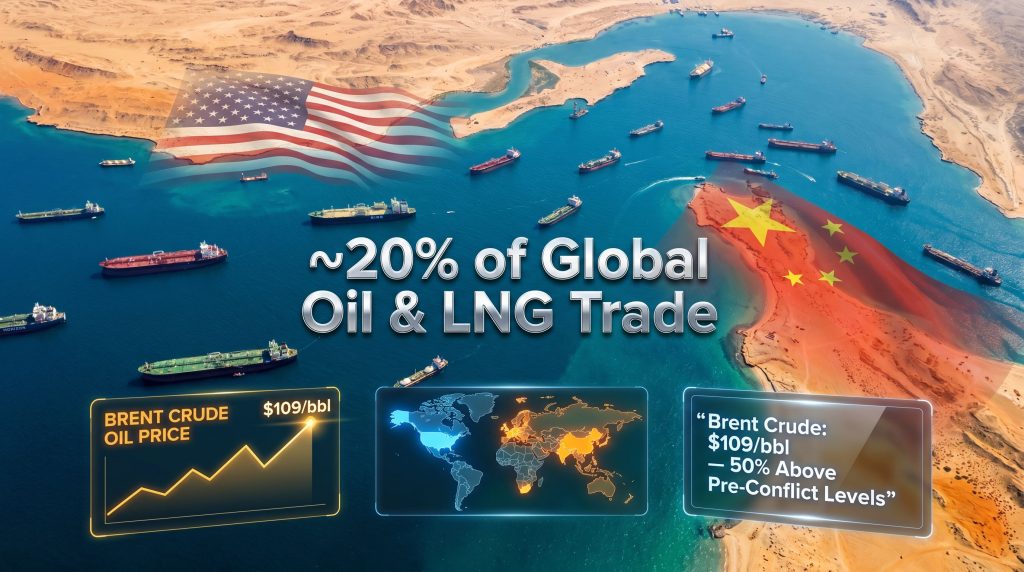
Approximately one-fifth of global oil and LNG trade passes through this single passage under normal operating conditions, according to reporting from World Oil. This figure is not merely an abstraction. It represents the daily energy intake of economies across Asia, Europe, and beyond, flowing through a waterway that has no functionally equivalent substitute at scale.
The infrastructure commonly cited as an alternative to Hormuz transit illustrates this limitation clearly:
- The Abu Dhabi Crude Oil Pipeline to Fujairah carries a maximum capacity of approximately 1.8 million barrels per day, a fraction of the Strait's normal throughput of 17 to 21 million barrels per day under pre-conflict conditions.
- The SUMED Pipeline across Egypt offers a further partial buffer but similarly cannot absorb anything approaching the full volume diverted from Hormuz.
- LNG re-routing via alternative terminals faces bottlenecks in regasification capacity and scheduling constraints that accumulate rapidly under sustained disruption.
The combined effect is a structural supply gap that cannot be bridged by existing infrastructure. This is precisely why Strait of Hormuz reopening talks carry market significance far beyond typical bilateral negotiations.
How Historical Hormuz Disruption Events Have Priced Into Markets
Previous episodes of Hormuz tension, including the 1980s Tanker War during the Iran-Iraq conflict and the 2019 tanker seizure incidents, each produced sharp but ultimately contained price responses. Critically, those events involved threats and incidents rather than a sustained operational closure backed by active naval enforcement. The current situation, in which the United States Central Command has redirected at least 75 commercial vessels away from the Strait since enforcement measures intensified, represents a qualitatively different disruption regime.
Where historical incidents created temporary risk premiums, the current closure has embedded a structural repricing across energy contracts, freight markets, and sovereign energy budgets simultaneously. This combination has no direct modern precedent, which helps explain why Brent crude has settled above $109 per barrel, representing approximately 50% above pre-conflict price levels, as reported by World Oil on May 15, 2026. Furthermore, as explored in analysis of oil price volatility patterns, these kinds of supply shocks reverberate far beyond the immediate region.
Historical analysis of strategic waterway disputes suggests that even after a diplomatic agreement is reached, the interval between that agreement and full commercial restoration typically spans 60 to 180 days under favourable conditions, sustaining elevated energy prices well beyond the moment of any initial announcement.
What the U.S.-China Alignment on Hormuz Actually Represents
Decoding a Rare Moment of Convergence
Following talks between President Donald Trump and Chinese President Xi Jinping, both nations publicly aligned on the position that the Strait must reopen. Chinese Foreign Minister Wang Yi communicated through state media that shipping should resume as quickly as possible, according to World Oil's May 15, 2026 reporting. This alignment between Washington and Beijing on a Middle Eastern security matter is notable given the depth of their strategic rivalry across trade, technology, and military posture in the Indo-Pacific.
What makes this convergence analytically significant is not the statement itself, but the divergent motivations driving each party toward the same publicly declared position:
- Washington's calculus: The United States maintains its naval blockade targeting Iranian ports and exports while simultaneously engaging in diplomatic outreach, reflecting a dual-track strategy of pressure and negotiation. Trump acknowledged aboard Air Force One that discussions covered sanctions on Chinese firms purchasing Iranian crude, as well as broader regional stabilisation, per World Oil's reporting.
- Beijing's calculus: China is Iran's largest crude customer, giving it both economic exposure and diplomatic leverage with Tehran. Chinese-flagged vessel access to the Strait has been selectively preserved through direct engagement with Iranian authorities, a diplomatic outcome that simultaneously serves Beijing's energy security interests and establishes its value as a potential intermediary.
The risk framework here is asymmetric. China can afford to advocate publicly for reopening while privately maintaining preferential access arrangements that partially insulate its own supply chain. The United States cannot easily accommodate Chinese oil purchases without triggering difficult domestic political consequences tied to its Iran sanctions architecture. Indeed, the trade war's impact on oil prices has added another layer of complexity to these already fraught negotiations.
China's Dual Role: Buyer, Broker, and Sanctions-Exposed Actor
Iran's reported signalling that Chinese-flagged vessels may continue transiting the Strait following discussions with Beijing places China in an extraordinarily complex negotiating position. On one hand, Beijing holds genuine leverage with Tehran that no other major power currently replicates. On the other hand, Trump stated publicly that a decision on easing sanctions against Chinese firms purchasing Iranian crude would come within days, according to World Oil, meaning Beijing's commercial relationships with Tehran remain directly exposed to U.S. regulatory action.
This dual vulnerability and leverage dynamic means China's role in Strait of Hormuz reopening talks is simultaneously indispensable and constrained. Any resolution mechanism that excludes Beijing is unlikely to achieve operational progress. Yet China's commercial entanglement with Iranian oil also limits its capacity to act as a fully neutral broker.
The Negotiating Deadlock in Detail
| Negotiating Dimension | U.S. Position | Iran's Demand |
|---|---|---|
| Naval Blockade | Actively maintained, targeting Iranian ports and exports | Full removal prior to any broader concessions |
| Sanctions Relief | Under active review, decision pending | Prerequisite condition for transit restoration |
| Commercial Vessel Access | At least 75 ships redirected by U.S. Central Command | Unrestricted passage restored immediately |
| Broader Conflict Resolution | Military operations ongoing | Cessation of U.S. and Israeli actions required |
As Bloomberg Economics defence analyst Becca Wasser noted in a May 15, 2026 research note reported by World Oil, negotiations remain firmly deadlocked, sporadic violence continues, and the economic costs of the sustained Hormuz closure are accelerating. This assessment underscores the gap between the diplomatic optics of U.S.-China alignment and the operational reality on the water. For a broader perspective, Australia's diplomatic engagement with international partners on the Hormuz situation offers further context on how allied nations are navigating this crisis.
How Energy Markets Are Processing an Unresolved Risk Premium
Brent Above $109: What the Price Anatomy Reveals
Brent crude settling above $109 per barrel following the Trump-Xi talks reflects a market that has become sophisticated about distinguishing between diplomatic signals and operational outcomes. Prices climbed approximately 50% from pre-conflict levels, per World Oil, and the brief uptick in tanker movements earlier in the week of May 15, 2026 reversed quickly after fresh reports of a vessel seizure near the Strait, demonstrating precisely how contingent any short-term relief rally remains.
Energy markets are currently pricing three overlapping risk categories simultaneously:
- Physical supply disruption premium: The quantifiable reduction in barrels and LNG volumes actually reaching their intended destinations.
- Uncertainty duration premium: The cost of not knowing when the disruption ends, which extends pricing impacts across forward contracts and term supply agreements.
- Incident escalation premium: The possibility that a shipping seizure, naval confrontation, or infrastructure strike materially worsens the supply picture beyond current conditions.
Even partial diplomatic progress, without a verified and sustained reopening, is unlikely to meaningfully deflate the risk premium embedded in current oil prices. Markets require operational confirmation, not diplomatic statements.
The War-Risk Insurance Multiplier
A dimension of the Hormuz crisis that receives less headline attention than crude prices but carries compounding economic consequences is the escalation of war-risk insurance premiums for vessels operating in or near the Persian Gulf. As security incidents accumulate, including the reported vessel seizure that reversed the brief tanker movement increase noted in World Oil's reporting, commercial operators face a feedback loop in which rising insurance costs effectively create a financial barrier to transit even when physical passage might technically be possible.
This insurance multiplier functions as an invisible supply reduction mechanism: vessels may be physically capable of transiting but commercially unviable to deploy without prohibitive coverage costs. The effect compounds the direct supply disruption from vessel redirections and translates geopolitical risk into structural price floors. Consequently, understanding commodities market volatility and hedging strategies has become increasingly critical for firms with exposure to Persian Gulf energy flows.
Three Scenarios for Hormuz Reopening: A Forward Analysis
Scenario 1: Phased Diplomatic Resolution (12 to 24 Month Timeline)
This pathway requires the convergence of several conditions that currently remain unmet:
- A U.S. decision to introduce flexibility in its Iran sanctions architecture, potentially beginning with a review mechanism or temporary carve-out for specific buyers
- Iranian agreement to provide verifiable compliance with unrestricted commercial passage
- A multilateral maritime monitoring framework with genuine enforcement capacity endorsed by a significant portion of the 40-plus nations currently engaged in diplomatic frameworks
- China's continued active mediation, leveraging its position as Iran's largest crude customer
Under this scenario, energy markets would experience gradual price normalisation, though a persistent geopolitical discount would likely remain embedded in forward contracts for years. The 60-to-180-day operational restoration timeline following any agreement means the price impact is protracted regardless of the announcement date.
Scenario 2: Partial Access Agreement (3 to 6 Month Timeline)
The most tactically plausible near-term outcome, given Iran's reported signalling to Beijing about Chinese-flagged vessel access, is a selective reopening framework that grants transit rights based on flag-state relationships or specific commercial arrangements. This scenario is already partially operational in its early form.
A formalised partial access agreement would create a two-tier tanker market with meaningful consequences:
- Chinese-flagged or Chinese-nominated vessels operating under preferential access arrangements
- All other commercial operators facing continued restrictions or prohibitive insurance premiums
- Divergent crude pricing between Iranian-origin barrels flowing to China versus alternative supply grades available to other buyers
This bifurcation would provide uneven price relief globally, with Asian markets most directly served by Chinese intermediation seeing more significant normalisation than European or other import-dependent regions.
Scenario 3: Prolonged Stalemate with Episodic Escalation
Given the current deadlock conditions, the baseline scenario remains one of sustained disruption punctuated by intermittent security incidents. Each vessel seizure or naval confrontation resets market sentiment and prevents any durable unwinding of the risk premium. The 75 commercial vessel redirections documented by U.S. Central Command reflect an active enforcement posture with no current signs of relaxation.
Long-term structural consequences of this scenario include:
- Accelerated capital investment in alternative energy corridors and pipeline infrastructure by Gulf state producers
- Reassessment of strategic petroleum reserve adequacy and drawdown protocols among IEA member countries
- Acceleration of LNG infrastructure development in markets seeking to diversify away from Persian Gulf dependency
- Deepening of currency and settlement arrangements between China and Persian Gulf producers that reduce U.S. dollar dependency in energy transactions
Who Bears the Greatest Economic Exposure
Country-by-Country Vulnerability Assessment
| Region / Country | Primary Exposure | Mitigation Capacity |
|---|---|---|
| China | Iranian crude supply as largest buyer | High: direct diplomatic channel with Tehran |
| Japan and South Korea | LNG and crude import dependency | Low: limited alternative supply routes at scale |
| India | Persian Gulf crude imports | Moderate: diversified supplier base provides partial buffer |
| Europe | LNG spot market pricing | Moderate: U.S. LNG and pipeline alternatives available |
| United States | Global oil price inflation | High: domestic production provides meaningful buffer |
Nations most structurally exposed are those combining high Persian Gulf energy dependency with limited alternative routing or supply substitution capacity. Japan and South Korea face particular vulnerability given their near-total reliance on imported energy and the logistical constraints of sourcing adequate replacement volumes from non-Gulf origins at scale and speed.
The European Secondary Exposure Problem
European markets face a secondary exposure pathway that is frequently underappreciated: LNG spot market repricing. Even though Europe does not directly rely on Hormuz transit for pipeline gas, the global LNG market is integrated, meaning that Asian buyers absorbing higher spot prices for alternative LNG cargoes diverted from Persian Gulf routes create upward pricing pressure across the entire spot market. This transmission mechanism connects Hormuz disruption to European energy costs without any direct physical supply link. Furthermore, the geopolitical landscape affecting metals and mining sectors illustrates how broadly these regional disruptions cascade through interconnected commodity markets.
The next major ASX story will hit our subscribers first
The Four Conditions Markets Are Watching
What Operational Reopening Actually Requires
Diplomatic statements of intent, however well-coordinated between Washington and Beijing, cannot substitute for the concrete operational steps required to restore commercial shipping through the Strait. Market participants monitoring Strait of Hormuz reopening talks should focus on four verifiable conditions rather than rhetorical alignment:
- Naval posture adjustment: A measurable reduction or formal restructuring of U.S. Central Command's vessel redirection operations, evidenced by a declining count of redirected commercial ships.
- Sanctions architecture modification: At minimum, a temporary review mechanism or carve-out arrangement for Chinese buyers of Iranian crude, the decision on which Trump indicated was imminent per World Oil's reporting.
- Iranian compliance signal: A verifiable public commitment from Iranian authorities to unrestricted commercial passage, going beyond selective preferential access for specific flag states.
- Third-party verification mechanism: A multilateral maritime monitoring framework with genuine enforcement credibility, not simply a diplomatic declaration without operational infrastructure.
The gap between the current public U.S.-China alignment statement and these four operational requirements illustrates precisely why markets have not unwound the conflict-driven risk premium in response to diplomatic developments alone.
Frequently Asked Questions: Strait of Hormuz Reopening Talks
What is the current status of negotiations to reopen the Strait of Hormuz?
As of mid-May 2026, Strait of Hormuz reopening talks remain deadlocked. While the United States and China have publicly aligned on reopening, no binding agreement or operational framework has been established. Iran continues demanding an end to the U.S. naval blockade and sanctions relief as preconditions, while Washington maintains its enforcement posture.
Why does China's involvement matter for a resolution?
Beijing is Iran's largest crude oil customer, providing direct economic leverage with Tehran. Iran's reported willingness to allow Chinese-flagged vessels preferential transit access demonstrates this relationship in operational terms, positioning China as a potential intermediary whose engagement could accelerate progress that purely U.S.-Iran bilateral talks have not produced.
How much have oil prices increased due to the Hormuz closure?
Brent crude has climbed approximately 50% since the conflict began, settling above $109 per barrel, as reported by World Oil. This price level reflects both physical supply disruption and a sustained geopolitical risk premium that markets have declined to unwind on the basis of diplomatic statements alone.
How many commercial ships has the U.S. redirected away from the Strait?
U.S. Central Command has redirected at least 75 commercial vessels away from the Strait of Hormuz since enforcement measures intensified, per World Oil's May 15, 2026 reporting.
What would a verified reopening mean for crude prices?
A confirmed and operationally sustained reopening would likely trigger meaningful unwinding of the conflict risk premium embedded in current prices. However, given the 60-to-180-day restoration timeline typical of strategic waterway disputes, price normalisation would be gradual rather than immediate, even following a credible diplomatic agreement.
Which nations face the greatest economic risk from the ongoing closure?
China, Japan, South Korea, and India face the most direct exposure through Persian Gulf energy dependency. European markets face secondary exposure via LNG spot market pricing effects, while U.S. domestic production provides a meaningful but not complete buffer against global price inflation. Reporting on Anthony Albanese's response to the Australian fuel crisis further illustrates how far-reaching the economic consequences of the closure have become.
The Strategic Horizon: What Comes After the Talks
Near-Term Catalysts With Market-Moving Potential
Three developments warrant close monitoring by investors and energy market participants in the weeks following the Trump-Xi discussions:
- Trump's pending decision on sanctions relief for Chinese firms purchasing Iranian crude, which he indicated was imminent per World Oil's reporting, represents the most immediate potential market catalyst.
- Any verified change in U.S. Central Command's vessel redirection posture, measurable through a declining count of redirected commercial ships, would signal genuine operational movement beyond rhetoric.
- Iran's response to multilateral pressure from the 40-plus nations currently engaged in diplomatic frameworks, particularly whether Tehran indicates any flexibility on its precondition demands.
Long-Term Structural Consequences for Energy Architecture
Whatever the near-term outcome of Strait of Hormuz reopening talks, the current crisis has already accelerated structural changes in global energy geopolitics that will persist beyond any resolution:
- Alternative corridor investment: Gulf state producers are reassessing the economic case for bypass infrastructure that reduces Hormuz dependency, even at the cost of significant capital expenditure.
- Strategic reserve policy revision: Major importing nations are revisiting the adequacy of their strategic petroleum reserve volumes and drawdown protocols in light of a disruption scenario that exceeds historical planning assumptions.
- U.S.-China energy diplomacy: The Hormuz crisis has demonstrated that energy security represents a domain where Washington and Beijing can find temporary alignment despite broader rivalry. Whether this translates into durable diplomatic frameworks or remains a situational convergence driven by mutual economic pain remains an open question.
Disclaimer: This article contains forward-looking analysis, scenario projections, and market assessments based on publicly available information current as of mid-May 2026. Nothing in this article constitutes financial or investment advice. Energy market forecasts and geopolitical scenarios involve inherent uncertainty, and actual outcomes may differ materially from those discussed. Readers should conduct independent research before making any investment decisions.
For ongoing upstream industry analysis and regional energy market reporting, readers can explore further coverage at World Oil.
Want to Stay Ahead of Market-Moving Mineral Discoveries Amid Global Energy Volatility?
While geopolitical disruptions like the Strait of Hormuz closure reshape commodity markets worldwide, Discovery Alert's proprietary Discovery IQ model delivers real-time alerts on significant ASX mineral discoveries, turning complex data across 30-plus commodities into actionable investment insights — explore historic discoveries and their returns to understand the opportunity, then begin your 14-day free trial at Discovery Alert to position yourself ahead of the broader market.