
June 12, 2026
The Hidden Engineering Story Behind Mexico's Refining Numbers
Refinery systems are among the most complex continuous-process industrial assets on earth. Unlike manufacturing plants that can be paused and restarted with relative ease, petroleum refining depends on a precise and uninterrupted chain of thermodynamic processes, each one feeding the next. When that chain functions as designed, the economic output is substantial. When it doesn't, the losses compound in ways that headline throughput figures rarely reveal. Understanding PEMEX refining output in Mexico requires looking beneath the aggregate statistics and examining the engineering realities, feedstock constraints, and yield dynamics that determine whether a refinery system is genuinely recovering or simply producing flattering year-on-year comparisons.
When big ASX news breaks, our subscribers know first
What Mexico's Six-Refinery Network Actually Does
Mexico's National Refining System, known by its Spanish acronym SNR, is not a single facility but a geographically distributed network of six refineries, each configured differently and processing crude at varying levels of complexity. The facilities at Salamanca, Tula, Cadereyta, Minatitlán, Salina Cruz, and the newer Olmeca refinery at Dos Bocas together form an integrated downstream infrastructure designed, at least in theory, to convert Mexican crude into domestic fuel supply.
Each refinery operates a distinct combination of processing units. Atmospheric distillation columns are the entry point for virtually all crude, separating feedstock into fractions by boiling point. Vacuum distillation units extend that separation into heavier fractions that cannot be processed at atmospheric pressure. Fluid catalytic cracking, or FCC, converts heavy gas oils into lighter, more valuable products such as gasoline and diesel. Coking units go one step further, thermally cracking the heaviest residual material into lighter hydrocarbon streams that can be upgraded into distillates.
Nameplate Capacity vs. Real-World Output: Why the Gap Matters
A persistent source of confusion in refinery analysis is the distinction between nameplate design capacity and actual operational throughput. Design capacity represents the theoretical maximum a facility was engineered to process under ideal conditions with fully functioning equipment. Operational throughput is what actually moves through the system on any given day, factoring in maintenance cycles, equipment degradation, feedstock quality variation, safety shutdowns, and process optimisation constraints.
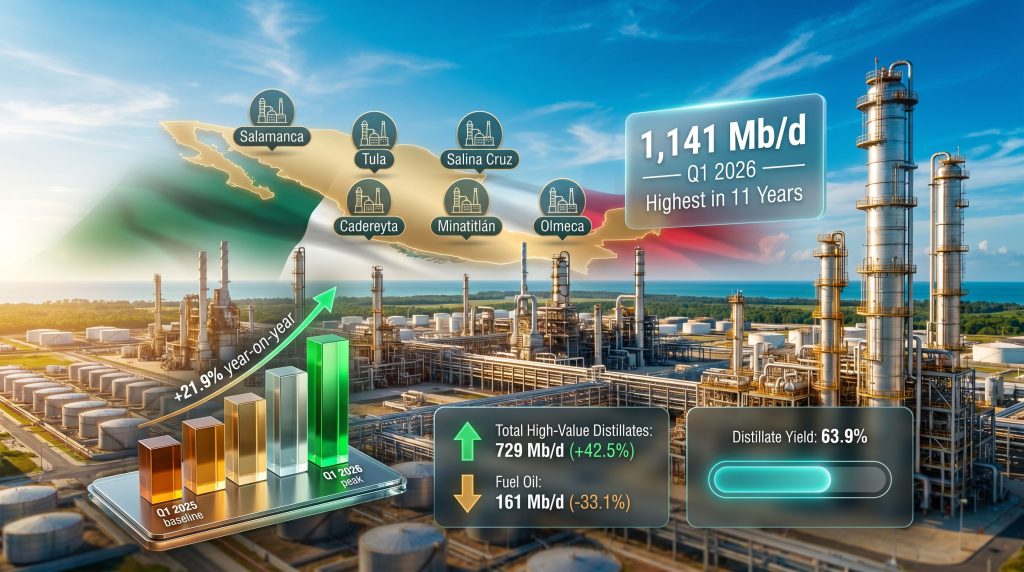
For PEMEX's SNR, this gap is not a minor technical footnote. It defines the entire narrative of the system's current condition. In Q1 2026, the SNR processed an average of 1.141 million barrels per day (MMb/d) of crude, the highest quarterly volume recorded in eleven years and a 21.9% increase compared to Q1 2025. That figure represents genuine progress. However, comparing it against the SNR's aggregate design capacity reveals how much headroom remains before the system reaches its engineering potential.
A further distinction worth understanding is the difference between crude throughput and product elaboration. Crude throughput measures how much raw feedstock enters the system. Product elaboration measures how much commercially useful output exits it. A refinery can run high crude volumes but still underperform if its conversion units are not functioning efficiently. The true performance benchmark is the distillate yield percentage — the share of each barrel processed that is converted into gasoline, diesel, turbosine, and other high-value products rather than residual fuel oil.
A Decade of Decline Followed by Five Quarters of Growth
To properly contextualise PEMEX refining output in Mexico today, it is necessary to understand how far the system fell before its current recovery began. Through the early 2010s, the SNR processed well over 1.0 MMb/d consistently. What followed was not a sudden collapse but a gradual, structurally driven deterioration that persisted for nearly a decade. Furthermore, the crude oil market overview during this period added additional pressure to an already strained downstream sector.
The causes were systemic rather than isolated. Chronic underinvestment in maintenance created cascading reliability problems across ageing facilities. Deferred turnarounds — the periodic full-facility shutdowns required to inspect and repair critical equipment — were repeatedly delayed as capital constraints tightened. Mexico's 2013 to 2014 energy reform, while opening the upstream sector to private investment, effectively redirected PEMEX's own capital allocation priorities toward exploration and production rather than downstream refining infrastructure. The consequence was a refining system that degraded progressively while Mexico's domestic fuel demand continued to grow.
The fiscal result was structural import dependency. Mexico, a crude oil exporter, became one of the largest importers of refined petroleum products in the Western Hemisphere, purchasing gasoline, diesel, and jet fuel primarily from U.S. refineries. The trade dynamic created both fiscal exposure and what successive administrations framed as an energy sovereignty vulnerability. Consequently, oil market impacts of this dependence compounded Mexico's economic exposure to external supply disruptions.
Five Consecutive Quarters of Growth: What the Data Shows
| Quarter | SNR Crude Throughput | Year-on-Year Change |
|---|---|---|
| Q1 2025 | ~936 Mb/d (implied) | Baseline |
| Q2 2025 | Recovery phase begins | Positive |
| Q3 2025 | Tula coking unit enters partial service | Positive |
| Q4 2025 | Olmeca ramp-up accelerates | Positive |
| Q1 2026 | 1,141 Mb/d | +21.9% |
Five consecutive quarters of throughput expansion represent the longest uninterrupted growth run the SNR has recorded in over a decade. Two facilities drove the bulk of the improvement: the Olmeca refinery at Dos Bocas contributed an additional 164 Mb/d versus Q1 2025, and the Tula refinery in Hidalgo added 39 Mb/d following partial activation of its coking unit in July 2025.
Olmeca: The Flagship Refinery Behind the Headlines
No facility shapes the PEMEX refining output story in Mexico more prominently than the Olmeca refinery at Dos Bocas, Tabasco. Commissioned as the flagship infrastructure project of the López Obrador administration, the refinery was designed with a nameplate crude processing capacity of 340,000 barrels per day, intended to make it one of the most significant new refining additions in North America in decades. However, as oilprice.com has reported, the facility's journey from groundbreaking to commercial operation has been far from straightforward.
The construction reality diverged substantially from the original plan. Total expenditure exceeded US$18 billion, more than double the original budget estimate. The timeline from groundbreaking to partial commercial operation extended across multiple years beyond initial projections, with meaningful throughput contributions not emerging until late 2024 and into 2025.
Intra-Quarter Performance: What Monthly Data Reveals
The year-on-year comparison for Olmeca in Q1 2026 is technically valid because the facility was contributing near-zero volumes in early 2025. However, examining the intra-quarter monthly trajectory reveals a pattern that the aggregate headline figure conceals.
| Month | Olmeca Product Output (Mb/d) | Crude Throughput (Mb/d) |
|---|---|---|
| January 2026 | 187.638 | 205.763 |
| February 2026 | 181.473 | 205.234 |
| March 2026 | 158.144 | 187.463 |
| Q1 2026 Average | ~175.8 | ~199.5 |
Output fell 15.7% from January to March in product terms, with crude throughput declining in parallel. Critically, the simultaneous decline in both crude throughput and product elaboration confirms that the output reduction was driven by reduced crude processing rather than by yield efficiency degradation alone. The facility's Q1 2026 average throughput of approximately 175.8 Mb/d in product terms represents roughly 52% utilisation of its 340,000 b/d design capacity.
A Pattern of Safety Incidents That Aggregate Data Does Not Capture
The operational reliability profile at Olmeca during Q1 2026 is a dimension of the PEMEX refining output story in Mexico that deserves careful examination. The sequence of events within a compressed timeframe is notable:
- January 23, 2026: A fire incident occurs at the facility.
- January 26, 2026: A pressure variation in the catalytic plant triggers a precautionary safety shutdown.
- February 14 to March 14, 2026: A 30-day scheduled preventive maintenance window takes the facility offline.
- April 9, 2026: A fire breaks out in the coke storage warehouse, representing the fourth safety-related incident within a 23-day window.
Prior incidents had also included a shutdown linked to salt-contaminated crude supply, a feedstock quality control failure that compounds process engineering challenges. Salt contamination in crude is a well-understood refinery problem; it accelerates corrosion in heat exchangers and distillation columns and can cause downstream catalyst poisoning if not removed in the desalter unit before crude enters the atmospheric tower.
"The combination of fires, pressure failures, contaminated feedstock shutdowns, and recurring maintenance interruptions within a facility's early operational years raises questions about whether commissioning was fully completed before commercial-scale throughput targets were pursued."
A facility that has cost over US$18 billion to construct operates under substantial political pressure to demonstrate output metrics. That pressure can, in some operating environments, create incentives to push throughput targets ahead of the systematic process stabilisation that new complex refineries require. Whether that dynamic is at play at Olmeca is speculative, but the incident pattern warrants scrutiny that quarterly press releases do not provide.
How Tula's Coking Unit Reshapes Mexico's Product Mix
While Olmeca dominates the headline narrative, the Tula refinery's coking unit contribution carries perhaps greater long-term structural significance for understanding PEMEX refining output in Mexico. To appreciate why, it helps to understand what a coking unit actually does and why its absence has historically penalised Mexican refining economics.
The Economics of Residual Upgrading
In conventional refining without deep conversion units, every barrel of crude processed yields a fraction of residual fuel oil — the heaviest, lowest-value output that atmospheric and vacuum distillation cannot crack into lighter products. Historically, fuel oil represented 30 to 35% of every barrel processed across Mexico's refinery network. That fraction sold at a deep discount to crude, creating a persistent drag on refining margins that made the economics of Mexican downstream operations structurally challenged even when facilities were running well.
A coking unit addresses this problem by thermally cracking residual material at very high temperatures into petroleum coke, lighter hydrocarbon gases, and naphtha fractions that can be upgraded into gasoline and diesel. The economics are compelling: converting material that would otherwise exit the refinery as discounted fuel oil into distillates that sell at significant premiums fundamentally improves the value extracted from every barrel processed.
The Tula coking unit entered partial service in July 2025 after years of delays from its original 2023 target completion date. According to OPIS, PEMEX's 2025 crude oil processing rate topped 1 million b/d for the first time since 2015, a milestone that reflects the broader SNR recovery trajectory. Its contribution of 39 Mb/d to the SNR's Q1 2026 throughput gain reflects both the direct volume addition and the improved distillate yield it enables. The distillate yield for the SNR reached 63.9% in Q1 2026, up 9.1 percentage points year-on-year, a more meaningful operational signal than raw throughput figures alone.
The Salina Cruz Coking Unit: A Delayed Strategic Piece
The second coking unit in PEMEX's downstream strategy, located at the Salina Cruz refinery in Oaxaca, now carries a revised completion timeline of the second semester of 2027, representing a multi-year delay from original projections. Until this unit becomes operational, the SNR's ability to fully optimise distillate yield across all six refineries remains structurally limited.
"Until both coking units operate simultaneously, the system's residual upgrading capability remains incomplete, and the full potential of the SNR's distillate yield improvement cannot be realised at scale."
For context, advanced refining systems in the United States typically operate at distillate yields of 70 to 75%, reflecting decades of deep conversion infrastructure investment. Mexico's 63.9% yield, while meaningfully improved, still indicates a conversion gap relative to North American peers that only the full coking unit programme can close.
What Q1 2026's Product Mix Tells Us About Refining System Maturity
High-Value Distillate Output: The Metrics That Matter
| Product | Q1 2025 Output (Mb/d) | Q1 2026 Output (Mb/d) | Year-on-Year Change |
|---|---|---|---|
| Gasoline | ~301 | 390 | +29.6% |
| Diesel | ~168 | 286 | +69.9% |
| Turbosine | Included in 511 total | Included in 729 total | Part of +42.5% aggregate |
| Total High-Value Distillates | 511 | 729 | +42.5% |
| Fuel Oil | 240 | 161 | -33.1% |
| Total Refined Products | ~910 | 1,110 | +21.9% |
The diesel production increase of 69.9% year-on-year is particularly significant. Diesel occupies a higher-value position in the refined product hierarchy than gasoline in most emerging market contexts because of its central role in freight, agriculture, and industrial power generation. A near-doubling of diesel output from domestic refining directly reduces the import bill for a product that is essential to virtually every segment of Mexico's physical economy.
Fuel Oil Reduction as an Economic Signal
The 33.1% decline in fuel oil output is not a production failure. It is the economic logic of coking technology made visible in output data. As the Tula coking unit converts residual material into distillates rather than allowing it to exit as fuel oil, the product mix shifts structurally toward higher-value fractions. This inverse relationship between fuel oil reduction and distillate yield improvement is precisely what refinery economics theory predicts when deep conversion capacity is added to a system previously reliant on atmospheric and vacuum distillation alone.
The next major ASX story will hit our subscribers first
Import Dependence, Trade Flows, and the 2030 Target
Quantifying the Fiscal Benefit
Fuel import dependence fell 23.3% year-on-year in Q1 2026, representing the most direct fiscal benefit of the PEMEX refining output recovery in Mexico. Domestic fuel sales grew 4.2% year-on-year concurrently, meaning the import reduction occurred against a backdrop of growing demand rather than demand contraction. In addition, the combination of higher domestic supply and lower import volumes reduces PEMEX's exposure to international refined product price volatility and improves the company's downstream margin structure.
The U.S. Refined Product Export Dimension
A consequence of PEMEX's refining recovery that receives limited attention in domestic Mexican coverage is its effect on North American refined product trade flows. Mexico has historically been one of the largest single-country export markets for U.S. gasoline, diesel, and jet fuel. As SNR throughput has expanded and import dependence has fallen, U.S. refined product exports to Mexico have declined as a direct and measurable result.
This cross-border dynamic has implications beyond bilateral trade statistics. U.S. Gulf Coast refineries that built export capacity and commercial relationships premised on sustained Mexican import demand face structural demand erosion as PEMEX's domestic supply expands. The effect is gradual rather than abrupt, but it is directionally consistent with the throughput trajectory the SNR has established over five consecutive quarters. Furthermore, oil price movements in global markets have added further complexity to this evolving trade relationship.
PEMEX's acquisition of the Deer Park refinery in Texas adds a further dimension to this picture. The facility allows PEMEX to process Mexican heavy crude in the U.S. and import the resulting products back into Mexico, a cross-border processing strategy that partially bypasses SNR throughput constraints. This supplements domestic refining capacity during the period when the SNR has not yet reached design utilisation rates. However, trade war and oil prices dynamics create additional uncertainty for PEMEX's cross-border refining and supply strategy.
How Far Mexico Has Progressed Toward Its 2030 Targets
| Metric | Current Status (Q1 2026) | 2030 Target |
|---|---|---|
| SNR Crude Throughput | 1.141 MMb/d | ~1.8 MMb/d total hydrocarbon production |
| Fuel Import Dependence | Reduced 23.3% YoY | Elimination (net exporter status) |
| Olmeca Utilisation Rate | ~52% of 340 Mb/d capacity | Full design capacity |
| Salina Cruz Coking Unit | Not yet operational | Operational by 2027 |
The International Energy Agency has previously noted that the full operational ramp-up of the Dos Bocas facility is a prerequisite for Mexico reaching net fuel exporter status by 2030. The gap between current throughput and that objective remains substantial. Closing it requires Olmeca reaching design capacity, the Salina Cruz coking unit becoming operational, and PEMEX's upstream crude production decline being arrested or reversed. Moreover, crude price volatility will remain a significant variable in whether the economics of this expansion trajectory hold over the medium term.
Four Structural Constraints Limiting PEMEX's Refining Potential
Understanding PEMEX refining output in Mexico requires equal attention to the constraints limiting further progress as to the gains already achieved.
1. Declining Upstream Crude Production
PEMEX's total crude production fell to approximately 1.635 MMb/d at end-2025, a year-on-year decline of roughly 7%. A refining system cannot sustainably increase throughput if its primary feedstock supply is contracting. The upstream-downstream misalignment creates a ceiling on how far SNR throughput can grow without either arresting production decline or increasing crude imports specifically for domestic refining.
2. Ageing Infrastructure at Legacy Facilities
Salamanca, Cadereyta, Minatitlán, and Salina Cruz are legacy facilities carrying decades of deferred maintenance. Operational reliability at these plants remains a persistent structural challenge. Capital allocation must balance Olmeca ramp-up requirements against the maintenance investment needed to sustain throughput at older facilities.
3. Olmeca's Commissioning Reliability Gap
The recurring safety incidents at Dos Bocas suggest the facility has not yet achieved stable, full-scale commercial operations. Each unplanned shutdown reduces quarterly throughput and delays the trajectory toward design capacity utilisation. The US$18 billion construction cost creates external pressure to demonstrate output metrics, but operational reliability at complex process facilities requires systematic stabilisation that cannot be compressed by policy timelines.
4. Coking Unit Completion Delays
The Salina Cruz coking unit's revised 2027 timeline means the SNR's residual upgrading capability remains structurally incomplete for at least two more years. Until both coking units operate simultaneously at design capacity, the distillate yield ceiling across the full system remains constrained.
The Retail Network as a Demand-Side Infrastructure Signal
PEMEX's downstream strategy extends beyond refining into retail distribution. As of March 31, 2026, 7,520 service stations operated under the PEMEX Franchise model, a 3.2% increase year-on-year. Of these, 45 stations are directly owned by PEMEX, with an additional 1,149 operating under the Brand Licence Use (LUM) scheme.
A growing retail network creates structural demand pull for domestically refined products. The alignment between refining capacity growth and retail distribution expansion is a prerequisite for reducing import dependence at the point of consumer delivery. Without the retail infrastructure to distribute domestically produced fuel efficiently, throughput gains at the refinery gate do not fully translate into import substitution at the pump.
Frequently Asked Questions: PEMEX Refining Output in Mexico
What was PEMEX's refining output in Q1 2026?
PEMEX's National Refining System processed an average of 1.141 MMb/d of crude in Q1 2026, the highest quarterly volume in eleven years and a 21.9% increase compared to Q1 2025. Total refined product output averaged 1.110 Mb/d over the same period.
Which refineries drove the Q1 2026 improvement?
Two facilities accounted for the majority of the gain: Olmeca at Dos Bocas contributed an additional 164 Mb/d versus Q1 2025, and Tula in Hidalgo added 39 Mb/d following partial activation of its coking unit in July 2025.
Why did Olmeca's output decline within Q1 2026 despite the strong year-on-year headline?
Monthly data shows product output fell from 187.6 Mb/d in January to 158.1 Mb/d in March, a 15.7% intra-quarter decline driven by two safety incidents in January, a 30-day maintenance shutdown in February and March, and a subsequent fire in April.
What is Olmeca's design capacity and current utilisation rate?
Olmeca was engineered for 340,000 b/d of crude throughput. Its Q1 2026 average of approximately 175.8 Mb/d in product output represents roughly 52% utilisation of that design capacity.
What does Mexico's distillate yield of 63.9% mean in a North American context?
Advanced U.S. refining systems typically achieve distillate yields of 70 to 75%, reflecting deeper conversion infrastructure. Mexico's 63.9% yield, up from approximately 54.8% in Q1 2025, represents meaningful progress but still reflects a conversion gap relative to North American peers.
When will the Salina Cruz coking unit be operational?
The Salina Cruz coking unit now carries a revised completion timeline of the second semester of 2027, several years behind its original schedule. Until it enters service, the SNR's residual upgrading capability remains structurally incomplete.
How has Mexico's fuel import dependence changed?
Fuel import dependence fell 23.3% year-on-year in Q1 2026. However, structural elimination of import dependence by 2030 requires Olmeca reaching full design capacity, the Salina Cruz coking unit becoming operational, and upstream crude production decline being reversed.
This article contains forward-looking statements and projections based on publicly available data from PEMEX quarterly reports and Mexico Business News. Actual operational outcomes, throughput levels, and construction timelines may differ materially from projections. This content is intended for informational purposes only and does not constitute investment advice.
Want To Identify the Next Major Resource Discovery Before the Market Does?
Discovery Alert's proprietary Discovery IQ model scans ASX announcements in real time, instantly converting complex mineral data across 30+ commodities into actionable investment insights — the same intelligence that helped early investors capitalise on transformative discoveries like De Grey Mining and WA1 Resources. Explore historic discovery returns to understand the scale of opportunity, then begin your 14-day free trial at Discovery Alert to position yourself ahead of the broader market.