June 15, 2026
Economic Forces Driving Global Methanol Market Realignment
The global methanol industry stands at a critical inflection point, where decades-old trade patterns face unprecedented disruption from fundamental shifts in feedstock economics and production geography. This transformation reflects broader macroeconomic forces that extend beyond simple supply-demand dynamics, encompassing structural changes in energy markets, technological advancement in unconventional gas extraction, and evolving competitive advantages across regional production centres. The phenomenon of US methanol producers displacing Trinidad represents a pivotal shift in global trade flows, driven by feedstock cost arbitrage and infrastructure advantages.
Natural gas feedstock represents approximately 65-75% of total methanol production costs, making access to competitively priced gas the primary determinant of production economics globally. The emergence of abundant, low-cost natural gas from North American shale formations has created a structural cost advantage that traditional methanol producers in feedstock-constrained regions struggle to match. Furthermore, the US natural gas forecast indicates continued price stability that supports American producers' competitive positioning.
Feedstock Cost Arbitrage Creates Competitive Advantage
US Henry Hub natural gas averaged approximately $2.87/MMBtu in 2024, establishing a fundamental economic moat compared to global LNG pricing, which typically ranges between $8-15/MMBtu depending on regional markets and contract terms. This price differential creates sustainable arbitrage opportunities that extend beyond simple cost comparisons.
The shale gas revolution transformed North American energy fundamentals by increasing US natural gas production from approximately 1.9 trillion cubic feet (tcf) in 2008 to 2.0-2.1 tcf annually by 2023-2024. Hydraulic fracturing technology, combined with horizontal drilling, enabled extraction from the Marcellus, Haynesville, and Eagle Ford shale formations, with production per well improving 200-300% from 2010 to 2023 through technological advancement.
Modern methanol synthesis operates at 50-100 bar pressure and 150-300°C temperatures, achieving approximately 40-50% single-pass conversion rates. When combined with recycle loops, overall yield improves to 85-95%, requiring approximately 1.8-2.0 tonnes of natural gas per tonne of methanol produced. This technical efficiency amplifies the economic impact of feedstock cost differentials across global production centres.
Infrastructure Investment Patterns Signal Long-Term Market Shifts
Greenfield methanol facilities typically require $400-600 million capital investment per million tonne per year of capacity in North America, compared to $800 million-1.2 billion in Caribbean or Asian locations where infrastructure must be developed concurrently. This capital efficiency advantage reinforces competitive positioning through lower depreciation costs and faster project payback periods.
Major North American producers demonstrate integration strategies that create additional structural advantages. Golden Triangle Polymers (Chevron Phillips Chemical/QatarEnergy joint venture) exemplifies this approach by positioning 2 million tonnes per year of HDPE capacity in Orange, Texas, to leverage local shale gas infrastructure and Gulf Coast methane stream access.
This backward and forward integration model reduces opportunity costs through internally transferred feedstock at below-market rates. Transportation cost differentials further amplify regional competitive advantages. Average truck/railcar transportation costs from US Gulf Coast to US East Coast facilities range from $40-80/tonne, depending on logistics networks and fuel surcharges.
The four-fold increase in East Coast truck/railcar premiums since 2021 reflects infrastructure economics where reduced Caribbean supplier volumes create regional supply tightness. Consequently, elevated transportation costs for remaining importers emphasise how US tariffs and inflation impact broader market dynamics across supply chains.
When big ASX news breaks, our subscribers know first
Natural Gas Supply Constraints Affecting Caribbean Methanol Economics
Trinidad and Tobago's natural gas production trajectory illustrates the structural challenges facing traditional methanol producers in mature resource basins. The twin-island nation's offshore fields exhibit classic depletion patterns that fundamentally constrain methanol production potential regardless of downstream investment or operational efficiency improvements.
Resource Depletion Timeline and Economic Impact Assessment
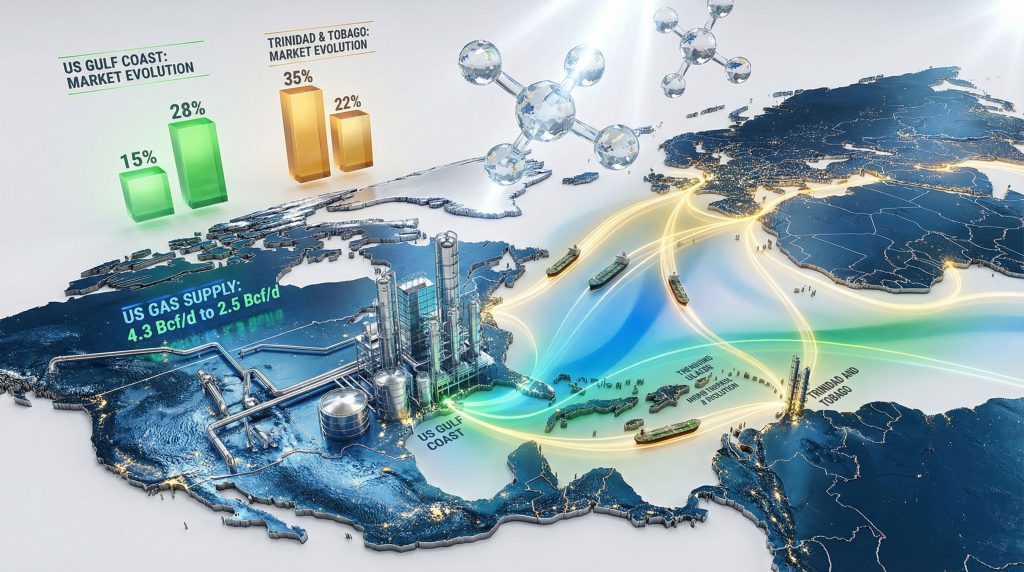
Trinidad's natural gas production declined from 4.3 Bcf/d in 2010 to 2.5 Bcf/d in 2025, representing a 40% reduction over 15 years. This decline trajectory reflects mature offshore field characteristics rather than cyclical market fluctuations, with primary fields experiencing 10-15% annual decline rates through the mid-2020s.
| Metric | Current Status | Economic Impact |
|---|---|---|
| Nameplate Capacity | 8 million t/yr | Fixed costs spread across reduced output |
| Actual Production | 4-5 million t/yr | 50-62.5% utilisation rate |
| Cost Impact | 80-100% above nameplate economics | Uncompetitive unit costs |
| Feedstock Allocation | 452 mn cf/d (Jan-June 2025) | Down 11% year-over-year |
The competitive hierarchy for Trinidad's diminishing natural gas reflects economic reality where LNG contracts command 15-20% premiums over methanol pricing on a per-energy-unit basis. Consequently, methanol production receives residual feedstock allocation, available only after higher-value molecules secure supply contracts. The LNG supply implications demonstrate how energy prioritisation affects downstream chemical production.
Natural gas directed to methanol production totalled 452 million cubic feet per day for January-June 2025, representing an 11% year-over-year decline compared to the same period in 2024. Competing demand allocation prioritises LNG production (45-50% of available gas) and ammonia production (20-25%), with methanol receiving the remainder (15-20%).
Cross-Border Energy Development Scenarios
Venezuela possesses estimated natural gas reserves of 147 trillion cubic feet, among the world's largest, predominantly in the Mariscal Sucre and Deltana fields. However, geopolitical factors prevent rational energy cooperation despite mutual economic benefits.
US sanctions on Venezuelan oil and gas operations (Executive Order 13884, August 2019, and subsequent extensions through 2024) effectively prohibit US companies from participating in Venezuela-Trinidad pipeline infrastructure. Additionally, the shared maritime boundary dispute over the Essequibo region creates political risk factors that compound investment uncertainty.
A transnational subsea pipeline connecting Venezuelan gas fields to Trinidad processing infrastructure would require:
• Initial capital investment: $2.0-3.5 billion USD
• Pipeline specifications: 24-36 inch diameter, 200+ kilometre subsea route
• Capacity rating: 1.0-1.5 Bcf/d
• Project timeline: 4-6 years from engineering through first gas delivery
• Economic threshold: WTI $70-80/barrel and natural gas $5-6/MMBtu for positive NPV
BP's announced 250 million cubic feet per day project (commencing April 2026) demonstrates energy sector prioritisation of LNG over methanol. The project represents 10% of Trinidad's total 2025 natural gas production, yet targets export LNG markets yielding higher returns than domestic methanol production.
Market Share Dynamics Revealing Global Methanol Trade Evolution
Regional export flow analysis demonstrates how structural advantages translate into measurable market share gains for US methanol producers displacing Trinidad and corresponding losses for traditional Caribbean suppliers.
Regional Export Flow Analysis
Methanol Export Market Share Shifts (2021-2025)
| Region | 2021 Market Share | 2025 Market Share | Volume Change |
|---|---|---|---|
| US Gulf Coast | 15% | 28% | +87% |
| Trinidad & Tobago | 35% | 22% | -37% |
| Middle East | 25% | 25% | Stable |
| Asia-Pacific | 25% | 25% | Stable |
US East Coast imports from Trinidad fell by 20% comparing January-September 2025 (221,079 metric tonnes) to the 2021-24 average for the same nine-month period. This displacement occurred despite transportation cost advantages for Caribbean suppliers, indicating fundamental shifts in production economics rather than logistics factors.
Simultaneously, US exports to Europe reached 1.7 million tonnes in the first nine months of 2025, representing 39% growth year-over-year and 200% growth compared to 2021. Trinidad exports to Europe declined 41% to 1 million tonnes from January-September 2025, demonstrating direct competitive displacement in key international markets.
Price Premium Analysis Across Transportation Modes
The East Coast truck/railcar premium expansion reflects fundamental infrastructure economics when traditional suppliers reduce volumes. This four-fold increase since 2021 creates economic incentives for domestic suppliers to displace methanol imports with local production, even accounting for additional transportation costs from Gulf Coast facilities.
Market participants indicate that lower imports from Trinidad raised transportation costs and widened price differentials, creating arbitrage opportunities that incentivise domestic production expansion over import dependency.
Global methanol supply chain nameplate capacity reached approximately 130 million tonnes per year as of 2024, with Asia-Pacific representing 55-60% of total installed capacity. However, capacity utilisation rates vary significantly across regions, with Trinidad's facilities operating at 50-62.5% utilisation compared to 85-95% rates achieved by cost-advantaged US Gulf Coast producers.
Production Capacity Trends Indicating Future Market Leadership
North American capacity expansion demonstrates how sustained feedstock advantages translate into strategic capital allocation decisions that reinforce competitive positioning over multi-year investment cycles. Additionally, the global tariff impact continues shaping international trade competitiveness across chemical sectors.
North American Capacity Expansion Pipeline
Golden Triangle Polymers expects to start up 2 million tonnes per year of HDPE capacity in Orange, Texas, by mid-2026, aimed almost entirely at export markets. This represents the latest in a series of capacity additions that increased US polymer exports from 39% of total sales in 2022 to 48% through November 2025.
Since 2023, more than 3.3 million tonnes per year of new capacity from Shell, Baystar, Nova, and Dow commenced operations, demonstrating sustained confidence in North American production economics. Dow's 600,000 t/yr HDPE/LLDPE swing unit in Freeport, Texas, began full ramp-up in July 2025, contributing to regional supply abundance.
The percentage of US sales directed to exports continues rising as new capacity additions exceed domestic demand growth. This trend reflects economic reality where global arbitrage opportunities provide superior returns compared to constrained domestic markets, particularly given competitive feedstock costs and integrated infrastructure access.
Caribbean Capacity Utilisation Efficiency Metrics
Trinidad's methanol capacity utilisation crisis exemplifies how feedstock constraints compound operational inefficiencies. Fixed costs (depreciation, labour, maintenance) distributed across 37.5-50% lower output raise per-unit production costs by 80-100% above nameplate economics, fundamentally undermining competitive positioning.
Historic capacity utilisation comparison reveals the magnitude of this deterioration:
• 2005-2010: 80-95% capacity utilisation (7.2-7.6 mn t/yr production)
• 2025: 50-62.5% capacity utilisation (4-5 mn t/yr production)
• Production decline: 47% vs. 40% gas production decline
The disproportionate production decline (47% vs. 40% gas decline) reflects feedstock allocation prioritisation toward higher-value molecules rather than proportional cuts across all derivatives. This pattern will persist absent radical changes in global price relationships or significant new gas discoveries.
End-Market Demand Patterns Influencing Producer Strategy
Derivative market segmentation reveals how downstream integration opportunities create additional competitive advantages for strategically positioned methanol producers.
Derivative Market Segmentation Analysis
Formaldehyde, MTBE, and emerging fuel applications exhibit varying growth rates that influence producer integration strategies. Surfactants demand remains relatively stable, supported by personal care, household, and industrial cleaning applications, while polyether polyols face pressure from sluggish construction and automotive markets.
Methanol-to-olefins (MTO) technology creates additional downstream optionality for integrated producers. This process flexibility allows producers to optimise product slate allocation based on relative price relationships across derivative markets, providing operational advantages unavailable to single-product facilities.
Transportation economics favour regional demand centre accessibility. European market penetration requires navigation of potential trade policy changes, including proposed EU-US trade deal provisions that could eliminate customs duties on industrial goods, potentially creating new arbitrage opportunities for US producers.
Geographic Demand Centre Accessibility
Asian market dynamics reflect China's increasing self-sufficiency, with approximately 4 million tonnes per year of new polyethylene capacity projected to start up in Asia during 2026. This regional capacity expansion challenges traditional export strategies and requires US producers to identify alternative demand centres.
Latin American regional trade flow optimisation benefits from proximity advantages, though Mexico's shifting derivative production patterns create both opportunities and competitive pressures. Mexico accounted for 44% of US butadiene exports through November 2025, reflecting broader petrochemical trade pattern evolution.
Market participants expect continued buyer market conditions through 2026, with plentiful supply and low export prices as producers compete for global market share. This environment favours large-scale, cost-advantaged producers with operational flexibility and integrated downstream access.
Investment Implications from Market Transformation
Capital allocation efficiency across regions demonstrates how sustained competitive advantages translate into superior risk-adjusted returns for strategically positioned market participants. The evolution of US methanol producers displacing Trinidad presents specific considerations for investment strategy 2025 planning.
Capital Allocation Efficiency Across Regions
Return on invested capital comparison between US and Caribbean projects reflects multiple factor advantages beyond simple feedstock costs. US projects benefit from:
• Lower political risk premiums: Stable regulatory environment vs. 3-7% additional discount rates for Venezuela-involved projects
• Infrastructure efficiency: Existing pipeline, storage, and transportation networks
• Technology access: Advanced process optimisation and operational best practices
• Market access: Proximity to diverse end-market demand centres
International development finance institutions typically apply 3-7% additional discount rates for Venezuela-involved projects, reflecting political risk factors that compound investment uncertainty. Current US sanctions regime (Executive Order 13884 and subsequent OFAC guidance) effectively prohibits US company participation in Venezuelan energy infrastructure, limiting financing options.
Strategic Asset Portfolio Optimisation
Diversification benefits of multi-regional production footprints face evaluation against concentrated exposure to cost-advantaged production centres. Operational flexibility value increases in volatile feedstock markets, particularly for producers with technological capability to optimise product slate allocation.
Technology advancement impact on production cost structures favours facilities with capacity for process optimisation and derivative integration. Modern synthesis units achieve higher conversion efficiency rates and reduced energy consumption per unit of output, amplifying feedstock cost advantages through operational excellence.
Market participants anticipate continued structural oversupply conditions through 2026, with new global capacity additions outpacing demand growth. This environment rewards scale economics, operational flexibility, and strategic positioning in cost-advantaged production regions.
The next major ASX story will hit our subscribers first
Macroeconomic Factors Shaping Long-Term Market Structure
Energy transition dynamics create both challenges and opportunities for methanol producers, with low-carbon applications potentially offsetting traditional demand pressures whilst requiring significant process modifications and capital investment.
Energy Transition Impact on Methanol Demand Growth
Low-carbon methanol applications in marine fuel and chemical feedstock represent emerging demand segments with premium pricing potential. However, renewable feedstock integration requires substantial process modifications and operates at economic disadvantages compared to natural gas-based production under current technology and cost structures.
Carbon pricing mechanisms affecting production location decisions remain geographically fragmented, with European carbon border adjustment mechanisms potentially impacting import competitiveness. US producers benefit from relatively lower carbon intensity due to abundant natural gas and modern facility design, creating additional competitive advantages in carbon-constrained markets.
Trade Policy and Regulatory Framework Evolution
The European Commission's proposed elimination of customs duties on US industrial goods under potential EU-US trade agreements could reshape competitive dynamics. Zero tariffs would open arbitrage opportunities for spot imports, though existing anti-dumping duties on specific products provide some protection until November 2026.
Monoethylene glycol retains protection from import surges through existing anti-dumping duties on US and Saudi material, effective until November 16, 2026. European producers prepare for sunset review of these measures, with potential changes rapidly reshaping competitive landscape.
Free trade agreement impacts on market access strategies require careful evaluation of tariff structure implications for international methanol trade. Bilateral safeguard mechanisms provide potential protection against significant import increases, though activation thresholds and implementation timelines introduce uncertainty.
Strategic Positioning for the Next Decade of Methanol Markets
Key Success Factors for Market Participants
Feedstock security emerges as the primary competitive advantage, with access to reliable, cost-competitive natural gas determining long-term viability more than operational efficiency or technology advancement. Scale economics in transportation and production create additional advantages through improved logistics networks and reduced per-unit fixed costs.
Downstream integration opportunities provide margin enhancement potential and market positioning advantages, particularly for producers with technological capability to optimise product slate allocation based on relative price relationships across derivative markets.
What Market Share Will US Producers Achieve by 2030?
Regional market share evolution through 2030 will likely continue favouring North American producers, with US methanol producers displacing Trinidad potentially reaching 35-40% of global export markets absent significant technological breakthroughs in alternative production regions or major new natural gas discoveries.
Critical decision points for existing Caribbean operations centre on feedstock security investments versus facility rationalisation. Trinidad's operators face fundamental choices between major upstream investment (requiring cross-border cooperation with Venezuela) or accepting diminished market position through capacity optimisation.
Investment timing considerations for new capacity additions favour early commitment to cost-advantaged locations, given multi-year project development timelines and increasing competition for optimal sites. Successful market participants will demonstrate sustained feedstock security, operational scale advantages, and strategic downstream integration capabilities.
Disclaimer: This analysis contains forward-looking statements and projections based on current market conditions, industry trends, and publicly available information. Actual market developments may differ materially from these assessments due to various factors including changes in energy policy, technological advancement, geopolitical developments, and macroeconomic conditions. Readers should conduct independent research and consult qualified advisors before making investment decisions.
Looking to Capitalise on Global Commodity Market Shifts?
Discovery Alert's proprietary Discovery IQ model delivers real-time alerts on significant ASX mineral discoveries, instantly empowering subscribers to identify actionable opportunities ahead of the broader market whilst global trade patterns undergo fundamental transformation. Begin your 30-day free trial today at Discovery Alert and secure your market-leading advantage in an evolving commodity landscape.