May 20, 2026
The Global Natural Gas Market Transformation Through Unconventional Resource Development
Natural gas markets worldwide are experiencing unprecedented transformation as producers pivot toward unconventional resource development to meet growing energy security demands. This shift represents more than technological evolution; it embodies a fundamental restructuring of energy supply chains that could reshape global hydrocarbon markets for decades. The emergence of large-scale unconventional gas projects signals a new era where traditional energy exporters are redefining their strategic positioning beyond conventional oil and gas production models.
Regional energy dynamics are being fundamentally altered as major hydrocarbon producers develop previously untapped unconventional formations. These developments create ripple effects throughout international energy markets, affecting everything from LNG trade flows to petrochemical feedstock availability. The scale and complexity of modern unconventional gas projects demonstrate how energy transition challenges are driving massive capital investments in resource diversification strategies.
When big ASX news breaks, our subscribers know first
Understanding the Scale of Modern Unconventional Gas Development
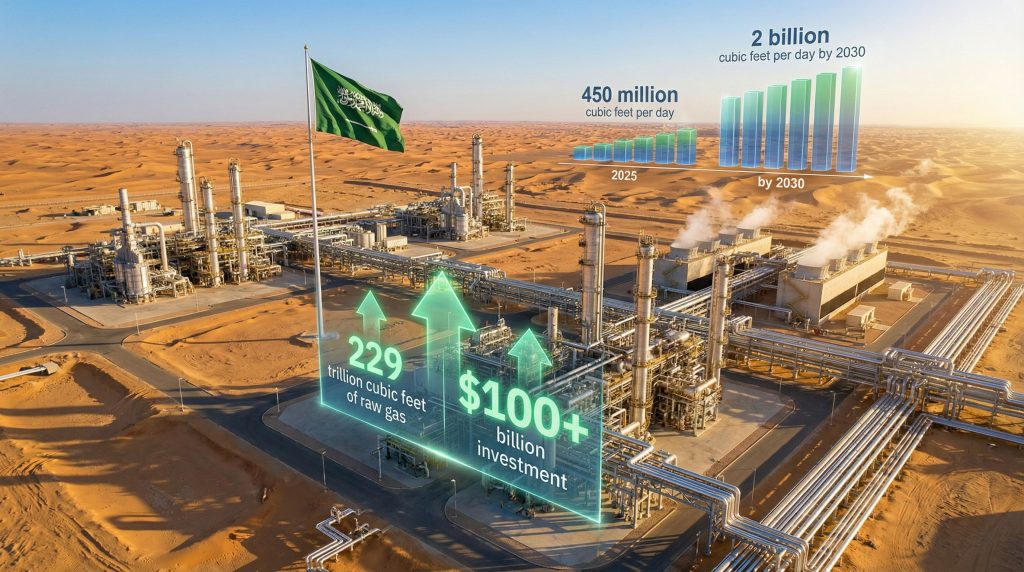
Saudi Arabia's Aramco Jafurah gas project exemplifies the transformative potential of unconventional resource development in reshaping regional energy markets. The project represents one of the most significant unconventional gas developments globally, with production operations officially commencing in 2026 according to industry reports. This milestone marks a strategic shift in Saudi Arabia's energy portfolio toward diversified hydrocarbon production beyond traditional crude oil extraction.
Project Development Metrics:
- Investment Commitment: Over $100 billion across the project lifecycle
- Production Target: 2 billion cubic feet per day by 2030
- Liquid Hydrocarbon Capacity: 630,000 barrels per day estimated output
- Ethane Production: 420 million cubic feet per day projected capacity
The Jafurah formation's liquid-rich characteristics provide superior economic returns compared to conventional dry gas developments. Condensate and natural gas liquids production creates multiple revenue streams that enhance project economics beyond simple gas sales. This multi-product approach enables better capital allocation efficiency and risk distribution across different hydrocarbon market segments.
Geological Advantages of Liquid-Rich Formations
Unconventional liquid-rich formations offer distinct economic advantages over dry gas plays through diversified hydrocarbon production streams. The presence of condensate and natural gas liquids provides higher-value products that command premium pricing compared to pipeline gas sales. These formations typically require specialised extraction methodologies including horizontal drilling and multi-stage hydraulic fracturing to maximise reservoir contact and production efficiency.
Technical Infrastructure Requirements:
- Advanced horizontal drilling programmes spanning extensive pipeline networks
- Multi-component gas processing systems for liquid separation
- Water management systems adapted for arid environment operations
- Integrated carbon capture frameworks for environmental compliance
Economic Forces Driving Unconventional Gas Development Strategies
Domestic Energy Security and Cost Optimisation
The development of domestic unconventional gas resources addresses critical economic inefficiencies in oil-dependent energy systems. Countries that historically burned crude oil for power generation face substantial opportunity costs when oil prices exceed $60-70 per barrel. Natural gas substitution enables these producers to redirect higher-value crude oil toward export markets while meeting domestic energy demand with lower-cost gas production.
Energy Substitution Economics:
- Power Generation Cost Reduction: 40-50% compared to oil-fired generation systems
- Industrial Feedstock Value: Enhanced petrochemical sector competitiveness
- Export Revenue Optimisation: Freed crude oil volumes for international markets
- Energy Security Enhancement: Reduced dependence on energy imports
Petrochemical Industry Integration Benefits
Unconventional gas development creates downstream integration opportunities through ethane and propane production for petrochemical feedstock applications. These light hydrocarbons serve as essential raw materials for plastics, synthetic rubber, and chemical manufacturing industries. Domestic feedstock availability reduces input costs for petrochemical complexes while creating additional revenue streams beyond traditional gas sales.
"Natural gas-fired power generation offers operational cost advantages over crude oil-fired plants through superior fuel conversion efficiency, reduced maintenance requirements, and improved emissions compliance performance."
Production Timeline Strategies and Capital Deployment Frameworks
Phased Development Approach Rationale
Large-scale unconventional gas projects typically employ phased development strategies to manage capital deployment risk and optimise production ramp-up timelines. This approach enables operators to validate reservoir performance, refine extraction techniques, and scale infrastructure development in alignment with market demand growth.
Phase 1 (2025-2026): Foundation Building
- Initial gas processing capacity establishment
- Core infrastructure development and testing
- Production methodology validation
- Market absorption capacity assessment
Phase 2 (2027-2030): Scale Expansion
- Full production capacity achievement
- Comprehensive processing facility operations
- Multi-product stream optimisation
- Regional market integration
How Do Advanced Financing Strategies Support Mega-Projects?
Modern energy mega-projects increasingly utilise sophisticated financing structures that separate operational control from infrastructure asset ownership. Lease-and-leaseback arrangements with international infrastructure funds enable operators to access global capital markets while maintaining strategic decision-making authority over production operations. Furthermore, these advanced financing strategies offer significant advantages for project developers.
Strategic Benefits of Advanced Financing:
- Capital Preservation: Reduced direct sovereign balance sheet burden
- Risk Distribution: Shared infrastructure development risks with specialised partners
- International Access: Leverage global infrastructure investment appetite
- Operational Control: Retained strategic asset management authority
Technological and Operational Challenges in Arid Region Development
Extraction Methodology Adaptations
Unconventional gas development in arid regions requires technological approaches adapted from successful operations in different geological and climatic contexts. The proven methodologies from North American shale plays must be modified for Middle Eastern geological formations and operational constraints including water scarcity and extreme temperature conditions.
Core Technology Requirements:
- Horizontal Well Design: Maximised reservoir contact in low-permeability formations
- Multi-Stage Hydraulic Fracturing: Artificial permeability creation in tight rock
- Advanced Completion Techniques: Complex reservoir heterogeneity management
- 3D Seismic Characterisation: Optimised drilling location identification
Water Management in Desert Operations
Water management represents a critical operational challenge for unconventional gas development in water-scarce regions. Multi-stage hydraulic fracturing operations typically require millions of gallons per well, creating significant logistical and environmental considerations for desert-based projects.
Water Management Solutions:
- Closed-loop water recycling systems
- Brackish water utilisation technologies
- Produced water treatment and reuse protocols
- Regulatory compliance monitoring systems
Regional Natural Gas Market Dynamics and Competitive Positioning
Middle Eastern Gas Supply Architecture Transformation
The emergence of significant unconventional gas production capacity fundamentally alters existing regional energy supply arrangements. Traditional gas trade relationships, pricing mechanisms, and supply security frameworks must adapt to accommodate new production sources with different cost structures and operational characteristics.
Regional Market Impact Categories:
- Import Dependency Reduction: Decreased reliance on LNG imports for domestic consumption
- Export Capacity Development: Potential surplus production for regional markets
- Competitive Pressure: Challenge to established supplier market share
- Energy Security Enhancement: Diversified supply sources for regional consumers
What Are the Global LNG Trade Flow Implications?
New unconventional gas production capacity in strategic geographic locations could significantly influence global LNG trade patterns. The Middle East's position between Asian and European markets provides natural advantages for LNG exports, potentially affecting established supplier relationships and pricing dynamics in international gas markets. However, understanding broader LNG market implications remains crucial for stakeholders.
LNG Market Positioning Factors:
- Geographic proximity to major demand centres
- Production cost competitiveness with global suppliers
- Infrastructure development for LNG export capacity
- Long-term contract availability and pricing flexibility
The next major ASX story will hit our subscribers first
Economic Diversification and Industrial Development Catalysts
Downstream Value Creation Opportunities
Unconventional gas development creates multiple downstream value creation opportunities beyond primary hydrocarbon production. The availability of ethane feedstock enables petrochemical industry expansion, while natural gas availability supports industrial development across manufacturing sectors requiring reliable energy supplies.
Industrial Development Metrics:
- Petrochemical Complex Investment: $20-30 billion development potential
- Employment Generation: 10,000+ direct and indirect positions
- Technology Transfer: International partnership development opportunities
- Infrastructure Expansion: Regional economic development catalyst effects
Vision 2030 Economic Transformation Integration
Large-scale energy projects serve as cornerstone initiatives for broader economic diversification strategies aimed at reducing oil dependency and expanding non-hydrocarbon GDP contributions. These projects provide stable revenue streams that support public investment programmes and international economic partnerships.
Economic Diversification Alignment:
- Non-oil GDP contribution expansion
- Industrial sector capacity growth in petrochemicals
- Export diversification beyond crude oil dependency
- Renewable energy integration through gas-fired backup power
Investment Market Implications and Capital Flow Dynamics
International Capital Market Access Strategies
Sophisticated financing partnerships demonstrate evolving approaches to international capital market engagement for energy infrastructure development. These structures could establish templates for future mega-project financing, combining sovereign strategic control with global financial expertise and risk distribution. Consequently, investors seeking strategic investment insights should consider these emerging models.
Capital Structure Innovation Benefits:
- Access to specialised infrastructure investment funds
- International risk management expertise
- Technology transfer and operational knowledge sharing
- Currency diversification and financial market integration
Sovereign Wealth Fund Portfolio Diversification
Revenue generation from domestic energy projects supports sovereign wealth fund diversification strategies by providing stable cash flows for international investment programmes. This creates a foundation for economic transformation initiatives while maintaining energy sector leadership positions.
Environmental Compliance and Sustainable Development Integration
Carbon Capture and Environmental Management
Modern unconventional gas projects increasingly incorporate advanced environmental management systems including carbon capture technologies and comprehensive emissions monitoring programmes. These systems position projects as models for responsible resource development in environmentally sensitive regions. Moreover, realising decarbonisation benefits becomes essential for long-term sustainability.
Environmental Technology Integration:
- Point-source carbon capture systems at processing facilities
- Methane leak detection and prevention protocols
- Water treatment and recycling technology deployment
- Biodiversity protection and habitat restoration programmes
Regional Climate Commitment Alignment
Environmental technology deployment in large-scale energy projects demonstrates alignment with national and regional climate commitments while maintaining economic development objectives. This balance enables continued hydrocarbon sector growth within evolving environmental regulatory frameworks.
Strategic Implications for Global Energy Market Evolution
The successful development of Saudi Arabia's Aramco Jafurah gas project represents more than unconventional resource extraction—it exemplifies a comprehensive economic transformation strategy that could influence energy market dynamics across multiple regions. The project's massive scale and integrated approach to natural gas development establishes new benchmarks for unconventional resource projects worldwide.
By 2030, the successful execution of this development timeline will likely position Saudi Arabia as a significant natural gas producer, fundamentally altering Middle Eastern energy supply dynamics and supporting long-term economic diversification beyond traditional oil dependency. The integration of advanced technology, international financing partnerships, and comprehensive environmental management creates a framework for sustainable energy development in arid regions.
This transformation occurs within broader global energy transition dynamics where natural gas serves as both a bridge fuel and industrial feedstock source. The project's success could accelerate similar developments across other regions with comparable geological resources and energy security imperatives.
Disclaimer: This analysis contains forward-looking statements and projections based on current industry developments and publicly available information. Actual project performance, production timelines, and economic outcomes may vary significantly from projections due to geological, technological, regulatory, and market factors beyond current predictions. Readers should conduct independent research and consult qualified professionals before making investment or business decisions related to energy sector developments.
Ready to Capitalise on the Next Major Energy Discovery?
Discovery Alert's proprietary Discovery IQ model delivers real-time alerts on significant ASX mineral and energy discoveries, instantly empowering subscribers to identify actionable opportunities ahead of the broader market. Begin your 14-day free trial today and secure your market-leading advantage whilst understanding why major mineral discoveries can lead to substantial market returns.