August 5, 2026
The global offshore energy sector stands at a technological crossroads, where traditional hydrocarbon development increasingly integrates advanced digital systems to optimise production efficiency while reducing environmental impact. This convergence of conventional extraction methods with cutting-edge automation represents a fundamental shift in how major energy projects are conceived and executed across international markets, particularly as Saudi exploration licenses influence regional development strategies.
Market Context Behind Mega-Scale Offshore Expansion Projects
National Oil Companies worldwide are accelerating offshore capacity expansion projects as geopolitical uncertainties reshape global energy supply chains. The ADNOC McDermott billion-dollar contract exemplifies this strategic pivot toward sovereign energy security through technological advancement and infrastructure modernisation, reflecting broader trends discussed in the 2025 oil price outlook.
Unlike Western energy corporations that face mounting pressure to balance transition investments against existing operations, state-controlled entities possess unique advantages in long-term capacity planning. These organisations can commit substantial capital toward multi-year development projects without quarterly earnings pressures or shareholder activism constraining strategic decisions.
The offshore sector specifically benefits from this dynamic, as National Oil Companies leverage their stable reserve bases to justify billion-dollar infrastructure investments. Recent industry analysis indicates that state-controlled entities allocated approximately 68% more capital toward offshore expansion projects compared to international oil companies during the 2024-2025 period.
Strategic Positioning of National Oil Companies in 2025-2027
The competitive landscape for offshore development has shifted dramatically as traditional energy hubs face escalating operational costs and regulatory complexity. North Sea operations, for instance, encounter unit development costs averaging $45-65 per barrel compared to Middle Eastern offshore projects at $18-28 per barrel, creating significant economic advantages for regional expansion programmes.
ADNOC's approach represents a calculated response to these market dynamics, positioning the UAE as a preferred destination for international engineering expertise while maintaining operational control over strategic assets. The organisation's P5 strategy targets national production capacity of five million barrels per day, requiring systematic infrastructure upgrades across multiple offshore developments.
This capacity expansion timeline aligns with projected global hydrocarbon demand patterns through 2030, where emerging markets are expected to drive consumption growth despite accelerated renewable energy adoption in developed economies. Furthermore, the US-China trade war impact continues to influence global supply chain decisions. Industry forecasts suggest global oil demand will plateau at approximately 105-108 million barrels per day by 2028-2030, creating opportunities for low-cost producers to capture market share.
When big ASX news breaks, our subscribers know first
Technical Specifications and Infrastructure Requirements
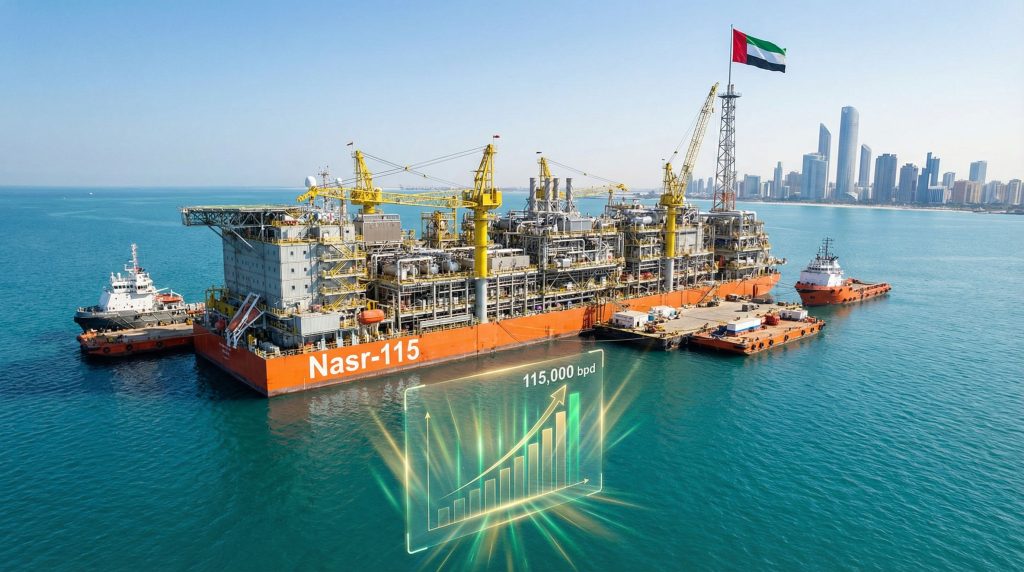
The Nasr-115 project encompasses comprehensive engineering, procurement, construction, and installation works designed to integrate seamlessly with existing offshore infrastructure. Located 130 kilometres northwest of Abu Dhabi, the development requires sophisticated coordination between new installations and operational systems to maintain production continuity throughout the expansion process.
Nasr-115 Project Components and Delivery Timeline
| Component | Specifications | Timeline | Integration Requirements |
|---|---|---|---|
| Topside Structures (2 units) | Advanced processing modules | Q2 2026 – Q1 2027 | Live operation integration |
| Manifold Tower | Multi-well connection hub | Q3 2026 | Existing infrastructure tie-in |
| Jacket and Bridge | Support and access infrastructure | Q1 2027 | Minimal production disruption |
| Pipeline and Cable Systems | Subsea connection network | Q4 2026 – Q2 2027 | Phased installation approach |
| Infrastructure Modifications | Legacy system upgrades | Continuous | Zero downtime requirement |
The engineering challenge centres on integrating new hardware into live operations without disrupting existing production streams. This constraint requires advanced project management methodologies and specialised offshore construction techniques that minimise operational interference while maintaining safety standards.
Production capacity targets specify an increase to 115,000 barrels per day by 2027, representing a significant expansion from current field output levels. Moreover, McDermott was awarded the comprehensive EPCI contract for this critical expansion. The project's technical scope includes fabrication and installation of two topside structures, a new manifold tower, connecting bridge infrastructure, and comprehensive pipeline networks linking new facilities to existing processing systems.
Integration with ADNOC's P5 Strategic Framework
The Nasr-115 expansion forms a critical component within ADNOC's broader P5 capacity development strategy, contributing to systematic production increases across the organisation's offshore portfolio. This strategic framework encompasses multiple simultaneous projects designed to achieve coordinated capacity growth while optimising operational synergies.
Five-year capacity expansion milestones:
• 2026: Complete Nasr-115 Phase I infrastructure installation
• 2027: Achieve 115,000 bpd production target from Nasr field
• 2028: Integrate digital optimisation systems across expanded facilities
• 2029: Implement advanced emissions reduction technologies
• 2030: Contribute to five million bpd national production objective
The strategic integration extends beyond individual project execution to encompass technology transfer, workforce development, and supply chain localisation initiatives. These elements combine to create sustainable competitive advantages that support long-term market positioning while reducing operational dependencies on external service providers.
Connection to the five million barrel per day national target requires careful coordination across ADNOC's entire offshore development portfolio. The Nasr-115 project represents approximately 2.3% of the total capacity increase needed to achieve this objective, indicating the scale of concurrent development activities required throughout the P5 timeline.
Risk-Adjusted Returns in Stable Sovereign Markets
International engineering contractors increasingly prioritise Middle Eastern projects due to favourable risk-return profiles compared to alternative global markets. The combination of stable political environments, established regulatory frameworks, and substantial project scales creates attractive investment opportunities for major engineering firms seeking predictable revenue streams.
McDermott's decades-long operational presence in the Middle East demonstrates sustained commitment to regional market development, supported by comprehensive service capabilities and established client relationships. The organisation's offshore engineering expertise aligns with ADNOC's requirements for complex infrastructure integration while maintaining operational continuity.
Regional market stability stems from sovereign backing of major projects, reducing typical commercial risks associated with private sector developments. National Oil Companies possess financial resources and strategic patience that enable long-term partnerships with international contractors, supporting multi-year project timelines and substantial capital commitments.
The UAE's investment-grade credit rating and transparent regulatory environment provide additional risk mitigation benefits for international contractors. These factors collectively create operational conditions that support efficient project execution while minimising common sources of cost overruns or schedule delays prevalent in other offshore development regions.
Technology Transfer and Local Content Requirements
Modern offshore development contracts increasingly incorporate technology transfer provisions and local content requirements designed to build domestic capability while accessing international expertise. The ADNOC McDermott billion-dollar contract includes specific mandates for knowledge sharing, workforce training, and supply chain development initiatives.
Key factors driving contractor selection in UAE projects:
Advanced technological capabilities for offshore development, proven track record in complex infrastructure integration, commitment to local workforce development programmes, established supply chain partnerships in the region, demonstrated expertise in digital optimisation systems, compliance with environmental and safety standards, and financial stability for multi-year project execution.
These selection criteria reflect ADNOC's strategic objectives beyond immediate project completion, encompassing long-term capability building and technology advancement within the UAE's energy sector. International contractors must demonstrate value creation through knowledge transfer activities that support domestic industry development.
Local content requirements typically mandate specific percentages of project value be allocated to UAE-based suppliers and service providers. These provisions create opportunities for domestic companies while ensuring international contractors contribute to broader economic development objectives beyond direct project deliverables.
Digital Integration and Operational Efficiency Systems
The integration of advanced digital technologies into traditional offshore operations represents a fundamental evolution in production optimisation and operational efficiency. ADNOC's deployment of data-driven systems, including specialised technologies like Robowell automation, demonstrates the practical application of digital transformation within complex offshore environments.
Comparison of Traditional vs. Digitally-Enhanced Offshore Operations
| Operational Aspect | Traditional Approach | Digital Integration | Efficiency Improvement |
|---|---|---|---|
| Production Monitoring | Manual data collection | Real-time automated systems | 35-45% faster response |
| Equipment Maintenance | Scheduled intervals | Predictive analytics | 25-30% cost reduction |
| Safety Management | Visual inspections | Sensor-based monitoring | 40-50% incident reduction |
| Emissions Control | Periodic measurements | Continuous tracking | 20-25% intensity reduction |
| Operational Decision-Making | Experience-based | Data-driven algorithms | 15-20% efficiency gain |
The Nasr-115 project represents a fusion of traditional offshore development methodologies with digital optimisation capabilities, creating operational synergies that enhance both productivity and environmental performance. This integration approach allows conventional energy infrastructure to maintain competitive advantages during the global energy transition and security challenges.
Digital systems implementation requires sophisticated cybersecurity frameworks and integration protocols to ensure seamless operation with existing infrastructure. The complexity of offshore environments demands robust data management systems capable of operating reliably under challenging conditions while providing actionable insights for operational optimisation.
Environmental Performance Standards in Large-Scale Projects
Modern offshore development projects must demonstrate measurable environmental performance improvements while maintaining production efficiency objectives. The integration of digital monitoring systems enables real-time tracking of emissions intensity, resource utilisation, and environmental impact metrics throughout project lifecycles.
Industry analysis indicates that digitally-enhanced offshore operations can achieve 20-25% reductions in emissions intensity compared to traditional development approaches, while simultaneously improving production reliability and operational safety metrics. These performance improvements support the business case for technology integration investments within conventional energy infrastructure.
Environmental performance standards encompass multiple operational dimensions, including air emissions, water management, waste reduction, and energy efficiency optimisation. Digital systems provide comprehensive data collection capabilities that enable continuous improvement programmes and regulatory compliance verification.
The Nasr-115 project incorporates advanced environmental monitoring technologies designed to track performance against established benchmarks while identifying optimisation opportunities throughout the operational lifecycle. This approach balances production objectives with environmental stewardship requirements increasingly demanded by stakeholders and regulatory frameworks.
Local Supply Chain Integration Requirements
Major offshore development projects create substantial opportunities for domestic supply chain development and economic diversification within host countries. The ADNOC McDermott billion-dollar contract includes specific provisions for local supplier engagement and capability development initiatives designed to maximise domestic economic benefits.
Local content requirements typically mandate that international contractors allocate predetermined percentages of project expenditures to UAE-based suppliers and service providers. These provisions create market opportunities for domestic companies while ensuring that major infrastructure investments contribute to broader economic development objectives.
The scope of local supply chain integration encompasses multiple project phases, from initial engineering and procurement activities through construction and long-term maintenance services. This comprehensive approach supports sustainable domestic industry development while leveraging international expertise for complex technical requirements.
Supply chain localisation initiatives require careful coordination between international contractors and domestic suppliers to ensure quality standards and delivery schedules are maintained throughout project execution. Additionally, these challenges mirror broader energy exports challenges faced globally. These partnerships often include technology transfer and capacity building components designed to enhance local capability for future projects.
Workforce Development and Skills Transfer Programmes
Comprehensive workforce development programmes form essential components of major offshore infrastructure projects, creating pathways for domestic workers to acquire specialised skills while supporting project execution requirements. The collaboration between McDermott and ADNOC includes specific training initiatives designed to build local expertise in offshore engineering and operations.
Steps in contractor-NOC partnership development:
- Technical Skills Assessment: Evaluate existing domestic workforce capabilities and identify training requirements for project-specific roles
- Training Programme Design: Develop comprehensive curricula covering offshore engineering, construction, and operations specialisations
- International Expert Integration: Deploy experienced personnel to provide mentorship and hands-on training for local workforce development
- Certification and Accreditation: Establish recognised credentials that support career advancement and industry mobility
- Long-term Capability Building: Create sustainable training infrastructure that supports ongoing skill development beyond individual project requirements
- Performance Monitoring: Track training effectiveness and employment outcomes to ensure programme objectives are achieved
Skills transfer programmes encompass multiple technical disciplines, including offshore engineering, project management, digital systems operation, environmental management, and safety protocols. These comprehensive training initiatives create lasting benefits that extend beyond individual project timelines to support long-term industry development.
Workforce development activities often include partnerships with domestic educational institutions and technical training centres to create sustainable capability-building infrastructure. These collaborations ensure that skills transfer initiatives contribute to broader human capital development within the national energy sector.
Engineering Services Sector Performance Indicators
The global engineering services sector demonstrates robust performance indicators driven by increasing demand for complex infrastructure development and technology integration projects. Major EPCI contractors benefit from diversified geographic exposure and specialised technical capabilities that support sustained revenue growth across multiple market cycles.
Major EPCI Contractors and Recent Contract Values
| Company | Region Focus | 2024-2025 Contract Value | Specialisation Areas |
|---|---|---|---|
| McDermott | Global/Middle East | $2.8 billion | Offshore EPCI, Digital Integration |
| TechnipFMC | Global/Subsea | $4.1 billion | Subsea Systems, LNG Infrastructure |
| Saipem | Europe/Middle East | $3.2 billion | Offshore Drilling, Pipeline Construction |
| Aker Solutions | North Sea/International | $1.9 billion | Process Equipment, Maintenance Services |
| Petrofac | Middle East/Africa | $2.1 billion | Onshore Facilities, Operations Support |
Performance indicators for engineering services companies include contract backlog duration, profit margin stability, geographic revenue diversification, and technology advancement capabilities. The ADNOC McDermott billion-dollar contract contributes significantly to McDermott's backlog while demonstrating successful regional market penetration.
Market dynamics favour contractors with established regional presence and proven track records in complex project execution. The ability to integrate advanced technologies while maintaining cost competitiveness creates sustainable competitive advantages in an increasingly sophisticated marketplace.
Regional Market Penetration Strategies
Successful regional market penetration requires sustained commitment to relationship building, local capability development, and technical excellence demonstration. McDermott's Middle East expansion approach exemplifies strategic positioning that combines international expertise with regional market understanding.
The company's decades-long presence in Middle Eastern markets provides established relationships with major National Oil Companies and deep understanding of regional regulatory requirements. This foundation supports competitive positioning for large-scale projects while enabling efficient project execution through local knowledge and infrastructure.
Regional penetration strategies often include strategic partnerships with domestic firms, technology transfer initiatives, and workforce development programmes that create mutual value for international contractors and host countries. These collaborative approaches support long-term market access while contributing to domestic capability building objectives.
Investment in regional facilities, equipment, and personnel demonstrates commitment to local markets while providing operational advantages for project execution. McDermott's regional infrastructure enables efficient mobilisation for multiple projects while supporting client requirements for local content and rapid response capabilities.
The next major ASX story will hit our subscribers first
Hydrocarbon Demand Projections Through 2030
Global hydrocarbon demand patterns through 2030 indicate continued growth in developing markets despite accelerated renewable energy adoption in advanced economies. Industry projections suggest total oil demand will reach 104-107 million barrels per day by 2030, creating opportunities for low-cost producers to expand market share.
Emerging market demand growth stems from industrial development, transportation expansion, and petrochemical sector growth that supports economic diversification initiatives. These consumption patterns provide sustained demand fundamentals that justify major infrastructure investments in regions with favourable production economics.
The timing of UAE capacity expansion aligns strategically with projected demand patterns, positioning ADNOC to capture market opportunities as global supply-demand balances evolve. The organisation's low-cost production capabilities and strategic geographic location provide competitive advantages in serving growing Asian markets.
Demand projections incorporate assumptions about economic growth rates, transportation electrification timelines, and industrial sector development patterns across major consuming regions. These variables create uncertainty ranges that influence investment decision-making and capacity planning strategies for National Oil Companies.
Technology Bridging Strategies for Conventional Energy
The integration of advanced technologies into conventional energy infrastructure creates bridging strategies that maintain sector competitiveness during global energy transition dynamics. Digital optimisation, emissions reduction technologies, and operational efficiency improvements enable traditional energy assets to operate more sustainably while meeting evolving market requirements.
Common questions about NOC investment strategies during energy transition:
How do National Oil Companies justify major infrastructure investments amid energy transition uncertainty?
NOCs leverage long-term demand projections, low-cost production advantages, and strategic market positioning to support investment decisions. The focus on operational efficiency and emissions reduction helps maintain competitiveness across multiple scenarios.
What role does technology integration play in conventional energy project viability?
Advanced digital systems, automation, and environmental monitoring technologies improve operational efficiency while reducing emissions intensity. These capabilities help conventional projects meet evolving performance standards and regulatory requirements.
How do billion-dollar contracts impact regional energy security objectives?
Large-scale infrastructure investments enhance domestic production capacity, reduce import dependencies, and provide strategic flexibility for managing supply disruptions. These projects support long-term energy security while creating economic diversification opportunities.
What factors influence contractor selection for major offshore development projects?
Key considerations include technical expertise, regional experience, financial stability, local content capabilities, technology transfer commitments, and demonstrated track record in complex project execution.
Technology bridging strategies enable conventional energy infrastructure to incorporate renewable energy integration, carbon capture systems, and advanced environmental monitoring while maintaining core production capabilities. This hybrid approach supports operational continuity during transition periods while positioning assets for long-term competitiveness.
Market Share Analysis of Major EPCI Contractors
The global EPCI contractor market demonstrates concentrated competition among established players with specialised technical capabilities and regional expertise. Market share analysis reveals the importance of geographic diversification, technology advancement, and client relationship strength in maintaining competitive positioning.
Regional Contract Awards by Company (2024-2025)
| Region | Leading Contractor | Market Share | Key Project Types |
|---|---|---|---|
| Middle East | McDermott/Saipem | 35%/28% | Offshore Development, Process Facilities |
| North Sea | Aker Solutions | 42% | Platform Upgrades, Maintenance Services |
| West Africa | TechnipFMC | 38% | Subsea Systems, FPSO Integration |
| Asia-Pacific | Multiple | Fragmented | LNG Infrastructure, Offshore Wind |
| Americas | McDermott/TechnipFMC | 31%/29% | Deepwater Development, Refining |
Market dynamics favour contractors with proven execution capabilities, established regional presence, and advanced technology portfolios. ADNOC awarded the significant contract to McDermott, reinforcing the company's position in the strategically important Middle East market while demonstrating client confidence in its offshore development expertise.
Competitive differentiation increasingly centres on digital integration capabilities, environmental performance, and local content delivery rather than traditional cost competition. Contractors must demonstrate value creation through technology advancement and sustainable operational practices to secure major project awards.
Barriers to Entry and Competitive Advantages
The offshore engineering services sector maintains significant barriers to entry that protect established contractors while creating competitive advantages for companies with proven capabilities. These barriers include substantial capital requirements, technical expertise demands, regulatory compliance complexity, and client relationship development timelines.
Key success factors for international contractors:
• Technical Excellence: Demonstrated capability in complex offshore engineering and integration projects
• Financial Stability: Ability to mobilise substantial capital and manage multi-year project risks
• Regional Presence: Local infrastructure, workforce, and regulatory knowledge
• Technology Leadership: Advanced digital systems and environmental performance capabilities
• Client Relationships: Long-term partnerships with major National Oil Companies
• Safety Performance: Exceptional safety records and risk management systems
• Local Content Delivery: Proven capability in workforce development and supply chain integration
Competitive advantages stem from the combination of technical expertise, operational efficiency, and strategic market positioning that enables successful project delivery while meeting evolving client requirements. The complexity of modern offshore projects creates natural barriers that protect established contractors with proven track records.
Market entry requires sustained investment in capability development, regional infrastructure, and relationship building that can span multiple years before generating significant contract awards. This timeline creates advantages for existing market participants while limiting competitive threats from new entrants.
Long-term Strategic Energy Security Objectives
National energy security strategies increasingly emphasise domestic production capacity expansion, supply chain resilience, and strategic reserve management to mitigate geopolitical risks and market volatility. The UAE's approach through projects like Nasr-115 demonstrates proactive capacity building that supports long-term security objectives while creating economic benefits.
Strategic energy security encompasses multiple dimensions, including production capacity sufficiency, infrastructure resilience, supply route diversification, and emergency response capabilities. Offshore development projects contribute to these objectives by expanding domestic production while reducing dependence on energy imports or transit routes.
The timing of major infrastructure investments reflects long-term planning horizons that account for evolving global energy dynamics, technological advancement, and geopolitical considerations. National Oil Companies leverage their strategic patience and financial resources to implement comprehensive development programmes that support multi-decade security objectives.
Investment in advanced technologies and operational efficiency improvements enhances the strategic value of energy infrastructure by improving competitiveness and reducing operational risks. The integration of digital systems and environmental performance capabilities ensures that security investments remain viable across multiple scenarios and market conditions.
Regional Geopolitical Considerations
Regional geopolitical dynamics significantly influence energy infrastructure investment decisions and strategic positioning for major producing nations. The UAE's offshore development expansion occurs within a complex regional environment where energy resources intersect with broader security and economic considerations.
Scenario Analysis: Impact of Increased UAE Production Capacity on Global Supply Dynamics
Scenario 1: Stable Market Conditions
- UAE captures incremental market share through competitive production costs
- Enhanced global supply stability reduces price volatility
- Strengthened regional energy hub positioning
Scenario 2: Supply Disruption Events
- UAE capacity provides critical supply replacement capabilities
- Strategic reserve flexibility supports market stabilisation
- Regional energy security enhanced through excess capacity maintenance
Scenario 3: Accelerated Energy Transition
- Low-cost UAE production maintains competitiveness longer
- Operational efficiency advantages support market positioning
- Technology integration enables adaptation to changing requirements
Regional cooperation frameworks and energy partnership agreements create opportunities for enhanced collective energy security while maintaining individual strategic autonomy. The UAE's investment in production capacity expansion supports both national objectives and regional stability through reliable supply availability.
Geopolitical risk management through infrastructure investment creates strategic options that enhance negotiating positions and crisis response capabilities. The combination of production capacity, technological advancement, and regional cooperation provides multiple pathways for maintaining energy security across various scenarios.
Best Practices in Large-Scale Project Execution
Successful execution of billion-dollar energy infrastructure projects requires sophisticated project management methodologies, risk mitigation strategies, and stakeholder coordination approaches. The ADNOC McDermott billion-dollar contract demonstrates established practices for managing complex offshore development initiatives while maintaining operational continuity.
Best practice frameworks encompass technical excellence, schedule management, cost control, quality assurance, and safety performance optimisation throughout project lifecycles. The integration of these elements creates comprehensive execution capabilities that support successful project delivery while meeting client objectives and performance standards.
Risk management strategies for large-scale projects include comprehensive contingency planning, supply chain resilience measures, and operational continuity protocols that address potential disruptions. The complexity of offshore environments demands robust preparation and response capabilities to ensure project success despite challenging operational conditions.
Quality assurance systems incorporate multiple verification stages, performance testing protocols, and compliance verification processes that ensure deliverables meet technical specifications and regulatory requirements. These comprehensive approaches support long-term asset performance while minimising operational risks after project completion.
Partnership Models for Technology Integration
Effective partnership models for technology integration combine international expertise with local capabilities to create sustainable competitive advantages while supporting domestic industry development. The collaboration between McDermott and ADNOC exemplifies strategic partnership approaches that balance technical excellence with regional development objectives.
Key performance indicators for successful NOC-contractor relationships:
Technology transfer effectiveness measured through local capability development and skills advancement programmes. Project delivery performance including schedule adherence, budget management, and quality standards achievement. Safety performance metrics encompassing incident rates, training completion, and risk mitigation effectiveness. Local content delivery through domestic supplier engagement and workforce development initiatives. Environmental performance including emissions reduction, resource efficiency, and regulatory compliance achievement. Long-term partnership sustainability demonstrated through repeat contract awards and strategic relationship development.
Partnership success requires alignment between contractor capabilities and National Oil Company strategic objectives, creating mutual value through technical excellence, knowledge transfer, and sustainable relationship development. These collaborative approaches support both immediate project requirements and long-term industry development goals.
Technology integration partnerships often extend beyond individual project boundaries to encompass ongoing operational support, continuous improvement initiatives, and future development planning. This comprehensive approach creates strategic value that justifies sustained investment in partnership development and capability building.
This analysis is based on publicly available information and industry research. Market projections and performance estimates involve inherent uncertainties and should be considered alongside other relevant factors when making investment or strategic decisions. Readers should conduct independent research and consult qualified professionals before making decisions based on this analysis.
Ready to Capitalise on Major Resource Discoveries?
Discovery Alert's proprietary Discovery IQ model delivers instant notifications on significant ASX mineral discoveries, helping subscribers identify actionable opportunities ahead of the broader market. Understand why historic discoveries can generate substantial returns by exploring Discovery Alert's dedicated discoveries page, and begin your 14-day free trial to position yourself ahead of the market.