May 12, 2026
The current petroleum market landscape reflects an increasingly complex interplay between global oil demand growth dynamics and evolving economic structures that extend far beyond traditional supply-demand calculations. Recent International Energy Agency revisions indicate global oil demand growth projections of 930,000 barrels per day for 2026, representing a significant upward adjustment that highlights the persistent strength of consumption patterns across major regional markets.
Understanding the Current Oil Demand Landscape
Global petroleum consumption patterns in 2026 demonstrate the complexity of modern energy forecasting. The International Energy Agency recently revised its global oil demand growth projections upward to 930,000 barrels per day for 2026, representing a 70,000 bpd increase from previous forecasts. This revision reflects stronger-than-anticipated economic performance driving consumption patterns across major consuming regions.
Current market dynamics reveal a persistent supply surplus of 3.69 million barrels per day, narrowing from the 3.84 million bpd surplus projected in December 2025. This 150,000 bpd reduction in oversupply conditions indicates gradual market tightening, though substantial excess capacity remains a defining characteristic of the mid-2020s petroleum landscape.
The baseline consumption environment operates against a backdrop of structural economic forces that extend beyond traditional cyclical patterns. Regional consumption divergence has become increasingly pronounced, with developed economies demonstrating declining petroleum intensity while emerging markets maintain robust growth trajectories. This bifurcation creates complex forecasting challenges for global oil demand growth scenarios.
Regional Consumption Patterns and Market Dynamics
Current Market Stabilisation Effects:
- Oversupply conditions providing price stability mechanisms
- Reduced volatility supporting long-term investment planning
- Strategic reserve accumulation opportunities for consuming nations
- Enhanced energy security buffers for major economies
Market participants recognise that excess supply conditions create both opportunities and risks across the petroleum value chain. The narrowing surplus trend suggests potential inflection points emerging in the 2027-2030 timeframe, dependent on sustained demand growth acceleration and supply discipline implementation.
Technical analysis of consumption patterns reveals significant variations in demand elasticity across different economic development stages. Advanced economies exhibit lower responsiveness to GDP growth, while emerging markets demonstrate elasticity coefficients ranging from 1.2 to 2.8 barrels per $1,000 GDP increase, depending on infrastructure development status and urbanisation rates.
When big ASX news breaks, our subscribers know first
What Economic Factors Drive Oil Demand Growth Projections?
Economic expansion remains the fundamental catalyst driving global oil demand growth through multiple transmission mechanisms that operate across different timeframes and geographical regions. The relationship between GDP growth and petroleum consumption has evolved significantly since 2020, reflecting structural changes in economic composition, energy efficiency improvements, and transportation system development patterns.
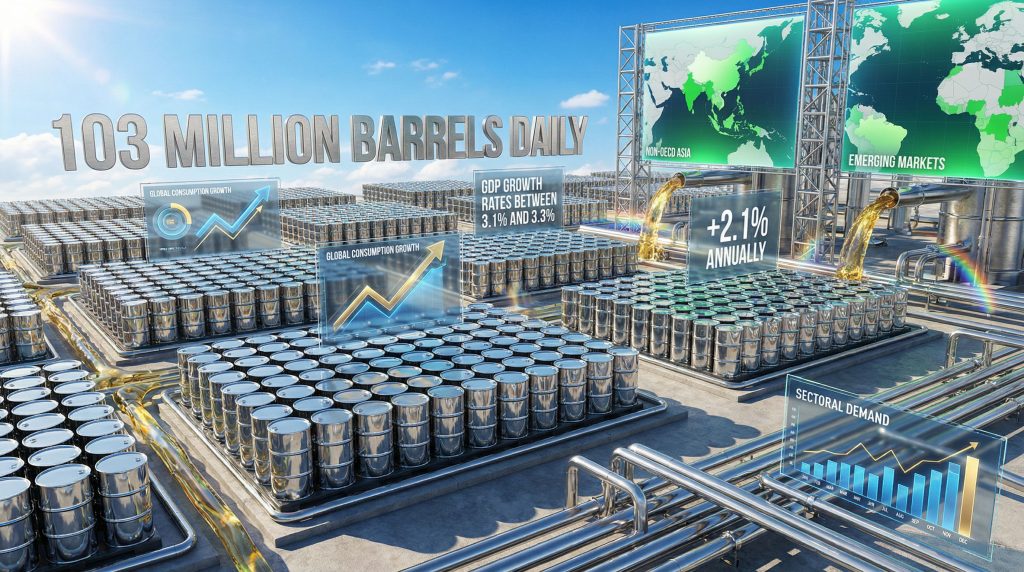
Current forecasting models incorporate GDP growth assumptions ranging between 3.1% and 3.3% annually through 2030, though regional variations create substantial complexity in aggregate demand calculations. Furthermore, emerging market economies demonstrate higher petroleum intensity during rapid development phases, typically consuming 2-4 additional barrels annually per capita during middle-income transition periods.
Economic Transmission Mechanisms
Industrial Production Linkages:
- Manufacturing sector expansion driving petrochemical feedstock demand
- Heavy industry development requiring energy-intensive processes
- Infrastructure construction consuming petroleum-based materials
- Export-oriented manufacturing supporting logistics demand growth
The correlation between industrial production indices and petroleum consumption varies substantially across regions. For instance, Non-OECD Asia demonstrates the strongest linkage, with 1% industrial production growth typically supporting 0.7-1.2% petroleum demand increases, depending on sectoral composition and efficiency implementation rates.
Consumer Spending and Mobility Patterns:
Transportation sector demand responds directly to disposable income growth, though the relationship exhibits non-linear characteristics. Initial motorisation phases in emerging markets generate exponential demand growth, while mature markets show declining petroleum intensity despite continued economic expansion.
| Economic Development Stage | GDP-Oil Elasticity | Primary Drivers | Peak Consumption Timing |
|---|---|---|---|
| Low-Income Transition | 2.1 – 2.8 | Infrastructure, Motorisation | 15-25 years post-transition |
| Middle-Income Growth | 1.4 – 2.1 | Industrial Development | 10-15 years post-transition |
| High-Income Maturation | 0.3 – 0.8 | Service Economy Expansion | Already peaked |
| Post-Industrial | -0.1 – 0.2 | Efficiency Gains | Declining consumption |
Regional Economic Divergence Analysis
Economic performance variations across major consuming regions create distinct demand trajectories that collectively determine global oil demand growth patterns. Asia-Pacific economies, representing approximately 45% of incremental demand growth, demonstrate sustained expansion despite periodic cyclical adjustments.
Emerging Market Economic Multipliers:
- Urban middle-class expansion: 1.7 billion consumers entering mobility markets by 2030
- Industrial workforce growth: 350 million manufacturing jobs supporting logistics demand
- Infrastructure investment cycles: $12 trillion in transportation development through 2035
- Consumer credit expansion: Vehicle financing accessibility driving motorisation acceleration
Latin American and African economies exhibit similar development patterns, though infrastructure constraints and financing limitations create more volatile demand trajectories. However, political stability and currency fluctuation factors significantly influence petroleum consumption growth sustainability in these regions.
How Do Supply-Demand Imbalances Affect Market Dynamics?
The persistent supply surplus characterising petroleum markets through the mid-2020s creates stabilisation mechanisms that influence both short-term price discovery and long-term investment allocation patterns. Current oversupply conditions of 3.69 million barrels per day represent approximately 3.6% of global consumption, providing substantial buffers against supply disruptions whilst constraining price volatility.
Supply-side resilience stems from multiple sources operating simultaneously across different geographical regions and production cost structures. United States shale production maintains output flexibility, whilst OPEC+ market influence retains spare capacity exceeding 4 million barrels per day, and non-conventional resources continue expanding despite moderate price environments.
Market Equilibrium Scenario Analysis
Three Primary Market Pathways Through 2030:
-
Gradual Tightening Scenario (2027-2030):
- Demand growth accelerates to 1.4-1.8 million bpd annually
- Supply discipline from major producers
- Surplus elimination by 2028-2029
- Price appreciation supporting marginal production
-
Extended Surplus Scenario (2025-2028):
- Oversupply conditions persist at 2-4 million bpd levels
- Demand growth remains moderate at 0.8-1.2 million bpd
- Continued supply expansion from low-cost producers
- Price stability with limited volatility
-
Volatility Cycles Scenario (2025-2030):
- Alternating surplus/deficit periods driven by geopolitical factors
- Quarterly demand revisions creating market uncertainty
- Production flexibility requirements for market participants
- Enhanced strategic reserve utilisation
Supply-Side Structural Factors
Production Capacity Analysis:
United States shale resources demonstrate remarkable production flexibility, capable of 500,000-800,000 bpd output adjustments within 12-18 month periods based on price signals. This responsiveness creates natural market equilibrium mechanisms that moderate extreme price movements in both directions.
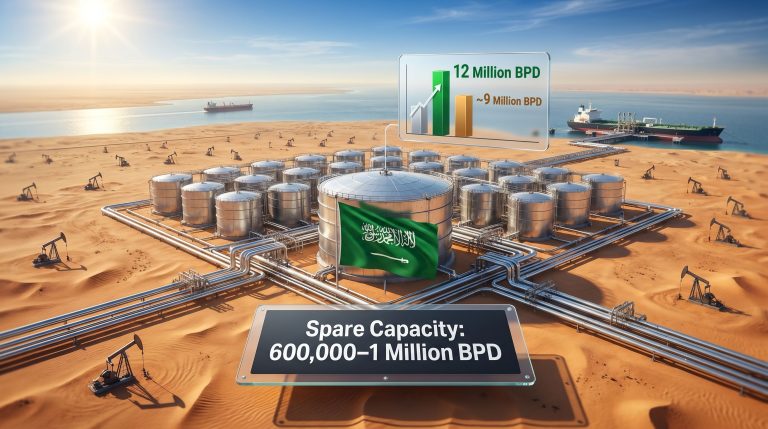
OPEC+ coordination mechanisms maintain approximately 4.2 million barrels per day of readily available spare capacity, concentrated primarily in Saudi Arabia, UAE, and Kuwait. This capacity buffer provides market stability assurance whilst enabling production optimisation based on global demand patterns.
Non-Conventional Resource Development:
- Canadian oil sands expansion adding 200,000-300,000 bpd annually
- Guyana offshore production reaching 1.2 million bpd by 2030
- Brazilian pre-salt development contributing 800,000 bpd growth
- Enhanced recovery technologies improving existing field productivity
Market participants increasingly recognise that supply surplus conditions create investment challenges for higher-cost production sources whilst providing consumption growth opportunities for price-sensitive emerging markets. In addition, this dynamic supports sustained demand expansion in developing economies whilst constraining supply growth from marginal resources.
What Role Do Emerging Economies Play in Demand Growth?
Emerging market economies represent the dominant force driving global oil demand growth through 2030, accounting for approximately 75-80% of incremental consumption increases based on current demographic and economic development trajectories. These regions experience petroleum demand expansion through multiple simultaneous channels that operate across different timeframes and consumption categories.
Demographic transformations in developing economies create sustained energy consumption growth that extends beyond traditional economic cycle patterns. Urban population growth of 2.1 billion people by 2030 generates transportation infrastructure requirements, residential energy needs, and commercial mobility services demand that collectively support petroleum consumption expansion.
Urbanisation and Infrastructure Development Catalysts
Transportation Infrastructure Investment Priorities:
- Highway network expansion: 450,000 kilometres of new road construction planned through 2030
- Aviation capacity development: 280 new airports and terminal expansions across emerging markets
- Maritime transport growth: Port capacity increases of 40% to support trade expansion
- Urban logistics systems: Last-mile delivery infrastructure supporting e-commerce growth
The correlation between infrastructure investment and petroleum demand operates through both direct construction-phase consumption and long-term utilisation patterns. Consequently, road network expansion typically generates 15-25 years of sustained demand growth as vehicle ownership rates adjust to infrastructure availability.
Middle-Class Expansion and Motorisation Patterns:
Income growth in emerging markets creates non-linear petroleum demand responses during critical development phases. Households crossing $8,000-12,000 annual income thresholds typically exhibit exponential transportation fuel consumption increases as vehicle ownership becomes economically accessible.
| Income Threshold (USD) | Vehicle Ownership Rate | Annual Fuel Consumption | Demand Elasticity |
|---|---|---|---|
| $5,000 – $8,000 | 15-35 vehicles/1000 people | 0.3-0.7 barrels/capita | 2.8-3.2 |
| $8,000 – $12,000 | 35-120 vehicles/1000 people | 0.7-1.4 barrels/capita | 3.2-2.1 |
| $12,000 – $18,000 | 120-280 vehicles/1000 people | 1.4-2.1 barrels/capita | 2.1-1.4 |
| $18,000+ | 280-450 vehicles/1000 people | 2.1-2.8 barrels/capita | 1.4-0.8 |
Regional Demand Growth Leadership
Asia-Pacific Dominance in Global Consumption Growth:
Non-OECD Asia, particularly India, Indonesia, Vietnam, and Bangladesh, demonstrates the strongest petroleum demand growth potential through 2030. These economies combine rapid GDP expansion, demographic dividends, and infrastructure development phases that collectively support sustained consumption increases.
India represents the largest single contributor to global oil demand growth, with projected consumption increases of 1.2-1.6 million barrels per day between 2025-2030. This expansion reflects multiple simultaneous development trends: industrial production growth, transportation network expansion, petrochemical sector development, and residential energy access improvements.
Africa and Middle East Development Patterns:
- Nigeria, Egypt, and South Africa leading continental demand growth
- Population growth rates of 2.5-3.2% annually supporting long-term expansion
- Infrastructure investment programmes totalling $180 billion through 2030
- Economic diversification initiatives reducing petroleum export dependency whilst increasing domestic consumption
Sub-Saharan Africa exhibits particularly strong demand growth potential due to low baseline consumption levels and rapid urbanisation rates. Countries with current per-capita consumption below 0.5 barrels annually demonstrate exponential growth characteristics during economic development acceleration phases.
Critical Development Insight: Emerging market petroleum demand growth represents a demographic and economic transition phenomenon that typically spans 20-30 years, creating sustained consumption expansion that proves relatively resilient to short-term economic fluctuations or price volatility.
How Will Energy Transition Policies Impact Oil Demand?
Energy transition policy frameworks increasingly influence petroleum consumption trajectories through regulatory mechanisms, incentive structures, and technology adoption mandates that operate across multiple timeframes. These policy interventions create both direct demand substitution effects and indirect efficiency improvements that collectively modify traditional consumption growth patterns.
Electric vehicle adoption represents the most visible policy-driven demand impact, with government mandates and incentive programmes accelerating market penetration beyond purely economic adoption rates. Current projections suggest 15% global EV market share by 2030, potentially reducing petroleum demand by 2.5 million barrels per day relative to baseline scenarios without policy intervention.
Policy Mechanism Analysis and Implementation Effects
Regulatory Framework Categories:
-
Vehicle Efficiency Standards:
- Corporate Average Fuel Economy (CAFE) requirements driving 3-5% annual efficiency gains
- Heavy-duty vehicle emission standards affecting commercial transportation
- Fuel quality specifications promoting higher-efficiency fuel formulations
- Import restrictions on low-efficiency vehicles in key emerging markets
-
Alternative Fuel Mandates:
- Renewable fuel standard requirements in major consuming regions
- Biofuel blending mandates reaching 8-15% by 2030 in key markets
- Synthetic fuel development incentives supporting non-petroleum alternatives
- Hydrogen infrastructure investment programmes affecting transportation fuel markets
-
Carbon Pricing and Taxation:
- Carbon tax implementations affecting petroleum product pricing
- Emissions trading systems creating fuel switching incentives
- Border adjustment mechanisms influencing trade-intensive petroleum products
- Subsidy removal programmes eliminating fossil fuel consumption incentives
Technology Disruption Timeline and Market Penetration
Electric Vehicle Adoption Acceleration:
Government purchase incentives, charging infrastructure investments, and internal combustion engine phase-out announcements create adoption curves that exceed pure market-driven penetration rates. European Union mandates targeting 55% EV sales by 2030, China's 40% target, and California's 100% zero-emission mandate by 2035 collectively influence global automotive production patterns.
| Technology Sector | Current Penetration | 2030 Projection | Oil Demand Impact | Policy Drivers |
|---|---|---|---|---|
| Light-Duty EVs | 8% global sales | 25-35% global sales | -3.2 million bpd | Purchase incentives, ICE bans |
| Heavy-Duty Electric | 2% in key markets | 15-20% in key markets | -1.1 million bpd | Emission zones, fleet mandates |
| Aviation Biofuels | 0.1% blend rate | 8-12% blend rate | -0.7 million bpd | Sustainable aviation fuel mandates |
| Industrial Efficiency | 15% improvement | 35% improvement | -1.4 million bpd | Energy management standards |
Renewable Power Generation Impact:
Renewable energy expansion to 35-40% of global electricity generation by 2030 primarily affects petroleum consumption through reduced industrial fuel oil usage and electricity sector oil demand elimination. However, direct transportation fuel impacts remain limited until electric vehicle adoption reaches critical mass levels.
Policy Implementation Risks and Market Response Mechanisms
Technology Adoption Barriers and Constraints:
- Infrastructure development timelines potentially delaying EV adoption in emerging markets
- Resource availability limitations for battery production affecting scaling capabilities
- Grid capacity constraints limiting renewable energy integration rates
- Economic competitiveness gaps requiring sustained policy support mechanisms
Policy effectiveness varies significantly across different economic development stages and regulatory implementation capabilities. Advanced economies demonstrate higher policy compliance rates and faster technology adoption, whilst emerging markets face financing and infrastructure constraints that moderate transition speeds despite ambitious regulatory targets.
Nevertheless, the EV adoption impacts on traditional petroleum markets continue accelerating, particularly in developed economies where supportive infrastructure and purchasing power facilitate faster technology transitions.
Market Adaptation Strategies:
Petroleum industry participants increasingly develop policy-responsive investment strategies that account for regulatory risk factors whilst maintaining operational flexibility. This includes enhanced recovery technology deployment, petrochemical sector expansion, and geographic diversification toward regions with slower transition timelines.
What Sectoral Demand Patterns Emerge Across Industries?
Transportation sector petroleum consumption maintains dominance across global markets whilst experiencing significant internal restructuring that affects both aggregate demand levels and product specification requirements. Light-duty vehicle fuel consumption faces the greatest policy and technology pressures, while heavy-duty trucking, aviation, and maritime sectors demonstrate continued growth trajectories through 2030.
Road transport accounts for approximately 50% of global petroleum consumption, though this share varies considerably across different economic development stages. Emerging markets exhibit higher transportation fuel intensity due to limited public transit infrastructure, whilst developed economies show declining per-capita consumption despite continued economic growth.
Transportation Subsector Analysis and Growth Trajectories
Heavy-Duty Commercial Transportation:
Trucking and commercial vehicle sectors represent the fastest-growing transportation fuel demand segment, driven by e-commerce expansion, global trade growth, and logistics network development in emerging markets. Heavy-duty vehicles demonstrate limited electrification potential due to range, payload, and infrastructure constraints, supporting sustained petroleum demand through 2030 and beyond.
Commercial Transportation Demand Drivers:
- E-commerce logistics growth: 15-20% annual expansion in last-mile delivery services
- Cross-border trade volumes: International freight movement increasing 4-6% annually
- Cold chain development: Temperature-controlled transportation expanding in emerging markets
- Construction and mining activities: Industrial vehicle usage supporting infrastructure development
Aviation Sector Recovery and Expansion:
International aviation petroleum consumption demonstrates robust recovery patterns following pandemic-related disruptions, with 4.5% annual growth projected through 2030. Emerging market aviation expansion, tourism industry development, and cargo transportation growth collectively support sustained jet fuel demand increases.
Aviation biofuel adoption remains limited despite regulatory mandates, with current blending rates below 1% globally. Infrastructure constraints, cost differentials, and supply availability limitations restrict faster alternative fuel penetration, maintaining petroleum-based jet fuel dominance through the forecast period.
Industrial and Petrochemical Sector Expansion
Non-Combustion Petroleum Uses:
Petrochemical feedstock demand represents the fastest-growing petroleum consumption category, with projected increases of 3.7 million barrels per day globally through 2030. This growth stems from plastic production expansion, synthetic material development, and pharmaceutical industry requirements that demonstrate limited substitution potential.
Industrial Demand Growth Categories:
-
Plastic and Polymer Production:
- Asian capacity expansions: 280 million tons of new petrochemical capacity planned through 2030
- Packaging industry growth: Single-use plastic demand increasing despite environmental policies
- Automotive applications: Lightweight materials adoption supporting fuel efficiency improvements
- Construction materials: Synthetic insulation and component demand in emerging markets
-
Specialty Chemical Manufacturing:
- Pharmaceutical intermediates: Active ingredient production requiring petroleum-based feedstocks
- Agricultural chemicals: Fertiliser and pesticide production supporting food security initiatives
- Industrial chemicals: Solvent and processing chemical demand linked to manufacturing growth
- Consumer products: Personal care and household product formulations
| Industrial Sector | Current Consumption | 2030 Projection | Growth Rate | Geographic Concentration |
|---|---|---|---|---|
| Petrochemicals | 14.2 million bpd | 17.9 million bpd | 3.8% annually | Asia-Pacific (65%) |
| Specialty Chemicals | 3.1 million bpd | 4.2 million bpd | 4.1% annually | North America, Europe |
| Industrial Heating | 2.8 million bpd | 2.4 million bpd | -2.1% annually | Global (efficiency gains) |
| Lubricants | 1.9 million bpd | 2.1 million bpd | 1.4% annually | Emerging markets focus |
Manufacturing Sector Integration:
Industrial petroleum consumption increasingly integrates with broader manufacturing development patterns, particularly in emerging markets where industrial capacity expansion creates sustained demand growth. Steel production, cement manufacturing, and chemical processing industries collectively support petroleum consumption through both direct fuel usage and feedstock requirements.
Power Generation and Utility Sector Transitions
Electricity Generation Oil Demand:
Utility sector petroleum consumption continues declining in most regions due to renewable energy expansion and natural gas substitution. However, certain emerging markets and island economies maintain oil-fired power generation due to infrastructure limitations and fuel availability constraints.
Peak-Load and Backup Generation:
- Grid stability requirements: Petroleum-based peaking plants providing electricity system flexibility
- Remote area power: Off-grid communities relying on diesel generation systems
- Emergency backup systems: Critical infrastructure maintaining petroleum-powered backup generation
- Industrial captive power: Manufacturing facilities using petroleum for process heating and electricity generation
The utility sector petroleum demand trajectory varies significantly by region, with Middle Eastern and African markets showing continued consumption growth whilst developed economies demonstrate accelerating declines due to renewable energy displacement.
The next major ASX story will hit our subscribers first
How Do Geopolitical Factors Influence Demand Projections?
Geopolitical stability and policy coordination across major consuming regions significantly influence petroleum demand patterns through multiple channels that extend beyond traditional supply disruption risks. Political factors affect both consumption capacity and consumption preferences, creating complex feedback mechanisms that influence long-term market equilibrium calculations.
Regional political stability directly correlates with economic development sustainability and infrastructure investment capabilities. Countries experiencing political uncertainty typically demonstrate volatile petroleum consumption patterns as economic activity fluctuates with governance effectiveness and policy continuity.
Political Risk Factors Affecting Consumption Patterns
Trade Policy and Economic Integration:
International trade agreements and tariff structures influence petroleum consumption through industrial production patterns and transportation logistics requirements. Trade policy changes affect manufacturing location decisions, shipping route optimisation, and energy-intensive industry development patterns that collectively modify regional demand trajectories.
The US‑China trade war impact demonstrates how bilateral trade tensions can reshape global supply chains and subsequently influence oil price movements through altered industrial production patterns and transportation demand.
Recent Trade Impact Examples:
- Regional trade agreements: RCEP implementation affecting Asian petroleum demand patterns
- Tariff modifications: Industrial production shifts influencing regional consumption distributions
- Supply chain relocations: Manufacturing nearshoring creating new transportation fuel demand patterns
- Export restriction policies: Petroleum product trade limitations affecting regional availability and pricing
Sanctions Regimes and Market Segmentation:
International sanctions create petroleum market segmentation effects that influence both supply availability and demand patterns across different geographical regions. Sanctioned economies often experience modified consumption patterns due to limited product availability and altered economic structure operations.
Currency Fluctuation and Purchasing Power Effects:
Exchange rate volatility affects petroleum consumption capacity, particularly in import-dependent emerging markets where currency depreciation creates affordability constraints. Oil-importing economies with volatile currencies typically demonstrate higher demand elasticity to international price fluctuations.
| Currency Risk Category | Demand Impact | Adjustment Timeframe | Policy Response Options |
|---|---|---|---|
| Commodity Currency Exporters | +0.15 correlation with oil prices | 6-12 months | Export revenue stabilisation |
| Import-Dependent Economies | -0.25 correlation with oil prices | 3-9 months | Strategic reserve utilisation |
| Diversified Economies | -0.05 correlation with oil prices | 12-18 months | Market-based adjustments |
| Fixed Exchange Rate Systems | Variable based on peg sustainability | 1-6 months | Monetary policy coordination |
Strategic Reserve Policies and Market Intervention
Government Stockpiling Programmes:
Strategic petroleum reserve policies create artificial demand fluctuations that distort short-term consumption statistics whilst providing market stability mechanisms during supply disruptions. Major consuming countries maintain reserve systems totalling approximately 1.5 billion barrels globally, representing significant market intervention capability.
Reserve Policy Impact Mechanisms:
- Acquisition programmes: Government purchases creating temporary demand increases
- Release authorisations: Strategic reserve sales moderating price volatility during disruptions
- International coordination: Multilateral reserve management affecting global market balance
- Private sector mandates: Required commercial inventory levels influencing demand timing
China's strategic petroleum reserve expansion represents the largest single source of artificial demand growth, with acquisition programmes potentially adding 200,000-400,000 barrels per day to consumption statistics during active accumulation phases. This government-directed demand creates market dynamics that extend beyond pure economic fundamentals.
Regional Security Considerations:
Energy security policies increasingly influence consumption patterns as governments prioritise supply diversification and domestic energy capacity development. These policies affect both petroleum import patterns and domestic consumption efficiency initiatives that collectively modify demand trajectory calculations.
Geopolitical Risk Scenario Planning
Conflict and Instability Impact Assessment:
Regional conflicts and political instability create both immediate consumption disruptions and long-term demand pattern modifications. Economic sanctions, military actions, and governance breakdowns affect petroleum consumption through reduced economic activity and infrastructure damage that requires extended recovery periods.
Risk Scenario Categories:
-
Supply Route Disruptions:
- Maritime chokepoint closures affecting petroleum product availability
- Pipeline infrastructure attacks creating regional supply constraints
- Port facility disruptions influencing product import capabilities
- Refinery targeting reducing regional processing capacity
-
Economic Warfare and Financial Restrictions:
- Banking system limitations constraining petroleum trade financing
- Technology export controls affecting energy infrastructure development
- Investment restrictions limiting petroleum sector capacity expansion
- Currency manipulation allegations creating trade relationship tensions
Political risk analysis increasingly incorporates climate policy coordination challenges, as international disagreement on energy transition timelines creates regulatory uncertainty that influences both consumption patterns and investment allocation decisions across the petroleum value chain.
What Investment Implications Emerge from Demand Growth Patterns?
Investment allocation strategies across the petroleum value chain require sophisticated analysis of demand growth sustainability, regional consumption patterns, and technology disruption timelines that collectively determine asset productivity and return potential. Global oil demand growth patterns create both traditional upstream opportunities and emerging downstream investment requirements that operate on different risk-return profiles.
Capital deployment decisions must account for peak demand timing uncertainty, with consumption patterns potentially plateauing between 2030-2035 as structural economic changes accelerate across major consuming regions. This timeline compression creates investment horizon challenges for long-duration assets whilst supporting shorter-payback investments in strategic locations.
Capital Allocation Strategy Framework
Upstream Investment Prioritisation:
Exploration and production investments increasingly focus on low-cost, high-return resources capable of generating positive returns throughout demand growth deceleration phases. Short-cycle investments receive priority over long-development projects due to demand trajectory uncertainty and policy-driven market disruption potential.
Investment Priority Matrix:
| Asset Category | Investment Priority | Payback Period | Risk Profile | Geographic Focus |
|---|---|---|---|---|
| Shale Resources | High | 2-4 years | Medium | North America |
| Offshore Deepwater | Medium | 6-10 years | High | Brazil, Guyana, West Africa |
| Conventional Onshore | Medium | 3-6 years | Low | Middle East, Russia |
| Enhanced Recovery | High | 1-3 years | Low | Global existing fields |
Midstream Infrastructure Development:
Pipeline, storage, and transportation infrastructure investments demonstrate attractive returns in demand-growth regions, particularly emerging markets with expanding consumption patterns. Infrastructure assets provide stable returns throughout demand cycle fluctuations whilst supporting regional economic development initiatives.
Strategic Infrastructure Investment Areas:
- Asian pipeline networks: Connecting production sources to growing consumption centres
- African storage facilities: Supporting petroleum product availability in developing markets
- Latin American transportation systems: Enhancing fuel distribution efficiency across remote regions
- Middle Eastern processing capabilities: Developing value-added petroleum product manufacturing
Downstream Investment Opportunities and Risk Assessment
Refining Capacity Optimisation:
Refinery investments focus on operational efficiency improvements and product specification upgrades rather than capacity expansions in mature markets. Emerging market refinery development supports regional demand growth whilst reducing import dependency and transportation costs.
Refining Investment Strategies:
-
Efficiency Enhancement Projects:
- Process optimisation technologies improving throughput and reducing operational costs
- Environmental compliance upgrades meeting increasingly stringent emission standards
- Product quality improvements addressing evolving fuel specification requirements
- Digital optimisation systems enhancing operational reliability and maintenance efficiency
-
Strategic Capacity Additions:
- Emerging market greenfield projects supporting regional demand growth
- Specialty product capabilities addressing petrochemical feedstock requirements
- Logistics integration investments connecting refining capacity to distribution networks
- Flexibility enhancements enabling varied crude oil input processing capabilities
Petrochemical Sector Expansion:
Chemical industry investments represent the most attractive downstream opportunity, with petrochemical demand growth exceeding transportation fuel expansion rates across all major regions. Integrated refining-petrochemical complexes provide operational synergies whilst capturing value from both energy and chemical markets.
Technology Investment and Innovation Strategies
Digital Transformation and Operational Excellence:
Technology investments focusing on operational efficiency, predictive maintenance, and supply chain optimisation generate substantial returns whilst reducing environmental impact. Artificial intelligence, automation systems, and data analytics create competitive advantages throughout the petroleum value chain.
Innovation Investment Categories:
- Carbon capture and utilisation technologies reducing environmental impact whilst generating revenue
- Enhanced recovery techniques extending existing field productivity and reserve life
- Process efficiency improvements reducing operational costs and energy consumption
- Alternative feedstock development diversifying input sources and reducing supply chain risks
Risk Management and Portfolio Diversification:
Investment strategies increasingly incorporate energy transition risks through portfolio diversification approaches that balance traditional petroleum assets with renewable energy investments and alternative fuel development projects. This diversification provides protection against demand growth deceleration whilst maintaining exposure to continued petroleum consumption growth.
Investment Strategy Insight: Successful petroleum sector investing through 2030 requires balancing short-cycle, high-return opportunities with strategic positions in demand-growth regions, whilst maintaining portfolio flexibility to adapt to accelerating energy transition timelines.
Market Psychology and Investor Sentiment Factors
ESG Investment Considerations:
Environmental, social, and governance factors increasingly influence capital allocation decisions, with institutional investors applying screening criteria that affect petroleum sector investment availability. ESG-focused investment mandates create capital constraints for certain petroleum projects whilst supporting sustainable development initiatives.
Investment Flow Impact Analysis:
- Divestment movements reducing capital availability for traditional petroleum investments
- Sustainable finance frameworks directing capital toward lower-carbon petroleum projects
- Transition investment strategies supporting companies with credible energy transition plans
- Impact investing approaches focusing on petroleum projects with positive social outcomes
Investor sentiment regarding peak demand timing significantly influences asset valuation approaches and investment horizon preferences. Market participants increasingly focus on cash flow generation capability rather than long-term reserve value, reflecting uncertainty regarding petroleum demand sustainability beyond 2035.
Valuation Methodology Evolution:
Traditional petroleum asset valuation models require modification to account for demand growth deceleration risks and policy-driven market disruption potential. Discounted cash flow analysis incorporates higher discount rates and shortened evaluation periods to reflect increased uncertainty regarding long-term consumption patterns.
Strategic Outlook: Navigating the Demand Growth Transition
The trajectory of global oil demand growth through 2030 represents a complex transition phenomenon characterised by regional divergence, sectoral restructuring, and policy-driven market evolution that collectively reshape traditional petroleum market dynamics. Understanding this transformation requires simultaneous analysis of demographic shifts, technological disruption cycles, and geopolitical realignment patterns that operate across multiple timeframes.
Peak petroleum consumption timing remains subject to significant uncertainty, with baseline scenarios suggesting plateau conditions emerging between 2032-2037 depending on economic growth sustainability, technology adoption acceleration, and policy implementation effectiveness across major consuming regions. This compressed timeline creates strategic planning challenges for market participants whilst highlighting the importance of adaptive investment approaches.
Structural Market Evolution and Adaptation Requirements
Demand Pattern Transformation:
Traditional consumption growth models require fundamental revision to account for non-linear adoption curves, policy intervention effects, and demographic transition impacts that create unprecedented market dynamics. Emerging market development patterns increasingly differ from historical precedents due to leapfrog technology adoption and accelerated urbanisation processes.
According to IEA's latest oil market outlook, these structural shifts necessitate more sophisticated forecasting methodologies that account for multiple simultaneous transformation processes.
Market Adaptation Strategies:
- Regional specialisation: Focusing operations and investments in sustained demand growth areas
- Product portfolio optimisation: Emphasising petrochemical feedstocks and specialty products over transportation fuels
- Operational flexibility enhancement: Developing capabilities to respond rapidly to demand pattern changes
- Strategic partnerships: Collaborating across value chain segments to optimise resource allocation efficiency
Policy Integration and Regulatory Coordination:
Energy transition policies create both constraints and opportunities that require sophisticated management approaches. Successful market participants increasingly develop policy-responsive strategies that align with regulatory trends whilst maintaining competitive positioning throughout transition periods.
Long-Term Market Structure Implications
Geographic Demand Concentration:
Petroleum consumption increasingly concentrates in specific regions with sustained development trajectories, creating market structure changes that affect everything from infrastructure requirements to geopolitical relationships. Asia-Pacific, Africa, and Middle Eastern economies collectively represent 85% of demand growth through 2030, necessitating strategic reorientation toward these markets.
Sectoral Demand Evolution:
Transportation sector petroleum consumption faces increasing pressure from electrification and efficiency policies, whilst industrial and petrochemical applications demonstrate sustained growth potential. This sectoral rebalancing creates different market dynamics, price relationships, and investment requirements that reshape traditional petroleum market structure.
Technology Integration and Market Disruption:
Digital technologies, automation systems, and alternative fuel development create both operational opportunities and competitive threats that require continuous adaptation. Market participants must balance technology investment with traditional operational excellence whilst preparing for accelerating disruption cycles.
Furthermore, global oil demand statistics indicate that structural consumption patterns continue evolving at unprecedented rates, requiring constant strategic reassessment.
Risk Management and Strategic Planning Framework
Scenario Planning and Strategic Flexibility:
Effective strategy development requires robust scenario analysis that accounts for multiple potential demand growth trajectories, policy implementation timelines, and technology adoption rates. Strategic planning frameworks must maintain flexibility to adapt to rapidly changing market conditions whilst pursuing consistent long-term objectives.
Key Risk Factors and Mitigation Strategies:
-
Demand Peak Timing Uncertainty:
- Diversified geographic exposure across different development stages
- Flexible asset portfolios capable of adaptation to various scenarios
- Strategic partnerships providing market intelligence and risk sharing
-
Policy and Regulatory Evolution:
- Active engagement in policy development processes
- Technology investments supporting regulatory compliance
- Geographic diversification across different regulatory environments
-
Technology Disruption Acceleration:
- Research and development partnerships with technology companies
- Pilot project investments in emerging technologies
- Flexible operational systems capable of rapid technology integration
The convergence of these factors creates both significant challenges and substantial opportunities for market participants who successfully navigate the transition period whilst maintaining focus on emerging demand growth centres and evolving consumption patterns that define the future petroleum market landscape.
Ready to Invest in the Next Major Mineral Discovery?
Discovery Alert instantly alerts investors to significant ASX mineral discoveries using its proprietary Discovery IQ model, turning complex mineral data into actionable insights. Understand why historic discoveries can generate substantial returns by exploring Discovery Alert's dedicated discoveries page, showcasing exceptional outcomes from major finds like De Grey Mining and WA1 Resources.