June 18, 2026
Understanding Global Oil Market Supply-Demand Dynamics
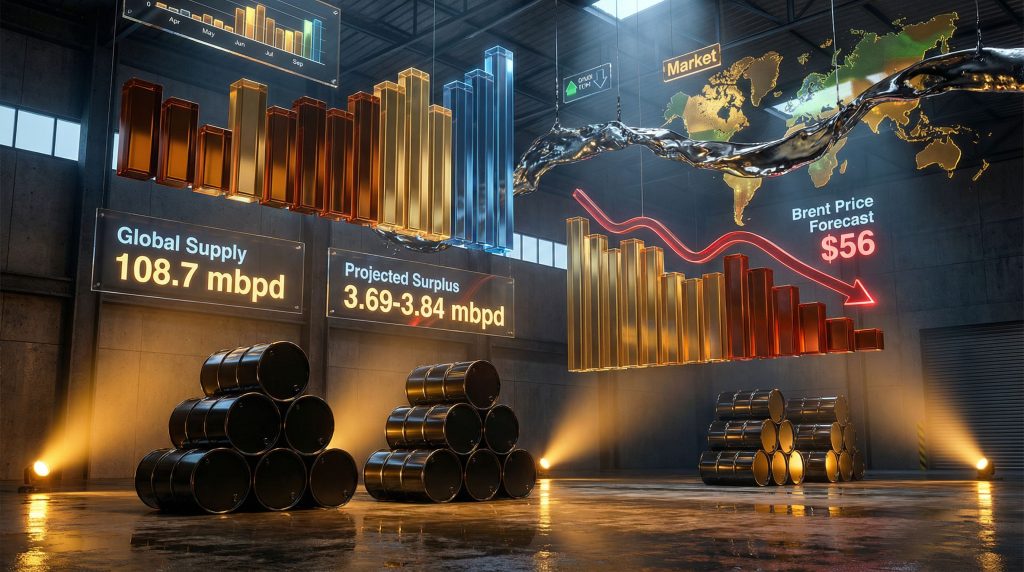
The petroleum industry's fundamental equilibrium remains under intense scrutiny as analytical frameworks diverge significantly regarding future market conditions. Current global production capacity utilisation hovers near historical averages while demand trajectories from emerging economies continue displaying robust momentum. Understanding these competing dynamics requires examination of operational constraints, inventory positioning, and spare capacity metrics rather than relying solely on theoretical production models.
International forecasting methodologies often emphasise production capability expansion without fully accounting for infrastructure limitations and geopolitical access restrictions. This analytical disconnect creates substantial variance in oil glut predictions, with some models projecting surplus conditions while industry operators observe tight market fundamentals.
Current Market Positioning Overview:
| Market Indicator | Current Status | Industry Threshold | Gap Analysis |
|---|---|---|---|
| Spare Capacity | 2.5% of global demand | 3.0% minimum required | 0.5% deficit |
| Commercial Inventories | Below 5-year average | Normal seasonal levels | Supply tightness |
| Offshore Storage | Sanctioned barrels predominant | Market-accessible crude | Limited availability |
| Production Growth Rate | 2.5 mbpd projected | Demand growth 1.2 mbpd | Potential oversupply |
When big ASX news breaks, our subscribers know first
Methodological Disparities in Market Assessment
Energy market analysis reveals fundamental disagreements between theoretical capacity models and operational reality assessments. Major international agencies typically calculate supply potential based on maximum sustainable production rates, while industry participants emphasise constraints that limit actual market delivery.
Production Constraint Categories:
• Infrastructure bottlenecks: Pipeline capacity, port facilities, and refinery processing limits
• Seasonal maintenance: Planned downtime reducing effective capacity utilisation
• Logistics coordination: Transportation scheduling and crude slate compatibility
• Regulatory compliance: Environmental restrictions and safety protocols
Geopolitical Supply Access Issues:
Current floating storage accumulations include significant volumes of crude that cannot access traditional markets due to sanctions regimes. These barrels exist physically but remain economically unavailable, creating artificial scarcity despite theoretical supply abundance. The distinction between production capability and market-accessible supply represents a critical factor in assessment methodology differences.
Regional Production Dynamics:
North American shale formations demonstrate rapid production response capabilities but face infrastructure constraints during peak output periods. However, concerns about US oil production decline continue to influence market sentiment. Brazilian offshore developments require extensive logistics coordination, limiting short-term flexibility despite substantial reserves. Norwegian platforms operate under seasonal restrictions that affect year-round production consistency.
Spare Capacity Limitations and Market Stability
Global petroleum markets require minimum spare production capacity of approximately 3% of total demand to maintain price stability during supply disruptions. Current measurements indicate spare capacity at 2.5% of global consumption, creating insufficient buffer for managing geopolitical events or operational accidents.
Critical Capacity Distribution:
• Middle East producers: Approximately 2.5-3.5 million barrels daily combined spare capacity
• OPEC+ coordination: Controls roughly 40% of global production through quota systems
• Non-OPEC swing capacity: Limited short-term response capability from major producers
• Emergency reserves: Strategic petroleum reserves provide temporary supply during crises
This capacity shortfall creates vulnerability to price volatility should OPEC+ producers increase output to address projected demand growth. Furthermore, recent analysis of OPEC production impact demonstrates how the Organisation of Petroleum Exporting Countries and allies maintain production adjustment mechanisms but face constraints when deploying spare capacity approaches minimum thresholds.
Technical Spare Capacity Measurement:
Industry standard methodology defines spare capacity as production volume that can be activated within 30 days and sustained for 90 days without depleting strategic reserves. This technical requirement involves detailed assessment of production infrastructure, maintenance schedules, and geological constraints for each producing region.
"The petroleum industry requires careful monitoring of spare capacity metrics as production increases could further reduce already limited flexibility for managing market disruptions."
Economic Implications of Surplus Scenarios
Extended periods of petroleum oversupply generate cascading economic effects across both consuming and producing economies. Consumer nations typically benefit from reduced energy costs, while oil-dependent exporters face fiscal pressures requiring budget adjustments or increased non-hydrocarbon revenues.
Consumer Economy Benefits:
• Transportation cost reductions: Lower fuel expenses for commercial and personal mobility
• Industrial input savings: Reduced petrochemical feedstock and energy costs
• Household spending increases: Additional discretionary income from lower heating and petrol prices
• Inflationary pressure relief: Energy cost declines supporting central bank monetary policy flexibility
Producer Economy Fiscal Impact:
Oil-exporting nations structure government budgets around specific petroleum price assumptions, with revenue shortfalls requiring either spending reductions or economic diversification acceleration. Saudi Arabia's fiscal planning typically assumes crude prices above $60 per barrel, while Russia's federal budget incorporates similar breakeven calculations.
Investment Cycle Responses:
Prolonged low-price environments historically trigger upstream capital expenditure reductions as project economics deteriorate. Consequently, development projects requiring $70-80 per barrel economics become unviable at $50-55 price levels, causing deferrals and industry consolidation through merger activity. Big Oil is preparing for leaner prices and harder choices as companies adapt their strategies accordingly.
Revenue Impact Analysis by Major Exporters:
| Producer Nation | Estimated Breakeven Price | Revenue Impact per $10 Decline |
|---|---|---|
| Saudi Arabia | $60-65 per barrel | $35-40 billion annually |
| Russia | $60-65 per barrel | $25-30 billion annually |
| Venezuela | $80+ per barrel | Economic instability threshold |
| Iraq | $50-55 per barrel | Fiscal constraint activation |
Long-Term Demand Trajectory Uncertainties
Global petroleum consumption projections face significant uncertainty from energy transition timelines, economic growth patterns, and technological adoption rates. Emerging market economies continue driving demand growth despite developed nation consumption plateaus and electric vehicle deployment acceleration.
Emerging Market Growth Drivers:
• Industrial expansion: Manufacturing sector development requiring energy-intensive processes
• Transportation infrastructure: Road networks and vehicle fleet expansion in developing regions
• Urbanisation trends: Population concentration creating increased mobility and energy demands
• Economic recovery: Post-pandemic consumption normalisation and growth resumption
Energy Transition Timeline Variables:
Electric vehicle adoption rates and renewable energy deployment affect petroleum demand trajectories, though transition speeds remain subject to infrastructure investment availability and policy implementation consistency. Consumer adoption patterns vary significantly across regions based on economic development levels and government incentive programmes.
For instance, tracking oil price movements provides insight into how geopolitical tensions and trade policies continue influencing long-term market expectations. In addition, oil markets may be facing their biggest glut in decades, which could fundamentally reshape consumption patterns.
Regional Consumption Outlook:
Asia-Pacific markets demonstrate strongest demand growth potential driven by population expansion and industrial development. African economies show increasing petroleum consumption from infrastructure projects and improved energy access. Latin American demand reflects economic recovery patterns and transportation sector expansion.
What Are the Key OPEC+ Production Management Strategies?
The Organisation of Petroleum Exporting Countries and allied producers maintain sophisticated production adjustment mechanisms to address market imbalances. Current quota systems affect approximately 40 million barrels daily, representing substantial leverage for market management despite spare capacity constraints.
Production Control Mechanisms:
• Quota allocation systems: Individual member production targets adjusted based on market conditions
• Voluntary cutting agreements: Additional reductions beyond agreed quotas during oversupply periods
• Coordinated response timing: Synchronised production adjustments among member states
• Market intervention flexibility: Spare capacity deployment during supply disruption events
Strategic Coordination Challenges:
OPEC+ faces increasing complexity managing production decisions as spare capacity approaches minimum thresholds. Member compliance with quota agreements varies based on individual fiscal requirements and production capabilities. Market timing decisions require balancing short-term price stability against long-term demand preservation regarding oil glut predictions.
Alternative Producer Strategies:
National oil companies pursue diversification initiatives including downstream integration through refining and petrochemical investments. International expansion strategies involve partnerships and acquisitions in consuming markets. Technology development focuses on cost reduction and operational efficiency improvements to maintain competitiveness during low-price periods.
The next major ASX story will hit our subscribers first
Market Psychology and Investment Considerations
Petroleum market sentiment reflects competing narratives regarding future supply-demand balance. Financial markets often anticipate fundamental shifts before physical market adjustments become apparent through inventory changes or production modifications.
Investor Positioning Factors:
• Hedging strategies: Risk management approaches for both producers and consumers
• Speculation influence: Financial market positioning affecting price discovery mechanisms
• Geopolitical premium: Political risk assessment in pricing models
• Transition timing: Long-term energy shift implications for petroleum investments
Risk Assessment Framework:
Market participants monitor inventory changes, OPEC+ production decisions, and demand patterns in major consuming regions to evaluate whether projected surplus scenarios materialise. Economic growth forecasts and geopolitical developments provide additional context for investment decision-making processes. Furthermore, comprehensive oil price crash analysis reveals how multiple factors converge to create volatile market conditions.
Technical Market Indicators and Monitoring
Professional petroleum market analysis requires systematic monitoring of supply-demand indicators, inventory dynamics, and production capacity utilisation. These technical metrics provide early warning signals for market direction changes and investment opportunity identification.
Critical Monitoring Parameters:
• Weekly inventory reports: Commercial stock changes and strategic reserve movements
• Production compliance data: OPEC+ quota adherence and non-OPEC output trends
• Refinery utilisation rates: Processing capacity utilisation and seasonal patterns
• Transportation logistics: Pipeline flows, tanker movements, and port congestion levels
How Do Oil Futures Trends Indicate Market Direction?
Commodity futures markets provide insight into market expectations regarding future price trajectories and supply-demand balance evolution. Contango and backwardation patterns indicate whether markets anticipate surplus or deficit conditions in forward periods. Monitoring oil futures trends helps investors understand whether current oil glut predictions align with forward-looking market sentiment.
Forward Curve Analysis Methodology:
The relationship between spot prices and futures contracts reveals market expectations about supply-demand fundamentals. When futures prices exceed spot prices (contango), markets typically anticipate current oversupply conditions resolving over time. Conversely, backwardation suggests tight current supply conditions with expected normalisation in future periods.
Disclaimer: This analysis reflects current market conditions and publicly available information. Oil market dynamics remain subject to rapid change due to geopolitical events, economic developments, and policy decisions. Investment decisions should incorporate comprehensive risk assessment and professional financial guidance.
Additional Resources:
Readers seeking deeper understanding of petroleum market fundamentals can explore educational content from energy research institutions, international agency monthly reports, and industry technical publications that provide detailed analysis of supply-demand dynamics and market structure evolution.
Ready to Capitalise on Commodity Market Opportunities?
Discovery Alert's proprietary Discovery IQ model delivers instant notifications about significant ASX mineral discoveries, helping investors navigate complex commodity markets with confidence. While global oil markets face supply-demand uncertainties, astute investors recognise that major mineral discoveries can generate exceptional returns regardless of broader market conditions—begin your 30-day free trial today to secure your competitive advantage.