July 10, 2026
Understanding the Current Global Oil Supply-Demand Framework
Energy markets in early 2026 are displaying remarkable resilience against previously forecasted oversupply scenarios. The anticipated Diamondback Energy global oil glut that dominated analyst predictions throughout 2024 and 2025 has failed to materialise, fundamentally altering the supply-demand equilibrium that industry observers expected would crater crude prices.
The transformation in market dynamics reflects a complex interplay of economic growth patterns, geopolitical constraints, and strategic producer behaviour that has defied conventional forecasting models. Where analysts once predicted overwhelming supply surpluses, current fundamentals suggest a more balanced energy landscape with implications extending far beyond commodity pricing. Furthermore, this shift has prompted a reassessment of oil price movements analysis across global markets.
Quantifying Global Production Capacity vs. Consumption Patterns
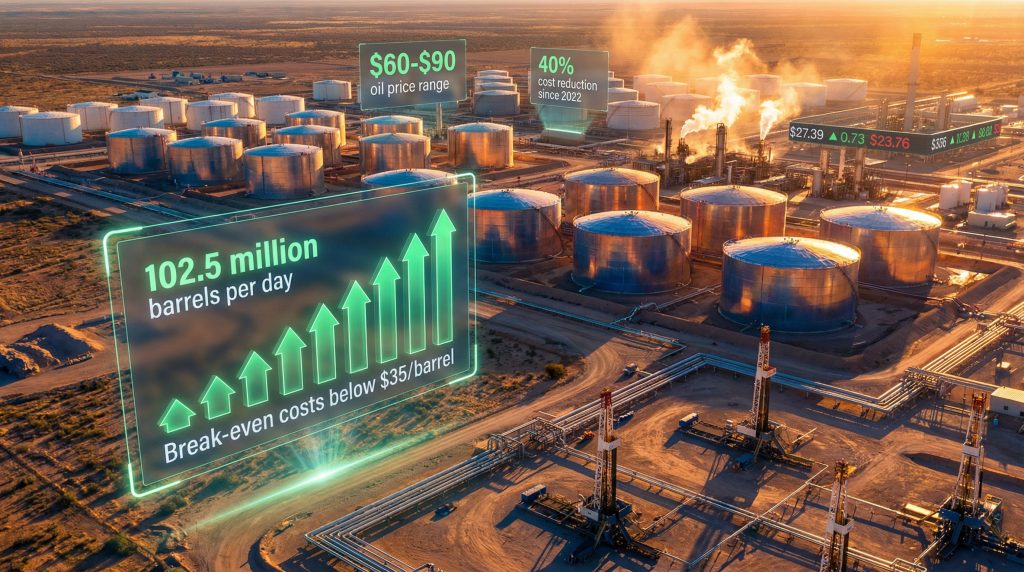
Current global oil production operates at approximately 102.5 million barrels per day, with consumption patterns demonstrating unexpected resilience across multiple economic sectors. This production level represents a delicate balance between available capacity and market demand, with regional consumption distribution revealing significant variations in growth trajectories.
Key Production and Consumption Metrics:
- OECD nations maintain stable consumption patterns around 47-48 MMbbl/d
- Non-OECD demand growth continues at 2.1% annually, driven primarily by Asian economies
- Transportation fuel demand represents 52% of global crude utilisation
- Petrochemical feedstock consumption accounts for 14% of total demand
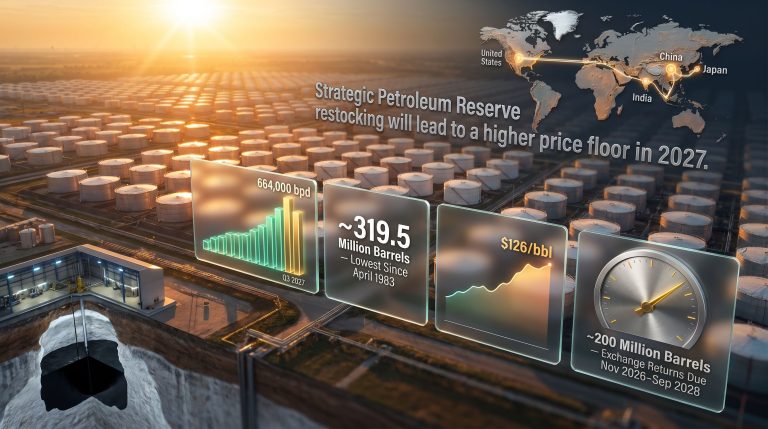
Strategic petroleum reserves worldwide have maintained relatively stable inventory levels, contrasting sharply with the dramatic drawdowns experienced during 2022-2023 energy disruptions. The United States Strategic Petroleum Reserve, currently holding approximately 350-380 million barrels, provides market participants with confidence regarding emergency supply availability.
Seasonal demand patterns through the first quarter of 2026 have exceeded historical averages, particularly in transportation fuels and heating oil consumption across Northern Hemisphere markets. This elevated demand profile has contributed to inventory draws that were not anticipated in December 2025 forecasting models.
Economic Indicators Driving Market Sentiment Shifts
Industrial production indices across major economies have demonstrated stronger correlation with crude consumption than general GDP growth metrics. Manufacturing output in key regions, particularly China's industrial base representing approximately 28-30% of global production, has maintained elevated levels despite policy interventions targeting energy intensity reduction.
However, these developments must be considered alongside broader US tariff impacts which could influence global trade patterns and energy demand in the coming quarters.
Economic Growth Correlation Factors:
| Economic Indicator | Oil Demand Correlation | 2026 Trajectory |
|---|---|---|
| Global GDP Growth | 0.7 multiplier effect | +3.2% projected |
| Industrial Production | 1.1 multiplier effect | +4.1% Q1 2026 |
| Transportation Activity | 1.4 multiplier effect | +2.8% year-over-year |
| Petrochemical Production | 0.9 multiplier effect | +5.2% projected |
The elasticity of oil demand relative to economic growth varies significantly by development stage and geographic region. Emerging markets typically exhibit elasticity coefficients ranging from 0.8 to 1.2, while developed economies demonstrate lower elasticity between 0.2 and 0.5. This differential has proven crucial in supporting global demand resilience as developing nations continue robust economic expansion.
When big ASX news breaks, our subscribers know first
What Factors Are Preventing the Predicted Oil Market Oversupply?
The anticipated oversupply scenario that dominated market sentiment through December 2025 has been systematically undermined by multiple demand-side and supply-side developments. Diamondback Energy leadership noted that demand strength continues alongside global economic growth, contradicting bearish forecasts that predicted energy transition pressures would depress consumption more rapidly than historical trends suggested.
Market participants who warned of impending crude surpluses, including major trading houses and international energy organisations, have quietly modulated their bearish positioning as fundamental conditions evolved differently than anticipated. In addition, the Diamondback Energy global oil glut scenario has been further complicated by regional supply constraints.
Demand Resilience Across Key Economic Sectors
Aviation industry fuel consumption has normalised to approximately 2.2-2.3 million barrels per day globally, representing complete recovery from pandemic-related suppression. International Air Transport Association data confirms that 2025 passenger traffic exceeded 2019 pre-pandemic levels, with jet fuel demand demonstrating particular strength in Asia-Pacific corridors.
Sectoral Demand Performance:
- Aviation kerosene consumption: +8.2% above 2024 levels
- Heavy industry energy requirements: +6.1% growth year-over-year
- Petrochemical feedstock demand: +5.7% in emerging markets
- Marine bunker fuel consumption: +3.4% reflecting trade volume recovery
Heavy industry energy requirements have significantly exceeded analyst projections, particularly in steel production, cement manufacturing, and chemical production. Chinese industrial indices, despite government efforts to reduce energy intensity, have maintained production levels that support continued crude consumption growth well above forecasted ranges.
Petrochemical feedstock demand growth in emerging markets has created sustained consumption for naphtha and light crude grades. Asian capacity expansions, particularly major integrated complexes in China and Southeast Asia, have driven feedstock demand to historically elevated levels that prevent regional oversupply despite theoretical capacity surpluses in other global regions.
Supply Chain Disruptions and Production Constraints
Geopolitical tensions continue affecting approximately 15% of global crude flows, creating supply-side constraints that offset theoretical production capacity. Major chokepoints include Middle East shipping lane security concerns, particularly Strait of Hormuz transit risks that affect 20-21% of global crude trade volumes.
Critical Supply Constraints:
- Russian Export Limitations: Sanctions-related constraints preventing full export capacity utilisation
- Iraqi Infrastructure Bottlenecks: Southern export terminals operating below design capacity
- Venezuelan Production Collapse: Caribbean supply reductions impacting regional balances
- Canadian Pipeline Constraints: Limited Albertan bitumen export capacity to non-North American markets
OPEC+ production discipline has maintained market balance through voluntary production cuts and quota compliance. The organisation's spare capacity, estimated at 4-5 million barrels per day primarily concentrated in Saudi Arabia, UAE, and Kuwait, provides market buffer capability while representing constrained reserves rather than available production growth.
Infrastructure bottlenecks in major producing regions have prevented full capacity utilisation despite technical production capability. Furthermore, concerns regarding a US oil production decline have added another layer of uncertainty to global supply calculations.
How Are Major Oil Producers Adapting Their Strategic Positioning?
Shale producers, particularly Permian Basin operators, have fundamentally altered their strategic approach to production growth and capital allocation. Diamondback Energy and similar independent operators are maintaining production discipline despite improving price signals, reflecting management recognition that commodity price improvements may not represent sustainable long-term levels.
This cautious approach contrasts with historical shale industry behaviour during price upswings, when operators typically maximised near-term production to capture revenue opportunities. Consequently, the industry has shown more strategic restraint in recent quarters.
Permian Basin Production Optimisation Strategies
Leading Permian operators have achieved breakthrough cost reductions of approximately 40% since 2022 through systematic operational improvements. Break-even costs have declined below $35 per barrel for major unconventional producers, fundamentally altering global cost curve dynamics and competitive positioning.
Operational Efficiency Improvements:
- Well completion cost reductions: 20-25% through standardisation and vendor competition
- Drilling cycle time compression: DUC inventory optimisation reducing time-to-revenue
- Production processing efficiency: Enhanced artificial lift and facility optimisation
- Supply chain negotiations: Proppant and fluid costs reduced 15-20% through competitive sourcing
Critical Industry Development: Permian operators have transformed unconventional economics through systematic cost reduction, creating sustainable production capability at price levels previously considered uneconomical.
Enhanced oil recovery techniques are expanding reserve life through advanced reservoir monitoring and artificial lift optimisation. Major integrated operators like ExxonMobil, through their Pioneer Natural Resources acquisition, have implemented sophisticated reservoir management systems that maximise recovery factors while minimising per-barrel lifting costs.
As reported by Oil Price, Diamondback Energy has initiated exploration of deeper geological formations within the Permian stratigraphic column, specifically testing the deepest development zones. This strategic shift toward unconventional deeper horizons, including lower Wolfcamp intervals and Bone Spring formations, represents reserve replacement prioritisation despite near-term price uncertainties.
International Producer Response Mechanisms
Middle Eastern national oil companies have maintained capacity utilisation discipline while managing spare capacity strategically. Saudi Aramco, Kuwait Petroleum Corporation, and Abu Dhabi National Oil Company operate with coordinated production policies that balance revenue optimisation against market stability objectives.
Strategic Producer Positioning:
| Producer Category | Capacity Utilisation | Strategic Focus |
|---|---|---|
| OPEC Core Members | 85-90% of capacity | Market share defence |
| Permian Independents | 92-95% of capacity | Cost optimisation |
| International Majors | 88-92% of capacity | Portfolio efficiency |
| National Oil Companies | 80-85% of capacity | Long-term revenue |
North Sea production decline mitigation strategies focus on enhanced recovery from mature fields while selectively developing remaining economic reserves. Operators in the UK and Norwegian Continental Shelf are implementing digital oilfield technologies and advanced reservoir management to extend field economic life rather than pursuing aggressive exploration programmes.
Offshore deepwater project economics have improved through cost reduction initiatives and selective development of high-return opportunities. Major deepwater provinces including Gulf of Mexico, Brazil pre-salt, and West Africa continue development activity focused on large-scale, long-duration projects that provide sustained production profiles.
Why Are Oil Price Forecasts Being Revised Upward?
Benchmark crude futures have advanced more than 15% in the first eight weeks of 2026, recovering almost all of 2025's approximately 20% decline. This remarkable price recovery reflects fundamental reassessment of supply-demand balance rather than speculative positioning or short-term disruption premiums.
The price trajectory validates industry observations that oversupply warnings, consistently predicted for the past two years, continue to be deferred into future periods as demand resilience and supply constraints maintain market equilibrium. For instance, our oil price rally analysis provides additional context on these market dynamics.
Fundamental Analysis of Price Support Mechanisms
Multiple price support factors have emerged simultaneously, creating sustained upward pressure that contrasts sharply with December 2025 bearish sentiment. Strong Asian demand growth, OPEC+ production discipline, elevated refining margins, and persistent geopolitical risk premiums have combined to establish price floors above previous analyst projections.
Price Support Factor Analysis:
| Price Support Factor | Impact Level | Duration Estimate | Price Impact |
|---|---|---|---|
| Strong Asian Demand | High | 12-18 months | $8-12/barrel |
| OPEC+ Discipline | Medium | 6-12 months | $4-7/barrel |
| Elevated Refining Margins | Medium | 3-6 months | $3-5/barrel |
| Geopolitical Premium | Variable | Ongoing | $2-8/barrel |
Asian demand growth, particularly from China, India, and Southeast Asian economies, has exceeded analyst expectations by creating sustained import requirements that have drawn down regional inventories. Chinese crude imports, averaging 10.5-11.2 million barrels per day, have maintained elevated levels despite domestic economic policy adjustments targeting energy efficiency.
Refining margin improvements have incentivised crude processing at elevated levels, supporting demand for specific crude grades while generating cash flow that justifies continued throughput. Complex refineries capable of processing heavy, sour crude grades have demonstrated particular strength in margin capture through product yield optimisation.
Technical Market Indicators and Trading Patterns
Futures curve backwardation has emerged across multiple contract months, signalling market perception of near-term supply tightness relative to forward expectations. This market structure contrasts with the contango patterns that prevailed through most of 2025, when forward prices exceeded spot levels.
Technical Market Signals:
- Options market volatility: Decreased compared to Q4 2025 uncertainty levels
- Institutional positioning: Net long positioning increased 35% since December 2025
- Futures curve structure: Backwardation extending through 12-month contracts
- Trading volume patterns: Increased physical market activity relative to financial trading
Institutional investor positioning has shifted markedly toward energy sector exposure, with commodity trading advisors and hedge funds establishing net long positions that exceed historical averages. This positioning reflects fundamental reassessment rather than momentum-driven speculation, suggesting sustained capital commitment to energy price appreciation.
What Are the Long-Term Implications for Energy Market Structure?
The failure of predicted oversupply conditions to materialise has profound implications for energy investment strategies, production planning, and geopolitical energy security considerations. Market participants are reassessing fundamental assumptions about demand growth trajectories, supply response mechanisms, and the timeline for energy transition impacts on crude oil consumption.
Investment capital allocation patterns have shifted toward unconventional resource development and infrastructure capacity expansion, reflecting recognition that demand resilience may persist longer than previously anticipated. Moreover, these developments intersect with broader concerns about a global recession outlook that could reshape demand patterns.
Investment Capital Allocation Trends
Private equity deployment in unconventional resources has accelerated as institutional investors recognise that cost reduction achievements have fundamentally improved project economics. Permian Basin infrastructure requirements alone are estimated at $50 billion through 2027, creating substantial investment opportunities across midstream and processing capacity.
Capital Allocation Priorities:
- Unconventional Resource Development: Focus on premier acreage with proven economics
- Infrastructure Expansion: Pipeline, processing, and export terminal capacity
- Technology Integration: Digital oilfield and artificial intelligence applications
- Carbon Management: CCUS integration for emissions reduction compliance
National oil company expansion strategies increasingly emphasise long-term production capacity maintenance rather than aggressive growth targeting. These entities, controlling approximately 65% of global reserves, are implementing measured development programmes that balance revenue generation against resource conservation for future decades.
Energy transition considerations have created complex investment dynamics where traditional upstream investment competes with renewable energy capital deployment. However, sustained crude demand has validated continued investment in oil and gas development alongside transition-related technologies.
Technological Innovation Reshaping Production Economics
Digital oilfield optimisation has achieved operational cost reductions of approximately 25% through integration of artificial intelligence, advanced sensors, and automated control systems. These technologies enable real-time reservoir management, predictive maintenance, and production optimisation that maximises recovery while minimising operational expenses.
Technology Integration Benefits:
- Artificial intelligence reservoir management: 15-20% production increase potential
- Predictive maintenance systems: 30-40% reduction in unplanned downtime
- Automated drilling systems: 25% improvement in drilling efficiency
- Real-time production optimisation: 10-15% recovery factor improvements
Carbon capture, utilisation, and storage (CCUS) integration is becoming economically viable for major production operations, particularly in regions with carbon pricing mechanisms or regulatory requirements. Enhanced oil recovery through CO2 injection provides dual benefits of emissions reduction and incremental production that improves project economics.
Advanced reservoir characterisation through machine learning and data analytics has improved geological understanding and development planning accuracy. These capabilities enable more precise well placement, completion optimisation, and production forecasting that reduces development risk and improves capital efficiency.
How Should Investors Position for Evolving Market Conditions?
The current energy market environment presents complex investment considerations that balance traditional commodity exposure against transition-related opportunities. The Diamondback Energy global oil glut fears have proven premature, suggesting that investor positioning should account for sustained demand resilience rather than oversupply scenarios.
Investment strategies must consider multiple time horizons and scenario probabilities while recognising that market fundamentals have evolved differently than consensus forecasts predicted.
Risk Assessment Framework for Oil Market Exposure
Scenario modelling suggests crude oil prices may sustain levels within a $60-$90 per barrel range through 2026-2027, with probability distributions weighted toward the higher end of this range based on current fundamental conditions. This price environment supports continued investment in unconventional development while providing economic returns for traditional upstream operations.
Investment Risk Considerations:
- Demand Duration Risk: Uncertainty regarding energy transition timeline impacts
- Supply Response Risk: Potential for rapid production growth if prices sustain elevated levels
- Geopolitical Risk: Regional conflicts affecting supply chain stability
- Policy Risk: Regulatory changes affecting production costs or market access
- Technology Risk: Breakthrough developments altering competitive economics
Hedging strategies for commodity price volatility should incorporate lessons from recent market dynamics where oversupply forecasts proved incorrect. Traditional hedging approaches may require adjustment to account for sustained price support mechanisms and reduced downside probability distributions.
Portfolio diversification across upstream, midstream, and downstream assets provides exposure to different value chain segments while reducing concentration risk. Integrated positions capture margin opportunities throughout the energy value chain while providing defensive characteristics during market volatility periods.
Emerging Opportunities in Energy Value Chains
Infrastructure investment opportunities have expanded significantly as production growth requires supporting capacity across transportation, processing, and export systems. Permian Basin development alone requires substantial midstream investment to connect production with end markets efficiently.
Infrastructure Investment Priorities:
| Infrastructure Type | Investment Requirement | Return Profile | Risk Level |
|---|---|---|---|
| Pipeline Capacity | $20-25 billion | 10-12% IRR | Medium |
| Export Terminals | $15-18 billion | 12-15% IRR | Medium-High |
| Processing Facilities | $8-12 billion | 14-18% IRR | High |
| Digital Infrastructure | $3-5 billion | 20-25% IRR | Medium |
Export terminal capacity expansion represents particularly attractive investment opportunities as North American production requires access to global markets. LNG export capability and crude oil export terminals provide essential infrastructure for monetising domestic resource development.
Renewable diesel feedstock supply chain development creates opportunities at the intersection of traditional energy infrastructure and transition technologies. These investments capture value from both conventional crude processing and renewable fuel production integration.
The next major ASX story will hit our subscribers first
Frequently Asked Questions About Global Oil Market Dynamics
Investment and industry participants frequently seek clarification regarding the evolving energy market landscape, particularly given the divergence between predicted oversupply scenarios and actual market conditions through early 2026.
Will the Global Oil Glut Materialise in 2026?
Current economic indicators and fundamental conditions suggest oversupply risks have diminished significantly compared to December 2025 forecasts. Demand growth has exceeded initial projections by approximately 1.2 million barrels per day, while supply constraints and production discipline have prevented the surplus accumulation that analysts anticipated.
The timeline for potential oversupply development has been pushed forward repeatedly, as Diamondback Energy leadership noted, suggesting that market balance may persist longer than originally expected. Economic growth supporting energy demand has proven more resilient than transition-focused forecasting models predicted.
How Are Shale Producers Responding to Market Conditions?
Leading unconventional operators are maintaining production discipline despite improving price signals, reflecting strategic focus on capital returns rather than production maximisation. This approach contrasts with historical shale industry behaviour during price upswings when operators typically pursued aggressive growth strategies.
Shale Producer Strategic Responses:
- Production maintenance at Q4 2025 levels despite price improvements
- Capital allocation prioritising shareholder returns over growth
- Deeper formation exploration for reserve replacement
- Technology integration for cost reduction and efficiency improvement
Exploration of deeper geological formations within established basins represents a strategic shift toward sustainable reserve replacement. Diamondback Energy and similar operators are testing deeper development zones that offer longer reserve life and sustained production capability.
What Role Does Energy Security Play in Current Market Dynamics?
Geopolitical tensions and energy security considerations have elevated strategic petroleum reserve management and domestic production prioritisation across multiple nations. Energy independence objectives have influenced policy decisions regarding production incentives and import dependency reduction.
Strategic petroleum reserve rebuilding programmes, particularly in the United States, have provided additional demand support while enhancing emergency preparedness capabilities. These government purchases represent sustained demand that supports market balance during inventory accumulation periods.
Regional energy security concerns have led to diversified supply source development and reduced dependency on specific geographic regions or transportation corridors. This diversification supports sustained investment in domestic production capability across multiple producing regions.
Navigating the Transformed Energy Market Landscape
The anticipated global oil glut has failed to materialise as robust economic growth, supply chain constraints, and strategic producer behaviour have maintained market equilibrium throughout early 2026. Current fundamentals suggest a more balanced supply-demand environment than previously forecasted, with implications extending beyond commodity prices to broader energy investment strategies and geopolitical considerations.
Diamondback Energy leadership observations regarding sustained demand strength and global economic growth have proven prescient, validating operational strategies focused on capital discipline rather than production maximisation. The systematic deferral of oversupply scenarios suggests that market participants may need to reassess fundamental assumptions about energy transition timelines and demand destruction mechanisms.
Investment opportunities within the energy sector have expanded as market conditions support sustained crude prices while technological innovations continue improving operational economics. The combination of cost reduction achievements, demand resilience, and supply discipline has created an environment where strategic energy investments may provide attractive returns across multiple time horizons.
Disclaimer: This analysis is based on market conditions and industry information available as of February 2026. Commodity markets involve significant risk and volatility. Investment decisions should consider multiple scenarios and consult qualified financial advisors. Past performance does not guarantee future results, and energy market conditions can change rapidly due to economic, geopolitical, and technological factors.
Ready to Capitalise on Energy Market Opportunities?
Energy market dynamics are shifting rapidly, creating new opportunities for astute investors across the resources sector. Stay ahead of major market-moving discoveries with Discovery Alert's proprietary Discovery IQ model, which provides instant notifications on significant ASX mineral and energy discoveries, ensuring you're positioned before the broader market recognises emerging opportunities.