June 20, 2026
Understanding Global Petroleum Revenue Dynamics
The interconnected nature of global energy markets creates complex fiscal relationships where commodity price fluctuations translate directly into government revenue volatility. Nations heavily dependent on hydrocarbon exports face particular vulnerability when international pricing mechanisms shift, creating cascading effects throughout their economic frameworks. This systematic exposure becomes especially pronounced when geopolitical tensions intersect with market fundamentals.
Modern petroleum-exporting economies operate sophisticated tax collection systems designed to capture value from resource extraction while maintaining competitive positioning in global markets. These mechanisms typically combine production taxes, export duties, and profit-sharing arrangements that automatically adjust based on prevailing market conditions. The mathematical precision of these systems means that even modest price movements can generate substantial budgetary impacts.
When big ASX news breaks, our subscribers know first
Russia Faces Sharp Drop in Oil Tax Revenue Through Complex Market Forces
Fiscal Architecture Under Pressure
Russia's petroleum revenue framework demonstrates the intricate relationship between international commodity markets and domestic fiscal stability. The nation's mineral extraction tax system operates through sophisticated formulations that convert crude export earnings into government receipts, historically generating approximately 25-30% of total federal budget revenues. This dependency creates immediate vulnerability to price volatility and market disruption.
The MET calculation methodology incorporates multiple variables including benchmark pricing relationships, currency exchange dynamics, and production cost adjustments. When export valuations decline or domestic currency strengthens, tax collections compress automatically through this mechanical relationship. The system's design amplifies both positive and negative price movements, creating fiscal volatility that extends beyond simple commodity exposure.
Key Revenue Components:
- Mineral Extraction Tax (MET): Progressive rates from 0% to 65% depending on price levels
- Export customs duties: Typically 10-30% of crude value
- Corporate profit taxes: From major energy companies
- Currency translation effects: USD revenues converted to rubles
Market Dynamics Driving Revenue Compression
Current market conditions demonstrate how multiple factors compound to create severe revenue pressure. Russian crude grades now trade at substantial discounts to international benchmarks, with Urals crude experiencing discount spreads of 8-15% below Brent, compared to historical premiums of 1-3%. This structural shift reflects both quality differentials and sanctions-related market access constraints.
Price Impact Analysis:
| Factor | Historical Range | Current Impact | Revenue Effect |
|---|---|---|---|
| Urals-Brent Spread | -1% to -3% | -8% to -15% | Reduced tax base |
| Export Route Costs | $1-2/barrel | $2-4/barrel | Margin compression |
| Insurance Premiums | Standard rates | 200-400% higher | Operational burden |
| Shipping Distances | Baseline | 40-70% longer | Increased logistics costs |
Exchange rate dynamics create additional complexity through currency appreciation effects. A strengthening ruble against the US dollar reduces the domestic value of dollar-denominated export earnings, mechanically compressing MET collections even when crude prices remain stable. This counterintuitive relationship means currency strength can paradoxically reduce energy revenues.
Structural Challenges Beyond Price Volatility
Sanctions Architecture Impact
The implementation of G7 price cap mechanisms and EU crude embargoes fundamentally altered Russia's export economics. The $60 per barrel price cap, enforced through insurance restrictions, acts as both a direct price ceiling and psychological market constraint. While current price levels may exceed this threshold, the mechanism creates ongoing uncertainty and limits long-term contract negotiations.
European embargo implementation forced a complete geographic reorientation of export flows. The elimination of approximately 2.2 million barrels per day of direct EU import capacity created immediate supply chain disruption. Traditional shipping routes through the Black Sea to Mediterranean markets became unavailable, forcing reliance on longer Asian routes with substantially higher operational costs.
Transportation Cost Analysis:
- Traditional route distance: 3,000-4,000 nautical miles
- Current Asian routes: 6,000-8,000 nautical miles
- Additional fuel consumption: $2-4 per barrel
- Extended transit time: 30-40 additional days
- Inventory financing costs: Increased working capital requirements
Infrastructure Vulnerability Factors
Targeted attacks on energy infrastructure create both immediate production disruptions and longer-term investment uncertainties. The Druzhba pipeline system experienced capacity reductions from approximately 1.4 million barrels per day to roughly 800,000 barrels per day, representing a 43% capacity decline. These operational constraints compound pricing pressures by reducing export reliability.
Arctic shipping routes, while offering alternative pathways, introduce seasonal limitations and require specialised icebreaker support. The operational complexity and weather dependency of these routes create additional cost structures that reduce net revenue realisation.
Quantifying Revenue Decline Severity
MET Collection Trends
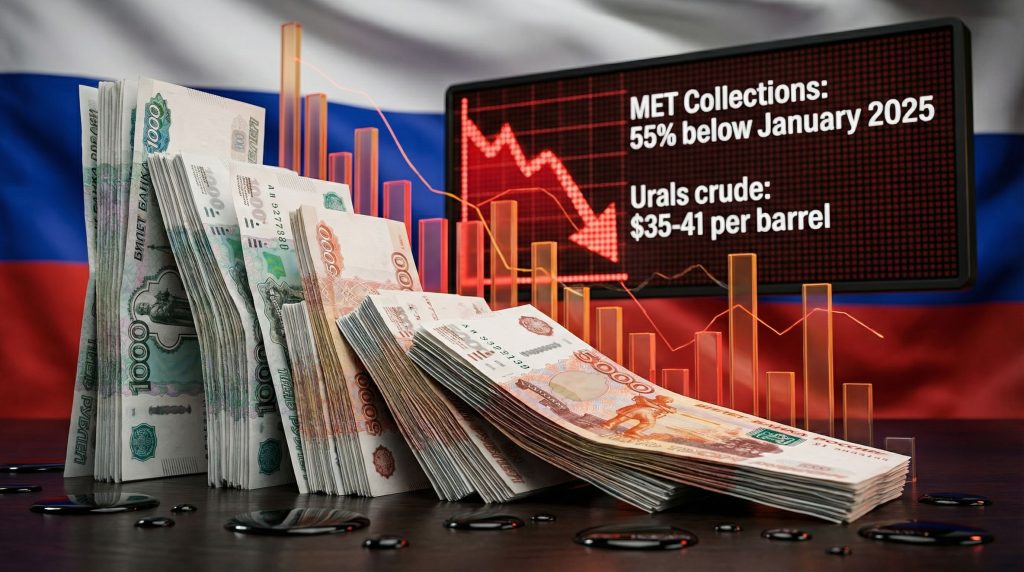
Recent data indicates significant deterioration in mineral extraction tax receipts, with collections showing both month-over-month and year-over-year declines. The Russian Ministry of Finance reported November 2024 energy tax revenues falling substantially below budgeted projections, forcing immediate policy adjustments across multiple fiscal categories.
Furthermore, the intersection of production challenges and market dynamics creates compounding effects on fiscal outcomes. The decline in oil production globally affects pricing structures, whilst OPEC production impact decisions influence international benchmark pricing relationships.
Budget Impact Metrics:
- Energy revenue dependency: 25-40% of federal receipts historically
- 2025 budget assumptions: Urals crude averaging $50-55 per barrel
- Current price variance: Sustained periods below budget assumptions
- Cumulative budget gap: Expanding deficit projections for 2025-2026
The National Welfare Fund, Russia's sovereign wealth mechanism, faces accelerating withdrawal pressure. Current depletion rates of approximately 3-4 trillion rubles annually suggest substantial fund exhaustion within 5-7 years if energy revenues fail to recover. This timeline assumes no significant recovery in commodity pricing or export capacity.
Comparative Historical Context
Revenue collections have reached levels not seen since the initial sanctions implementation period of late 2022. Unlike temporary market downturns, current conditions reflect structural market changes that may persist regardless of short-term price recovery. The combination of reduced market access, higher operational costs, and persistent risk premiums creates a fundamentally different operating environment.
Consequently, analysts conducting oil price crash insights examine how geopolitical factors interact with traditional market fundamentals. The impact extends beyond immediate pricing to encompass longer-term investment cycles and production capacity planning.
Policy Response Mechanisms
Fiscal Adjustment Strategies
Moscow has deployed multiple tools to address widening revenue gaps, prioritising immediate budget balance over long-term fiscal sustainability. Domestic bond issuance expanded to approximately 5.5-6.0 trillion rubles in 2024, representing significant increases from previous years. However, elevated interest rates of 12-16% on government bonds create substantial debt service obligations.
Revenue Enhancement Measures:
- Increased excise taxes on energy exports beyond base MET rates
- VAT adjustments on domestic business transactions
- Windfall profit mechanisms on non-oil corporate earnings
- Reduced personal income tax deductions to offset inflation
Expenditure Reallocation Priorities
Budget adjustments reflect shifting national priorities, with military and defence spending estimated at 6-7% of GDP by 2024. This allocation comes at the expense of infrastructure investment and social programmes, creating potential long-term economic consequences. The emphasis on immediate security needs over economic development indicates acceptance of structural fiscal constraints.
Sovereign wealth fund management faces competing mandates between counter-cyclical fiscal support and long-term savings preservation. Current withdrawal rates suggest prioritisation of immediate budget needs over intergenerational wealth preservation, indicating assumptions about near-term revenue recovery or acceptance of fund depletion scenarios.
Broader Economic Implications
Current Account Dynamics
Russia's current account surplus historically provided macroeconomic stability through substantial foreign currency inflows. 2021 baseline surplus of $121 billion compared to projected 2024 levels of $70-80 billion demonstrates the scale of external balance deterioration. This decline constrains import capacity and affects exchange rate stability.
Reduced energy export revenues directly impact foreign currency availability for essential imports and debt service obligations. The compression of current account surpluses limits Russia's ability to maintain currency stability through market intervention, potentially creating additional inflationary pressures.
According to recent analysis, Russia's oil and gas revenues declined 34% year-on-year in November, highlighting the severity of fiscal challenges facing the government. Additionally, energy export data reveals sustained pressure on traditional revenue streams.
Debt Trajectory Projections
Federal debt-to-GDP ratios show concerning upward trends as borrowing requirements increase while economic growth moderates. The combination of reduced revenues and elevated expenditure needs creates fiscal deficits that require sustained domestic borrowing. Higher interest rates on government debt compound fiscal pressure through increased debt service obligations.
Fiscal Sustainability Indicators:
- Projected deficit expansion through 2026-2027
- Reduced fiscal flexibility for counter-cyclical policies
- Enhanced sensitivity to commodity price volatility
- Limited access to international capital markets
Global Market Interconnections
Supply Chain Ramifications
Russia's fiscal stress influences production decisions and export strategies with global implications. Reduced upstream investment capacity may create longer-term supply constraints, while short-term export maximisation efforts could pressure international pricing. The relationship between fiscal needs and production decisions creates complex market dynamics.
Market participants increasingly incorporate Russian energy supply disruption risks into global commodity benchmarks. These risk premiums affect pricing even in non-Russian supply chains, demonstrating how localised fiscal stress can create systemic market effects.
In addition, the broader context of OPEC market influence creates additional layers of complexity for global price formation. The interaction between sanctions-affected supplies and traditional cartel dynamics produces volatile pricing environments that challenge forecasting models.
Risk Premium Evolution
Geopolitical risk pricing has become embedded in energy markets, creating persistent volatility that extends beyond fundamental supply-demand relationships. Insurance costs, shipping rates, and financing terms all reflect elevated risk assessments that compound operational challenges and reduce net revenue realisation.
However, recent oil price rally analysis suggests that geopolitical premiums may fluctuate significantly based on policy developments and sanctions enforcement effectiveness.
The next major ASX story will hit our subscribers first
Monitoring Framework for Market Participants
Critical Fiscal Indicators
Monthly MET collection data from the Russian Ministry of Finance provides real-time insights into revenue trends and fiscal stress levels. These announcements offer early signals of budget pressure and potential policy responses. Urals-Brent spread movements indicate market access effectiveness and pricing power deterioration.
Key Monitoring Metrics:
- Ruble-dollar exchange rate volatility affecting revenue translation
- National Welfare Fund withdrawal rates indicating fiscal sustainability
- Domestic borrowing costs reflecting risk assessment and inflation expectations
- Production capacity utilisation versus technical maximums
Structural Development Indicators
Medium-term factors include upstream investment levels affecting future production capacity and export route diversification progress. Sanctions regime evolution and enforcement effectiveness create ongoing uncertainty that impacts long-term planning and investment decisions.
Investment Impact Analysis:
- Reduced capital allocation to exploration and development
- Deferred infrastructure maintenance and upgrades
- Limited access to advanced extraction technologies
- Constrained financing for capacity expansion projects
Strategic Implications and Market Outlook
Recovery Timeline Considerations
Revenue normalisation depends on multiple variables including international price trends, sanctions regime modifications, and alternative market development success. Current structural factors suggest sustained pressure rather than rapid recovery scenarios. The interaction between fiscal needs and production optimisation creates complex decision matrices for energy policy.
Geographic market rebalancing toward Asian consumers requires substantial infrastructure investment and relationship development. The timeline for achieving pre-2022 revenue levels involves both market access restoration and operational efficiency improvements that may require years to implement effectively.
Scenario Planning Framework
Optimistic scenarios assume gradual sanctions reduction and successful Asian market integration, potentially restoring 70-80% of historical revenue levels within 3-5 years. Pessimistic scenarios involve continued market access constraints and persistent discounting, creating sustained fiscal pressure requiring fundamental economic restructuring.
Base case projections suggest revenue recovery to 60-70% of historical levels over a 5-7 year timeline, assuming successful export route diversification and stable Asian demand relationships. This scenario requires continued sovereign fund utilisation and domestic borrowing expansion to maintain fiscal stability.
The intersection of fiscal constraints and energy policy creates complex trade-offs between short-term revenue maximisation and long-term sector sustainability. Market participants should monitor both immediate fiscal indicators and structural capacity trends to assess evolving supply dynamics and their global market implications.
Investment decisions involving Russian energy sector exposure should consider both immediate fiscal stress indicators and longer-term structural market changes. The regulatory environment remains dynamic, requiring ongoing assessment of sanctions compliance and risk management frameworks.
Looking to Capitalise on Global Energy Market Opportunities?
Discovery Alert's proprietary Discovery IQ model delivers real-time alerts on significant ASX mineral discoveries, instantly empowering subscribers to identify actionable opportunities ahead of the broader market. Begin your 30-day free trial today and secure your market-leading advantage whilst global energy dynamics create new investment landscapes.