
June 22, 2026
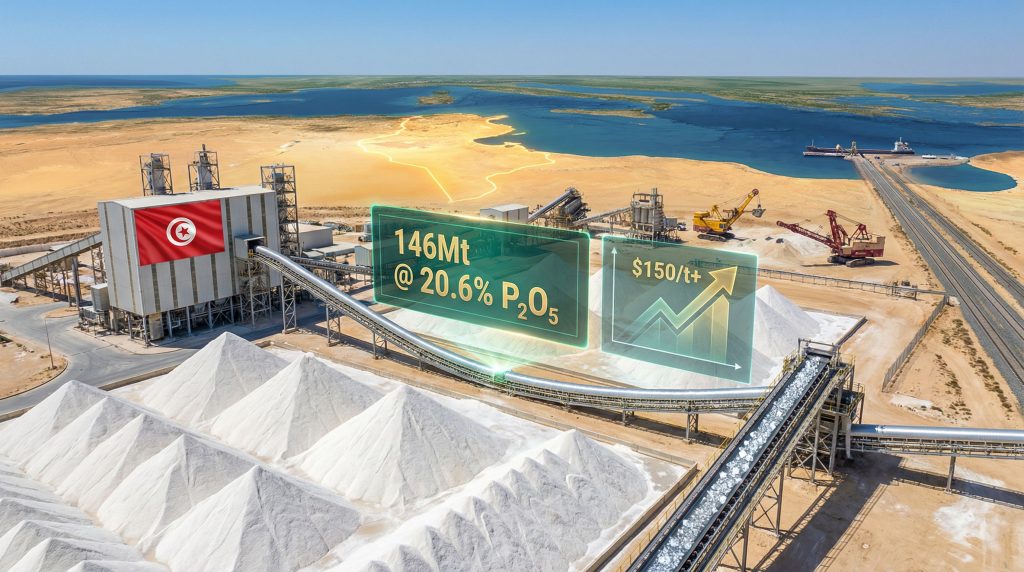
Global Phosphate Market Dynamics: Why North African Deposits Matter
Critical fertilizer supply chains face unprecedented strain as geopolitical tensions reshape global phosphate markets. The PhosCo Gasaat phosphate project in Tunisia represents a strategic response to this crisis, positioned within a region where economically viable reserves create systemic vulnerabilities that extend far beyond agricultural systems into emerging technology sectors and food security frameworks.
Supply Chain Vulnerabilities in Critical Fertilizer Markets
The global phosphate market operates within a highly concentrated reserve structure that poses significant strategic risks to importing nations. Ninety percent of the world's phosphate reserves are controlled by just five countries: the USA, Morocco, Jordan, China, and South Africa. This concentration becomes particularly problematic when considering that Russia and China, the world's largest producers, have systematically reduced export volumes to Western markets.
Furthermore, the US‑China Trade War Impact on global supply chains has compounded existing market vulnerabilities. Additionally, the supply chain crisis in minerals has created unprecedented challenges for resource security.
Key market vulnerabilities include:
• Reserve Concentration Risk: North Africa, primarily Morocco, holds the largest single concentration of economically viable phosphate deposits
• Export Restriction Impacts: Both Russia and China have implemented policies reducing phosphate availability to Western agricultural systems
• Import Dependency: Australia and Europe rely heavily on phosphate imports due to insufficient domestic reserves
• Logistical Disruptions: Ukraine-related supply chain interruptions have compounded existing market stress
Price volatility demonstrates the severity of these structural challenges. During the 2015-2020 period, phosphate traded at approximately USD $70 per tonne, reflecting oversupply conditions. Current market pricing has surged to USD $150 per tonne and higher for ammoniated phosphates, driven by supply constraints and rising operational costs across the value chain.
Consequently, tariffs and investment markets have become increasingly interlinked, affecting global resource allocation strategies. Moreover, European CRM supply initiatives have highlighted the urgent need for supply chain diversification.
Structural Demand Drivers Beyond Traditional Agriculture
While 90% of global phosphate consumption serves agricultural applications, emerging demand vectors are creating additional market support mechanisms. The role of phosphate in electric vehicle battery chemistry represents a significant structural shift that investors often overlook.
Electric Vehicle Battery Demand:
The majority of electric vehicles globally utilize Lithium Iron Phosphate (LFP) battery chemistry for energy storage systems. This application creates incremental phosphate demand beyond traditional fertilizer markets, providing diversification of end-use applications that supports medium and long-term price stability.
Agricultural Fundamentals:
The inelastic nature of phosphate demand stems from its critical role in plant biology. Forty percent of global food production depends on fertilizer use, with phosphate serving as one of three essential macronutrients alongside nitrogen and potassium. Phosphate compounds enable:
• Strong root system development in crop production
• Seed and fruit production efficiency
• Photosynthesis and DNA synthesis processes
• Cell membrane integrity and solar energy conversion
Population growth projections and nutrient use efficiency trends in modern farming practices continue to support baseline demand growth. However, projects like the Ammaroo Phosphate Project demonstrate how regional development initiatives are responding to these structural demand patterns, creating a foundation for sustained market fundamentals independent of pricing cycles.
When big ASX news breaks, our subscribers know first
How Does PhosCo's Gasaat Project Compare to Global Phosphate Operations?
The PhosCo Gasaat phosphate project in Tunisia demonstrates exceptional resource characteristics that position it within the upper quartile of global phosphate development opportunities. Project economics reflect the advantages of high-grade mineralization, extended mine life, and favorable extraction conditions.
Resource Scale and Quality Benchmarking
| Metric | Gasaat Project | Industry Benchmark | Competitive Position |
|---|---|---|---|
| Total Resource | 146Mt @ 20.6% P₂O₅ | Varies significantly | Upper quartile |
| Mine Life | ~50 years | 15-30 years typical | Extended operation |
| Strip Ratio | Low (open pit) | Variable | Cost advantage |
| Concentrate Grade | >30% P₂O₅ target | 28-32% standard | Premium quality |
| Resource Confidence | JORC-compliant | Industry standard | Institutional grade |
The 146 million tonne resource at 20.6% P₂O₅ provides substantial scale advantages over smaller phosphate operations. The approximately 50-year mine life significantly exceeds the 15-30 year typical lifespan of comparable operations, offering long-term cash flow visibility that enhances project financing attractiveness.
Operational Economics and Development Metrics
Project financial metrics demonstrate compelling investment characteristics, particularly when evaluated against current phosphate pricing environments. The December 2022 Scoping Study established robust economic parameters that support development decision-making.
Capital and Operating Cost Structure:
• Development Capital Requirement: USD $170 million
• Operating Costs: USD $79 per tonne (competitive positioning despite absolute cost levels)
• Post-Tax NPV (10% discount rate): USD $657 million
• Internal Rate of Return: 54% at USD $150/tonne phosphate pricing
• Payback Period: 1.5 years (exceptional for mining development projects)
Production Profile:
The operation targets 67.6 million tonnes of concentrate production over the mine life, with 15 million tonnes projected during the initial 10-year operational phase. This production profile supports sustained cash flow generation while allowing for operational optimization during the ramp-up period.
The low strip ratio open pit mining approach enables cost-effective extraction, while high-grade mineralization (20.6% P₂O₅) supports margin expansion relative to lower-grade competitor operations. In addition, the concentrate target specification of greater than 30% P₂O₅ with less than 1% MgO aligns with premium market requirements and European fertilizer supply chain standards.
What Are the Geopolitical and Jurisdictional Advantages of Tunisia?
Tunisia's strategic positioning within North African phosphate markets offers unique advantages for international mining companies seeking jurisdictional diversification. The country's historical production capacity and recent policy reforms create attractive conditions for private sector participation.
Tunisia's Phosphate Industry Renaissance Strategy
Tunisia represents a "sleeping giant" in global phosphate production, having achieved peak annual output exceeding 8 million tonnes in 2010 before political disruptions reduced operational capacity. Recent government initiatives signal a deliberate strategy to restore the country's position as a significant global supplier.
Government Policy Framework:
• Foreign Investment Precedent: PhosCo received the first phosphate mining permit granted by the Tunisian government to a foreign company
• Tax Incentive Structure: Zero corporate tax for the first five years of mining operations (compared to the standard 25% corporate rate)
• International Company Presence: Shell, Anglo Oil & Gas, TotalEnergies, Scatec, and AMEA Power maintain active operations
• Regulatory Acceptance: Shift toward private sector participation in strategic minerals development
The five-year corporate tax exemption represents a material financial benefit, potentially enhancing project economics by USD $17-25 million in cumulative tax deferral over the incentive period, depending on operating cash flows.
Infrastructure and Logistics Competitive Advantages
Strategic geographic positioning provides the PhosCo Gasaat phosphate project in Tunisia with superior logistics infrastructure relative to many landlocked phosphate operations globally.
Transportation Infrastructure:
• Rail Connectivity: 35 kilometers distance to established rail networks
• Port Access: Direct shipping routes through Port of Rades (Tunisia's primary commercial port)
• Mediterranean Positioning: Strategic location within established trade corridors to European markets
• Operational Precedent: Existing infrastructure supports current mining activities in the region
The relatively short 35-kilometer distance to rail connectivity eliminates the need for independent rail infrastructure development. Consequently, this significantly reduces capital requirements compared to projects requiring extensive logistics infrastructure construction. This proximity enables economical concentrate transport to port facilities for international shipment.
How Does the European Bank for Reconstruction and Development Partnership Impact Project Viability?
Institutional financing partnerships provide critical validation for emerging market resource projects, particularly in jurisdictions where political risk considerations influence commercial lending decisions. The European Bank for Reconstruction and Development (EBRD) involvement with the PhosCo Gasaat phosphate project in Tunisia demonstrates multilateral financial institution confidence in project fundamentals.
Institutional Financing Framework Analysis
The formal EBRD mandate establishes a structured pathway toward larger-scale project financing while providing immediate technical development support. According to reports from Energy Capital Power, this partnership represents significant institutional validation for the project.
EBRD Commitment Structure:
• Co-Financing for Technical Studies: USD $1.8 million
• Equity Option Grant: 150 million options exercisable at USD $0.05 per share
• Arrangement Status: Formal mandate providing institutional framework
• Development Focus: Bankable Feasibility Study advancement and technical work progression
The 150 million option grant at USD $0.05 exercise price represents significant potential EBRD equity participation. Furthermore, this indicates institutional confidence in project value creation potential. This arrangement structure aligns EBRD interests with project success while providing upside participation in development value.
Risk Mitigation Through Multilateral Support
Development finance institution involvement creates several risk mitigation benefits that enhance project attractiveness to commercial lenders and offtake partners.
Institutional Benefits:
• Political Risk Mitigation: EBRD backing provides implicit political risk insurance through multilateral status
• Due Diligence Standards: EBRD involvement requires adherence to international environmental and social standards
• Commercial Validation: Independent institutional assessment validates project technical and economic merit
• Financing Pathway: Establishes precedent for additional development finance institution participation
EBRD participation often facilitates subsequent commercial financing arrangements by providing third-party validation of project viability and management capabilities. In addition, this institutional endorsement can accelerate offtake negotiations and reduce financing costs through enhanced credit profile.
What Are the Key Development Milestones and Investment Catalysts?
Project advancement toward production readiness requires systematic completion of technical studies, resource expansion, and commercial arrangements. The PhosCo Gasaat phosphate project in Tunisia maintains several near-term catalysts that could drive valuation re-rating events.
Near-Term Technical and Commercial Milestones
Resource expansion represents the most immediate value creation opportunity, with significant exploration potential across the broader project area. For instance, detailed analysis from business publications highlights the project's substantial development potential.
Technical Milestones:
• Maiden Resource Estimate: KM prospect results targeted for Q1 2026
• Exploration Target: 110-165 million tonnes across remaining prospects
• Bankable Feasibility Study: Progression following resource expansion
• JORC Resource Upgrade: Potential conversion to higher confidence categories
The project encompasses 112 square kilometers with 9 identified prospects, yet only two prospects have been explored beyond preliminary levels. However, this exploration pipeline provides substantial potential for resource expansion that could significantly enhance project scale and economics.
Commercial Development:
• Offtake Agreement Negotiations: European fertilizer market integration opportunities
• Infrastructure Development: Coordination with Tunisian government on transportation enhancements
• Sekarna Project Integration: Analogous geology offering portfolio expansion potential
• Value-Added Processing: Potential for downstream processing development
Market Positioning and Offtake Strategy
Strategic positioning within Mediterranean trade corridors enables preferential access to European fertilizer markets, which face increasing supply security challenges following geopolitical disruptions.
Market Access Advantages:
• European Union Dependencies: Growing reliance on fertilizer imports following Russian supply reductions
• Premium Market Access: >30% P₂O₅ concentrate specifications target high-value applications
• Supply Chain Resilience: Alternative to traditional Russian and Chinese suppliers
• Regional Hub Potential: Strategic positioning for broader North African resource development
What Are the Investment Risks and Mitigation Strategies?
Resource development projects inherently involve multiple risk categories that require systematic assessment and mitigation planning. The PhosCo Gasaat phosphate project in Tunisia faces operational, market, and jurisdictional challenges common to emerging market mining ventures.
Operational and Technical Risk Assessment
Primary Operational Risks:
• Open Pit Mining Execution: North African climate conditions and operational complexity
• Concentrate Quality Consistency: Meeting >30% P₂O₅ specifications throughout mine life
• Infrastructure Dependencies: Rail and port capacity coordination with government entities
• Water and Power Supply: Processing operation utility requirements in arid environment
• Skilled Labor Availability: Technical workforce development in emerging market context
Technical Risk Mitigation:
The December 2022 Scoping Study provides preliminary technical validation, while the upcoming Bankable Feasibility Study will address detailed engineering and operational parameters. Furthermore, EBRD technical study co-financing ensures adherence to international engineering standards and best practices.
Market and Financial Risk Factors
Market Risk Categories:
• Phosphate Price Volatility: Historical price ranges from USD $70/tonne to USD $150+/tonne
• Long-Term Demand Sustainability: Agricultural demand growth versus supply expansion
• Currency Exposure: USD-denominated operations with AUD listing considerations
• Competition Risk: Established global phosphate producers with operational advantages
Financial Risk Mitigation:
The robust project economics (54% IRR, 1.5-year payback) provide significant downside protection, while the 50-year mine life enables sustained cash flow generation across commodity cycles. Moreover, EBRD partnership facilitates access to development finance institution funding pools with favorable terms.
Regulatory and Political Considerations:
Tunisia's recent policy evolution toward private sector participation reduces regulatory risk. In addition, the presence of major international companies (Shell, TotalEnergies, Anglo Oil & Gas) demonstrates established operational frameworks for foreign investors.
The next major ASX story will hit our subscribers first
How Does Gasaat Position Within the Broader Fertilizer Supply Chain?
Strategic integration opportunities within Mediterranean fertilizer markets enable the PhosCo Gasaat phosphate project in Tunisia to capitalise on structural supply chain disruptions while building long-term commercial relationships with European agricultural systems.
Integration Opportunities in Mediterranean Markets
European Union fertilizer import dependencies have intensified following geopolitical disruptions to traditional supply sources, creating market opportunities for alternative suppliers with reliable production capacity.
European Market Dynamics:
• Import Dependency Growth: Reduced Russian and Chinese phosphate availability
• Supply Chain Security Focus: Policy emphasis on diversified fertilizer sourcing
• Premium Market Access: High-specification concentrate commanding price premiums
• Logistics Advantages: Mediterranean shipping routes to European distribution networks
The project's >30% P₂O₅ concentrate specifications with <1% MgO align with European fertilizer production requirements. Consequently, this enables integration into established supply chains without extensive product modification or blending requirements.
Strategic Value Creation Through Resource Expansion
Exploration upside across the broader project area provides multiple avenues for value creation beyond the current 146 million tonne resource base.
Expansion Opportunities:
• Exploration Pipeline: 7 additional prospects beyond current resource areas
• Resource Upgrade Potential: Conversion from Indicated to Measured categories
• Reserve Conversion: Translation of resources into mineable reserves through feasibility studies
• Portfolio Development: Additional Tunisian concession opportunities through government partnerships
The 112 square kilometre project area encompasses significant geological potential, with only 2 of 9 prospects explored beyond preliminary levels. However, this exploration pipeline provides substantial resource expansion potential that could significantly enhance project scale and operational efficiency.
Regional Hub Strategy:
Tunisia's position within North African phosphate markets enables potential development of a regional processing and logistics hub serving broader Mediterranean and European markets. Furthermore, government support for foreign investment in strategic minerals development creates favourable conditions for expansion beyond the initial Gasaat project scope.
Investment Disclaimer: This analysis is provided for informational purposes only and should not be construed as investment advice. Phosphate market dynamics, project development timelines, and commodity prices involve significant uncertainties. Potential investors should conduct independent due diligence and consult qualified financial advisors before making investment decisions. Mining development projects carry inherent operational, technical, and market risks that may result in loss of invested capital.
Could You Be Missing the Next Major Mineral Discovery?
Discovery Alert's proprietary Discovery IQ model instantly identifies significant ASX mineral discoveries, transforming complex market data into actionable insights that position investors ahead of broader market recognition. Experience firsthand why major mineral discoveries consistently generate exceptional returns by exploring Discovery Alert's dedicated discoveries page, then begin your 30-day free trial to secure your market-leading advantage.