June 11, 2026
Global Steel Market Dynamics: Understanding China's Export Strategy Shifts
Industrial overcapacity management has emerged as one of the most complex challenges facing global commodity markets in 2025. When production capabilities exceed domestic absorption rates, exporters must navigate between maintaining operational efficiency and avoiding international trade friction. This dynamic becomes particularly pronounced in sectors where single countries dominate global production, creating ripple effects that reshape entire supply chains and competitive landscapes worldwide.
The intersection of domestic policy constraints and international market forces creates unique strategic pressures for major commodity producers. These pressures manifest differently across metal categories, reflecting varying demand patterns, production technologies, and end-use applications that drive distinct export behaviors even within the same national industrial framework.
When big ASX news breaks, our subscribers know first
Production Capacity Optimization Drives Export Acceleration
China's steel manufacturing sector faces an unprecedented combination of domestic demand weakness and production capacity constraints that has fundamentally altered global trade flows. The implementation of an informal production ceiling at 1.005 billion metric tons, representing the previous year's maximum output, has created strategic pressure for mills to optimise profitability through international market penetration rather than capacity expansion.
Steel production data for the first 10 months of 2025 reached 817.87 million metric tons, positioning the country for its first sub-billion-ton output year since 2019. This production constraint, combined with ongoing weakness in China's property construction sector, has forced mills into a binary strategic choice: either reduce operational capacity or pursue aggressive export market development.
The economic logic strongly favours export market penetration over capacity reduction. Domestic steel prices have compressed significantly, with Shanghai exchange rebar contracts trading at 3,128 yuan ($442.43) per metric ton as of December 8, 2025, representing levels that have remained near five-year lows since hitting a trough of 3,012 yuan in early June.
Domestic Construction Sector Weakness Creates Export Imperative
The structural decline in China's property development sector has eliminated the primary domestic demand driver for steel consumption. Property construction activities traditionally consume substantial volumes of rebar, structural steel, and reinforced concrete materials. Without near-term recovery catalysts visible in the real estate sector, mills cannot rely on domestic demand recovery to absorb production capacity.
This demand gap has created an export imperative rather than an export opportunity. Mills are essentially compensating for domestic market weakness through international sales, viewing exports as a necessity for maintaining operational viability rather than a strategic optimisation.
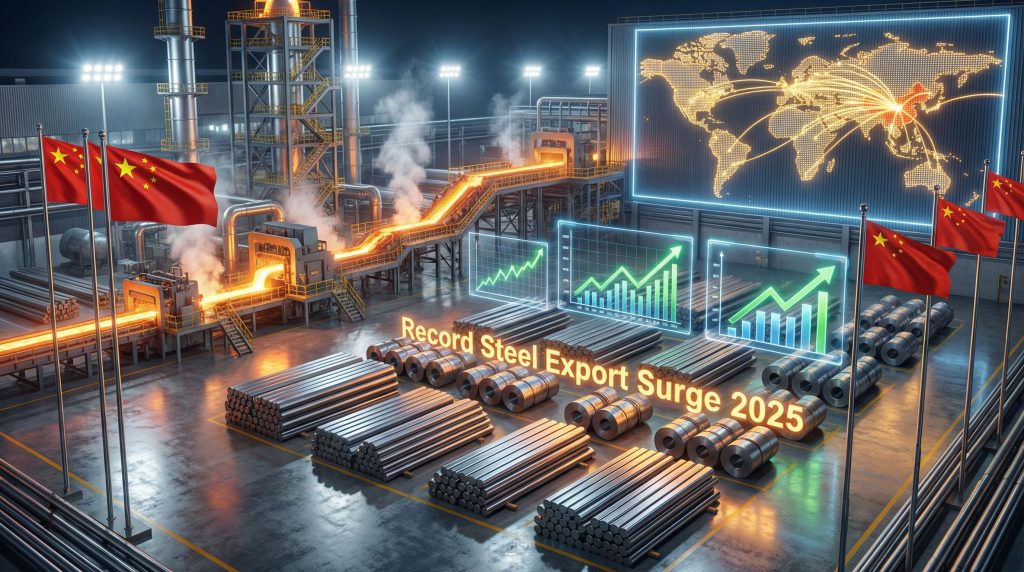
Chinese steel exports increased 6.7% year-over-year to 107.72 million tons during the first 11 months of 2025. Consequently, projecting average December export levels suggests full-year 2025 steel shipments will reach approximately 117 million metric tons, surpassing the previous record of 112.39 million tons established in 2015.
International Price Competitiveness Overcomes Trade Barriers
Despite multiple countries implementing protective tariffs on Chinese steel imports, export volumes have continued accelerating throughout 2025. This apparent contradiction reflects the substantial price advantage Chinese producers maintain against international benchmarks, enabling tariff absorption while preserving competitive positioning.
Furthermore, our comprehensive tariff impact analysis reveals how London Metal Exchange Turkish rebar contracts closed at $560.50 per metric ton during the first week of December 2025, compared to Shanghai rebar equivalent pricing of $442.43 per metric ton. This creates a price differential of approximately 21.1% in favour of Chinese steel, providing sufficient margin to absorb typical tariff rates of 15-25% while maintaining competitive advantage.
Regional Market Penetration Patterns Favour Asian Destinations
The majority of Chinese steel exports are absorbed by other Asian countries, particularly those with limited domestic steel production capacity. This geographic concentration reflects rational economic decision-making where importing Chinese steel proves more cost-effective than developing domestic production capabilities.
Countries receiving substantial Chinese imports typically face constraints including:
- Limited domestic iron ore reserves requiring expensive imports
- Insufficient capital investment in blast furnace infrastructure
- Higher domestic energy costs for steel production
- Geographic proximity reducing transportation costs from Chinese mills
The tariff resistance implemented by various countries has proven ineffective because the underlying cost structure advantages allow Chinese mills to maintain competitive pricing even with tariff-inclusive calculations. However, the effectiveness of these measures continues to be evaluated alongside US-China trade strategies that may influence future trade dynamics.
Supply Chain Redistribution Reshapes Global Steel Markets
The concentration of 117 million metric tons of annual Chinese steel exports represents the largest single-source export supply globally, creating systematic impacts on supply chain dynamics and competitive positioning across regions.
| Market Segment | Chinese Penetration | Price Impact | Regional Response |
|---|---|---|---|
| Construction Steel | High market share | 15-20% discount | Tariff implementation |
| Manufacturing Steel | Moderate growth | 10-15% discount | Mixed resistance |
| Infrastructure Steel | Strategic targeting | Variable pricing | Government intervention |
This market share redistribution creates tiered competitive dynamics where Chinese producers dominate price-sensitive commodity segments while higher-value specialised applications remain contested by developed-economy producers.
Developed Market Producer Adaptation Strategies
European and North American steel producers face margin compression from Chinese competitive pressure, forcing strategic adaptations focused on:
- Product specialisation toward high-strength steel grades
- Corrosion-resistant and technical specification segments
- Higher-margin applications requiring quality premiums
- Capacity optimisation through selective furnace operations
Developing market producers experience more severe competitive displacement, losing market share in commodity segments where Chinese pricing advantages prove insurmountable for local production economics.
Aluminum Export Contraction Reflects Domestic Demand Strength
In stark contrast to steel export acceleration, China's aluminium trade flows demonstrate the opposite dynamic through 2025. Refined aluminium and product exports declined 9.2% to 5.59 million tons during the first 11 months, reflecting strong domestic demand absorption rather than capacity constraints.
China's aluminium production approaches very close to the 45 million metric ton annual production ceiling, but unlike steel, this cap functions as a genuine supply constraint rather than an overflow management mechanism. Nevertheless, recent China demand insights show that domestic demand from manufacturing sector recovery and energy sector expansion has absorbed aluminium production that would otherwise enter export markets.
Price Impact Demonstrates Supply Tightness
The reduction in Chinese aluminium exports has created substantial upward pressure on global benchmark pricing. London Metal Exchange aluminium prices reached $2,920 per metric ton on December 5, 2025, representing the highest level since May 2022. The contract has appreciated 27% since its 2025 low of $2,300 per metric ton recorded in early April.
This 30-month price high demonstrates how Chinese export policy decisions directly impact global commodity pricing mechanisms. For instance, a Mining.com analysis highlights how the loss of Chinese aluminium supply in international markets has provided relief for Western-based smelters, particularly European and Australian operations struggling with rising energy costs.
Domestic Demand Drivers Create Export Constraint
Two primary sectors are absorbing Chinese aluminium production that previously entered export markets:
Manufacturing Sector Recovery:
- Post-COVID manufacturing expansion driving aluminium demand
- Appliances, electronics, automotive applications increasing
- Consumer goods production requiring aluminium inputs
Energy Sector Expansion:
- Renewable energy infrastructure development
- Solar panel frames and wind turbine components
- Power transmission infrastructure requiring substantial aluminium volumes
If Beijing maintains the 45 million metric ton production cap through 2026, global aluminium supply tightening will likely continue, supporting elevated pricing levels and providing ongoing competitive relief for international smelters.
Strategic Implications for Global Commodity Markets
China's divergent approach to steel and aluminium exports reflects sophisticated demand management that prioritises domestic economic objectives while managing international trade relationships. This strategy creates lasting implications for global commodity market structure and competitive dynamics.
Steel Market Outlook Through 2026
The sustainability of record chinese steel exports surge depends primarily on domestic construction sector recovery timing. Key factors influencing export trajectory include:
- Property sector policy changes and demand recovery
- Infrastructure spending levels and steel intensity
- Production cap adjustments or modifications
- International tariff escalation and effectiveness
As long as construction activity remains suppressed, Chinese steel mills will continue pursuing export market profitability or implementing capacity reductions through furnace retirements. Furthermore, understanding these global tariff effects remains crucial for predicting market movements.
Aluminum Supply Constraint Durability
The aluminium market faces fundamentally different dynamics with supply constraints likely persisting through 2026. Continued domestic demand growth from manufacturing and energy sectors, combined with production cap maintenance, suggests:
- Sustained upward pressure on global aluminium pricing
- Continued competitive relief for Western smelters
- Potential for additional price appreciation above $2,920/ton levels
- Supply chain adjustments as consumers adapt to higher pricing
The next major ASX story will hit our subscribers first
Market Adaptation Strategies for Global Participants
The structural nature of China's commodity export divergence requires adaptive strategies across the global supply chain ecosystem, particularly as the broader mining industry evolution continues to reshape competitive landscapes.
Steel Industry Participants
Competing Producers:
- Defensive consolidation and capacity optimisation
- Product specialisation toward premium segments
- Technology advancement for competitive positioning
- Regional market protection through trade policy engagement
Steel Consumers:
- Supply chain diversification beyond Chinese sources
- Inventory management for volatile pricing environments
- Product redesign to accommodate lower-cost alternatives
- Geographic sourcing strategy optimisation
Aluminum Market Positioning
Western Smelters:
- Capacity utilisation optimisation at higher price levels
- Investment in energy-efficient production technologies
- Long-term supply contract negotiations at elevated pricing
- Market share recovery in regions previously dominated by Chinese exports
Aluminum Consumers:
- Supply security through diversified sourcing arrangements
- Material substitution analysis for cost management
- Long-term pricing hedging strategies
- Regional supplier development initiatives
Conclusion: Navigating Structural Commodity Market Changes
China's steel export surge to record levels while simultaneously constraining aluminium shipments represents a sophisticated approach to industrial capacity management that creates lasting global market implications. The 117 million metric tons of projected 2025 steel exports, combined with 9.2% aluminium export reductions, demonstrates how single-country production decisions reshape entire commodity ecosystems.
The steel export acceleration reflects domestic construction weakness forcing mills to pursue international profitability, while aluminium export constraints result from strong domestic demand absorption in manufacturing and energy sectors. These opposing dynamics create distinct competitive landscapes requiring differentiated strategic responses from global market participants.
"The divergence between China's steel and aluminium export strategies illustrates how production caps function differently across commodity sectors, creating steel export pressure while constraining aluminium supply in ways that fundamentally alter global pricing and competitive dynamics."
For international steel producers, the challenge involves adapting to sustained Chinese export pressure through specialisation, efficiency improvements, and defensive market strategies. Aluminium market participants face supply constraint opportunities requiring capacity optimisation and strategic positioning for sustained higher pricing environments.
The sustainability of these trends depends on China's domestic economic recovery patterns, particularly in construction and manufacturing sectors. In addition, as reported by Reuters, market participants should monitor Chinese property sector policies, infrastructure spending levels, and production cap modifications as key indicators for future commodity trade flow directions.
Disclaimer: This analysis is based on publicly available market data and industry reports as of December 2025. Commodity markets involve significant volatility and risk. Market participants should conduct independent analysis and consult qualified professionals before making investment or strategic business decisions.
Looking to Navigate Chinese Commodity Export Shifts?
Discovery Alert's proprietary Discovery IQ model delivers real-time alerts on significant ASX mineral discoveries, helping investors identify opportunities in the evolving global commodity landscape shaped by China's strategic export decisions. With Chinese steel exports hitting record levels while aluminium shipments decline, understanding how these dynamics impact Australian mining companies becomes crucial—start your 30-day free trial today to gain actionable insights ahead of market movements.