
August 3, 2026
Global Steel Market Dynamics and Bilateral Trade Vulnerabilities
The intersection of industrial policy and international trade creates complex webs of economic dependency that can rapidly transform from cooperative partnerships into strategic vulnerabilities. Within the Asia-Pacific region, China-Australia steel trade tensions have generated pricing pressures that transcend simple market mechanisms, revealing how government intervention and strategic industry protection can reshape global commodity flows.
Modern trade relationships in heavy industry sectors demonstrate the fragility of assumptions about comparative advantage when national security considerations enter policy frameworks. The steel manufacturing ecosystem connects raw material suppliers, finished goods producers, and downstream industries in ways that make bilateral tensions particularly disruptive to established supply chains.
When big ASX news breaks, our subscribers know first
Understanding Contemporary Steel Trade Imbalances
Steel market dynamics across the Asia-Pacific region reflect structural overcapacity issues that have persisted since the global financial crisis. Chinese steel production capacity expansion during the 2008-2015 period created sustained downward pressure on global prices, affecting producers worldwide who operate under different cost structures and regulatory environments.
The economic foundation of current tensions stems from allegations that subsidised production creates unfair competitive advantages. Australian steel manufacturers face challenges competing with imports that benefit from different energy costs, labour conditions, and government support mechanisms. These market conditions have prompted regulatory investigations into whether pricing practices constitute dumping under international trade law definitions.
Key market participants include:
• Domestic steel producers seeking protection through government intervention
• Import-dependent construction and manufacturing sectors benefiting from low-cost inputs
• Government agencies balancing industrial policy objectives with trade relationship stability
• Raw material exporters potentially vulnerable to retaliatory measures
Iron Ore Industry Vulnerability Assessment
Australia's iron ore export sector represents one of the most significant single-country dependencies in global commodity markets. The interconnection between steel import policies and iron ore demand creates potential for cascading economic effects that extend far beyond the immediate industries involved.
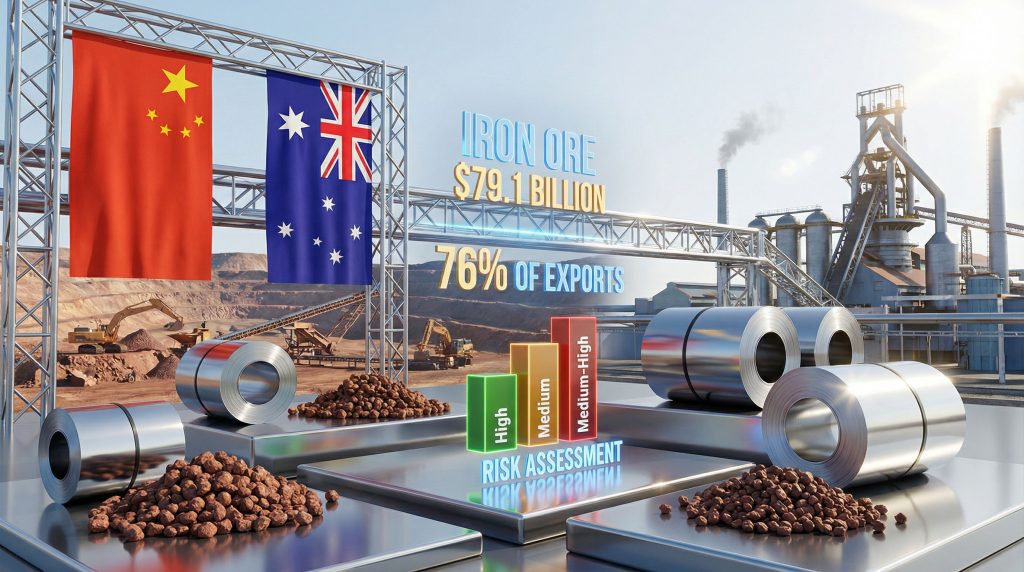
Chinese steel mills consume approximately three-quarters of Australia's iron ore exports, creating a bilateral relationship where trade protection measures in one sector can trigger responses affecting upstream suppliers. This dependency relationship illustrates how modern commodity markets create strategic vulnerabilities that complicate traditional trade policy approaches.
Economic Impact Analysis Framework
| Economic Indicator | Current Exposure | Vulnerability Level |
|---|---|---|
| Iron Ore Export Revenue | $75+ billion annually | Critical |
| Employment Direct/Indirect | 300,000+ positions | High |
| Regional Community Dependence | Multiple mining towns | Severe |
| Government Royalty Income | Billions per annum | Significant |
The employment implications extend beyond direct mining jobs to encompass transportation, port operations, equipment manufacturing, and professional services. Regional communities in Western Australia and South Australia depend heavily on mining sector economic activity, creating concentrated vulnerability to trade disruptions.
Chinese steel producers have demonstrated their ability to influence Australian commodity markets through selective purchasing decisions and premium pricing negotiations. State-controlled buying entities can coordinate market approaches in ways that private sector purchasers typically cannot, adding geopolitical dimensions to commercial relationships.
Furthermore, current iron ore price trends suggest that market volatility will likely continue as these tensions unfold.
Theoretical Frameworks for Trade Protection Analysis
Economic theory provides multiple lenses through which to analyse steel trade tensions, each offering different insights into optimal policy responses and likely outcomes. Classical comparative advantage theory suggests specialisation benefits both trading partners, but modern strategic trade theory recognises that certain industries may justify protection for national security or technological spillover reasons.
The prisoner's dilemma framework applies particularly well to China-Australia steel trade tensions. Both countries benefit from cooperative trade relationships, but each faces incentives to protect domestic industries even when such protection might trigger retaliatory responses that leave both parties worse off than under free trade scenarios.
Game Theory Applications in Trade Policy
Strategic interactions between governments involve incomplete information about the other party's priorities and constraints. Australia must consider whether China views steel industry protection as a minor trade irritant or a significant challenge to its industrial export strategy. Similarly, China must assess whether Australia's actions represent broader containment policies or narrow industry protection measures.
Nash equilibrium outcomes in trade disputes often involve both parties implementing suboptimal policies because cooperation requires trust and coordination that may be difficult to achieve when domestic political pressures favour protectionist responses.
International Steel Market Context
Global steel production capacity exceeds demand by significant margins, creating structural oversupply that suppresses prices worldwide. Chinese production capacity represents approximately half of global steel output, giving Chinese policy decisions substantial influence over international market conditions.
The persistence of excess capacity reflects industrial policy approaches that prioritise employment and regional development over market efficiency. Steel production provides employment in regions where alternative industries may be limited, creating political incentives to maintain capacity even during periods of weak demand.
Additionally, broader tariffs impact investment markets in ways that compound these structural challenges.
Regional Production Cost Comparisons
Manufacturing cost differences between countries reflect multiple factors including energy prices, labour costs, environmental regulations, and capital access. Chinese steel producers benefit from integrated supply chains, government-coordinated investment, and energy cost structures that may not fully reflect market pricing for inputs.
Australian steel producers operate within different regulatory frameworks that impose environmental compliance costs and safety requirements that may not apply equally to international competitors. These regulatory differences create competitive challenges that extend beyond simple labour cost comparisons.
Macroeconomic Implications for Australia
Steel trade tensions carry implications that extend throughout Australia's economy, affecting employment, government revenues, regional development, and international investment flows. The mining sector's significance to Australia's economic structure means that disruptions to iron ore demand could trigger broader adjustment challenges.
Employment and Regional Economic Effects
Direct employment in Australia's iron ore sector exceeds 200,000 positions, with additional indirect employment in transportation, equipment supply, professional services, and regional support industries. Mining communities depend heavily on sustained commodity demand for economic viability.
The multiplier effects of mining employment extend through regional economies where mining wages support retail, housing, education, and healthcare sectors. Reduced mining activity creates cascading effects that can devastate regional communities with limited economic diversification.
Consequently, understanding the iron ore decline analysis becomes crucial for predicting these broader economic impacts.
Currency and Financial Market Implications
The Australian dollar's status as a commodity currency means that trade tensions affecting major export sectors can influence exchange rates and capital flows. Uncertainty about China-Australia trade relationships may affect investor confidence in resource sector investments and broader economic stability.
"Iron ore price volatility historically correlates strongly with Australian dollar movements, creating feedback loops between trade tensions and broader economic conditions."
Government fiscal positions also depend significantly on mining sector royalties and corporate tax revenues. Reduced profitability in iron ore operations would affect both federal and state government budgets, potentially requiring fiscal adjustments or reduced public spending.
The next major ASX story will hit our subscribers first
Investment Market Response Patterns
Financial markets typically respond to trade tension announcements through increased volatility in affected sector equities and adjustments to risk premiums for companies with high exposure to bilateral trade relationships. Resource sector stocks demonstrate particular sensitivity to policy announcements that might affect China-Australia commercial relationships.
Equity Market Vulnerability Assessment
Major Australian resource companies face market valuation adjustments when trade tensions escalate. Companies with high exposure to Chinese demand, including BHP Group Limited and Rio Tinto Limited, experience stock price volatility correlating with policy announcement timing.
Project financing costs may increase as lenders incorporate geopolitical risk premiums into loan pricing. Long-term investment decisions become more difficult when policy uncertainty clouds future cash flow projections.
Credit rating agencies monitor trade tension developments for potential impacts on sovereign and corporate credit assessments. Sustained disruption to major export sectors could affect Australia's economic growth prospects and debt servicing capacity.
However, the broader tariff economic implications extend well beyond bilateral relationships and influence global investment patterns.
Policy Tool Analysis and Implementation Options
Australian policymakers possess multiple instruments for addressing steel dumping concerns, each carrying different economic costs, legal requirements, and diplomatic implications. Anti-dumping investigations represent the most common approach but require extensive documentation and may take months or years to complete.
Regulatory Framework Mechanisms
The Productivity Commission conducts anti-dumping investigations under established legal procedures that require proof of material injury to domestic industries and evidence of below-cost pricing by foreign competitors. These investigations follow World Trade Organisation guidelines and international law requirements.
Safeguard measures provide temporary protection during periods of import surge that threaten domestic industry viability. These measures must be applied on a non-discriminatory basis and include compensation mechanisms for affected trading partners.
Negotiated voluntary restraint agreements offer alternatives to formal tariff imposition but require cooperation from exporting countries and may violate WTO principles if they restrict trade below market-determined levels.
Policy Implementation Considerations
Effective policy responses require coordination between:
• Trade policy agencies responsible for international agreement compliance
• Industry regulators monitoring market competition and consumer interests
• Diplomatic services managing broader bilateral relationship considerations
• Treasury departments assessing macroeconomic implications of policy choices
Regional Trade Integration Challenges
Steel trade tensions occur within the broader context of regional economic integration efforts, including the Comprehensive and Progressive Trans-Pacific Partnership and Regional Comprehensive Economic Partnership agreements. Bilateral disputes can undermine multilateral cooperation frameworks that depend on trust and shared commitment to trade liberalisation principles.
Supply Chain Diversification Strategies
Companies increasingly evaluate supply chain resilience strategies that reduce dependence on single-country relationships. This diversification trend affects both steel importers seeking alternative suppliers and iron ore exporters developing relationships with non-Chinese steel producers.
Regional supply chain integration requires infrastructure investment, relationship building, and technology transfer that may take years to implement effectively. Short-term policy responses must consider long-term structural adjustment requirements.
Moreover, US‑China trade impacts demonstrate how bilateral tensions can reshape global supply chains beyond the immediate parties involved.
Strategic Industry Policy Considerations
Modern economies face tensions between efficiency maximisation through international specialisation and maintaining domestic industrial capabilities for strategic security reasons. Steel production capabilities connect to defence manufacturing, infrastructure development, and technological innovation ecosystems that justify consideration beyond pure economic efficiency metrics.
Technology and Innovation Dimensions
Advanced steel manufacturing increasingly involves sophisticated metallurgy, environmental control systems, and quality management processes that generate technological spillovers benefiting other industries. Maintaining domestic steel production capacity may support broader industrial innovation capabilities.
Research and development investments in steel technology can contribute to competitive advantages in related manufacturing sectors. Policy approaches must balance short-term protection costs against long-term innovation and industrial development benefits.
Recent developments suggest that China's steel industry faces significant challenges that could reshape the competitive landscape moving forward.
Future Scenario Development Framework
Trade tension outcomes depend on multiple variables including global economic conditions, domestic political considerations in both countries, and broader geopolitical relationship evolution. Scenario planning helps policymakers prepare for different possible outcomes and develop contingency response strategies.
Probability-Weighted Outcome Analysis
| Scenario | Key Characteristics | Economic Impact | Policy Response |
|---|---|---|---|
| Negotiated Settlement | Limited tariffs, consultation mechanisms | Minimal disruption | Status quo maintenance |
| Graduated Protection | Selective tariffs, safeguard measures | Moderate adjustment costs | Diversification acceleration |
| Trade Conflict Escalation | Comprehensive restrictions, retaliation | Significant economic disruption | Emergency policy intervention |
The most likely outcomes involve some form of managed protection that balances domestic industry concerns with broader economic relationship preservation. Complete trade conflict escalation remains unlikely given the mutual economic dependence between the countries.
Analysis suggests that strategic trade relationships require careful balance between economic interests and security considerations.
Long-Term Structural Adjustment Imperatives
Regardless of immediate policy responses to steel trade tensions, Australia faces longer-term challenges in managing economic relationships with dominant trading partners while maintaining industrial diversity and strategic autonomy. These challenges require coordinated policy approaches that extend beyond single-sector protection measures.
Economic diversification strategies must recognise that commodity exports will likely remain central to Australia's international economic position while developing complementary capabilities in technology, services, and advanced manufacturing sectors that reduce vulnerability to single-sector disruptions.
The resolution of current China-Australia steel trade tensions will establish precedents for managing future disputes in other sectors while maintaining the broader economic relationship that benefits both countries. Success requires sophisticated understanding of how sectoral policies interact with broader economic and strategic considerations in an increasingly complex global trading environment.
In conclusion, these tensions represent more than simple trade disputes—they reflect fundamental questions about economic interdependence, strategic autonomy, and the future structure of global supply chains. How Australia navigates these challenges will significantly influence both its economic prosperity and regional strategic position in the coming decades.
Looking to Navigate Mining Investment Opportunities Amid Trade Volatility?
Discovery Alert's proprietary Discovery IQ model delivers real-time alerts on significant ASX mineral discoveries, helping investors identify actionable opportunities even during periods of trade uncertainty and commodity market shifts. With Australia's resource sector facing complex global dynamics, subscribers gain crucial market intelligence to make informed investment decisions ahead of broader market movements—begin your 30-day free trial today to secure your competitive advantage.