July 28, 2026
Global Supply Chain Disruption: How Complex Brine Chemistry Reshapes Lithium Market Dynamics
The global transition toward electric mobility has created unprecedented demand for lithium-ion batteries, fundamentally altering how nations approach mineral resource development. Within this landscape, countries possessing significant lithium reserves face mounting pressure to transform geological endowments into industrial capacity. The challenge extends beyond mere extraction to encompass technological sophistication, regulatory frameworks, and international partnership structures that determine whether massive underground resources translate into market-relevant production capacity.
Complex brine chemistry presents unique technical obstacles that traditional salt flat extraction methods struggle to overcome efficiently. High magnesium-to-lithium ratios, elevated impurity levels, and challenging processing requirements create economic bottlenecks that separate resource potential from commercial viability. Understanding these technical dynamics becomes essential for investors, policymakers, and industry participants evaluating long-term supply security in the global battery materials sector. The lithium extraction in Bolivia exemplifies these challenges, where vast reserves meet complex technical and regulatory obstacles.
When big ASX news breaks, our subscribers know first
Bolivia's Lithium Endowment: Resource Scale and Geographic Significance
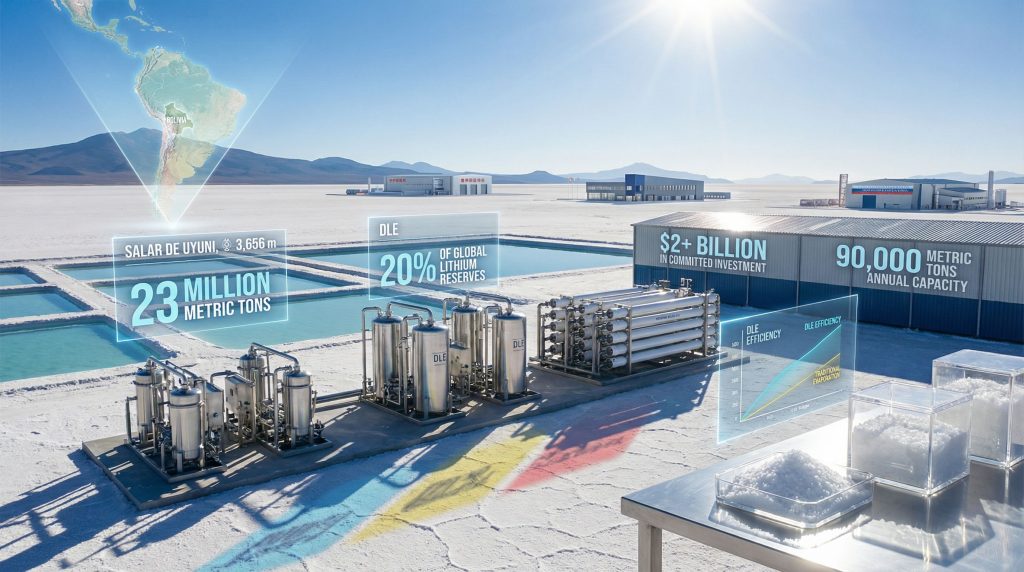
Bolivia commands approximately 23 million metric tons of lithium resources, representing roughly 20% of global identified reserves according to recent geological assessments. This positioning places the South American nation within the upper tier of lithium-rich countries, competing directly with Argentina and Chile within the renowned Lithium Triangle region. The resource concentration across Bolivia's salt flats creates potential for substantial annual production volumes, theoretically capable of supporting battery manufacturing for millions of electric vehicles once fully developed.
The Salar de Uyuni, situated at 3,656 meters above sea level, contains the majority of Bolivia's lithium resources within its expansive salt flat system. This geological formation spans over 10,000 square kilometers, making it the world's largest salt flat and a critical component of South America's lithium resource base. Furthermore, the elevated altitude presents operational challenges including extreme weather conditions, logistical complexities, and infrastructure requirements that significantly impact development costs and timelines.
Bolivia's resource distribution extends beyond Uyuni to encompass additional salt flats including Coipasa and five smaller formations across the Altiplano region. Each location presents distinct brine chemistry profiles, mineral concentrations, and extraction requirements that influence processing technology selection and economic viability. Consequently, the geographic spread of these resources provides diversification opportunities while complicating unified development strategies.
Comparative Resource Analysis Within the Lithium Triangle
| Country | Estimated Reserves (Million Tonnes) | Primary Salt Flats | Key Advantages | Technical Challenges |
|---|---|---|---|---|
| Bolivia | 23 | Uyuni, Coipasa | Largest single deposit | High Mg:Li ratio (20:1) |
| Argentina | 22 | Hombre Muerto, Olaroz | Lower processing costs | Water scarcity issues |
| Chile | 9.6 | Atacama | Established infrastructure | Environmental restrictions |
The comparative analysis reveals Bolivia's resource magnitude advantage while highlighting the technical processing challenges that have historically limited commercial development. In addition, Argentina lithium insights demonstrate lower magnesium-to-lithium ratios that enable more cost-effective traditional evaporation methods, while Chile's mature infrastructure provides operational advantages despite smaller reserve quantities.
Technical Barriers Limiting Production Development
Bolivia's lithium extraction in Bolivia faces three primary technical obstacles that distinguish it from other major producing regions. High magnesium content within Uyuni's brine creates processing complexities requiring advanced separation technologies rather than conventional evaporation methods. The magnesium-to-lithium ratio approaching 20:1 significantly exceeds ratios found in Chilean or Argentine salt flats, necessitating additional purification stages and increasing production costs.
Landlocked geography compounds extraction challenges through elevated transportation costs and limited port access options. Raw materials and finished products must traverse extensive overland routes to reach Pacific or Atlantic shipping terminals, adding logistical complexity and cost premiums that impact project economics. This geographic constraint affects both input costs for processing equipment and chemicals as well as export revenue realisation for finished lithium products.
Infrastructure limitations throughout Bolivia's mining regions create additional development barriers. Limited road networks, inconsistent power supply, and minimal processing facilities require substantial upfront capital investment before extraction operations can commence. However, the combination of high-altitude conditions, remote locations, and underdeveloped industrial infrastructure creates compound challenges for international investors and technology providers.
Traditional vs. Advanced Extraction Method Comparison
| Parameter | Evaporation Ponds | Direct Lithium Extraction | Membrane Technology |
|---|---|---|---|
| Recovery Rate | 20-40% | 80-95% | 70-85% |
| Processing Time | 12-36 months | Days to weeks | 2-4 weeks |
| Water Usage (m³/tonne) | 100-800 | 50-200 | 75-300 |
| Magnesium Tolerance | Poor | Excellent | Good |
| Capital Investment | Low | High | Medium |
The comparison demonstrates why Direct Lithium Extraction (DLE) technology represents Bolivia's most viable pathway toward commercial production despite higher upfront costs. Furthermore, traditional evaporation methods prove economically unviable due to extended processing times and poor recovery rates in high-magnesium environments. This technological advancement aligns with broader mining industry evolution trends towards more efficient extraction methods.
State Control and Investment Framework Challenges
Yacimientos de Litio Bolivianos (YLB) maintains monopoly control over Bolivia's lithium resources through state ownership structures that complicate private investment attraction. The agency's dual role as regulatory authority and industrial operator creates institutional tensions affecting project bankability and international partnership development. Foreign investors face uncertainty regarding technology transfer requirements, profit-sharing arrangements, and operational control parameters under YLB's oversight framework.
Bolivia's industrialisation mandate requires downstream processing development rather than raw material exports, creating additional complexity for international partners. This policy approach demands integrated facility development including lithium carbonate production, battery material manufacturing, and potentially complete battery assembly operations. The mandate increases capital requirements while extending project timelines and technical risk profiles.
Political transitions have historically disrupted major lithium development agreements, creating investor concern regarding contract stability and policy continuity. Recent changes in government leadership have introduced opportunities for partnership realignment while maintaining underlying uncertainty about long-term policy consistency. Consequently, the challenge of balancing nationalist resource control objectives with international technology and capital requirements continues to impact project development momentum.
Industry Analysis Insight: Bolivia's state-controlled approach creates a fundamental tension between maximising resource value through international partnerships and maintaining sovereign control over strategic mineral assets. This balance significantly influences project bankability and financing accessibility.
Direct Lithium Extraction: Technology Solutions for Complex Brines
Direct Lithium Extraction (DLE) technology represents Bolivia's primary pathway toward overcoming high-magnesium processing challenges. These advanced systems utilise selective ion exchange processes and membrane separation techniques to achieve high lithium recovery rates while managing impurity levels that render traditional evaporation methods economically unviable. DLE systems can process complex brines within days or weeks rather than the 12-36 month timeline required for conventional evaporation approaches.
Sorbent-based separation systems specifically address magnesium interference through selective lithium binding that excludes competing ions. These technologies enable processing of brines with magnesium-to-lithium ratios exceeding 20:1, making Uyuni's challenging chemistry commercially accessible. The technology's ability to maintain high recovery rates in complex brine environments positions DLE as essential for Bolivia's lithium development strategy.
Membrane filtration advances provide complementary separation capabilities through size-selective barriers that isolate lithium ions while rejecting larger magnesium and calcium compounds. Combined DLE and membrane systems achieve recovery rates between 80-95% compared to traditional evaporation's 20-40% efficiency in high-magnesium environments. This technological advancement supports battery-grade lithium refining requirements for downstream applications.
Recent Innovation and Patent Development
Bolivia's state lithium agency submitted patent applications in January 2025 covering DLE processes specifically designed for complex brine chemistry. These applications address technical innovations developed through pilot plant operations and represent Bolivia's effort to develop proprietary extraction intellectual property. The patent portfolio includes both process improvements and industrial equipment designs for portable charging systems, indicating broader technological development ambitions.
The patent applications demonstrate Bolivia's strategic approach toward capturing technology value rather than solely licensing international extraction methods. This intellectual property development strategy aligns with the country's broader industrialisation objectives while potentially creating revenue streams through technology licensing to other high-magnesium brine operations globally.
International Partnership Landscape and Investment Commitments
Bolivia's recent partnership agreements represent over $2 billion in committed international investment targeting combined annual production capacity exceeding 90,000 metric tons of lithium carbonate equivalent. These agreements span Chinese, Russian, and emerging European partnerships, each bringing distinct technological capabilities and market access advantages while creating geopolitical complexity for Bolivia's resource development strategy.
Chinese partnerships through CBC (Contemporary Amperex Technology) involve integrated battery supply chain development combining lithium extraction with downstream processing capabilities. The partnership structure includes technology transfer provisions, joint venture arrangements, and potential battery manufacturing facility development within Bolivia. Chinese involvement provides access to established battery industry relationships and proven DLE technology systems.
Russian engagement through Uranium One brings nuclear industry expertise in complex mineral processing and state-to-state partnership experience. This collaboration emphasises advanced extraction technology development and potential uranium-lithium co-processing opportunities within Bolivia's mineral-rich regions. The partnership includes substantial infrastructure development commitments and technology training programs, though recent geopolitical developments have created additional complexity.
Partnership Investment Analysis
| Partnership | Investment Commitment | Technology Focus | Annual Capacity Target | Development Timeline |
|---|---|---|---|---|
| CBC/CATL (China) | $1.03 billion | Integrated DLE + Battery | 75,000 tpa | 2025-2027 |
| Uranium One (Russia) | $970 million | Advanced DLE Systems | 14,000 tpa | 2025-2026 |
| European Consortium | Under negotiation | Sustainable Extraction | 25,000+ tpa | 2026-2028 |
Recent political developments have introduced uncertainty regarding partnership continuity and contract enforcement. Judicial challenges halted several 2024 partnership agreements, creating investor concern about policy stability and contract sanctity. The resolution of these legal disputes significantly impacts Bolivia's ability to attract additional international investment and technology partnerships.
The next major ASX story will hit our subscribers first
Environmental Sustainability and Community Impact Considerations
Water resource management presents critical challenges for lithium extraction in Bolivia's arid highland environment. Traditional evaporation methods consume between 500-800 cubic meters of water per metric ton of lithium produced, potentially depleting local aquifers and disrupting agricultural activities within indigenous communities. Advanced DLE technology offers 50-75% water consumption reduction compared to conventional approaches, addressing environmental sustainability concerns while improving community relations.
Indigenous community consultation requirements affect project development timelines and social license maintenance throughout Bolivia's lithium regions. Local Quechua and Aymara communities possess traditional land use rights and cultural connections to salt flat areas targeted for lithium extraction. For instance, meaningful consultation processes and benefit-sharing arrangements significantly influence project acceptance and operational continuity.
Agricultural impact assessments reveal potential conflicts between lithium extraction activities and traditional farming practices dependent on regional water resources. Community reports indicate concerns about farming disruption in areas surrounding active extraction zones. These concerns require comprehensive mitigation strategies including water recycling systems, alternative agricultural support programs, and transparent environmental monitoring protocols.
Environmental Impact Comparison
• Traditional Evaporation: High water consumption, extensive land use, long-term pond maintenance requirements
• DLE Technology: Reduced water usage, smaller surface footprint, potential for water recycling systems
• Membrane Systems: Moderate water consumption, chemical processing requirements, waste stream management needs
• Combined Approaches: Optimised resource efficiency, higher capital costs, complex operational management
The integration of renewable energy in mining operations could further reduce environmental impacts while supporting sustainable extraction practices.
Production Scenarios and Market Timing Analysis
Bolivia's lithium production development faces critical timing challenges within rapidly evolving global battery material markets. Conservative development scenarios project initial commercial production reaching 15,000-25,000 metric tons annually by 2027, representing entry-level market participation rather than significant global supply impact. This timeline assumes successful resolution of current partnership disputes and effective DLE technology implementation.
Aggressive expansion scenarios envision 90,000+ metric tons annual production by 2030 through full partnership implementation and additional international agreements. This production level would represent approximately 8-10% of projected global lithium demand, positioning Bolivia as a major supply source within the global battery materials sector.
Current market price volatility affects project economics and investment timeline decisions. Low lithium carbonate prices reduce project returns and complicate financing arrangements, potentially delaying full-scale development regardless of technical progress. Successful project development requires sustained lithium price recovery supporting long-term investment commitments. Drawing insights from Australia lithium innovations demonstrates how supportive policy frameworks can accelerate development timelines.
Production Timeline Projections
Phase 1 (2025-2027): Initial Commercial Operations
• First industrial plant optimisation and capacity expansion
• Partnership agreement resolution and project restart
• DLE technology pilot scaling and optimisation
• Target output: 25,000-40,000 tpa lithium carbonate equivalent
Phase 2 (2027-2030): Major Partnership Implementation
• Large-scale DLE facility construction and commissioning
• Multiple salt flat development and integrated processing
• Export infrastructure development and logistics optimisation
• Target output: 75,000-120,000 tpa lithium carbonate equivalent
Phase 3 (2030+): Market Leadership Position
• Downstream battery material manufacturing integration
• Regional processing hub development and technology export
• Diversified product portfolio including specialty lithium compounds
• Target output: 150,000+ tpa lithium carbonate equivalent
Investment Risk Assessment and Financial Considerations
Political stability concerns represent the primary investment risk for Bolivia's lithium sector development. Historical policy volatility, contract disputes, and changing government priorities create uncertainty regarding long-term partnership sustainability and return realisation. Recent judicial interventions halting major agreements exemplify these institutional risks affecting investor confidence.
Technical execution risks involve unproven DLE technology performance at commercial scale within Bolivia's challenging brine chemistry. While pilot operations demonstrate technological feasibility, scaling to industrial production volumes presents unknown operational challenges and potential cost escalations. Quality consistency requirements for battery-grade lithium compound complexity through varying seasonal conditions and brine composition changes.
Currency and macroeconomic stability affect project returns and financing accessibility throughout development timelines. Bolivia's economic pressures including inflation, fuel shortages, and foreign exchange reserve constraints create additional investment considerations beyond mining-specific risks. These macroeconomic factors influence both local operational costs and international partnership terms.
Risk Mitigation Strategies
| Risk Category | Mitigation Approaches | Implementation Requirements |
|---|---|---|
| Political/Regulatory | International arbitration clauses, staged investment | Bilateral investment treaties, escrow arrangements |
| Technical/Operational | Phased capacity scaling, technology partnerships | Pilot plant validation, equipment redundancy |
| Market/Financial | Off-take agreements, price hedging | Long-term supply contracts, financial derivatives |
| Environmental/Social | Community benefit-sharing, water recycling | Stakeholder engagement, monitoring systems |
Global Supply Chain Implications and Market Integration
Bolivia's successful lithium development would significantly impact global supply concentration currently dominated by Australian hard-rock mining and Chilean brine operations. Diversified supply sources reduce geopolitical risks affecting battery material security while potentially stabilising long-term lithium pricing through increased production capacity.
Technology transfer effects extend beyond Bolivia to influence lithium extraction methods globally. DLE technology optimisation for high-magnesium brines creates intellectual property and operational knowledge applicable to similar challenging deposits worldwide. Bolivia's technical innovations could accelerate extraction efficiency improvements throughout the global lithium industry.
Regional integration opportunities within the Lithium Triangle enable coordinated development approaches maximising South American resource advantages. Shared technology development, integrated logistics networks, and coordinated market strategies could enhance competitive positioning relative to Australian and North American lithium producers.
Bolivia's lithium extraction in Bolivia represents a critical test case for complex resource development requiring advanced technology integration, international partnership management, and sustainable community engagement. Success would demonstrate pathways for other nations possessing challenging mineral deposits to participate meaningfully in global battery material supply chains.
The convergence of massive resource endowments, breakthrough extraction technologies, and international partnership capital creates unprecedented opportunity for transformational economic development. However, realising this potential requires resolving institutional challenges, maintaining policy stability, and executing complex technical projects within competitive global market timeframes.
Disclaimer: This analysis involves forward-looking projections and assumptions about technology development, political stability, and market conditions that may not materialise as anticipated. Investment decisions should incorporate comprehensive due diligence and professional financial advice considering individual risk tolerance and investment objectives.
Ready to Discover the Next Major Mineral Breakthrough?
Discovery Alert's proprietary Discovery IQ model instantly identifies significant mineral discoveries across the ASX, including lithium exploration plays that could capitalise on global supply chain disruptions. Understand how historic mineral discoveries generate substantial returns and begin your 14-day free trial today to position yourself ahead of the market.