June 15, 2026
Global Supply Chain Vulnerabilities Drive Structural Market Transformation
The global potash market operates within a complex web of geological limitations, infrastructure bottlenecks, and concentrated production capacity that fundamentally shapes pricing dynamics and supply security. Unlike many commodity markets, potash production remains geographically constrained by specific geological formations, creating inherent supply vulnerabilities that persist regardless of geopolitical developments.
Current market conditions reflect deeper structural issues beyond temporary sanctions or policy changes. The industry's reliance on a handful of major production centers creates systemic risks that affect global food security and agricultural productivity across all major farming regions. Furthermore, these tariffs market impact considerations add complexity to the already challenging market dynamics.
When big ASX news breaks, our subscribers know first
How Production Bottlenecks Shape Market Fundamentals
Mining Infrastructure Creates Natural Monopolies
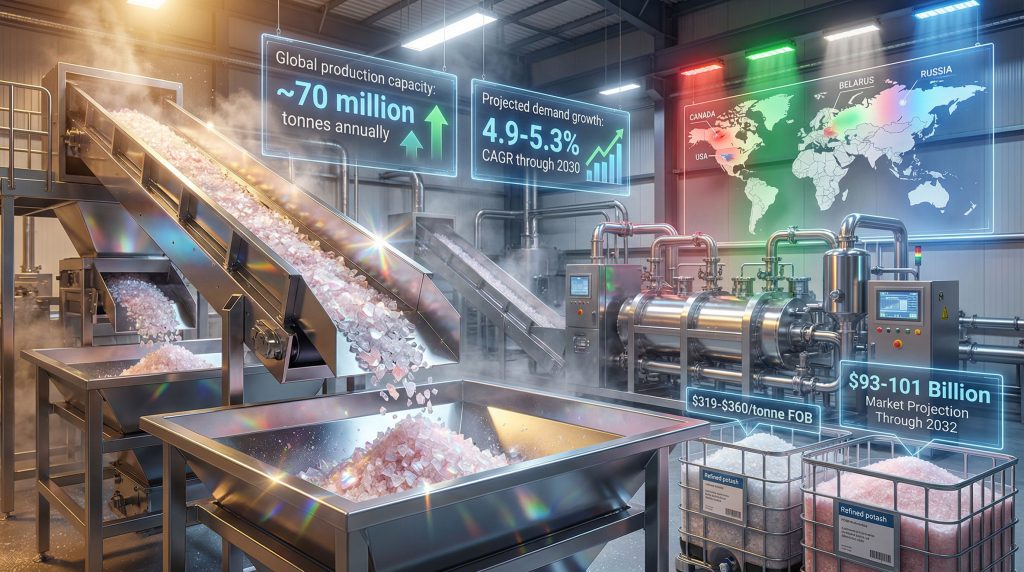
Potash extraction requires massive capital investments and specific geological conditions that limit new entrant possibilities. Current global production capacity operates near 70 million tonnes annually, yet demand projections suggest consumption will reach 40.9 million tonnes K2O equivalent by 2025, indicating tight supply-demand balance.
The concentration of production among four major suppliers creates market vulnerabilities:
• Canada: Nutrien Ltd. dominates North American production through Saskatchewan operations
• Belarus: State-controlled Belaruskali maintains approximately 20% global market share
• Russia: Uralkali PJSC controls significant Eurasian supply
• United States: Mosaic Co. provides domestic production base
Infrastructure Dependencies Limit Supply Flexibility
Belarus exemplifies how geographic constraints affect market dynamics regardless of policy changes. The country lacks direct seaport access, forcing reliance on Russian Baltic terminals and rail exports to China for international distribution. This infrastructure dependency creates persistent logistical costs and supply chain risks.
Recent export data demonstrates market adaptation capabilities: Belarus achieved 88% of pre-sanctions export levels in 2024 through alternative shipping routes, though at higher operational costs. This recovery illustrates both supply chain resilience and the permanent cost implications of geographic limitations. Additionally, the mining industry evolution continues to reshape operational efficiency across global markets.
Capacity Expansion Faces Extended Lead Times
New potash production projects typically require 7-10 years from initial development to commercial operation. Current projections indicate less than 3 million tonnes of additional capacity will come online between 2025-2027, insufficient to meet projected demand growth of 4.9-5.3% CAGR through 2030.
This extended development timeline creates structural supply constraints that persist independent of short-term policy changes or market disruptions. Consequently, industry consolidation trends are accelerating as companies seek to secure long-term production capacity.
Agricultural Demand Drivers Support Long-Term Growth Trajectory
Regional Consumption Patterns Drive Market Expansion
Asia-Pacific markets account for over 38% of global consumption, driven by intensive agricultural practices in potassium-deficient soils. China and India's expanding crop production requires continuous potash application to maintain soil fertility and agricultural productivity.
Key regional growth drivers include:
• China: Industrial-scale agriculture supporting 1.4 billion population
• India: Government food security initiatives requiring fertilizer subsidies
• Brazil: Intensive row-crop production for global export markets
• Argentina: Expanding agricultural sector focusing on soybeans and grain
Food Security Policies Create Demand Stability
National agricultural policies increasingly recognize potash as strategically critical for food security. Government programs supporting fertilizer access, stockpiling initiatives, and import diversification create sustained demand foundations that reduce market cyclicality.
These policy frameworks provide demand stability during economic uncertainty while supporting long-term consumption growth aligned with population expansion and dietary improvements in developing regions. However, trade war effects continue to influence agricultural trade patterns globally.
Premium Product Segments Expand Market Value
While Muriate of Potash (MOP) dominates volume consumption, specialty products drive market value expansion:
| Product Type | Market Position | Application Focus |
|---|---|---|
| Muriate of Potash | ~50% revenue share | General crop production |
| Potassium Sulfate | Premium pricing | Chloride-sensitive crops |
| Controlled-release | Specialty segment | Precision agriculture |
| Micronutrient blends | Customized solutions | High-value crop production |
Current Pricing Dynamics Reflect Structural Tightness
Market Fundamentals Support Price Stability
Current spot prices ranging $319-$360 per tonne FOB reflect underlying supply-demand imbalances rather than speculative trading patterns. Inventory levels at major import terminals remain below historical averages, creating competitive bidding for available supply.
Market analysts note that recent policy changes have generated muted reactions from major producers, suggesting current tight supply conditions stem from structural factors rather than temporary disruptions. In this context, market volatility hedging strategies become increasingly important for market participants.
Seasonal Demand Amplifies Price Volatility
Potash markets exhibit pronounced seasonal patterns that interact with limited storage capacity:
• Q1-Q2: Peak application season drives demand spikes during planting periods
• Q3: Harvest activities create temporary demand reduction
• Q4: Forward contracting for following growing season begins
• Storage limitations: Port terminal capacity constraints amplify seasonal price swings
Cost Structure Pressures Support Price Floors
Production cost inflation affects all major suppliers through:
• Energy costs: Natural gas and electricity for mining operations
• Transportation: Rail and shipping cost increases
• Currency fluctuations: Impact on international trade settlements
• Infrastructure maintenance: Aging mine and processing equipment
Geopolitical Factors Reshape Global Trade Networks
Supply Chain Adaptation Demonstrates Market Resilience
The Belarus sanctions case study reveals market adaptation mechanisms. Despite initial disruption, alternative shipping routes through Russia enabled 88% export recovery by 2024, though at increased operational costs. This demonstrates both supply chain flexibility and permanent efficiency losses.
Industry analysts observe that because Belarus has largely regained global market share, additional US market access may simply redistribute existing supply rather than create net new capacity. This dynamic suggests limited impact on global pricing from recent policy changes.
Strategic Stockpiling Reduces Available Supply
Major importing nations increasingly maintain strategic fertilizer reserves, effectively removing supply from commercial markets. These stockpiling programs create demand floors during market weakness while reducing supply availability during tight market conditions.
Regional Trade Partnerships Evolve
Agricultural trade increasingly organizes around regional supply security:
• North America: Integrated US-Canada production and distribution
• Eurasia: Russia-Belarus-Central Asia corridor development
• South America: Brazil-Argentina regional cooperation frameworks
• Asia-Pacific: China-led import diversification strategies
Investment Landscape Reflects Structural Advantages
Producer Consolidation Benefits Existing Players
Limited new production capacity combined with high capital requirements favors existing major producers through:
• Pricing power: Oligopolistic market structure supports margin stability
• Operational scale: Integrated supply chains reduce unit costs
• Market access: Established distribution networks create barriers to entry
• Resource control: Access to high-grade ore bodies provides competitive advantages
Infrastructure Investment Requirements Create Barriers
Market expansion requires substantial infrastructure development:
• Port capacity: Enhanced export terminal facilities
• Rail networks: Improved transportation from mine to market
• Storage facilities: Strategic inventory management capabilities
• Processing technology: Efficiency improvements and product quality enhancement
Technology Integration Creates Differentiation Opportunities
Digital agriculture adoption enables new market segments:
• Precision nutrient management: Real-time soil monitoring integration
• Customized formulations: Crop-specific nutrient blending
• Application timing: Weather and growth stage optimization
• Yield optimization: Data-driven fertilizer recommendation systems
The next major ASX story will hit our subscribers first
Long-Term Market Evolution Through 2030
Demand Sustainability Considerations
Future consumption growth faces potential moderation from agricultural efficiency improvements:
• Precision agriculture: More efficient nutrient application reduces waste
• Soil health programs: Organic matter restoration improves nutrient retention
• Crop breeding: Enhanced nutrient use efficiency in new varieties
• Alternative sources: Recycling and bio-based nutrient development
Supply Response Timeline Constraints
New production capacity development requires extended periods from project initiation to commercial production. Current pipeline projects suggest supply constraints persist through 2027-2028, supporting sustained pricing strength during this period.
Environmental permitting, community engagement, and technical development phases each require multiple years, creating natural supply response delays that benefit existing producers. For instance, potash industry analysis indicates the market is expected to reach $93.5 billion by 2032.
Market Scenario Analysis
Three potential market trajectories emerge based on demand growth and supply response timing:
| Scenario | Price Range | Key Drivers | Probability Factors |
|---|---|---|---|
| Sustained Strength | $300+ through 2027 | Delayed capacity additions | Supply bottlenecks persist |
| Gradual Normalization | $250-280 by 2028 | Demand moderation | Efficiency improvements |
| Sharp Correction | Below $200 | Demand disappointment | Economic downturn impact |
Technology Disruption Potential
Long-term market dynamics may shift through technological innovation:
• Alternative nutrient sources: Synthetic biology and recycling technologies
• Application efficiency: Precision delivery systems reducing consumption
• Crop modification: Enhanced nutrient uptake and utilization
• Soil management: Improved organic matter and microbiome optimization
Strategic Market Implications
The global potash market operates within structural constraints that create sustained competitive advantages for existing major producers while limiting new entrant opportunities. Geographic concentration, infrastructure dependencies, and extended development timelines combine to support market stability despite periodic policy disruptions.
Current supply-demand fundamentals suggest continued market tightness through 2026-2027, with pricing dynamics reflecting structural rather than speculative factors. Investment opportunities favor companies with established production assets, integrated supply chains, and access to high-grade ore reserves. Moreover, according to comprehensive market research, the global potash market continues to demonstrate robust growth potential across multiple application segments.
Long-term market evolution will depend on the interaction between sustained agricultural demand growth, supply capacity development, and technological innovation affecting both production efficiency and application methods. These dynamics create a complex investment landscape requiring careful analysis of geological, technological, and geopolitical factors affecting global food production systems.
Investment Disclaimer: This analysis presents market information for educational purposes and does not constitute investment advice. Commodity markets involve substantial risks, and potential investors should conduct independent research and consult qualified financial advisors before making investment decisions. Past performance does not guarantee future results, and market conditions can change rapidly based on numerous factors including but not limited to economic conditions, regulatory changes, and geopolitical developments.
Want to Capitalise on Mineral Discovery Opportunities?
Discovery Alert's proprietary Discovery IQ model delivers real-time alerts on significant ASX mineral discoveries, instantly empowering subscribers to identify actionable opportunities ahead of the broader market. Begin your 30-day free trial today and secure your market-leading advantage.