July 14, 2026
Global Supply-Demand Fundamentals Reshaping Oil Markets
The petroleum industry confronts a structural transformation where production acceleration creates persistent oversupply conditions. Current market mechanics reveal how expanding extraction capabilities across diverse geographical regions generate inventory accumulation patterns not observed since 2020's demand destruction period. Furthermore, this production-consumption imbalance drives fundamental repricing across energy commodity markets, with the EIA Brent price forecast 2026 pointing to unprecedented low levels.
The Structural Shift in Production vs. Consumption Dynamics
Market analysis reveals production growth rates substantially exceeding consumption expansion across major global regions. According to the EIA's latest outlook, crude oil production increases have overwhelmed demand fundamentals, creating conditions where growing crude oil production outweighs geopolitical supply disruptions including drone attacks on Russian infrastructure and new sanctions on Russia's oil sector.
The progression demonstrates clear oversupply emergence throughout 2025:
• Q1 2025: Brent averaged $75.83/barrel, reflecting balanced supply conditions
• Q2 2025: Prices declined to $68.01/barrel as production acceleration began
• Q3 2025: Further softening to $69.00/barrel indicated persistent oversupply
• November 2025: Spot prices reached $64/barrel, representing an $11/barrel year-over-year decline
This trajectory indicates structural market rebalancing rather than cyclical volatility. The EIA's assessment confirms that strong global oil production growth has outpaced consumption in recent months, driving rapid inventory accumulation throughout the second half of 2025. Moreover, non-OPEC production expansions contribute significantly to oversupply conditions, whilst the US oil production decline in certain sectors creates complex regional dynamics.
Non-OPEC production expansions contribute significantly to oversupply conditions. Unconventional extraction improvements in North American shale formations, deepwater developments offshore South America, and emerging production centres in regions like Guyana create additional supply streams that challenge traditional market balance mechanisms.
Inventory Accumulation as a Price Pressure Mechanism
Global oil inventory builds represent the primary mechanism through which oversupply conditions manifest in price discovery. The EIA projects that global oil inventory builds will exceed two million barrels per day in 2026, continuing similar accumulation rates observed throughout 2025. This inventory expansion fundamentally alters market structure by shifting focus from flow dynamics to storage economics.
The storage capacity constraint mechanism creates critical pricing implications:
- Land-based storage utilisation approaches maximum capacity across major commercial hubs
- Floating storage deployment becomes necessary as terrestrial options saturate
- Marginal storage costs increase substantially when shifting to vessel-based alternatives
- Price discovery reflects storage economics rather than traditional supply-demand fundamentals
The EIA warns that persistent inventory builds could fill commercial storage options on land, which may prompt market participants to increasingly seek other, more expensive options for storing crude oil, such as floating storage. This transition embeds higher carrying costs directly into commodity pricing structures.
Commercial storage economics create specific cost pressures:
| Storage Type | Typical Cost Range | Capacity Constraints |
|---|---|---|
| Land-based terminals | $0.50-1.50/barrel/month | Limited by infrastructure |
| Underground caverns | $0.25-0.75/barrel/month | Geological limitations |
| Floating storage | $1.50-3.50/barrel/month | Vessel availability |
| Strategic reserves | Government-directed | Policy limitations |
The EIA explicitly states that some of the crude oil price declines will likely reflect the higher marginal cost of storage, indicating storage economics become embedded in forward curve structures. This represents a fundamental shift from traditional pricing mechanisms toward cost-plus storage models during oversupply periods.
When big ASX news breaks, our subscribers know first
How Will OPEC+ Policy Decisions Impact 2026 Brent Prices?
OPEC+ production policy faces unprecedented challenges as cartel production management confronts persistent global oversupply conditions. Traditional market control mechanisms prove insufficient against the magnitude of non-OPEC production growth, forcing strategic recalibration of volume-versus-price optimisation frameworks.
Production Strategy Adjustments Under Market Pressure
The EIA's December 2025 assessment projects significant OPEC+ production shortfalls from stated targets. Given our expectation of substantial global oil inventory builds, we forecast OPEC+ will produce about 1.3 million barrels per day less than targeted production in 2026, according to the EIA's analysis. Consequently, this production gap indicates market conditions require more aggressive supply management than initially anticipated.
OPEC+ policy flexibility mechanisms demonstrate tactical awareness of deteriorating market conditions. The November 30, 2025 decision framework shows strategic adaptability: OPEC+ reaffirmed plans to keep production flat in the first quarter, but left open the potential for future adjustments. This policy stance acknowledges uncertainty regarding inventory accumulation severity and price trajectory.
The cartel's production decision matrix reflects multiple competing priorities:
• Revenue optimisation under declining price environment
• Market share preservation against expanding non-OPEC production
• Member cohesion maintenance despite varying fiscal breakeven requirements
• Price support credibility in face of structural oversupply conditions
Despite OPEC+ intervention capabilities, the trade war oil impacts combined with current oversupply conditions suggest traditional cartel influence mechanisms face reduced effectiveness under current market structure.
Market Share vs. Price Support Trade-offs
OPEC+ members confront strategic decisions between production volume maintenance and price support objectives. Individual member fiscal requirements create divergent incentives for production policy, complicating coordinated cartel responses to market oversupply.
The production compliance framework faces stress testing under deteriorating price conditions:
- Voluntary production cuts require member sacrifice of market share
- Compliance monitoring becomes critical as financial pressures increase
- Spare capacity utilisation provides tactical flexibility for market intervention
- Revenue stability depends on effective volume-price balance optimisation
Historical compliance patterns indicate OPEC+ coordination effectiveness varies significantly during extended low-price periods. Member-specific production capabilities, fiscal constraints, and geopolitical considerations influence individual compliance with collective production targets.
The EIA assessment that both OPEC+ policy and China's continued inventory builds will limit declines suggests cartel intervention provides price floor support rather than upward price momentum. This indicates OPEC+ policy operates defensively against further price deterioration rather than actively driving price recovery.
What Role Does Chinese Strategic Stockpiling Play in Price Stability?
China's strategic petroleum reserve expansion creates sustained demand underpinning global crude oil markets independent of commercial consumption fundamentals. Government-directed stockpile accumulation provides price support mechanisms that operate independently from traditional supply-demand dynamics or commercial storage economics.
Strategic Petroleum Reserve Expansion Programmes
Chinese strategic stockpile programmes represent systematic government intervention supporting oil market stability. The EIA identifies that a large portion of oil inventory builds this year have been in strategic stockpiles in China, which has limited downward price pressures. This government purchasing creates baseline demand floors independent of industrial consumption patterns.
The strategic reserve expansion trajectory extends through 2026: We expect that China will continue building strategic stockpiles into 2026, according to EIA projections. This sustained purchasing provides predictable demand supporting price stability during oversupply conditions.
China's SPR strategy operates through several mechanisms:
• Government-directed purchasing independent of commercial economics
• Long-term energy security objective driving sustained accumulation
• Import diversification supporting multiple supplier relationships
• Price opportunism during favourable market conditions
The SPR expansion programme creates demand elasticity that supports market stability. Unlike commercial inventory accumulation subject to storage economics and profit optimisation, strategic reserve building responds to national security considerations and long-term energy independence objectives.
Economic Growth Trajectory and Energy Security Priorities
China's crude oil demand patterns reflect both economic growth requirements and strategic stockpile objectives. Industrial consumption supports baseline import demand whilst government reserve accumulation creates additional purchasing above commercial requirements.
Strategic petroleum reserve filling aligns with broader energy security policies designed to reduce supply disruption vulnerability. China's approach demonstrates systematic preparation for potential supply chain interruptions through domestic storage capacity expansion and inventory accumulation.
The relationship between commercial imports and strategic stockpile filling creates complex demand patterns:
| Import Component | Primary Driver | Price Sensitivity |
|---|---|---|
| Refinery feedstock | Commercial demand | High sensitivity |
| Strategic reserves | Security policy | Low sensitivity |
| Product exports | Economic optimisation | Medium sensitivity |
| Industrial consumption | GDP growth | Medium sensitivity |
China's continued SPR building provides market participants with demand visibility extending through 2026, creating price support independent of cyclical economic conditions or commercial storage decisions.
Why Are Storage Costs Becoming a Critical Price Factor?
Storage capacity constraints transform petroleum market pricing by embedding physical infrastructure limitations directly into commodity valuations. The transition from unlimited storage assumptions to capacity-constrained reality creates new pricing mechanisms where storage economics determine marginal cost structures.
Commercial Storage Capacity Constraints
Global commercial storage infrastructure approaches utilisation limits as inventory accumulation exceeds facility capacity. Land-based storage terminals, underground cavern systems, and strategic reserve facilities face capacity constraints that force market participants toward more expensive storage alternatives.
The storage capacity transition mechanism creates escalating cost structures:
- Primary storage utilisation reaches maximum capacity at lowest cost
- Secondary storage deployment engages higher-cost alternatives
- Floating storage activation provides marginal capacity at premium pricing
- Storage cost embedding affects forward curve and price discovery
Floating storage economics introduce substantial carrying cost increases compared to land-based alternatives. Vessel charter rates, crew expenses, insurance costs, and financing charges create monthly storage expenses significantly exceeding terrestrial facilities.
Storage Cost Pass-Through to Market Pricing
The EIA explicitly identifies storage cost embedding in crude oil pricing: some of the crude oil price declines will likely reflect the higher marginal cost of storage. This mechanism represents fundamental shifts from traditional supply-demand pricing toward cost-plus storage models during oversupply periods.
Forward curve structures reflect storage economics through contango relationships where future prices exceed spot levels by amounts sufficient to cover carrying costs:
• Storage facility costs including lease, maintenance, and operations
• Financing charges for inventory carrying and working capital
• Insurance premiums covering product quality and facility risks
• Transportation costs for product movement and positioning
Contango market conditions incentivise inventory accumulation when forward price premiums exceed total carrying costs. These economic incentives support continued stockpile building despite already elevated inventory levels.
The marginal storage cost principle determines price relationships during capacity-constrained periods. As lower-cost storage options reach capacity, marginal inventory must utilise more expensive alternatives, with these higher costs reflected in market pricing structures.
How Do Geopolitical Sanctions Affect Long-Term Price Forecasts?
International sanctions targeting major oil producers create complex market dynamics where supply disruption risks compete against oversupply fundamentals. Current geopolitical tensions demonstrate how traditional risk premiums operate differently under structural oversupply conditions.
Russian Oil Infrastructure and Export Capacity
Ongoing geopolitical tensions create supply-side pressures that historically would support higher oil prices. However, current market conditions demonstrate how production growth from other regions offsets traditional geopolitical risk premiums. The EIA notes that crude oil prices continue to fall as growing crude oil production outweighs the effect of increased drone attacks on Russia's oil infrastructure, and the latest sanctions on Russia's oil sector.
This observation reveals fundamental changes in how geopolitical risk affects pricing:
• Supply disruption impacts become absorbed by excess global production capacity
• Risk premium calculations adjust for alternative supply availability
• Sanctions effectiveness varies based on global supply-demand balance
• Market adaptation through supply chain rerouting and alternative sourcing
Russian export capacity constraints from infrastructure attacks and sanctions create regional supply disruptions without generating sustained global price increases. This indicates the magnitude of global oversupply conditions overwhelms traditional geopolitical risk factors.
Global Energy Security Recalibration
Energy importing nations accelerate supply chain diversification strategies that reduce dependence on potentially unreliable suppliers. These structural changes affect long-term demand patterns for sanctioned producers while creating opportunities for alternative suppliers.
Supply chain resilience improvements include:
- Alternative supplier development through investment and long-term contracts
- Transportation infrastructure expansion supporting multiple supply routes
- Strategic reserve accumulation reducing vulnerability to supply disruptions
- Renewable energy acceleration decreasing overall oil import dependence
The effectiveness of sanctions depends partially on global market conditions. During oversupply periods, sanctioned volumes find alternative markets more easily whilst importing nations access substitute supplies without significant price premiums.
What Are the Quarterly Price Trajectory Expectations Through 2026?
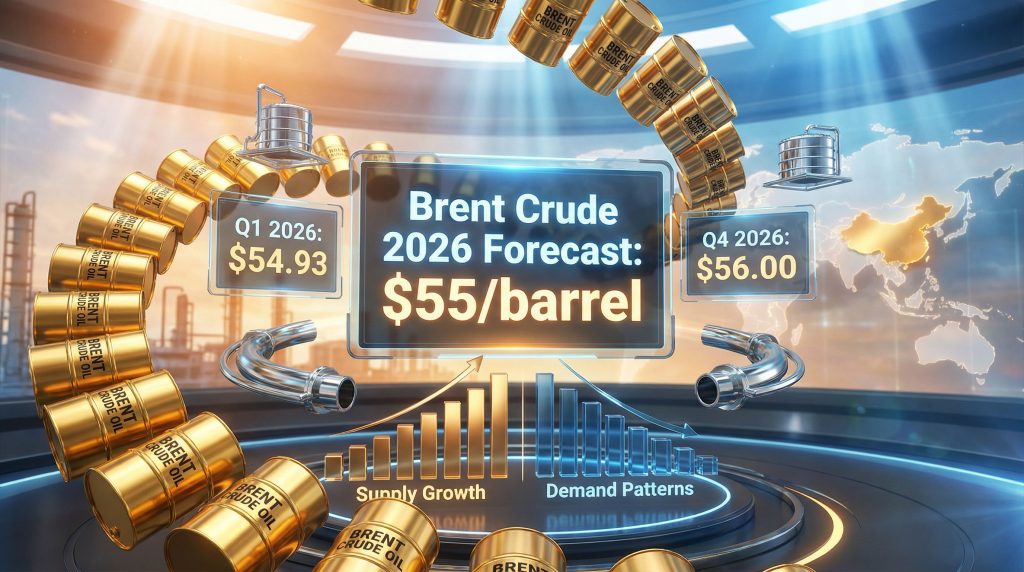
The EIA Brent price forecast 2026 quarterly progression reveals systematic price decline expectations with limited seasonal recovery potential. This trajectory reflects persistent oversupply conditions overwhelming traditional seasonal demand patterns and cyclical price recovery mechanisms.
Seasonal Demand Patterns and Price Volatility
Traditional seasonal price patterns face disruption from structural oversupply conditions that minimise typical winter heating demand and summer driving season price increases. The EIA's quarterly progression shows limited seasonal price variation compared to historical patterns:
| Quarter | Projected Brent Average | Seasonal Factors |
|---|---|---|
| Q4 2025 | $63.10/barrel | Winter heating demand onset |
| Q1 2026 | $54.93/barrel | Peak heating season |
| Q2 2026 | $54.02/barrel | Maintenance season |
| Q3 2026 | $55.32/barrel | Driving season demand |
| Q4 2026 | $56.00/barrel | Storage cost pressures |
The projected Q1 2026 average of $54.93/barrel represents the lowest quarterly expectation, coinciding with typically the strongest seasonal demand period. This inversion of normal seasonal patterns indicates oversupply conditions overwhelm traditional consumption cycles.
The modest Q3 2026 recovery to $55.32/barrel during driving season suggests limited seasonal demand elasticity under persistent inventory accumulation conditions. Furthermore, the Q4 2026 projection of $56.00/barrel reflects potential storage cost pressures rather than fundamental demand improvement, whilst oil price stagnation continues to influence market dynamics.
Technical Analysis of Price Support Levels
The EIA's $55/barrel average 2026 Brent forecast establishes technical support levels around multi-year lows. This price range approaches production breakeven costs for higher-cost suppliers whilst remaining above long-term marginal production costs for efficient producers.
Price support mechanisms operating at these levels include:
• Chinese strategic stockpile accumulation providing demand floor effects
• OPEC+ production adjustments reducing supply when economically necessary
• Higher-cost producer curtailments as projects become uneconomical
• Storage capacity constraints limiting further inventory accumulation
The quarterly progression suggests price stability rather than continued decline expectations beyond Q1 2026. The narrow price range between $54.02/barrel and $56.00/barrel indicates structural support around the $55 level despite ongoing oversupply conditions.
Technical resistance levels remain limited given fundamental oversupply conditions. Price recovery above $60/barrel appears unlikely without significant supply disruptions or demand acceleration beyond current projections.
The next major ASX story will hit our subscribers first
How Reliable Are Long-Term Energy Price Forecasts?
Energy price forecasting accuracy faces inherent limitations from geopolitical volatility, technological disruption, and demand pattern evolution that create substantial uncertainty around multi-year projections. Historical forecast performance reveals systematic challenges in predicting major market transitions and external shock impacts.
Forecast Accuracy and Revision Patterns
The EIA's December 2025 forecast revisions demonstrate ongoing uncertainty regarding 2026 price trajectories. Compared to previous projections, the $55.08/barrel 2026 forecast represents upward revision from earlier estimates whilst maintaining bearish overall expectations:
• September 2025 STEO: $51.43/barrel 2026 average
• October 2025 STEO: $52.16/barrel 2026 average
• November 2025 STEO: $54.92/barrel 2026 average
• December 2025 STEO: $55.08/barrel 2026 average
This revision pattern indicates improving price expectations despite persistent oversupply fundamentals. The approximately $3.50/barrel upward adjustment from September to December projections suggests model sensitivity to evolving market conditions and policy responses.
Forecast methodology limitations include:
- Geopolitical risk quantification difficulties in modelling conflict escalation or resolution
- Demand elasticity assumptions that may not capture behavioural changes
- Technology adoption rates affecting both supply capabilities and demand patterns
- Policy intervention effectiveness in areas like strategic reserve accumulation or production management
Alternative Scenario Planning Considerations
Multiple scenario frameworks reveal potential variance around the baseline $55/barrel forecast depending on key variable outcomes. Upside scenarios could support higher prices through supply disruptions, demand acceleration, or more aggressive OPEC+ production cuts. However, the oil futures outlook suggests limited upside potential given structural oversupply.
Upside Risk Factors:
• Geopolitical escalation creating significant supply disruptions
• Chinese economic acceleration increasing oil import demand beyond SPR requirements
• OPEC+ production cuts more aggressive than currently projected
• Storage capacity constraints forcing inventory liquidation
Downside Risk Scenarios:
• Demand destruction from economic recession or energy transition acceleration
• Production growth exceeding current projections from new field developments
• Technology adoption reducing transportation fuel consumption faster than expected
• Policy changes affecting strategic stockpile accumulation or carbon pricing
The probability distribution around the $55 baseline suggests $45-65/barrel range encompasses most likely outcomes absent major external shocks. However, tail risks in both directions create possibility for prices outside this range depending on scenario realisation.
Investment Implications of the $55 Barrel Price Environment
The sustained $55/barrel oil price environment fundamentally alters energy sector investment attractiveness and portfolio allocation strategies. This price level challenges traditional energy sector profitability assumptions whilst creating selective opportunities in efficient producers and alternative energy investments.
Energy Sector Profitability Thresholds
The $55 Brent price forecast approaches or falls below breakeven levels for numerous oil production projects, particularly higher-cost deepwater developments, oil sands operations, and marginal shale formations. This price environment forces operational efficiency improvements and capital discipline across the energy sector.
Breakeven analysis reveals significant variation across production methods:
| Production Type | Typical Breakeven Range | Profitability at $55/bbl |
|---|---|---|
| Saudi conventional | $10-20/barrel | Highly profitable |
| US shale (Permian) | $35-50/barrel | Marginally profitable |
| Deepwater projects | $45-70/barrel | Break-even to unprofitable |
| Oil sands | $50-80/barrel | Unprofitable to marginal |
| Arctic developments | $60-100/barrel | Unprofitable |
Major integrated oil companies face margin pressure on upstream operations whilst potentially benefiting from refining spreads during oversupply conditions. Downstream operations may experience improved profitability from lower feedstock costs, partially offsetting upstream challenges.
Capital expenditure sustainability becomes critical at these price levels. Companies must prioritise highest-return projects whilst deferring marginal developments that become uneconomical below $60/barrel sustained pricing.
Portfolio Allocation Strategies for Energy Investors
The $55/barrel price environment creates distinct investment opportunities across energy sub-sectors whilst challenging traditional energy equity valuations. Value-oriented investors may find opportunities in oversold energy securities trading below asset replacement costs.
Moreover, the oil price rally analysis indicates that any potential recovery remains constrained by structural factors. Analysts examining why oil prices are set to fall below $60 highlight the fundamental challenges facing the energy sector.
Investment Strategy Considerations:
• Low-cost producer focus on companies with strong breakeven economics
• Integrated company advantages from downstream margin expansion during crude oversupply
• Renewable energy acceleration as oil price competitiveness declines
• Energy transition beneficiaries including natural gas and renewable infrastructure
Risk Management Approaches:
- Commodity price hedging for direct energy exposure
- Diversification across energy types including renewables and traditional
- Geographic diversification across different cost structure regions
- Sector rotation timing based on price cycle expectations
Energy sector dividend sustainability faces pressure at $55/barrel pricing for higher-cost producers. Investors should evaluate payout ratios and free cash flow generation capabilities under sustained low-price scenarios when assessing income-oriented energy investments.
The broader market implications include potential disinflationary pressure from lower energy costs supporting consumer discretionary spending whilst challenging energy sector equity valuations and credit quality for leveraged producers.
This analysis is based on the U.S. Energy Information Administration's December 2025 Short-Term Energy Outlook and represents forecasts subject to significant uncertainty from geopolitical, economic, and market factors. Actual price outcomes may vary substantially from projections. Investors should conduct independent analysis and consider multiple scenarios when making investment decisions. Oil price forecasts are inherently uncertain and should not be relied upon as the sole basis for investment decisions.
Are You Positioning Yourself for the Energy Market Transformation?
Discovery Alert's proprietary Discovery IQ model delivers real-time alerts on significant ASX mineral discoveries, instantly empowering investors to identify actionable opportunities ahead of the broader market during volatile energy transitions. With oil prices heading below $55/barrel and reshaping the entire commodities landscape, now is the crucial time to start your 30-day free trial and secure your market-leading advantage in resources investing.