June 15, 2026
The Economics of Extraction: Why Mine Waste Is Becoming a Strategic Asset
Across the global mining industry, a quiet but significant revaluation is underway. Material that was once hauled away from pit edges and left to consolidate into permanent landscape features is increasingly being scrutinised through an entirely different economic lens. Goa critical mineral recovery from iron ore dumps sits at the heart of this shift, as the minerals that were economically irrelevant during the iron ore booms of the 1960s through the 2000s are precisely the minerals that modern clean energy technologies cannot function without.
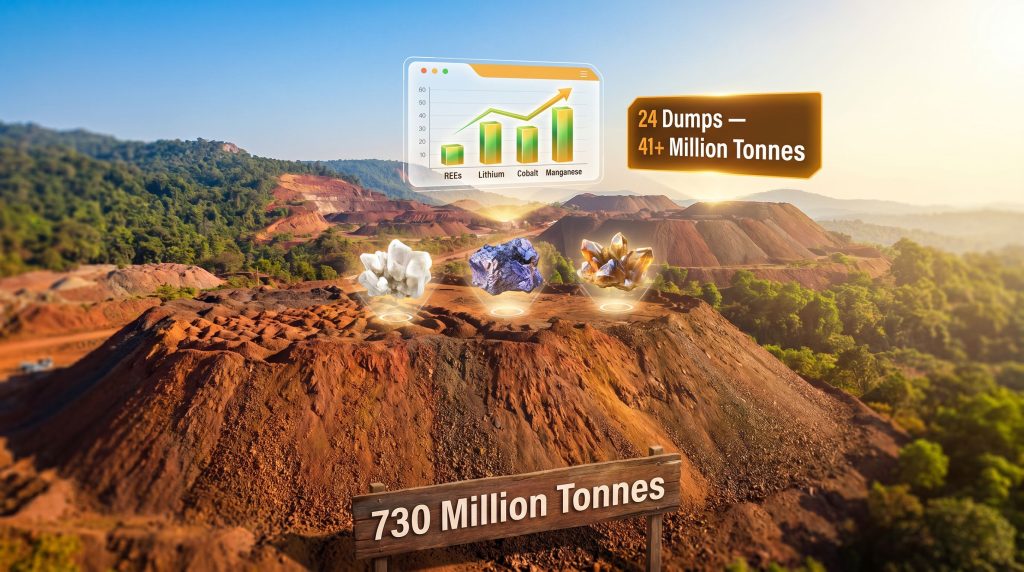
Rare earth elements, cobalt, lithium, and titanium compounds now sit at the centre of geopolitical competition among the world's largest economies. Furthermore, in a state like Goa, where decades of iron ore extraction left behind an estimated 730 million tonnes of accumulated dump material, that historical burden is beginning to look less like a liability and more like an unprocessed inventory.
This is the conceptual shift that makes Goa's current critical mineral survey initiative genuinely worth examining, not merely as a local mining story, but as an indicator of how resource-rich developing nations are rethinking the relationship between legacy extraction and future strategic value.
When big ASX news breaks, our subscribers know first
Understanding the Material: What Iron Ore Dumps Actually Contain
To appreciate the opportunity, it helps to understand what an iron ore dump actually is, and why it might contain minerals of interest beyond its namesake commodity.
In Goan mining history, the extraction process was oriented almost entirely toward iron ore of sufficient grade to satisfy export demand, primarily from Japanese and Chinese steelmakers. Material that fell below threshold grade was physically separated and stockpiled at mine peripheries. This created several distinct waste categories:
- Low-grade iron ore dumps: Ore with insufficient iron content for direct export but still mineralogically complex
- Overburden: Soil and rock removed to access ore, often carrying trace mineral loads
- Mine tailings: Fine-grained residue from beneficiation processes
- Run-of-mine rejects: Material excluded from processing circuits due to grade or size constraints
What makes these categories geologically interesting is the nature of iron ore formation in the Western Ghats lateritic belt. Lateritic iron deposits in Goa are associated with deeply weathered profiles in which multiple mineral species concentrate together. The same geological processes that created iron-rich hardcap layers also concentrated elements such as rare earth elements in phosphate-bearing zones, cobalt and nickel in lateritic overburden, and titanium-bearing heavy minerals in the associated sand fractions.
Historically, none of these co-occurring minerals were economically worth recovering. The processing infrastructure did not exist at scale, market prices did not justify the effort, and the regulatory framework offered no incentive. However, all three of those conditions have now changed materially, as growing critical minerals demand continues to reshape the economics of extraction globally.
| Mineral | Typical Association with Iron Ore Geology | Primary Strategic Use |
|---|---|---|
| Rare Earth Elements (REEs) | Phosphate-bearing iron formations, laterite zones | Magnets, defence electronics, wind turbines |
| Cobalt | Lateritic iron ore overburden | EV battery cathodes, aerospace alloys |
| Lithium | Clay-hosted deposits near laterite profiles | EV batteries, grid-scale energy storage |
| Manganese | Co-deposited with low-grade iron ore beds | Steel alloys, battery anodes |
| Titanium (ilmenite) | Heavy mineral sands in overburden sequences | Aerospace components, pigment manufacturing |
It is critical to note that these associations represent geological plausibility, not confirmed resource presence. As of mid-2026, no commercially viable concentrations of critical minerals have been publicly confirmed for Goa's specific dump inventory. The Geological Survey of India (GSI) analysis of samples collected from 12 surveyed dumps remains ongoing, and results are still awaited.
The National Critical Mineral Mission: Policy Architecture That Changes the Calculus
India's National Critical Mineral Mission (NCMM) represents the most structured domestic policy response yet to the country's deep vulnerability in critical mineral supply chains. India currently imports the overwhelming majority of its cobalt, lithium, and rare earth processing capacity, a dependency that carries direct strategic risk for domestic electric vehicle manufacturing, defence electronics, and renewable energy infrastructure.
The NCMM's approach to addressing this vulnerability is notable for its explicit inclusion of mine waste streams as recoverable resource targets. The mission formally characterises overburden, tailings, fly ash, and red mud as above-ground ore bodies worthy of systematic assessment and recovery. This framing is not merely rhetorical; it establishes a policy pathway through which waste-hosted minerals can progress from survey to resource characterisation to formal auction inclusion.
In addition, the energy security role played by domestic critical mineral production underpins the entire NCMM strategic framework, making Goa's dump surveys nationally significant rather than merely a regional mining story.
India's NCMM framework positions mine waste recovery not as a secondary activity but as a core pillar of domestic critical mineral strategy, directly legitimising survey activity of the type underway in Goa.
This policy positioning places India alongside several other major economies that have moved in similar directions, though at varying stages of operational maturity. A useful overview of India's dump allocation progress can be found in coverage of Goa's low-grade iron ore dump allocations, which tracks the commercial rollout of these initiatives.
Comparative Mine Waste Recovery Maturity Across Key Jurisdictions:
| Country/Region | Policy Framework | Operational Stage | Primary Target Minerals |
|---|---|---|---|
| European Union | Critical Raw Materials Act | Active assessment and pilot operations | REEs, lithium, cobalt |
| United States | DOE and USGS characterisation programs | Early-stage pilots, coal ash focus | REEs from coal ash and tailings |
| Australia | State-level approvals framework | Commercial operations at select sites | Lithium, REEs from tailings |
| India (Goa) | NCMM framework | Exploration and auction phase | REEs, lithium, cobalt (unconfirmed) |
| Chile and DRC | Established industry practice | Full commercial operations | Cobalt, copper from tailings |
India sits at the earlier end of this spectrum, but the policy architecture is in place and Goa's Directorate of Mines and Geology (DMG) survey activity is a direct operational expression of NCMM objectives.
The Auction Mechanics: Phase 1 Lessons and Phase 2 Ambitions
The state government's e-auction program for low-grade iron ore dumps provides the clearest window into how commercial interest is actually developing in this space, and where the structural tensions lie.
Phase 2 Dump Auction: Key Parameters
| Parameter | Detail |
|---|---|
| Total dumps on offer | 24 |
| Total ore volume | Over 41 million tonnes |
| Largest single dump | Approximately 10 million tonnes (Sonus, Sattari) |
| Smallest dumps | Approximately 1 lakh tonnes |
| Number of bidding companies | Around 50 |
| Reserve price structure | 22% of Indian Bureau of Mines benchmark price |
| Geographic spread | Sanguem, Dharbandora, Bicholim, Sattari, Bardez |
Phase 1 delivered a cautionary result: four of five dumps offered attracted zero bids. Only the largest dump on offer, representing the most material volume and therefore the most viable operating scale, was successfully auctioned. The four smaller dumps received no commercial interest whatsoever.
This outcome exposes a structural dynamic that is not unique to Goa but is particularly visible here. Dump mining economics are heavily sensitive to scale. Fixed costs associated with mobilisation, beneficiation plant commissioning, and logistics infrastructure do not compress proportionally with dump size. A 1-lakh-tonne dump simply cannot generate the revenue throughput needed to recover those fixed costs at a 22% reserve price, particularly when processing heterogeneous, weathered material that requires more intensive treatment than fresh ore.
The Phase 1 outcome reveals a clear commercial threshold: below a certain tonnage, dump mining is commercially stranded without either processing subsidies or the additional revenue uplift that confirmed critical mineral content could provide.
Phase 2 contains a more diverse size profile, with the Sonus dump in Sattari offering approximately 10 million tonnes at one end and sub-100,000-tonne deposits at the other. The participation of around 50 companies, with several submitting bids across multiple sites, suggests that commercial appetite at the upper end of the size range remains intact.
How the Technical Process Works: From Dump Survey to Recoverable Mineral
Understanding the full operational sequence helps clarify why timelines in this sector tend to be longer than initial policy announcements suggest.
- Geophysical and geochemical surveying: Field teams collect systematic samples across dump material, measuring surface and subsurface characteristics to identify anomalies worth investigating further
- Laboratory assay submission to GSI: Samples are submitted for detailed multi-element analysis, including testing for rare earth element suites, cobalt, lithium, and other target minerals
- Grade and tonnage estimation: Analysis results are used to construct preliminary resource estimates, assessing whether mineral concentrations meet minimum thresholds for economic recovery
- Feasibility assessment: Project developers evaluate whether identified grades and volumes justify the capital investment required for processing
- Beneficiation and physical separation: Valuable mineral fractions are physically separated from waste gangue using gravity, magnetic, or flotation techniques depending on mineral characteristics
- Hydrometallurgical or pyrometallurgical extraction: Chemical processing is applied to extract refined critical minerals from concentrate, representing the most technically demanding and capital-intensive stage
- Residue management: Post-extraction material must be managed to prevent environmental contamination, a particularly sensitive requirement in Goa's ecologically sensitive Western Ghats-adjacent terrain
A technically underappreciated challenge in this context is the heterogeneity of weathered dump material. Unlike fresh ore from an active mining face, dump material has typically been exposed to decades of atmospheric weathering, biological activity, and leaching. This alters mineralogy in ways that can either concentrate certain elements through residual enrichment or disperse others through chemical mobility, making grade predictions from surface sampling less reliable than in conventional ore body assessment.
Goa's existing mining infrastructure, including beneficiation plants, rail connectivity, and port access at Mormugao, does provide a meaningful capital expenditure advantage for dump mining operators compared to greenfield scenarios. This infrastructure legacy reduces the upfront investment threshold but does not eliminate the processing complexity challenge. Consequently, understanding economic cut-off grades becomes essential when evaluating whether any given dump parcel is genuinely viable for commercial recovery.
What GSI Analysis Must Confirm Before Viability Is Established
The Geological Survey of India's role in this process is not ceremonial. GSI analysis of the 12 surveyed dumps will need to establish several specific thresholds before critical mineral recovery becomes commercially viable:
- Minimum grade concentrations: Each target mineral has a different economic cut-off grade depending on market price and processing cost. For rare earth elements, economically meaningful concentrations typically require total REE oxide grades measured in hundreds to thousands of parts per million
- Sufficient tonnage: Grade alone is insufficient. The volume of material meeting minimum grade thresholds must be large enough to sustain a processing operation at commercial scale over a viable mine life
- Mineralogical recoverability: Minerals must occur in forms that are amenable to available processing technology. REEs hosted in highly stable mineral lattices may require processing conditions that are technically achievable but economically prohibitive at small scale
No official timeline has been published for when GSI results will be available. Analysis timelines vary considerably depending on the number and complexity of elements being tested, laboratory throughput, and the need for confirmatory assays on anomalous samples.
Environmental Dimensions: Remediation as a Co-Benefit
Goa's iron ore dump legacy carries significant environmental baggage. Exposed dump faces generate dust during dry months, potential leachate from disturbed material creates water quality risks, and the ecological sensitivity of the Western Ghats region means that any new disturbance of dump material requires careful environmental management.
The Iron Ore Dump Handling Policy 2023 establishes the current regulatory framework governing how dumps must be handled, including dust suppression requirements, progressive rehabilitation obligations, and environmental monitoring. The Supreme Court has historically maintained active oversight of Goa's mining sector following the extraction controversies of the prior decade.
There is, however, a genuine environmental co-benefit argument for dump mining. Systematic recovery and processing of dump material, when conducted to standard, reduces the long-term footprint of legacy mining waste. Furthermore, proper mine reclamation of fully processed and rehabilitated dumps represents a net improvement in the environmental status of former mining landscapes, an argument that has been effectively deployed in European mine waste recovery programs to build community and regulatory acceptance.
The next major ASX story will hit our subscribers first
Investor Scenario Analysis: Three Pathways for Dump Mining Economics
For companies currently participating in Phase 2 bidding, the financial picture depends heavily on which of three broad scenarios materialises.
Base Case
Dumps are processed primarily for their low-grade iron ore content. Critical mineral recovery either does not materialise from GSI analysis or produces only minor supplementary revenue. Project economics are tight at the 22% reserve price, particularly for smaller-volume dumps. Returns are modest and heavily dependent on iron ore benchmark price movements.
Upside Case
GSI analysis confirms commercially viable concentrations of rare earth elements, cobalt, or lithium within surveyed dump material. Dump assets are re-rated as dual-commodity or critical mineral projects, attracting a different class of investor and potentially triggering re-pricing of Phase 2 auction bids. This scenario would transform the entire economic narrative around Goa's 730-million-tonne dump inventory, and positions the region as a meaningful source of critical raw materials for domestic clean energy industries.
Downside Case
GSI analysis returns sub-economic grades across the surveyed dumps. Phase 2 auction results mirror Phase 1, with only the largest-volume dumps attracting bids. Smaller dumps remain commercially stranded and the critical mineral recovery thesis for Goa's dumps remains aspirational rather than operational.
The asymmetry of this risk profile is what makes the current moment interesting from an investment perspective. The downside is largely known, whilst the upside is genuinely transformative if critical mineral concentrations are confirmed.
Disclaimer: This analysis is provided for informational purposes only and does not constitute financial advice. Investors should conduct independent due diligence and consult qualified advisers before making investment decisions related to any mining or critical minerals assets.
Frequently Asked Questions: Goa Critical Mineral Recovery from Iron Ore Dumps
What critical minerals are being targeted in Goa's iron ore dump surveys?
The DMG surveys are investigating whether rare earth elements and other critical minerals including cobalt, lithium, and titanium-bearing compounds are present within low-grade iron ore dump material. These targets reflect the known geological associations between iron ore laterite profiles and co-occurring mineral species. No commercially viable concentrations have been confirmed for Goa's specific dumps as of mid-2026.
How many dumps are currently under survey or on auction in Goa?
The DMG has completed surveys of 12 dumps, with results submitted to the GSI for detailed laboratory analysis. Separately, 24 dumps containing over 41 million tonnes of ore material are currently being offered in the Phase 2 e-auction program.
Why did Phase 1 auctions largely fail to attract bids?
Four of the five dumps offered in Phase 1 received no bids. The most likely explanation is a combination of sub-scale tonnage volumes and marginal economics at the 22% reserve price structure. The one dump that was successfully auctioned was the largest on offer, reinforcing the view that commercial viability in dump mining is strongly correlated with operational scale.
What does the 22% reserve price actually mean in practice?
The state government has set the minimum auction price at 22% of the Indian Bureau of Mines benchmark price for iron ore. As a practical illustration, if the IBM benchmark is set at Rs 100 per tonne, the successful bidder commits to paying Rs 22 per tonne to the government. This structure is designed to make dumps accessible to commercial operators while ensuring the state captures a share of recovery value.
When will GSI analysis results be available?
No official timeline has been publicly confirmed. The complexity of multi-element analysis, combined with laboratory capacity constraints, means GSI characterisation timelines are difficult to predict with precision.
The Road Ahead: Sequential Dependencies That Will Define Outcomes
The pathway from Goa's current survey and auction activity to any commercially meaningful Goa critical mineral recovery from iron ore dumps involves at least three critical decision points, each of which is genuinely uncertain at this stage.
First, GSI analysis must return results that confirm economically meaningful critical mineral concentrations in at least a portion of the surveyed dumps. Without that confirmation, the critical mineral narrative remains speculative rather than grounded in geological reality.
Second, Phase 2 auction outcomes need to demonstrate sufficient competitive tension across a meaningful range of dump sizes. A repeat of the Phase 1 pattern, where only the largest asset attracts a bid, would suggest the commercial case for smaller dumps remains unresolved regardless of critical mineral potential.
Third, India's NCMM framework will need to evolve to address the processing economics challenge. Survey and auction frameworks are necessary but not sufficient. If the economics of processing heterogeneous dump material at small scale remain marginal without additional incentive structures, a significant portion of Goa's dump inventory will remain commercially stranded even after geological confirmation of mineral presence.
The longer-term strategic context provides compelling reason to persist through these near-term uncertainties. If even a modest fraction of Goa's estimated 730-million-tonne total dump inventory contains recoverable critical mineral concentrations, the aggregate resource opportunity scales to national strategic significance. India's ambition to reduce import dependency for EV batteries, defence systems, and renewable energy infrastructure cannot be achieved without domestic critical mineral production, and above-ground inventories like Goa's dumps represent one of the fastest pathways to building that production base.
For a detailed overview of the legislative and technical framework governing India's mine waste and dump handling policies, the Government of India's official waste dumps guidelines provide essential regulatory context for investors and operators engaged in this space.
Ready to Track the Next Critical Mineral Discovery Before the Market Does?
Discovery Alert's proprietary Discovery IQ model scans ASX announcements in real time, instantly identifying actionable opportunities across critical minerals, rare earths, and the commodities reshaping the clean energy economy — the same sector driving the revaluation of Goa's 730-million-tonne dump inventory. Explore how major mineral discoveries have historically delivered extraordinary returns on Discovery Alert's dedicated discoveries page, and begin your 14-day free trial today to position yourself ahead of the broader market.