July 11, 2026
The Structural Architecture Driving Gold's Multi-Year Bull Market
The global financial system faces unprecedented structural pressures as sovereign debt burdens expand beyond historical precedent while monetary authorities worldwide grapple with inflation control mechanisms. These foundational shifts create persistent demand for alternative value storage systems, positioning precious metals as essential portfolio components rather than speculative trading instruments. Central bank balance sheet expansion combined with currency competition dynamics establishes long-term support mechanisms for gold appreciation that extend far beyond traditional market cycles.
When big ASX news breaks, our subscribers know first
How Monetary Policy Transitions Shape Gold's Investment Appeal
Federal Reserve Interest Rate Mechanics and Precious Metal Valuations
The relationship between monetary policy adjustments and gold price formation operates through multiple transmission channels that institutional investors monitor systematically. When real interest rates compress through central bank intervention, opportunity costs for holding non-yielding assets decline materially, creating favourable conditions for precious metal allocation increases.
Goldman Sachs anticipates gold reaching $5,400 by the end of 2026, with Senior Commodities Analyst Lina Thomas emphasising significant upside potential beyond this baseline forecast. The investment bank's projections assume continued central bank purchasing at historical rates combined with private investor demand following anticipated Federal Reserve rate reductions.
Critical Policy Transmission Elements:
• Real yield compression encourages institutional portfolio rebalancing away from fixed-income securities
• Currency debasement concerns amplify precious metal demand during quantitative expansion periods
• Central bank credibility challenges drive alternative reserve asset accumulation
Emerging Market Central Bank Reserve Restructuring
Monetary authorities in developing economies continue systematic diversification away from traditional dollar-denominated reserve holdings, creating structural demand growth that differs fundamentally from cyclical investment patterns. Thomas from Goldman Sachs notes that emerging market central banks remain underweight gold relative to optimal portfolio compositions, suggesting continued purchasing pressure regardless of short-term price fluctuations.
Reserve Diversification Indicators:
• Central bank purchases projected above 800 tonnes annually
• Emerging market reserve portfolios showing systematic gold allocation increases
• Geographic concentration in Asia-Pacific and Middle Eastern monetary authorities
Economic Scenarios Supporting Gold's Path Above $6,000
Persistent Inflation Dynamics and Monetary System Stress
The interaction between sustained inflationary pressures and aggressive fiscal expansion creates ideal environmental conditions for precious metal appreciation cycles. Furthermore, our comprehensive inflation hedge analysis demonstrates gold's effectiveness as purchasing power preservation during periods of significant currency depreciation, with real returns often exceeding inflation rates during monetary expansion phases.
Swedish investment firm AuAug projects $6,000 as their 2026 target, representing 39% upside potential, while considering any price above $5,500 (27% appreciation) as constituting a very strong performance year. The firm emphasises that gold continues reflecting the enormous expansion of fiat currencies driven by rising global debt levels and central banks operating their monetary creation mechanisms at maximum capacity.
Inflation Protection Framework:
• Real asset characteristics during periods of monetary debasement
• Negative correlation patterns with major currency strength indices
• Portfolio insurance mechanisms against systematic purchasing power erosion
Geopolitical Risk Premium Integration
International political tensions and trade fragmentation contribute measurable risk premiums to precious metal valuations as market participants increasingly recognise gold's essential hedging properties against systemic political disruption. Recent volatility patterns reflect these premium adjustments as geopolitical uncertainty influences investment allocation decisions.
Goldman Sachs acknowledges increased market volatility expectations, with Thomas noting that diversification flows have been expressed through call options strategies, creating sharper price action patterns. The investment bank maintains its bullish outlook while anticipating continued volatility as these dynamics evolve.
Supply-Side Constraints and Production Response Mechanisms
Australian Gold Production Leadership
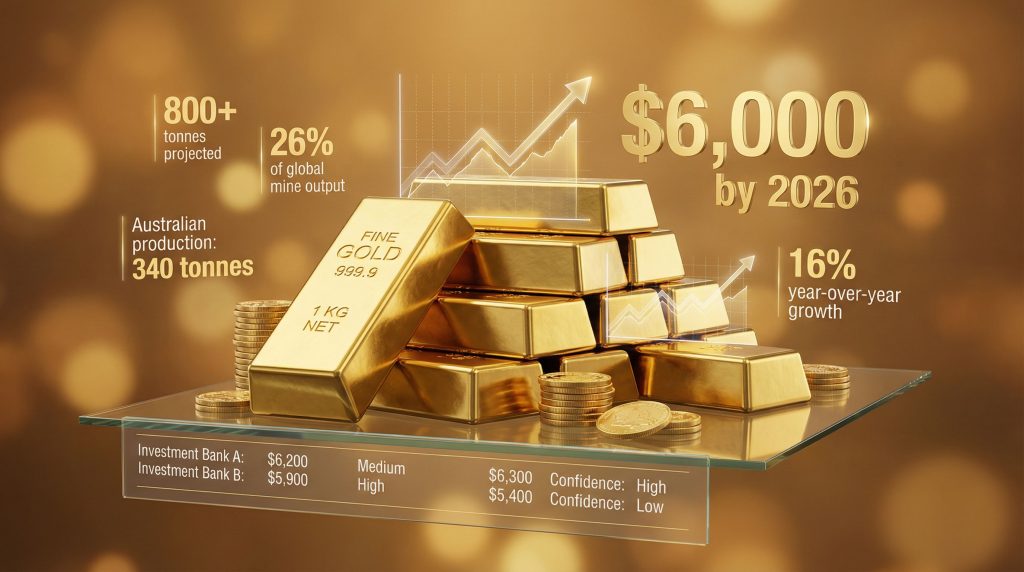
Australia maintains its position as a global gold production leader, with the Department of Industry, Science, and Resources projecting 340 tonnes output in 2025-26, representing a 16% year-over-year increase. Production is expected to reach 369 tonnes in 2026-27 as new mining operations commence, with Western Australia accounting for 80% of total gold exploration spending during recent quarterly measurements.
The Australian government's analysis indicates that high gold prices are expected to stimulate supply increases from both new and existing mining operations, including the reopening of previously shuttered mines. In addition, our detailed CEO perspective on gold highlights how mining executives are responding to these market conditions. The largest production increases globally are anticipated in Canada and Indonesia according to official projections.
Production Expansion Metrics:
• New mine project additions: 30 tonnes expected over 5-10 years
• Exploration spending concentration: 40% of total mineral exploration focused on gold
• Regional production leadership maintained through Western Australian operations
Secondary Supply Market Dynamics
Recycling market participation demonstrates price elasticity characteristics, with secondary gold supply projected to grow approximately 5% to peak above 1,500 tonnes in 2026, representing a 14-year high driven by elevated price incentives. This recycling volume provides natural market stabilisation mechanisms while remaining insufficient to offset primary demand growth from institutional sources.
Secondary Supply Characteristics:
• Price-responsive recycling volumes providing market equilibrium support
• Historical maximum recycling levels anticipated during 2026
• Natural stabilisation mechanisms during price appreciation cycles
Institutional Investment Flow Evolution
Exchange-Traded Fund Strategic Positioning
Professional portfolio managers increasingly utilise gold-backed exchange-traded funds for systematic exposure implementation rather than tactical trading strategies. This structural demand evolution provides price floor support during market correction periods as institutions maintain strategic allocation targets regardless of short-term price movements.
Goldman Sachs emphasises that diversification flows into gold represent meaningful demand sources beyond baseline central bank purchasing, suggesting institutional rebalancing constitutes a structural phenomenon rather than cyclical trading activity.
ETF Allocation Evolution:
• Strategic asset allocation increases across institutional mandates
• Risk parity portfolio integration incorporating precious metals systematically
• Pension fund diversification requirements driving allocation increases
Private Wealth Management Integration
High-net-worth individuals and family office investment strategies demonstrate expanding precious metal allocations as traditional portfolio correlations experience breakdown during periods of market stress. Consequently, this wealth management trend supports sustained demand growth independent of institutional positioning changes.
Wealth Preservation Strategies:
• Alternative asset allocation expansion across private wealth platforms
• Currency hedging implementation through precious metal holdings
• Multi-generational wealth preservation focus driving allocation decisions
Professional Forecast Analysis and Price Target Framework
Investment Bank Projection Consensus
Leading financial institutions maintain bullish gold price forecasts for 2026 despite acknowledging increased volatility expectations. The consensus supports price ranges between $5,400-$6,000 as baseline scenarios, with significant upside potential identified through multiple demand acceleration mechanisms.
According to recent JPMorgan's commodities research, institutional analysis continues to support elevated precious metal valuations through 2026. Furthermore, Kitco's latest analysis suggests gold could reach near $6,500 per ounce as the bull case strengthens.
| Institution | 2026 Target | Key Assumptions | Upside Factors |
|---|---|---|---|
| Goldman Sachs | $5,400 | Central bank buying continues, Fed rate cuts | Further diversification flows |
| AuAug | $6,000 | Fiat currency expansion continues | Global debt acceleration |
| Australian DISR | $4,000 | Supply response dampens prices | Production constraints exceed expectations |
Scenario-Based Price Modelling
Multiple economic development pathways support gold appreciation through 2026, with conservative scenarios suggesting $5,200-$5,500 trading ranges and optimistic projections reaching $6,500+ based on crisis acceleration factors.
Scenario Framework Analysis:
• Conservative Case: $5,200-$5,500 (policy normalisation succeeds)
• Base Case: $5,500-$6,000 (continued monetary uncertainty)
• Bullish Case: $6,000-$6,500 (crisis acceleration scenarios)
However, the Australian Department of Industry, Science, and Resources presents a contrarian perspective, forecasting gold to remain around $4,000 per ounce over 2026 before declining in 2027 as supply increases outpace demand growth. This analysis suggests that gold demand will bottom out in 2026 when prices peak, reflecting their assessment of supply-demand equilibrium changes.
The next major ASX story will hit our subscribers first
Market Volatility Management and Investment Strategy Implications
Options Market Influence on Price Discovery
Derivatives market activity creates amplified price movements during trend transitions, requiring sophisticated risk management approaches for institutional market participants. Goldman Sachs notes that diversification strategies increasingly utilise call options, generating sharper price action patterns as position adjustments occur systematically.
Our comprehensive market performance insights examine how these derivative strategies influence overall market dynamics. For instance, this analysis provides crucial context for understanding gold's 2026 trajectory.
Volatility Management Elements:
• Call option positioning effects creating price amplification during uptrends
• Systematic rebalancing triggers generating predictable flow patterns
• Liquidity provision challenges during high-volatility periods
Portfolio Construction Evolution
Modern portfolio theory applications increasingly recognise gold's unique correlation characteristics during market stress periods, leading to higher strategic allocation recommendations across institutional investment mandates. This theoretical framework evolution supports sustained demand growth as portfolio optimisation models incorporate precious metals systematically.
Regional Production and Consumption Balance Assessment
Global Supply Chain Considerations
International gold production demonstrates geographic concentration patterns that influence supply chain stability and pricing mechanisms. Canada and Indonesia represent primary growth regions for new production capacity, while established producers focus on optimising existing operations rather than capacity expansion.
Production Geography Analysis:
• Canadian mining sector expansion leading global production increases
• Indonesian regulatory environment supporting output growth
• Australian operations maintaining production leadership through efficiency improvements
Traditional Consumption Market Stability
Established gold-consuming regions maintain robust physical demand despite price appreciation, supporting fundamental market stability through cultural preferences and investment traditions. This consumption base provides demand floor support independent of financial market speculation.
Long-Term Investment Thesis Supporting Continued Appreciation
Monetary System Structural Evolution
The international monetary architecture faces fundamental challenges from unprecedented debt accumulation levels, currency competition dynamics, and technological disruption patterns. These structural pressures create persistent demand for alternative store-of-value assets that maintain purchasing power independence from fiat currency systems.
AuAug establishes $10,000 per troy ounce as their next major milestone target, suggesting that achievement would require only a few more strong performance years following 2026. The Swedish investment firm will reassess and establish new long-term targets based on global economic conditions upon reaching this level.
Additionally, our detailed historic surge explanation provides valuable context for understanding how previous price movements establish precedents for future appreciation patterns.
Investment Portfolio Integration Trends
Professional portfolio management increasingly recognises precious metals as essential diversification instruments rather than speculative investment categories. This conceptual shift supports sustained institutional demand growth as allocation models systematically incorporate gold as a portfolio foundation rather than opportunistic position.
The convergence of monetary policy uncertainty, geopolitical risk premium requirements, and structural economic transformation creates compelling conditions for continued gold appreciation through 2026 and beyond. While short-term volatility patterns remain inevitable, fundamental demand drivers support gold price forecast 2026 targets in the $5,500-$6,500 range as institutional adoption accelerates and central bank diversification strategies continue expanding globally.
Disclaimer: This analysis contains forward-looking projections and speculation based on current market conditions. Gold investments carry inherent risks, and price forecasts should not be considered guaranteed outcomes. Investors should consult qualified financial professionals before making investment decisions based on commodity price projections.
Ready to Capitalise on the Next Gold Discovery Opportunity?
While gold prices soar toward $6,000, Discovery Alert's proprietary Discovery IQ model delivers instant notifications on significant ASX mineral discoveries, including gold prospects that could benefit from these exceptional market conditions. Start your 14-day free trial today and position yourself to identify actionable opportunities before the broader market recognises their potential.