June 12, 2026
What You're Really Buying When You Buy Gold
Most people who decide to invest in gold bullion vs jewelry for investment focus almost entirely on timing. They watch price charts, read macro commentary, and debate whether to enter now or wait for a pullback. What rarely enters that conversation is a question that has a far larger impact on financial outcomes than entry timing: what physical form is the gold actually in?
The vehicle through which you acquire gold determines how much of each dollar you spend actually functions as gold exposure, how accurately your holding tracks the spot price, and how efficiently you can convert it back to cash when the time comes. At elevated price levels, this structural question carries more dollar significance than at any other point in a bull market cycle.
When big ASX news breaks, our subscribers know first
The Two Fundamentally Different Things Being Sold as Gold
When someone purchases investment-grade bullion, they are acquiring a standardised financial instrument. Bars and government-minted coins refined to .999 or .9999 fineness (99.9% to 99.99% pure gold) are priced against the spot market, with a modest dealer premium layered on top. That premium covers refining, authentication, packaging, and distribution.
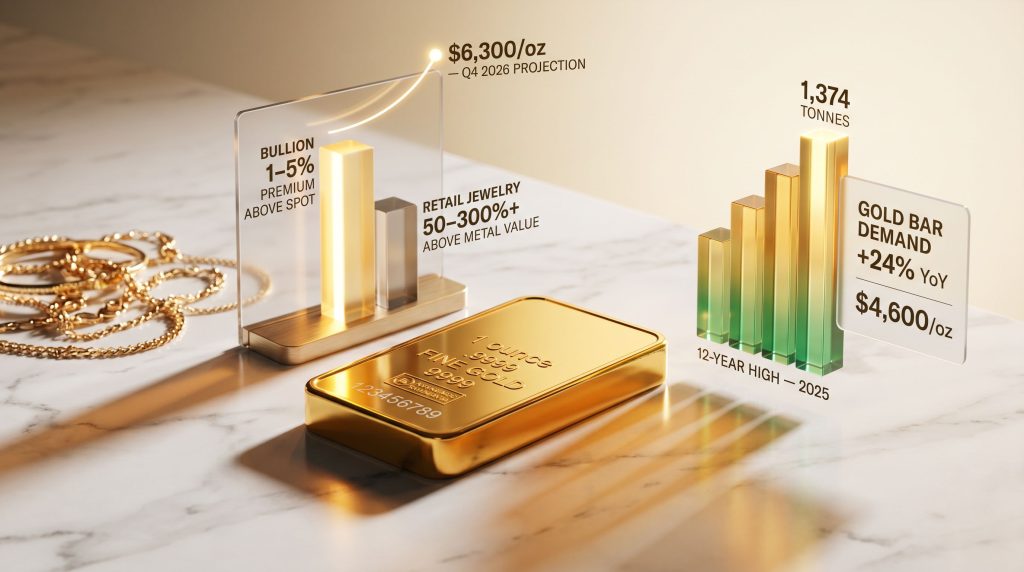
A standard 1-ounce bar from a reputable refiner typically carries a premium of 1–5% above spot price. Larger formats such as kilo bars and 10-ounce bars carry lower percentage premiums due to economies of scale; smaller fractional pieces such as 1-gram bars can carry premiums of 15–30% or more given the proportionally higher fabrication cost per unit of metal.
Gold jewellery, however, operates on entirely different economic logic. It is a consumer retail product that contains gold as a raw material input. The purchase price reflects not just the metal but the full cost of getting that product onto a retail shelf: manufacturing labour, store lease costs, advertising campaigns, brand licensing, packaging, and sales commissions.
At mainstream retail chains, these layers produce markups of 50–200% above the actual gold content value. At luxury brands, public financial data from major jewellers confirms that brand moat economics can sustain markups of 300–400% above the underlying metal cost (Signet Jewelers Fiscal 2025 Fourth Quarter Results; The Market Capitalist, 2026).
The economic gap between these two categories is not a matter of degree. It is a structural difference in what the buyer is actually purchasing per dollar spent.
Understanding why gold holds value in the first place helps contextualise precisely why format selection matters so much to long-term outcomes.
Karat Ratings and the Alloy Problem
A detail that many first-time gold buyers underestimate is how dramatically purity varies across jewellery grades. Unlike investment bullion, which is held to a near-universal standard of .999 fine or better, jewellery sold in Western retail markets spans a wide purity spectrum.
| Karat Rating | Gold Purity (%) | Typical Market |
|---|---|---|
| 10K | 41.7% | Budget U.S. retail jewellery |
| 14K | 58.3% | Mainstream U.S. jewellery market |
| 18K | 75.0% | Premium Western and European jewellery |
| 22K | 91.7% | South Asian and Middle Eastern markets |
| 24K | 99.9% | Investment-grade bullion standard |
The remaining percentage in lower-karat pieces consists of base metals including copper, zinc, silver, and nickel. These are added to improve workability, durability, and colour variation. A standard 14K piece is more than 40% non-gold by weight, yet its retail price reflects the full cost of the finished product rather than its gold fraction alone.
When that piece reaches a secondary buyer, the offer is calculated on pure gold content at or below spot. The alloy metals carry no recovery value whatsoever. This means a buyer purchasing a 14K retail jewellery item is not only paying a significant markup over spot — they are also paying retail price for a product whose gold exposure per dollar is structurally diluted.
Investment-grade bullion at .9999 fine eliminates this entirely: every dollar deployed maps directly to gold metal. Furthermore, it is worth noting that purity standards for bullion coins vary internationally. The American Gold Eagle, for instance, is minted at 91.67% gold (22 karat) by U.S. Mint specification, though it carries a full troy ounce of gold within a coin weighing slightly more than one ounce. The Canadian Gold Maple Leaf and PAMP Suisse bars are refined to .9999 fine.
The Full Cost Structure: What Enters the Price and What Exits at Resale
The practical consequence of these structural differences becomes visible when purchase and resale economics are placed side by side.
| Cost Component | Investment Bullion (1 oz bar) | Mainstream Jewellery (14K retail) |
|---|---|---|
| Effective gold content per dollar | ~95–99% | ~33–50% |
| Manufacturing and refining premium | 1–5% above spot | Absorbed into retail markup |
| Design and craftsmanship | Not applicable | 20–60% of retail price |
| Brand and advertising overhead | Not applicable | 10–30% of retail price |
| Resale recovery | Near spot value on gold content | 70–80% of melt value at best |
Dealers and secondary buyers purchasing jewellery assess it exclusively at melt value. The weight of the piece, multiplied by its karat-determined gold fraction, is priced at or below the prevailing spot rate. The brand name, the craftsmanship, the original retail premium — none of these transfer at resale.
Independent estimates and dealer industry practice suggest secondary buyers typically offer 70–80% of melt value on jewellery, meaning the seller recovers a fraction of a fraction of their original outlay. For a deeper comparison of how this stacks up against other gold formats, physical gold vs ETFs is another consideration worth exploring alongside bullion and jewellery decisions.
Scenario comparison: An investor allocates $5,000 to gold.
Under the bullion path, paying a 3% entry premium, they hold approximately $4,854 in effective gold exposure. Selling near spot, the round-trip cost is roughly $150–$250 in spread.
Under the retail jewellery path at a 150% markup, the actual gold content value at purchase is approximately $2,000. Selling at 75% of melt value returns approximately $1,500. The round-trip loss on $5,000 deployed: potentially $3,500 or more.
At a projected gold price of $6,300 per ounce by Q4 2026 (J.P. Morgan Global Research), the absolute dollar magnitude of this gap widens substantially with each incremental rise in spot price. Consequently, keeping a close eye on gold price forecasts becomes especially relevant when assessing which format delivers genuine value.
What the Market's Own Behaviour Reveals
Global demand patterns in 2025 offered a striking illustration of how informed capital approaches gold format selection. According to the World Gold Council's Gold Demand Trends Full Year 2025 report:
- Global bar and coin demand reached 1,374 tonnes, the highest level in 12 years
- Gold bar demand specifically rose 24% year-over-year to 1,068 tonnes
- Total gold demand including over-the-counter transactions exceeded 5,000 tonnes for the first time in recorded history
- Jewellery consumption recorded six consecutive quarters of double-digit year-over-year volume declines through Q3 2025
The divergence is instructive. As gold prices rose, institutional and retail investors accelerated their accumulation of standardised bullion formats. Simultaneously, jewellery consumption contracted sharply, reflecting both consumer price sensitivity at elevated spot levels and a fundamental reorientation of demand toward more efficient vehicles.
This is not coincidental. When investors want gold exposure, they concentrate capital in the instrument with the tightest spread between spot price and acquisition cost. Gold has been trading near $4,600 per ounce as of April 2026, representing approximately 43% year-over-year appreciation (Trading Economics). At this price level, the cost implications of format selection are materially larger in absolute dollar terms than they would be at $1,500 or $2,000 per ounce.
Liquidity: The Exit Matters as Much as the Entry
One dimension of the bullion versus jewellery comparison that receives less attention than purchase costs is exit liquidity. Gold as a safe haven depends fundamentally on the ability to convert it to cash efficiently when required, making liquidity a critical factor in format selection.
Investment bullion products from established refiners and government mints carry globally standardised specifications. Reputable dealers publish live buyback prices close to spot, and settlement timelines are measured in hours to days rather than weeks. The spread between buy and sell prices is known in advance, making the total cost of ownership fully calculable before a single dollar is committed.
Jewellery resale, however, operates through a fragmented set of channels with inconsistent valuation methodologies:
- Pawn shops and scrap gold buyers offer melt-value-based prices, often 70–80% of gold content value
- Jewellers may offer trade-in credits but rarely cash at fair market value
- Online gold buyers vary widely in offer quality and transparency
- Auction houses can achieve premium outcomes for rare, vintage, or signed collectible pieces, but require original documentation, provenance records, and favourable market timing
For the overwhelming majority of retail jewellery purchases, the design and brand components are economically irrelevant at resale. Additional friction factors specific to jewellery resale include assay testing requirements to verify karat rating, condition assessments that can reduce offers further, and the absence of any standardised pricing benchmark that the seller can reference independently. According to an in-depth comparison by APMEX, these resale challenges consistently disadvantage jewellery holders relative to bullion investors.
The next major ASX story will hit our subscribers first
The Regional Exception: When Jewellery Approximates Bullion Economics
One important qualification deserves careful treatment. The analysis above applies primarily to mainstream Western retail jewellery markets. In significant portions of South Asia and the Middle East, the economics of gold jewellery operate under fundamentally different conditions.
In India, Pakistan, and parts of the Gulf states, high-karat gold jewellery (22K and 24K) has historically served as a primary vehicle for household wealth storage. Critically, jewellery in these markets is frequently purchased at prices transparent to gold content value, with making charges (fabrication fees) disclosed separately and kept modest relative to Western retail markups.
A 22K or 24K piece acquired at or near melt value, with documented purity and transparent making charges from a reputable seller, can approximate bullion economics while offering wearability. The conditions that make this viable include:
- Purity of 22K or higher to minimise alloy dilution of gold exposure
- Purchase price at or near melt value with separately disclosed and minimal making charges
- Acquisition from a seller with documented purity verification and established market reputation
- A realistic expectation that resale will be assessed at melt value, not retail price
For Western retail jewellery purchased through mainstream chains at standard markups, none of these conditions typically apply. Goldsecure's comparison of gold jewellery and bullion in Australia offers additional regional context on how these dynamics play out locally.
A Structured Format Comparison for Investment Decision-Making
| Attribute | Investment Bullion Bars | Government-Minted Coins | High-Karat Jewellery (22K–24K) | Mainstream Retail Jewellery (10K–18K) |
|---|---|---|---|---|
| Gold purity | 99.9–99.99% | 91.67–99.99% | 91.7–99.9% | 41.7–75% |
| Entry premium over spot | 1–5% | 3–8% | Variable (5–30%+) | 50–300%+ |
| Resale liquidity | Very high | Very high | Moderate | Low |
| Secondary market depth | Global, standardised | Global, standardised | Regional | Minimal |
| Non-metal cost recovery | None embedded | None embedded | Partial | None |
| Recommended for wealth preservation | Yes | Yes | Conditional | Not recommended |
Practical Steps Before Committing Capital to Any Gold Purchase
Regardless of format, a systematic evaluation process reduces the risk of overpaying or acquiring a product with poor resale characteristics. Those considering buying gold in Australia should find these steps particularly useful when comparing bullion and jewellery options from local dealers.
- Verify the current spot price from a reliable real-time source before any purchase conversation begins
- Calculate the explicit premium above spot being charged, whether for bullion or for jewellery
- Confirm purity documentation through hallmarks, assay cards, or certificates of authenticity
- Assess the secondary market depth for the specific product before committing
- Obtain the dealer's written buyback policy and current buyback price before purchase
- Compare round-trip costs across formats, including the entry premium and the anticipated exit spread
Several warning signs warrant heightened caution: absence of transparent gold content disclosure, markups framed as craftsmanship value without melt-value disclosure, dealers unwilling to provide a written buyback policy, and pressure to purchase based on aesthetic appeal rather than financial metrics.
The Quantitative Summary
| Metric | Gold Bullion | Retail Jewellery |
|---|---|---|
| Typical entry premium | 1–5% above spot | 50–300%+ above metal value |
| Gold purity standard | 99.9–99.99% | 41.7–75% (10K–18K) |
| Resale channel | Global dealer network, near-spot | Melt value only, 70–80% of content |
| 2025 global demand trend | Up 16% YoY (12-year high) | Down 10%+ YoY (6 consecutive quarters declining) |
| Price forecast relevance | Full participation in spot appreciation | Partial, only gold content fraction appreciates |
At current and projected price levels, the gap between bullion efficiency and jewellery inefficiency is not a rounding error. It is a structural cost that compounds with every dollar invested and every dollar of price appreciation that follows. Investors who want genuine gold exposure — and who understand the full economics of gold bullion vs jewelry for investment — are best served by standardised, investment-grade bullion formats with transparent pricing, documented purity, and established secondary markets.
This article is intended for informational and educational purposes only and does not constitute financial or investment advice. Precious metals investments carry risk, including the potential loss of capital. Readers should consult a qualified financial adviser before making any investment decisions. Price projections and demand figures cited are sourced from publicly available third-party research and are subject to change. Past performance is not indicative of future results.
Want To Catch The Next Major ASX Mineral Discovery Before The Market Does?
Discovery Alert's proprietary Discovery IQ model delivers real-time alerts on significant ASX mineral discoveries, transforming complex data across 30-plus commodities into clear, actionable insights for both short-term traders and long-term investors — explore the historic returns major discoveries have generated to see what's possible, then begin your 14-day free trial at Discovery Alert to position yourself ahead of the broader market.