
August 25, 2026
Resource Nationalism Is Reshaping the Economics of African Gold Mining
Across the African continent, the relationship between sovereign governments and multinational mining companies is undergoing a fundamental recalibration. Decades of fixed royalty arrangements, passive regulatory oversight, and relatively predictable lease renewals are giving way to a more assertive model of resource nationalism — one driven by elevated commodity prices, domestic political pressures, and a growing conviction among resource-rich governments that historical agreements undervalue their mineral endowments. Ghana sits at the forefront of this shift, and nowhere is that tension more visible than in the ongoing Gold Fields Ghana mining lease renewal negotiations surrounding the Tarkwa gold mine.
Understanding what is happening at Tarkwa requires more than tracking a single regulatory event. It demands an appreciation of Ghana's evolving fiscal architecture, the precedent set by the Damang mine handover, and the structural implications of a royalty regime deliberately designed to capture windfall profits at elevated gold prices. Furthermore, the broader geopolitical mining risks across Sub-Saharan Africa provide essential context for interpreting how these negotiations are likely to unfold.
When big ASX news breaks, our subscribers know first
Understanding Tarkwa's Weight in the Gold Fields Portfolio
Where Tarkwa Sits in the Production Hierarchy
Tarkwa is not a peripheral asset. It is one of Gold Fields' most consequential African operations, and its mining leases are scheduled to expire in April 2027. The mine's output feeds directly into the company's full-year production guidance of 2.4 million to 2.6 million ounces, and Gold Fields has explicitly identified Tarkwa as one of two operations at risk of missing its individual production target for 2026, the other being Gruyere in Australia.
Tarkwa operates as a large-scale open-pit mine situated within the Ashanti Gold Belt, one of the world's most prolific gold-producing geological structures. The belt's geology is characterised by Birimian-age greenstone sequences hosting structurally controlled and paleoplacer-style gold mineralisation — a geological setting that has supported continuous large-scale mining for well over a century.
The sheer scale of the Tarkwa operation, its long mine life, and its infrastructure footprint make it categorically different from smaller satellite mines where lease non-renewal carries more manageable consequences. For a company generating group-level production of more than 1.27 million gold-equivalent ounces in the first half of 2026 alone, the loss of Tarkwa would not be a footnote. It would fundamentally alter Gold Fields' African production base and force a reassessment of its long-term output trajectory.
The Damang Precedent: Ghana's Blueprint in Action
The clearest guide to how the Gold Fields Ghana mining lease renewal process may unfold is the treatment of Damang. Ghana's Minerals Commission declined to renew the Damang mining licence, setting in motion a structured wind-down process. A transitional operating arrangement allowed Gold Fields to continue managing the asset temporarily before a formal handover was completed on 18 April 2026.
The Damang case is instructive for several reasons beyond the obvious outcome. It demonstrated that:
- Ghana's government is prepared to follow through on non-renewal decisions even when the commercial cost to the operator is significant.
- A transitional arrangement is a realistic interim mechanism, not a path to reinstating the original lease.
- The process from licence non-renewal to formal asset transfer can be completed within approximately one year.
- The Ghanaian state has both the institutional capacity and the political will to absorb transferred mining assets.
The Damang transfer is not simply a historical data point. It is the operational and diplomatic template against which every aspect of the Tarkwa renewal negotiation is now being measured, by both parties.
A Timeline of the Tarkwa Renewal Process
The negotiation timeline reveals a process that has moved more slowly than the April 2027 expiry date would seem to demand. According to renewal discussions reported by Mining Weekly, the pace of formal engagement between Gold Fields and Ghanaian authorities has remained measured throughout 2026.
| Milestone | Date / Period |
|---|---|
| Early renewal application submitted by Gold Fields | November 2025 |
| Minerals Commission signals no automatic renewal | Early 2026 |
| Reuters reports Ghana's in-principle renewal commitment | May 2026 |
| Gold Fields clarifies focus remains on negotiating terms | June 2026 |
| Commercial proposal submitted to Ghanaian government | July 2026 |
| No formal government response received | As of August 2026 |
| Tarkwa leases scheduled to expire | April 2027 |
Ghana's Minerals Commission has been explicit that the Tarkwa lease will not be extended automatically. Gold Fields is required to submit detailed development proposals for technical review before any ministerial decision can proceed. This multi-stage procedural requirement creates several intervention points, each capable of extending the timeline or reshaping commercial terms.
As of its half-year results announced on 25 August 2026, Gold Fields had received no formal government response to its July commercial proposal. CEO Mike Fraser confirmed that an adverse renewal outcome would have a material and adverse impact on the company, and that Gold Fields was actively considering all available options — including the potential exercise of legal rights under existing lease agreements, its development agreement with the Ghanaian government, and applicable law.
How Ghana's Royalty Regime Complicates the Commercial Equation
The Sliding-Scale Structure Introduced in March 2026
Ghana's introduction of a sliding-scale royalty framework in March 2026 reframes the entire financial logic of operating in the country. The mechanism links the royalty rate directly to the prevailing gold price, ensuring that the government's revenue share rises automatically as prices climb. Consequently, this structural shift has significant implications for how investors assess gold mining equities exposed to Ghanaian operations.
| Gold Price Threshold | Royalty Rate Applied |
|---|---|
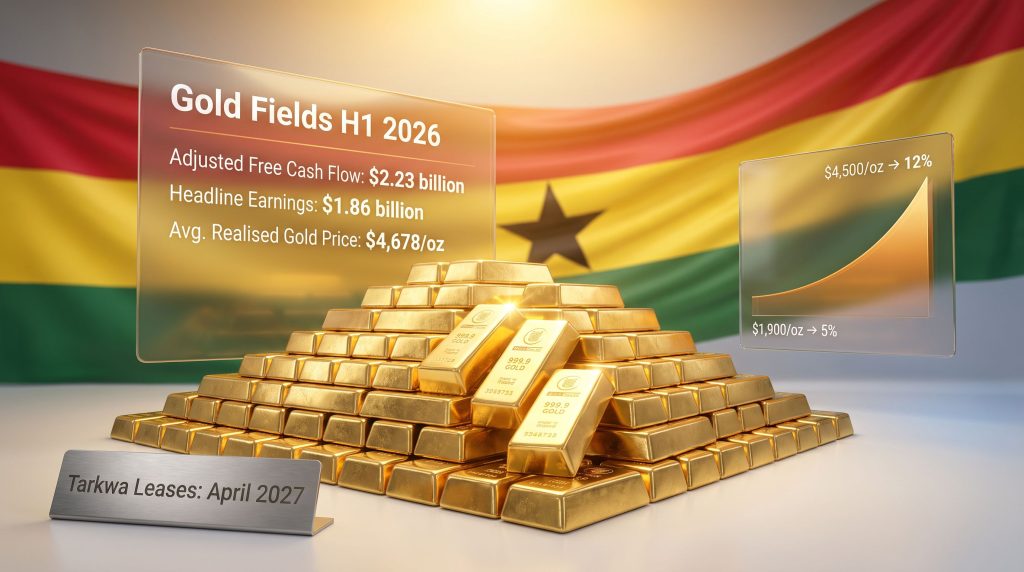
| $1,900/oz | 5% |
| $2,500/oz | ~7% (estimated mid-range) |
| $4,500/oz | 12% (maximum) |
Gold Fields' average realised gold price in H1 2026 was $4,678 per ounce, which sits above the threshold triggering the maximum royalty rate. At that price level, every ounce produced at Tarkwa would attract a 12% levy on revenue under the new framework. For a mine of Tarkwa's scale, this represents a structurally significant increase in operating costs compared to the previous fixed royalty regime.
What makes this particularly consequential for the lease renewal is that the royalty rate applicable under any new agreement is likely to reference or build upon this sliding-scale framework. Ghana is not negotiating a return to historical terms. It is negotiating from a position where elevated gold prices have fundamentally increased the perceived value of its mineral assets.
Pending Mining Law Reforms: An Additional Layer of Uncertainty
Beyond the royalty restructure, Ghana was working through a broader overhaul of its mining legislation in 2026. As Bloomberg has reported, if enacted before the Tarkwa renewal is finalised, new statutory provisions could alter local equity ownership requirements, environmental compliance obligations, and revenue-sharing arrangements in ways that materially change the commercial landscape Gold Fields is negotiating against.
The combination of a sliding-scale royalty regime, a pending legislative overhaul, and a non-automatic renewal policy does not represent a single risk. It represents a layered risk environment where each element compounds the others.
It is also worth noting a separate but related challenge flagged by independent industry coverage: Ghana's state gold-buying scheme was reported to be experiencing a cash crunch in mid-2026 — a dynamic that signals fiscal pressure within the Ghanaian government more broadly. Governments under fiscal stress historically negotiate mineral agreements more aggressively, which may further harden the government's negotiating position on Tarkwa. In addition, the current gold price outlook suggests prices are likely to remain elevated, sustaining Ghana's motivation to secure a larger share of Tarkwa's revenue.
Gold Fields' Financial Strength in H1 2026: Record Numbers, Concentrated Risk
Half-Year Results at a Glance
| Financial Metric | H1 2026 Result | Year-on-Year Change |
|---|---|---|
| Gold-equivalent production | 1.27 million oz | +12% |
| Headline earnings | $1.86 billion | +81% |
| Adjusted free cash flow | $2.23 billion | More than doubled |
| Average realised gold price | $4,678/oz | Significant uplift |
| Interim dividend | 1,625 SA cents/share | More than doubled vs 700c prior year |
| Additional shareholder returns | $500 million | New allocation |
| Total shareholder return programme (since Nov 2025) | $1.25 billion | Cumulative total |
These are exceptional numbers by any measure. Adjusted free cash flow more than doubling to $2.23 billion, combined with an 81% increase in headline earnings, reflects the powerful operating leverage that gold miners carry when realised prices surge above cost structures.
However, investors interpreting these results as a signal of reduced risk would be reading the situation in reverse. The same gold price that is driving Gold Fields' record cash generation is simultaneously strengthening Ghana's resolve to capture a larger share of Tarkwa's economics. High prices increase the asset's value to both parties, which historically makes negotiations more complex, not more straightforward.
The declaration of a 1,625 SA cents per share interim dividend and the allocation of an additional $500 million to shareholder returns — bringing the total programme since November 2025 to $1.25 billion — was made against a backdrop where Tarkwa's operating future beyond April 2027 remains entirely unresolved. Investors should weigh these returns against the possibility of a material write-down or production loss if negotiations fail.
Operational Divergence Across the Portfolio
Salares Norte: The Standout Performer
Gold Fields' Salares Norte operation in Chile delivered the most dramatic operational improvement of any asset in the group during H1 2026. Production increased 173% year-on-year to 337,000 gold-equivalent ounces as the mine completed its ramp-up phase and transitioned into steady-state production. Strong plant performance through the early winter period positioned Salares Norte to potentially exceed its full-year production target, providing a meaningful offset to underperformance elsewhere in the portfolio.
South Deep and Gruyere: Recovery Underway but Incomplete
South Deep in South Africa produced 151,000 ounces in H1 2026, marginally below the prior year's equivalent period, though second-quarter output showed improvement as operational initiatives took effect. The mine continues to operate as one of the world's deepest mechanised gold mining operations, with the geological complexity of ultra-deep hard-rock mining creating ongoing productivity management challenges.
Gruyere in Western Australia saw production decline 17% to 120,000 ounces in the first half, a consequence of mining productivity shortfalls. Gold Fields expects the operation to return to its targeted production rate by the end of the third quarter, though ounces lost during the first half are unlikely to be fully recovered within the calendar year.
Windfall: Capital Decision Still Pending
The Windfall project in Quebec, Canada, remains subject to a final investment decision contingent on environmental approval. That approval is now expected in the second half of 2026. Construction cost estimates sit at the upper end of the $1.7 billion to $1.9 billion range. A reclassification of some previously categorised capital expenditure as exploration spending contributed to a reduction in group capital guidance, now set at $1.6 billion to $1.8 billion, down from the earlier $1.9 billion to $2.1 billion range.
The next major ASX story will hit our subscribers first
Three Scenarios for the Tarkwa Lease Outcome
Scenario Modelling: Pathways Beyond April 2027
Scenario 1: Negotiated Renewal on Revised Commercial Terms
Ghana grants a new lease that incorporates the sliding-scale royalty regime, potentially revised local equity participation requirements, and updated development commitments. Gold Fields retains operational control but operates under a structurally higher cost base. This scenario preserves production continuity but compresses long-term margins at Tarkwa and likely reduces its contribution to group free cash flow.
Scenario 2: Extended Transitional Arrangement Following the Damang Model
Negotiations extend beyond April 2027 without formal resolution. A temporary operating arrangement — mirroring the Damang transitional period — allows continued production while commercial terms remain under discussion. Capital allocation to Tarkwa would likely become constrained during this period given the uncertainty, potentially accelerating mine life deterioration.
Scenario 3: Non-Renewal and Structured Asset Transfer
Ghana declines renewal on terms acceptable to Gold Fields. A structured handover process begins, with Gold Fields pursuing legal remedies under its development agreement, applicable lease provisions, and international investment law frameworks. This is the most operationally disruptive outcome, with direct consequences for production guidance, asset valuations, and the long-term African growth narrative.
Each scenario carries materially different implications for Gold Fields' production profile, cost structure, and dividend sustainability beyond 2027. The current $1.25 billion shareholder return programme was announced while Tarkwa's future remains formally unresolved.
Furthermore, the outcome of this negotiation may accelerate gold M&A activity as investors reassess African asset risk and reposition capital accordingly.
Jurisdictional Risk in Context: How Ghana Compares
| Jurisdiction | Royalty Approach | Lease Renewal Policy | Recent Precedent |
|---|---|---|---|
| Ghana | Sliding-scale 5–12% | Non-automatic; technical review required | Damang non-renewal (2025–26) |
| South Africa | Fixed royalty formula | Regulatory renewal process | Generally stable for established mines |
| Zimbabwe | Negotiated royalties | Case-by-case ministerial approval | Karo Platinum 25-year deal (2026) |
| Canada (Quebec) | Fixed mining duties | Regulatory renewal | Windfall under environmental review |
| Chile | Royalty-based regime | Concession system | Salares Norte operating under stable framework |
Ghana's adoption of a sliding-scale royalty structure places it among the more interventionist mining jurisdictions in sub-Saharan Africa in terms of active revenue capture at elevated commodity prices. The non-automatic renewal policy further differentiates Ghana from jurisdictions where lease continuity for operating mines is the regulatory default.
Zimbabwe's Karo Platinum transaction, which secured a 25-year mining deal in 2026, illustrates that African jurisdictions can offer long-term certainty when commercial terms are agreed. The contrast with Ghana's more contested renewal environment highlights that jurisdictional risk is not uniformly distributed across the continent. Considering gold as a safe haven continues to attract institutional capital globally, however, Ghana's mineral endowment ensures it will remain a critical destination for gold investment despite its evolving regulatory framework.
Frequently Asked Questions: Gold Fields Ghana Mining Lease Renewal
When does the Tarkwa mining lease expire?
The Tarkwa mining leases are scheduled to expire in April 2027. Gold Fields submitted an early renewal application in November 2025, and as of August 2026, had received no formal government response to its July 2026 commercial proposal.
Has Ghana committed to renewing the Tarkwa lease?
Ghana signalled an in-principle commitment to renewal, according to reporting from May 2026, but has ruled out any automatic extension. The Minerals Commission requires detailed development proposals for technical review before ministerial sign-off, meaning formal approval remains pending.
What happened to Gold Fields' Damang mine in Ghana?
Ghana declined to renew the Damang mining licence. Following a transitional operating arrangement, the mine was formally transferred to the Ghanaian government on 18 April 2026, establishing a clear precedent for how Ghana handles non-renewal situations.
How does Ghana's sliding-scale royalty affect Tarkwa's economics?
The royalty framework introduced in March 2026 ranges from 5% at $1,900 per ounce to 12% at $4,500 per ounce. With Gold Fields' H1 2026 average realised price at $4,678 per ounce, royalty obligations under this structure would sit at or near the maximum rate, representing a material increase in per-ounce operating costs.
What legal options does Gold Fields have?
Gold Fields has indicated it is considering all available options, including exercising legal rights under its existing leases, its development agreement with Ghana, and applicable law. The specific mechanisms would depend on agreement terms and relevant international investment frameworks.
Key Takeaways for Investors and Industry Observers
- The Gold Fields Ghana mining lease renewal for Tarkwa is one of the most consequential unresolved regulatory risks facing any major gold producer globally in 2026.
- Ghana's sliding-scale royalty regime, non-automatic renewal policy, and pending mining law overhaul collectively represent a structural shift in how the country intends to monetise its gold endowment at current price levels.
- The Damang precedent provides a concrete and recent reference point for how Ghana handles lease negotiations when commercial alignment cannot be reached.
- Gold Fields' record H1 2026 results — including $2.23 billion in adjusted free cash flow and an 81% increase in headline earnings — provide a substantial capital buffer but do not neutralise the operational and strategic risk that a Tarkwa non-renewal would create.
- The resolution or otherwise of the Tarkwa lease will likely define the shape of Gold Fields' African asset base and its group production profile through the end of the decade.
This article contains forward-looking statements and scenario analysis that involve inherent uncertainty. Outcomes may differ materially from those described. This content is intended for informational purposes only and does not constitute financial or investment advice. Readers should conduct their own due diligence before making any investment decisions.
Want to Stay Ahead of Major ASX Mineral Discoveries as Resource Nationalism Reshapes Global Mining Economics?
Discovery Alert's proprietary Discovery IQ model delivers real-time alerts on significant ASX mineral discoveries, instantly translating complex data across more than 30 commodities into clear, actionable insights — ensuring subscribers are positioned ahead of the broader market. Explore Discovery Alert's dedicated discoveries page to understand how historic mineral discoveries have generated substantial returns, and begin your 14-day free trial today to secure a decisive market advantage.