August 25, 2026

The Quiet Erosion of Monetary Confidence and Why Gold Is Filling the Void
Across financial history, the most consequential monetary shifts have rarely been announced by a single dramatic event. Instead, they accumulate through a series of smaller decisions, each one individually justifiable, but collectively representing a fundamental repricing of trust. Reserve currency transitions, debt monetisation cycles, and the gradual migration of institutional capital between asset classes all share this characteristic: they move slowly, then all at once.
That pattern appears to be repeating today, and gold winning the battle for monetary trust is no longer simply an argument made by precious metals enthusiasts. It is a thesis increasingly reflected in price behaviour, central bank reserve data, and the structural mechanics of sovereign debt markets simultaneously. Furthermore, gold in the monetary system is being reassessed at the highest institutional levels, reinforcing that this shift carries real structural weight.
When big ASX news breaks, our subscribers know first
Nominal Wealth vs. Real Wealth: The Distinction That Changes Everything
Understanding why gold is reasserting its monetary role requires separating two concepts that modern finance often conflates: nominal wealth and real wealth. Nominal wealth is the number displayed in a brokerage or bank account. Real wealth is the purchasing power those numbers represent — specifically, what they can command in terms of goods, services, housing, food, and transportation.
Inflation quietly widens the gap between the two. When a middle-income household redirects spending previously allocated to discretionary categories toward basic grocery bills simply to maintain dietary standards, its real standard of living has declined regardless of whether its nominal income figure has grown. Acute price pressures in specific categories can concentrate this erosion long before it registers broadly in headline inflation data.
Key Insight: Real wealth is not measured by account balances. It is measured by the choices those balances make available. Transportation, housing, food, entertainment, and access to desired goods are the practical metrics of living standards. When those metrics deteriorate alongside rising nominal figures, the numbers themselves become misleading.
This distinction carries direct implications for portfolio construction. If monetary inflation flows into equities and real estate, creating elevated nominal valuations without a corresponding increase in the real productive capacity of those assets, then conventional benchmarks can generate what appears to be strong performance while delivering declining real returns.
How Sovereign Debt Lost Its Role as the Definitive Safe Haven
For the better part of the post-World War II era, U.S. Treasury bonds occupied an uncontested position at the top of the global reserve asset hierarchy. Institutions, governments, and central banks accumulated Treasuries as the ultimate expression of safety, liquidity, and monetary trust.
That positioning rested on a critical assumption: that the dollars received at maturity would retain purchasing power comparable to the dollars originally invested. A sovereign bond is, at its core, a promise. It commits a government to repaying a specified quantity of currency at a future date. However, it makes no promise about what that currency will purchase.
Gold carries no such promise, and no such dependency. Its value is not contingent on any institution's fiscal discipline, any government's monetary policy credibility, or any central bank's willingness to honour a commitment made decades earlier. This structural difference is now being reassessed at the institutional level in ways that are visible in both price data and reserve composition statistics.
The $40 Trillion Pressure Point
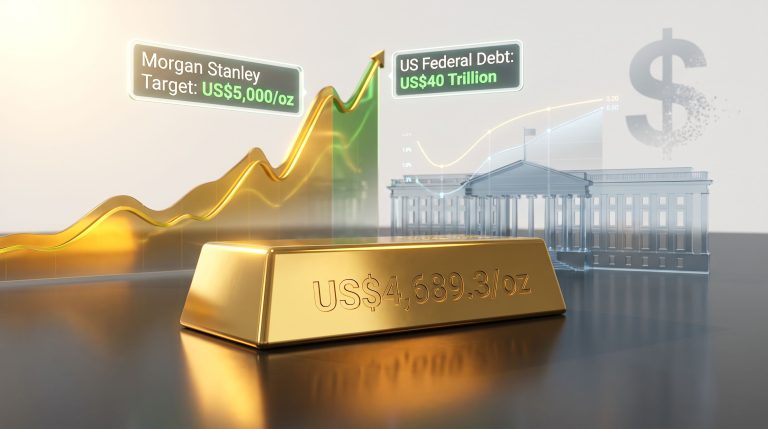
The arithmetic of U.S. sovereign debt has become increasingly difficult to ignore. With outstanding federal obligations approaching $40 trillion and annual interest expenses already exceeding $1 trillion, the sensitivity of the fiscal position to rising borrowing costs is acute. Each percentage point increase in the average yield on outstanding debt translates into hundreds of billions in additional annual expenditure.
This creates a structural incentive, independent of any particular policy preference, to manage long-term interest rates rather than allow market participants to freely determine the true cost of sovereign borrowing. When the Treasury accelerates buybacks of longer-duration government debt to suppress yields, it effectively substitutes administrative price management for genuine price discovery.
The bond market's traditional role as a trust signal — whereby rising yields communicate investor scepticism about fiscal sustainability — is compromised when the government becomes a significant buyer of its own debt. Consequently, gold, which cannot be repurchased, reissued, or repriced by any administration, becomes the alternative signal that the bond market is no longer permitted to send clearly. As Forbes notes, gold is likely to keep rising as trust flies out the window of conventional financial systems.
Price Milestones and What They Reveal About Structural Demand
The metals' price behaviour through mid-2026 deserves analytical attention that goes beyond the headline numbers.
| Metric | Level | Significance |
|---|---|---|
| Gold price (mid-2026) | Above $4,500/oz | More than 10% above the prior $4,000 resistance level |
| Silver price (mid-2026) | Approaching $69/oz | Sustained breakout above the $60 structural level |
| U.S. federal debt | ~$40 trillion | Annual interest cost now exceeds $1 trillion |
| Silver industrial demand share | ~60% of total | Up from approximately 35% roughly 25 years ago |
| Silver content per robot (est.) | ~20-30 grams | Approximately 1 troy ounce per unit at the upper range |
August is historically a seasonally weak period for precious metals. Consumer demand patterns typically soften, institutional activity slows, and speculative positioning often unwinds. The fact that both gold and silver held well above their respective technical breakout levels during this period suggests the primary driver is structural institutional demand rather than momentum-driven speculation.
If seasonal weakness failed to produce meaningful corrections from prices already trading at historically elevated levels, the underlying bid is almost certainly institutional in character. Near-term correction scenarios — should a bond market disruption or interest rate shock materialise — have accordingly been revised upward. Rather than retracing to $4,000, gold might find support closer to $4,200, while silver could pull back toward approximately $62.50 before resuming its trajectory.
These revised downside floors themselves represent a structural upgrade in the market's base, a characteristic typical of sustained institutional accumulation rather than retail-driven momentum cycles.
Central Banks and the Quiet Accumulation of Monetary Insurance
Perhaps the most institutionally significant development in the current cycle is the documented shift in central bank reserve composition. Multiple independent data sources confirm that central bank gold demand has been elevated across recent years, with gold reportedly surpassing credit instruments as the leading reserve asset class held across central bank balance sheets.
The motivation is structural rather than speculative. Gold sits entirely outside the dollar-denominated financial system. It cannot be frozen by a foreign government's sanctions policy. It cannot be devalued by another nation's monetary decisions. It carries no counterparty default risk. For nations seeking reserve assets immune to the geopolitical weaponisation of financial infrastructure, gold's appeal has become uniquely practical rather than merely philosophical.
The IMF's own analytical framework acknowledges that gold's monetary role is anchored in institutional scarcity and collective trust. When confidence in monetary governance weakens, gold's relative attractiveness increases not because the metal itself changes, but because the alternatives deteriorate in the specific characteristic that matters most: the ability to preserve value independent of any issuer's behaviour.
In addition, gold's safe-haven role has become increasingly relevant as geopolitical tensions and fiscal imbalances continue to compound, reinforcing institutional conviction in physical metal accumulation.
Silver's Dual Identity: Industrial Backbone and Monetary Asset
Silver occupies a structurally distinctive position in the precious metals complex because it simultaneously serves two demand bases with different behavioural characteristics. Indeed, silver's dual role as both a monetary asset and an industrial input makes it uniquely positioned in the current environment.
The Demand Composition Shift
| Demand Category | ~25 Years Ago | Current (~2026) |
|---|---|---|
| Industrial demand | ~35% of total | ~60% of total |
| Investment and monetary demand | ~65% of total | ~40% of total |
Industrial consumption is, by nature, relatively stable. Manufacturers plan procurement well in advance, smooth demand across production cycles, and generally do not contribute to sudden short-term price dislocations. The variable that creates explosive price movements is investment and monetary demand — specifically the condition where financial investors and industrial users compete simultaneously for the same finite inventory of deliverable physical metal.
When both demand streams converge on available physical supply at the same time, price moves can be rapid and severe. This dynamic is widely credited with contributing to the dramatic silver price acceleration observed during late 2025 and early 2026.
The Substitution Question and Its Limits
Higher silver prices predictably stimulate research into substitution, particularly in solar panel manufacturing where silver paste is a significant material cost. Copper has emerged as the most technically viable partial substitute for certain solar applications.
However, the substitution argument encounters a durability constraint that is not always incorporated into cost comparisons. If a copper-intensive solar panel achieves an operational lifespan of approximately five years compared to twenty-five years for a silver-intensive equivalent, the apparent per-unit material savings dissolve entirely when measured against lifecycle replacement costs.
Beyond solar, demand vectors that were negligible or nonexistent a decade ago are becoming material:
- Energy storage and battery systems
- Advanced semiconductor fabrication
- Artificial intelligence data centre infrastructure
- Electrical grid transmission and distribution expansion
- Robotics manufacturing
The next major ASX story will hit our subscribers first
The Robotics Silver Demand Thesis: Speculative but Directionally Significant
Among emerging demand categories, robotics represents perhaps the least quantified but potentially most consequential. Research into silver content in robotic systems suggests individual units may contain approximately 20 to 30 grams of silver, with the upper range representing roughly one troy ounce per robot.
Hypothetical Scenario: If global annual robot production were to reach 100 million units, and each unit contained approximately one troy ounce of silver at the upper range of current estimates, robotics alone could theoretically generate demand for approximately 100 million ounces of silver annually. This would represent a meaningful share of total global silver supply.
It is essential to be precise about what this calculation represents. It is not a production forecast. Robotics manufacturing is not currently operating at this scale, and the industry remains too early-stage to provide the data necessary for confident demand modelling. The significance is directional: robotics is an emerging demand category that is currently negligible in silver demand accounting but could become material within the next decade.
Unlike solar substitution risks, which are relatively well-understood and already being priced into long-term supply models, robotics, AI hardware, and advanced semiconductor demand are poorly quantified and subject to upside surprises that current models are not capturing.
Decoding Asian Silver Premiums: What the Headline Number Actually Contains
Reports of elevated silver premiums in Asian markets, particularly China, have attracted significant attention as potential evidence of physical supply tightness. The analytical reality is more nuanced and is worth decomposing carefully.
| Cost Component | Nature | Signal Quality |
|---|---|---|
| Import tariffs | Policy-driven | Not a supply/demand signal |
| CNY/USD currency hedging costs | Market-driven | Embedded, not pure metal premium |
| Ocean freight and logistics | Operational | Fixed cost per bar |
| Counterparty and settlement costs | Market-driven | Relationship-specific |
| True physical metal premium | Supply/demand signal | Often approximately $1 or less of total |
A multi-dollar apparent premium between Asian and Western silver prices does not automatically represent physical scarcity of the metal itself. Once tariffs, currency hedging costs, shipping expenses, and counterparty considerations are stripped out, the residual true metal premium may be relatively modest.
Arbitrage does not automatically eliminate this difference because the logistics of moving physical silver across oceans are genuinely costly and slow. Silver is dense, expensive to insure, and the metal's price can move significantly during the transit window, transforming a theoretically profitable trade into a loss before the shipment arrives.
Mining Equities as an Institutional Confirmation Signal
One framework for monitoring whether institutional conviction in the monetary shift thesis is deepening involves watching capital flows into major listed precious metals companies. Senior producers including Newmont, Barrick, Wheaton Precious Metals, and Franco-Nevada function as the primary vehicle through which large institutional investors obtain scaled exposure to gold and silver price movements.
Physical metal custody at institutional scale involves prohibitive storage, insurance, and operational costs. Listed mining equities provide leveraged price exposure through liquid exchange-traded instruments, making them the practical entry point for pension funds, sovereign wealth funds, and large asset managers.
| Factor | Physical Metal | Mining Equities |
|---|---|---|
| Counterparty risk | None | Operational, management, political |
| Price leverage | 1:1 | 2:1 to 5:1 (amplified) |
| Liquidity | Lower | Higher (exchange-traded) |
| Storage and custody cost | Required | None |
| Monetary insurance function | Primary | Secondary or supplemental |
Significant institutional capital flows into senior producers — visible through 13-F filings, NAV premium expansion, and analyst coverage initiation at major investment banks — would represent a meaningful confirmation that sophisticated capital is making long-duration, conviction-weighted allocations to the monetary trust thesis. Furthermore, monitoring the gold-silver ratio insights can provide additional context for evaluating the relative positioning between these two metals at the institutional level.
How to Position for a Structural Monetary Realignment
Investors approaching this environment face a risk hierarchy that differs meaningfully from conventional asset allocation frameworks. The objective is not short-term price capture. It is purchasing power preservation across an extended period of monetary uncertainty, which requires building positions with assets whose value is not contingent on any institution's promise.
A systematic dollar-cost averaging approach to physical metal accumulation removes the psychological burden of timing decisions and allows investors to accumulate real assets incrementally, building exposure through both rising and falling price phases without the emotional friction that concentrated entry points generate.
The risk hierarchy for precious metals exposure, ordered from lowest to highest counterparty and operational risk:
- Physical gold and silver — foundational monetary insurance with no counterparty obligation
- Streaming and royalty companies — reduced operational exposure relative to direct producers, leveraged to metal prices
- Senior mining producers — higher price leverage with corresponding operational and management risk
- Junior and exploration companies — highest risk, highest potential return, appropriate only as a speculative allocation
The positioning principle that anchors this framework is straightforward: gold and silver are not being accumulated because of a prediction about the precise timing of a monetary system change. They are being accumulated because the evidence suggests confidence in the current system is already shifting, and positioning before that confidence change becomes widely recognised is the essential discipline.
The Inflation-Deflation Paradox and What Comes After the Reset
One of the less widely discussed analytical frameworks in the current monetary debate is the historical observation that sustained inflationary cycles tend to culminate in deflationary corrections or monetary resets of some form. Inflation can persist as long as collective confidence in the currency holds, but the weight of accumulated debt, distorted price signals, and eroding real purchasing power eventually forces a structural adjustment.
What form that adjustment takes remains genuinely uncertain. Future monetary architectures may incorporate digital settlement units, blockchain-based exchange mechanisms, or entirely novel distribution systems. The specific technology is secondary to the fundamental question: what will those units purchase?
The number of currency units an individual holds is economically irrelevant without knowing their real purchasing power. This is the insight that unifies the entire precious metals thesis. Gold and silver do not derive their value from a promise. They derive it from the scarcity and productive effort required to bring them into existence, and from the collective trust their physical properties command across millennia of monetary history. As Money Metals Exchange observes, gold winning the battle for monetary trust reflects a deeper reassertion of sound money principles that transcends any single market cycle.
The Core Principle: When confidence in promises to pay begins deteriorating at the institutional level, assets that carry no promise and require no trust in any issuer become the rational repository for real monetary value.
The price behaviour of gold and silver through mid-2026, their resilience through a seasonally weak period, their continued accumulation by central banks, and the structural deterioration of sovereign debt's price-discovery function collectively suggest this transition is not hypothetical. It is already underway. Gold winning the battle for monetary trust is, in this context, not a prediction — it is an observation grounded in the data already in front of us.
Disclaimer: This article is for informational and educational purposes only and does not constitute financial advice. Price forecasts, scenario projections, and demand estimates referenced throughout are speculative in nature and subject to significant uncertainty. Investors should conduct their own due diligence and consult a qualified financial adviser before making investment decisions. Past performance of any asset class is not indicative of future results.
Want to Position Ahead of the Next Major Mineral Discovery Signalling the Same Structural Shift?
Discovery Alert's proprietary Discovery IQ model delivers real-time alerts on significant ASX mineral discoveries, instantly translating complex data into actionable investment insights for both short-term traders and long-term investors — explore the historic returns major discoveries have generated and begin your 14-day free trial today to secure a market-leading edge before the broader market catches on.