
August 25, 2026
The Fiscal Architecture Reshaping Gold's Role in Modern Portfolios
For much of the past century, gold's price movements were tethered primarily to inflation expectations and real interest rate dynamics. That framework, while still relevant, no longer captures the full complexity driving bullion's behaviour in 2026. A new and arguably more powerful force has entered the equation: the systematic erosion of sovereign fiscal credibility, playing out in real time through mechanisms that most retail investors have never encountered before.
The US Treasury bond buy-back gold rally, a phenomenon rooted in policy tools once considered routine and technical in nature, has become one of the most consequential catalysts in the current bullion market. Understanding why requires moving beyond surface-level rate analysis and into the deeper mechanics of how government debt management decisions transmit through currency markets, institutional portfolio construction, and ultimately into the price of hard assets like gold.
When big ASX news breaks, our subscribers know first
What the US Treasury Bond Buy-Back Programme Actually Does
Mechanics Behind Government Debt Repurchases
At its core, a Treasury bond buy-back involves the federal government purchasing its own previously issued debt securities from the open market before they reach maturity. Unlike conventional debt retirement, these operations are conducted with the explicit goal of managing liquidity conditions across the yield curve, particularly in longer-dated maturities where market depth can become uneven.
The critical detail that markets are focused on in 2026 is not that the programme exists, but that its scale has materially expanded. Operations that previously ran at approximately US$2 billion per transaction have been scaled to exceed US$4 billion, with a specific focus on the 10-to-20-year and 20-to-30-year maturity bands. These longer-duration securities are among the most sensitive to fiscal credibility perceptions, making them a strategic focal point.
| Parameter | Previous Level | Updated Level |
|---|---|---|
| Operation Size | ~US$2 billion | US$4 billion+ |
| Target Maturities | Broad | 10-20yr and 20-30yr focus |
| Effective Start Date | Prior cycle | September 9 |
| Stated Objective | Market liquidity | Long-duration stability |
| Market Interpretation | Routine management | Fiscal stress signal |
Why Scale Matters More Than the Programme Itself
The doubling of operation size sent an unambiguous signal to bond markets. When a government aggressively repurchases its own long-dated obligations, it compresses yields across that portion of the curve. This mechanical outcome has cascading effects: borrowing costs fall for longer timeframes, the domestic currency weakens in relative terms, and assets that carry no yield but offer scarcity and portability — gold being the canonical example — become structurally more attractive.
Furthermore, as analysts at Bullion Vault have noted, Treasury buy-backs and quantitative easing are frequently conflated, but they operate through distinct channels. QE involves the central bank creating new monetary base to purchase assets. A Treasury buy-back uses existing fiscal resources, making it a government-side operation that carries a different and arguably more pointed fiscal message to markets.
How Treasury Buy-Backs Transmit Into Gold Prices
The Three-Channel Transmission Framework
The connection between bond repurchase activity and gold is not a single-step relationship. It operates through at least three reinforcing transmission channels, each contributing to bullion's upward repricing:
-
Yield Channel – Expanded buy-back operations suppress long-duration Treasury yields, which directly reduces the opportunity cost of holding gold. When a 30-year bond offers less return, the relative attractiveness of a non-yielding asset like gold improves measurably.
-
Currency Channel – Downward pressure on long yields weakens the US dollar in relative terms. Since gold is priced globally in dollars, a softer dollar mechanically lowers the cost of bullion for international buyers, expanding demand across major markets in Asia, Europe, and the Middle East.
-
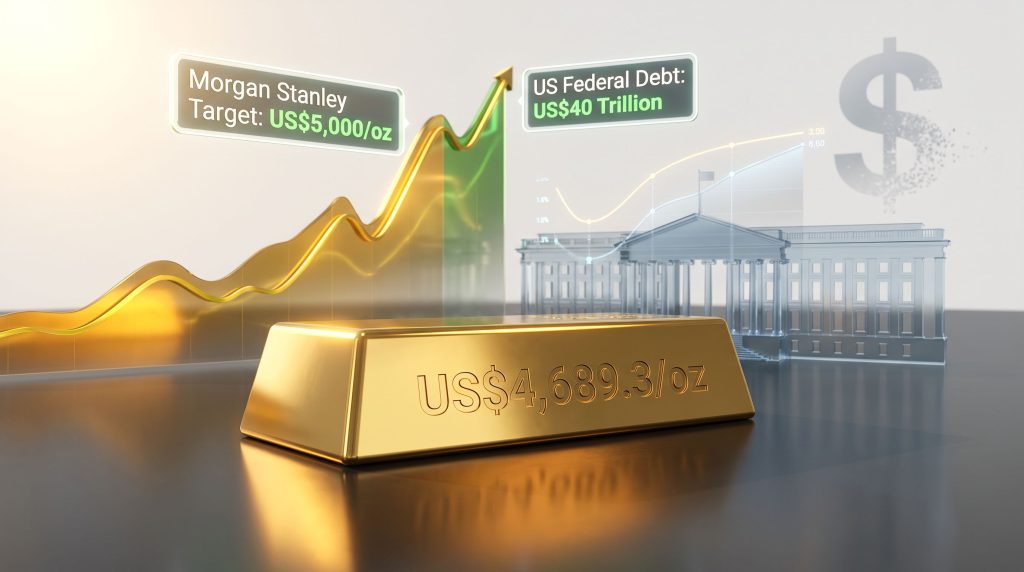
Credibility Channel – This is the most nuanced but arguably most powerful driver. Large-scale sovereign debt repurchases, set against US federal debt that has now surpassed US$40 trillion for the first time in history, reactivate investor concerns about the long-run purchasing power of dollar-denominated assets.
Gold's 5.1% weekly gain following Treasury Secretary Scott Bessent's programme announcement, followed by a further 0.2% advance to a three-month high of US$4,689.3 per ounce, illustrates just how rapidly these transmission channels activate when a credible policy trigger arrives. The gold market analysis for 2025 laid important groundwork for understanding why institutional investors were already positioned to respond quickly to precisely this kind of fiscal signal.
Why Gold Rose Without a Rate Cut
One of the most analytically significant aspects of the current rally is that it occurred without any formal Federal Reserve rate reduction. Historically, gold's strongest moves have coincided with easing cycles. The fact that bullion posted a multi-percent weekly gain on fiscal policy news alone suggests that institutional markets are now pricing sovereign credibility risk as an independent variable, separate from the traditional rate-sensitivity framework.
ING commodity strategy noted that gold's resilience points to a rally whose foundations extend well beyond yield mechanics. The prospect of larger Treasury buy-backs has redirected institutional attention toward government borrowing trajectories and fiscal credibility more broadly, whilst simultaneously reviving long-dormant concerns about currency debasement as a structural rather than cyclical risk.
The Debasement Trade: Structural or Cyclical?
Understanding Currency Debasement in Modern Context
Currency debasement, in its classical sense, referred to the physical reduction of precious metal content in coinage. In the modern monetary context, it describes the gradual erosion of a fiat currency's purchasing power through persistent deficit spending, debt accumulation, and monetary expansion that outpaces productive economic growth.
The debasement trade is the investment thesis built around this erosion. It has kept gold demand elevated across multiple market cycles over the past several years, with investors systematically adding bullion exposure to portfolios as a counterweight to concentrated Treasury and dollar-denominated positions. Understanding gold as a strategic investment in this context helps clarify why the current environment is drawing such significant institutional attention.
| Asset Class | Role in Debasement Trade | Primary Driver |
|---|---|---|
| Gold | Core beneficiary | Dollar erosion, fiscal credibility concerns |
| Bitcoin | Secondary hard asset | Scarcity narrative, anti-sovereign appeal |
| Broad Commodities | Inflation hedge | Supply constraints and dollar weakness |
| US Treasuries | Reduced reserve appeal | Debt trajectory and buy-back signals |
What US$40 Trillion in Federal Debt Changes
The crossing of the US$40 trillion debt threshold is not merely a symbolic milestone. It represents a point at which the compounding mathematics of debt servicing begin to consume an increasingly significant share of federal revenue, constraining future fiscal flexibility and raising the probability that debt management will involve financial repression, yield curve control, or continued monetisation in some form.
For long-term institutional allocators, this trajectory alters the risk-adjusted return profile of sovereign bonds. When the credibility of the world's primary reserve currency comes into question, even marginally, the demand premium for non-sovereign stores of value expands. Gold is the deepest, most liquid, and most historically validated beneficiary of that dynamic.
The buy-back programme, while smaller in absolute scale than previous Federal Reserve quantitative easing rounds, carries a distinct fiscal signalling dimension. Analysts have interpreted the programme as an indication that the current administration may not be actively pursuing meaningful constraints on new debt issuance or deficit reduction, which has direct implications for the trajectory of US dollar purchasing power.
Gold Price Forecasts and the Jackson Hole Catalyst
What Institutional Targets Reveal About Market Conviction
The forward-looking consensus among major financial institutions has shifted materially in 2026. Morgan Stanley has set a target of US$5,000 per ounce by 2027, a forecast predicated on continued fiscal expansion and sustained dollar weakness. ING has flagged meaningful upside risk throughout the remainder of the year, with the bank's commodity strategy team pointing to ongoing buy-back momentum as a key sustaining factor.
| Institution | Price Target | Timeframe | Key Assumption |
|---|---|---|---|
| Morgan Stanley | US$5,000/oz | By 2027 | Continued fiscal expansion, dollar weakness |
| ING | Material upside risk | 2026 | Dovish Fed tone, buy-back continuation |
| Market Consensus (Aug 2026) | US$4,689+ | Near-term | Jackson Hole catalyst pending |
The Jackson Hole Variable
The Federal Reserve's annual Jackson Hole symposium carries outsized market significance because it historically serves as a venue where Fed leadership telegraphs future policy direction. In the current environment, any signal from Federal Reserve Chair Kevin Warsh tilting toward a dovish or accommodative stance would add a fourth transmission channel to gold's existing momentum.
Given gold's well-established inverse relationship with real interest rate expectations, a policy signal suggesting rates will remain flat or decline would reduce the forward opportunity cost of holding bullion. Combined with the fiscal credibility backdrop already in place, this scenario could accelerate gold's trajectory toward the US$4,800 to US$5,000 range within a medium-term horizon. The relationship between gold bonds and economic cycles provides additional context for why this particular confluence of signals is drawing such serious institutional attention.
How the 2026 Move Compares to Historical Gold Rallies
Situating the Current Rally in Long-Term Context
Each major gold rally in recent decades has been anchored to a distinct macro catalyst. The 2008 to 2011 cycle was driven by the Federal Reserve's balance sheet expansion through quantitative easing, producing a 170% price increase over roughly three years. The 2020 rally combined fiscal and monetary stimulus in an unprecedented simultaneity, generating a 28% advance over approximately 12 months.
| Episode | Primary Catalyst | Gold Price Move | Duration |
|---|---|---|---|
| 2008-2011 GFC QE Cycle | Fed balance sheet expansion | +170% | ~3 years |
| 2020 COVID Stimulus | Fiscal and monetary expansion | +28% | ~12 months |
| 2022-2023 Inflation Cycle | Real rate repricing | Volatile, range-bound | ~18 months |
| 2026 Treasury Buy-Back | Fiscal credibility and dollar weakness | +5.1% weekly, developing | Ongoing |
Why This Rally Has a Different Qualitative Character
The 2026 move is structurally distinct because its primary catalyst is fiscal rather than monetary. Previous rallies were largely reactive to central bank policy decisions. The current advance is being driven, at least in part, by Treasury Department operations that signal something about the government's intentions regarding its own debt trajectory.
This distinction matters for duration. Monetary policy cycles have defined endpoints; they conclude when central banks reverse course. Fiscal credibility concerns, particularly when anchored to debt levels exceeding US$40 trillion, are less easily resolved by a single policy announcement. This arguably gives the current US Treasury bond buy-back gold rally a more durable structural foundation than prior cycles that relied predominantly on rate-sensitivity dynamics.
The next major ASX story will hit our subscribers first
Portfolio Strategy for the Debasement Environment
How Institutional Allocators Are Repositioning
The investment community's response to the current environment extends well beyond tactical gold positions. Institutional allocators are reassessing the foundational assumption that US Treasuries represent a risk-free anchor. As that assumption is tested by fiscal data, debt ceiling debates, and buy-back programme signalling, the structural case for diversifying into hard assets gains analytical grounding.
Key portfolio strategy considerations in this environment include:
- Reducing sovereign debt concentration: With US federal debt above US$40 trillion, traditional Treasury-heavy allocations carry asymmetric downside risk tied to fiscal deterioration scenarios.
- Reframing gold's role: Bullion is increasingly being treated not purely as a crisis hedge, but as a structural portfolio component with specific relevance to dollar purchasing power protection.
- Hard asset scarcity premium: Gold's rally alongside bitcoin points to a broader institutional repricing of the scarcity premium embedded in non-sovereign assets, a trend with implications beyond any single commodity.
- Rate-independent positioning: Gold's 5.1% weekly gain in the absence of a formal rate cut demonstrates that fiscal risk is now being priced as an independent variable, allowing gold to generate returns even in periods when monetary policy remains static.
In addition, central banks influencing gold prices continue to play a meaningful role in reinforcing these structural trends, as sovereign institutions themselves diversify away from concentrated dollar-denominated reserve positions.
Risk Factors That Could Interrupt the Rally
Balanced analysis requires acknowledgment of the conditions that could disrupt gold's current trajectory. These include an unexpected hawkish pivot from Federal Reserve leadership at Jackson Hole, a material strengthening of the US dollar driven by geopolitical safe-haven flows into Treasuries, or a credible improvement in the US fiscal outlook that reduces debasement concerns among institutional allocators.
However, as Market Watch has reported, the announcement from the Treasury has already catalysed meaningful repositioning across both gold and bitcoin, suggesting the market response has a breadth that extends beyond any single asset class.
Three conditions required to sustain the rally:
- Continued or expanded Treasury buy-back operations beyond the September 9 commencement date.
- A neutral to dovish tone from Federal Reserve Chair Kevin Warsh at the Jackson Hole symposium.
- No material improvement in the US fiscal deficit trajectory or a credible resolution to debt ceiling pressures.
Furthermore, the recession impact on gold prices remains a relevant consideration, as deteriorating economic conditions could simultaneously amplify safe-haven demand whilst complicating the Federal Reserve's policy calculus.
Frequently Asked Questions
What Is the Difference Between a Treasury Buy-Back and Quantitative Easing?
A Treasury buy-back is a fiscal operation in which the government uses its own resources to repurchase outstanding bonds from the market. Quantitative easing is a monetary operation in which the central bank creates new base money to acquire assets. Both can compress yields and weaken the dollar, but buy-backs carry a distinct fiscal signalling dimension because they reveal something about how the government is managing its debt obligations, rather than how the central bank is managing monetary conditions.
Why Does a Weaker US Dollar Push Gold Prices Higher?
Gold is denominated and traded globally in US dollars. When the dollar weakens, the effective price of gold falls for buyers using other currencies, which mechanically expands the global demand pool. Additionally, dollar weakness often correlates with erosion in the currency's real purchasing power, which reinforces gold's appeal as a store of value that cannot be debased by government policy.
Is the Debasement Trade a Long-Term Theme or a Short-Term Reaction?
The debasement trade has sustained demand for gold across multiple years and market cycles, suggesting it has meaningful structural depth. However, individual price surges within that broader theme can be amplified by short-term catalysts like the Treasury buy-back announcement. Investors should distinguish between the long-term structural thesis, anchored in debt trajectory and currency dynamics, and shorter-term tactical momentum that may experience consolidation periods.
Disclaimer: This article is intended for informational and educational purposes only. It does not constitute financial, investment, or legal advice. All forecasts, price targets, and analyst projections referenced herein represent third-party views and involve significant uncertainty. Past performance of any asset class is not indicative of future results. Readers should conduct independent research and consult qualified financial advisers before making investment decisions.
Want to Know Which ASX Gold Explorers Could Benefit From Rising Bullion Prices?
Discovery Alert's proprietary Discovery IQ model scans ASX announcements in real time, instantly identifying significant mineral discoveries and turning complex data into actionable investment insights — explore historic discoveries and their remarkable returns, then start your 14-day free trial to position yourself ahead of the market.