August 13, 2026
Capital Intensity at a Crossroads: Understanding Gold Fields' Two-Speed Growth Strategy
The economics of large-scale gold mine construction have always been unforgiving. Cost overruns, weather events, regulatory delays, and inflationary labour markets have derailed more development-stage projects than commodity price cycles ever have. For investors tracking Gold Fields Salares Norte and Windfall capex, the current period represents one of the most consequential capital allocation windows in the company's recent history — one asset emerging from the crucible of a difficult ramp-up, the other still navigating the regulatory and financial uncertainty that precedes a final construction commitment.
Understanding both simultaneously, rather than in isolation, is where genuine analytical value lies. Furthermore, the broader gold price outlook plays a critical role in determining how much financial buffer Gold Fields has to absorb these competing capital demands.
When big ASX news breaks, our subscribers know first
Two Projects, Two Very Different Capital Stories
Gold Fields has spent the better part of the last decade reshaping itself from a South African heritage producer into a globally diversified gold miner with meaningful exposure across South America, West Africa, Australia, and now Canada. The ambition is sound. The execution, however, has been complicated by the simultaneous development and operational challenges of two capital-intensive assets at opposite ends of their lifecycle.
Salares Norte, located in the Chilean Atacama at extreme altitude, has been operationally active but experienced a deeply disruptive ramp-up period in 2024. Windfall, buried in the Abitibi Greenstone Belt of Québec, remains pre-production and is waiting on environmental clearances before construction capital can be formally committed.
Together, these two projects define Gold Fields' medium-term capital profile and, by extension, its dividend sustainability, balance sheet trajectory, and equity re-rating potential.
Salares Norte: From Frozen Pipes to Front-Runner
The Geology and Geography That Make This Mine Both Valuable and Vulnerable
Salares Norte sits at approximately 4,500 metres above sea level in the Atacama Desert, one of the driest environments on Earth. The deposit hosts both gold and silver mineralisation within a high-sulphidation epithermal system — a geological setting typically associated with high grades but also with complex metallurgical characteristics and infrastructure challenges tied to extreme elevation.
That altitude creates a paradox. The same remote, high-elevation environment that limits access to mineralisation of this quality also introduces construction complexity and weather vulnerability that few comparable projects face. Pipe failures caused by premature sub-zero temperatures during the 2024 ramp-up phase were not a freak occurrence — they were a consequence of operating at the intersection of extreme climate and critical infrastructure timing.
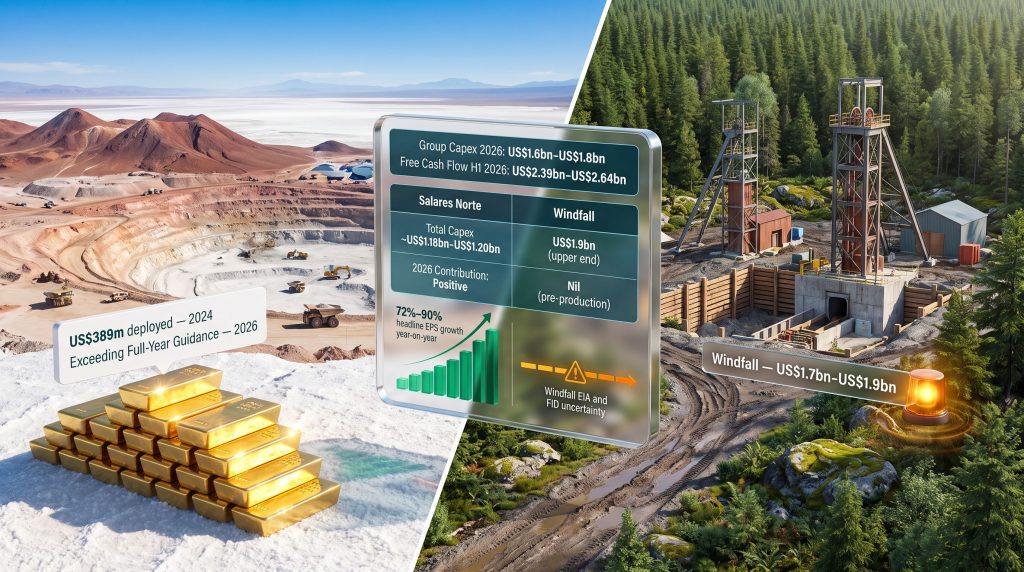
Total project capital escalated materially through development. The revised guidance issued in early 2024 placed cumulative project costs in the US$1.18bn to US$1.20bn range, with approximately US$389 million deployed in 2024 alone during the critical ramp-up year. Gold Fields' own Chile operations reporting documents the scale of infrastructure investment required to sustain production at this elevation.
A Structural Inflection: The 2026 Recovery Narrative
The 2026 operating season has told a materially different story. Winter weather events in the Atacama region, including snowfall that forced copper production suspensions at Lundin Mining's Caserones operation and prompted a multi-day halt at Antofagasta's Minera Los Pelambres site, did not deliver the same blow to Salares Norte that the 2024 cold snap inflicted. The mine continued operating through regional weather disruption that shut down neighbouring copper producers — a meaningful operational resilience signal.
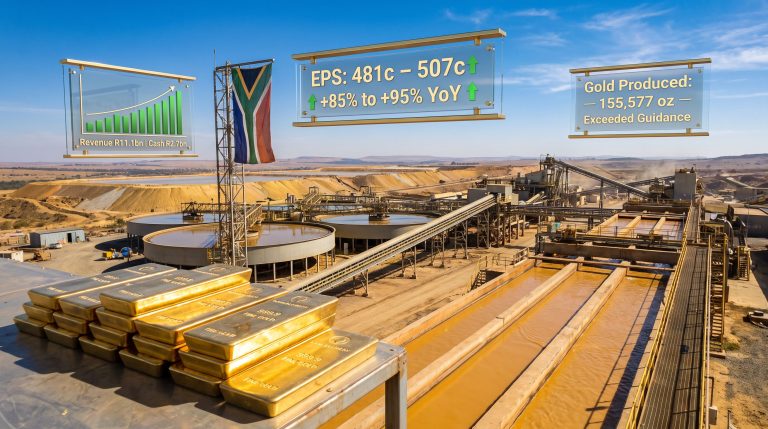
Gold Fields confirmed in its H1 2026 operational update that Salares Norte was not only maintaining continuity but was tracking to exceed its full-year production guidance — a complete reversal from the 2024 narrative. This outperformance is now carrying significant strategic weight across the group's portfolio.
Key Inflection Point: The transition of Salares Norte from capital consumer to cash generator is the single most important operational development within the Gold Fields portfolio in 2026. Its outperformance is compensating for underperformance elsewhere.
Why Salares Norte's Outperformance Matters Beyond Its Own Metrics
Gold Fields' 2026 group production guidance of up to 2.6 million ounces is being sustained — at the upper end — specifically because Salares Norte is delivering above expectations. Two other major assets are underperforming:
-
Gruyere (Western Australia): Productivity has been curtailed by elevated workforce turnover and fleet under-utilisation, a structural challenge in tight Western Australian labour markets. However, the Gruyere production outlook for subsequent periods may improve as workforce conditions stabilise.
-
Tarkwa (Ghana): A sluggish first-quarter start, combined with uncertainty about the mine's ownership and operating structure from 2027 onwards, has placed this asset's contribution in question.
Salares Norte's excess production is therefore not merely an operational win — it is a portfolio-level stabiliser absorbing the earnings impact of these concurrent weaknesses.
Windfall: The Cornerstone Asset With an Unresolved Capital Question
What Makes Windfall Geologically Compelling
The Windfall underground gold project occupies a position within the Abitibi Greenstone Belt, arguably the most prolific gold-producing geological terrane in the Western Hemisphere. The Abitibi belt has yielded more than 180 million ounces of gold over its productive history, hosting legendary deposits including those associated with the Kirkland Lake, Timmins, and Val-d'Or camp clusters.
Windfall's deposit is characterised by high-grade gold mineralisation within structurally controlled zones — a deposit geometry well suited to bulk underground mining methods. The project targets approximately 300,000 ounces of annual production at steady state, positioning it as a meaningful long-life asset in one of the world's most mining-friendly and geologically proven jurisdictions.
The Capex Problem: Upper-End Pressure and an Open Timeline
Gold Fields has guided Windfall's project capital at the upper end of the C$1.7bn to C$1.9bn range, reflecting construction scope expansion, Canadian inflationary pressures, and an extended pre-production timeline. According to reporting from the Northern Miner, this effectively represents a doubling of the original capex estimate, underscoring the degree of scope creep that has occurred. The company has been explicit that a revised capital estimate and updated execution schedule will only be issued after Environmental Impact Assessment approval and Final Investment Decision confirmation.
That sequencing creates a meaningful information gap for investors. The FID milestone was previously characterised by management as needing to be in place by June 2026 to avoid schedule slippage. As of the H1 2026 operational update, EIA approval remained outstanding.
The implications of this delay compound over time:
-
Extended timelines push first production further into the future, delaying Windfall's contribution to group cash flow.
-
Construction cost inflation in Canada's mining sector accumulates during delay periods, potentially breaching the upper end of current capex guidance.
-
Debt servicing on any project-level financing drawn in anticipation of construction begins to erode financial returns if production commencement is deferred.
Windfall Capex Scenarios: Forward-Looking Risk Assessment
| Scenario | Capex Outcome | Timeline | Investor Impact |
|---|---|---|---|
| Base Case | ~US$1.9bn (upper range) | FID confirmed H2 2026 | Manageable within current balance sheet |
| Optimistic Case | ~US$1.7bn | EIA approved, scope streamlined | Positive FCF re-rating potential |
| Downside Case | Exceeds US$1.9bn | Regulatory delays, scope creep | Dividend pressure, balance sheet strain |
| Severe Downside | Material overrun + multi-year delay | Slippage beyond 2027 | Significant equity de-rating risk |
The Permitting Complexity That Investors Rarely Price Correctly
Environmental permitting in Québec is governed by a multi-stakeholder process that involves provincial environmental authorities, federal oversight where applicable, and Indigenous consultation obligations under Canadian constitutional frameworks. These processes are not merely bureaucratic checkboxes — they represent substantive legal requirements with genuine capacity to reshape project timelines.
The Abitibi region has a long mining history, but modern permitting standards applied to new underground developments are considerably more demanding than those governing operations that received approvals decades ago. Consequently, the mining permitting risks associated with Windfall's EIA process must navigate this contemporary regulatory environment, which introduces uncertainty that is difficult to model with precision.
Analyst Perspective: RMB Morgan Stanley noted that Gold Fields management had previously signalled that all key milestones, including EIA approval and FID confirmation, were needed by June 2026 to prevent schedule disruption. That deadline has now passed without full regulatory clearance, making timeline risk the dominant variable in Windfall's capital story.
Cost Metrics: The Reclassification Effect That Changes the Analysis
One of the less-discussed aspects of Gold Fields' 2026 guidance is how the reclassification of certain Windfall expenditure from project capital to exploration spend has altered reported cost metrics. This accounting treatment directly affects the all-in cost figure, which captures non-sustaining growth capital alongside sustaining costs.
| Cost Metric | 2026 Guidance Range | Notes |
|---|---|---|
| All-In Sustaining Cost (AISC) | $1,800 – $2,000/oz | Excludes growth capital |
| All-In Cost (AIC) | $2,075 – $2,300/oz | Includes non-sustaining capex |
| AIC (revised) | Lower end of range | Reflects Windfall exploration reclassification |
| Total Group Capex (2026) | $1.6bn – $1.8bn | Revised down from $1.9bn–$2.1bn |
Analysts modelling forward costs on the basis of prior-year AIC figures need to account for this reclassification. The reduction in reported AIC does not reflect operational cost efficiency — it reflects a definitional shift in how certain Windfall spend is categorised. The underlying capital commitment to the project has not diminished.
H1 2026 Financial Performance: The Numbers Behind the Narrative
The financial backdrop against which these capital allocation decisions are being made is unusually strong. Gold Fields guided H1 2026 free cash flow before discretionary expenditure to approximately double year-on-year, with a projected range of US$2.39bn to US$2.64bn. Headline earnings per share are expected to rise between 72% and 90% compared to the prior year, landing in the range of US$1.98 to US$2.18 per share.
These outcomes reflect the dual benefit of elevated gold prices and Salares Norte's operational recovery. However, investors should avoid treating this as a signal that Windfall's capital requirements are fully absorbed within current cash generation capacity. The bulk of Windfall's construction spend has not yet commenced — and when it does, the demands on group free cash flow will intensify considerably.
The critical question is whether sustained gold prices above US$2,500 per ounce provide sufficient buffer to absorb the upper end of Gold Fields Salares Norte and Windfall capex requirements without compressing dividends or stretching the balance sheet. A correction toward US$2,000 per ounce would materially narrow that margin of safety.
The next major ASX story will hit our subscribers first
Comparing Both Assets: A Side-by-Side Framework
| Dimension | Salares Norte (Chile) | Windfall (Canada) |
|---|---|---|
| Development Stage | Operational | Pre-production |
| Target Annual Output | ~500,000+ oz peak | ~300,000 oz steady state |
| Total Project Capex | ~US$1.18bn–US$1.20bn | US$1.7bn–US$1.9bn (upper end) |
| Primary Risk | Weather/operational | Regulatory permitting |
| 2026 Contribution | Positive, above guidance | Nil |
| Capex Phase | Transitioning to sustaining | Major deployment pending FID |
| Geological Setting | High-sulphidation epithermal | Abitibi Greenstone Belt |
| Strategic Role | Current production driver | Future cornerstone asset |
What Investors Should Watch in the Months Ahead
The following milestones represent the critical path for the Gold Fields Salares Norte and Windfall capex story through the remainder of 2026 and into 2027:
-
Windfall EIA approval confirmation from Québec environmental authorities.
-
Final Investment Decision announcement, accompanied by a formal construction commencement timeline. A definitive feasibility study framework is typically required to underpin this decision with sufficient technical rigour.
-
Updated Windfall capital estimate, which Gold Fields has committed to publishing post-FID — this figure will determine whether the project stays within the guided C$1.7bn to C$1.9bn range or breaches it.
-
Salares Norte full-year production delivery relative to the elevated guidance being supported by current outperformance.
-
Tarkwa ownership resolution, which could trigger a write-down, divestment, or renegotiated operating agreement that reshapes Gold Fields' portfolio from 2027 onward. In addition, broader gold M&A activity in the sector may influence how Gold Fields positions its portfolio through this period.
Gold Fields enters the second half of 2026 with one project performing above expectations and another carrying the most consequential unresolved capital question in its pipeline. The interplay between Salares Norte's cash generation and Windfall's capital demands will define the company's financial trajectory for years to come.
Disclaimer: This article is intended for informational purposes only and does not constitute financial advice. All forecasts, guidance ranges, and scenario projections referenced are subject to material change and should not be relied upon as the basis for investment decisions. Readers should conduct independent due diligence and consult a qualified financial adviser before making investment decisions.
Want to Track the Next Major Gold Discovery Before the Market Moves?
Discovery Alert's proprietary Discovery IQ model scans ASX announcements in real time, instantly identifying significant mineral discoveries across gold and 30+ other commodities — turning complex data into actionable investment insights for both short-term traders and long-term investors. Explore how historic discoveries have generated substantial returns on Discovery Alert's dedicated discoveries page, and begin your 14-day free trial today to position yourself ahead of the broader market.