July 21, 2026
How Gold Forms Through Cosmic Stellar Events
Gold formation in space represents one of the universe's most extraordinary manufacturing processes, operating within stellar catastrophes that generate conditions far exceeding any terrestrial industrial capability. While civilisations have treasured gold for millennia, the mechanisms responsible for creating this precious metal stretch beyond Earth's boundaries into the violent hearts of dying stars and colliding neutron stars.
Understanding these cosmic foundries reveals not only how gold came to exist on our planet but also illuminates the broader processes that distribute heavy elements throughout the universe. This knowledge fundamentally reshapes our perspective on resource scarcity, mineral exploration insights, and the interconnected nature of cosmic and terrestrial processes.
When big ASX news breaks, our subscribers know first
What Cosmic Events Create Gold in the Universe?
The universe operates several distinct heavy element factories, each contributing to the cosmic inventory of precious metals through fundamentally different physical processes. These stellar events generate the extreme conditions necessary to forge atoms heavier than iron, including the gold formation in space that eventually became incorporated into planetary systems.
Neutron Star Collisions: The Primary Gold Factories
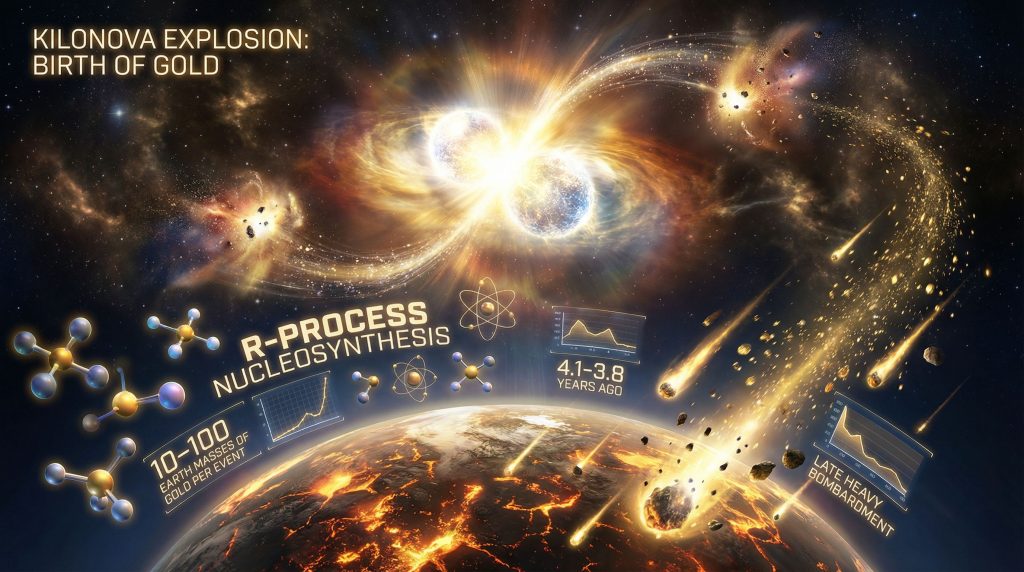
Binary neutron star mergers represent the most prolific gold production facilities in the observable universe. When two neutron stars spiral toward each other, gravitational wave radiation causes orbital decay over millions of years until the final merger occurs within milliseconds. The resulting kilonova explosion generates conditions of unparalleled extremity.
The gravitational wave event GW170817, detected on August 17, 2017, provided humanity's first direct observation of gold formation in real-time. This cosmic collision ejected approximately 10 Earth masses of neutron-rich material into space, with spectroscopic analysis confirming the presence of newly synthesised heavy elements including gold.
Key statistics reveal the astronomical scale of these events:
- Neutron density during merger: 10²⁴ neutrons per cubic centimetre
- Temperature at collision interface: 10 billion Kelvin
- Gold production per merger: 1-100 Earth masses of r-process elements
- Merger frequency: Once every 10,000-100,000 years per galaxy
The extreme gravitational forces compress matter to densities exceeding atomic nuclei, creating an environment where the normal rules of chemistry cease to function. Instead, pure nuclear physics governs the rapid assembly of heavy elements through successive neutron capture processes.
Supernova Explosions as Secondary Gold Sources
Type II supernovae contribute to gold formation through a different pathway, though their yield remains significantly lower than neutron star mergers. When massive stars (exceeding 25 solar masses) exhaust their nuclear fuel, core collapse triggers explosive nucleosynthesis in the outer stellar layers.
The supernova environment creates neutron-rich conditions through several mechanisms:
- Neutrino-driven winds from the proto-neutron star core
- Alpha-rich freeze-out in the explosion's shock-heated material
- Beta-decay sequences that convert neutron-heavy nuclei toward stability
However, achieving the entropy conditions necessary for substantial gold production (exceeding 100 k_B per baryon) proves challenging in most supernova scenarios. Research indicates that supernovae produce 100-1000 times less r-process material per event compared to neutron star mergers, relegating them to secondary contributors in the cosmic gold budget.
The Physics Behind Rapid Neutron Capture (R-Process)
The r-process represents nuclear alchemy operating under the most extreme conditions imaginable. Unlike the slow neutron capture (s-process) that occurs in normal stellar interiors, r-process nucleosynthesis requires neutron bombardment rates that overwhelm beta-decay timescales.
Critical Parameters for R-Process Operation:
| Parameter | Required Value | Comparison |
|---|---|---|
| Neutron Density | >10²⁴ n/cm³ | 10¹⁶× higher than stellar cores |
| Temperature | 1-3 billion K | 100× hotter than stellar fusion |
| Timescale | 0.1-1 seconds | 10⁹× faster than s-process |
| Neutron-to-seed Ratio | >100:1 | Extreme neutron excess |
The process begins with existing iron-peak nuclei (primarily iron-56) serving as "seed" material. In the neutron-rich environment, these seeds rapidly capture neutrons faster than they can undergo radioactive decay. This pushes nuclei far from the valley of beta stability, creating exotic isotopes that exist only in these extreme environments.
As neutron bombardment continues, nuclei become increasingly neutron-rich until they reach the neutron drip line, where additional neutrons cannot be bound. At this point, beta-decay begins converting neutrons to protons, gradually moving the nucleus back toward stability. For gold formation in space, this pathway requires incorporating approximately 82 neutrons beyond the initial iron-56 seed, followed by precise beta-decay sequences that ultimately produce stable gold-197.
How Did Gold Travel from Deep Space to Earth?
The journey of gold from stellar explosion sites to terrestrial geological formations spans billions of years and involves complex astrophysical and geochemical processes. Understanding this pathway reveals how cosmic nucleosynthesis ultimately enables human civilisation's access to precious metals.
Galactic Distribution Patterns Following Cosmic Events
Stellar explosions disperse newly synthesised elements through multiple mechanisms operating on vastly different timescales. Kilonova explosions launch material at velocities reaching 10,000-30,000 kilometres per second, while supernova ejecta propagates through interstellar space at 5,000-15,000 kilometres per second.
This high-velocity material interacts with the interstellar medium through several processes:
- Stellar wind dispersion carries gold atoms across light-years over millions of years
- Supernova shock waves compress and heat surrounding gas clouds
- Galactic chemical evolution gradually enriches star-forming regions with heavy elements
- Molecular cloud incorporation captures dispersed metals during gravitational collapse
Statistical modelling reveals significant variations in gold abundance across different galactic regions. Areas near the galactic centre, where stellar densities and merger rates are higher, show enhanced r-process element concentrations. Conversely, outer spiral arm regions display lower heavy element abundances due to reduced nucleosynthesis activity.
Early Solar System Gold Integration
The solar system formed approximately 4.567 billion years ago from the gravitational collapse of a molecular cloud that had been enriched with elements from previous stellar generations. Gold particles, dispersed from ancient kilonova and supernova events, became incorporated into the swirling disk of dust and gas surrounding the young Sun.
Protoplanetary Disk Dynamics:
During the first 100,000-1,000,000 years of solar system formation, gold-bearing dust particles underwent complex orbital evolution:
- Gravitational settling concentrated heavy particles toward the disk midplane
- Radial drift caused by gas drag moved particles inward toward the Sun
- Turbulent mixing distributed gold throughout the disk volume
- Planetesimal accretion incorporated gold into growing planetary bodies
The total mass of the protoplanetary disk ranged from 0.01-0.1 solar masses, with gold concentrations matching typical carbonaceous chondrite abundances of approximately 200 parts per billion. This seemingly low concentration translated into enormous absolute quantities when distributed across planetary-scale mass accumulations.
The Late Heavy Bombardment Period
Earth's early differentiation process sequestered most accreted gold into the metallic core due to gold's extreme siderophile (iron-loving) behaviour. Calculations indicate that 99.9% of originally accreted gold migrated to the core, where it remains inaccessible to geological processes or human extraction.
The gold accessible in Earth's crust arrived primarily through the Late Heavy Bombardment (LHB), occurring between 4.1-3.8 billion years ago. During this period, a renewed pulse of meteorite impacts delivered additional extraterrestrial material to both Earth and the Moon.
LHB Impact Statistics:
- Impact frequency: 50-100× higher than present-day rates
- Peak bombardment: Approximately 3.95 billion years ago
- Gold delivery to crust: 5,000-20,000 million tons
- Impact velocities: 15-25 kilometres per second
These impacts distributed gold through multiple mechanisms including vapour phase condensation, particulate fallout, and hydrothermal circulation through impact-heated crustal rocks. The resulting distribution created the foundation for all subsequent geological gold concentration processes.
What Makes Gold Formation So Rare in the Universe?
The extraordinary rarity of gold formation in space reflects the convergence of multiple astrophysical factors that rarely align simultaneously. Understanding these constraints illuminates why gold commands such premium value and why its cosmic abundance remains limited despite billions of years of stellar evolution.
Stellar Evolution Requirements for Gold Production
Gold formation demands stellar environments that represent extreme outliers in cosmic evolution. The pathway to neutron star formation requires initial stellar masses exceeding 25 solar masses, yet such massive stars constitute less than 0.1% of all stellar births in typical galaxies.
Stellar Mass Distribution and Gold Production:
| Initial Stellar Mass | Stellar Population % | Final Fate | Gold Production |
|---|---|---|---|
| 0.1-8 solar masses | 95% | White dwarf | None |
| 8-25 solar masses | 4.9% | Neutron star (single) | Minimal |
| >25 solar masses | 0.1% | Black hole/NS merger | Maximum |
The rarity extends beyond simple mass requirements. Successful binary neutron star formation requires:
- Synchronised stellar evolution in binary systems
- Survival through multiple supernova explosions
- Orbital decay through gravitational wave radiation
- Merger within cosmic timeframes (typically <1 billion years)
Each step introduces additional probability constraints, making the complete sequence extraordinarily uncommon across cosmic history.
Competing Element Formation Pathways
Nuclear physics strongly favours the production of lighter elements over heavy ones through multiple thermodynamic and kinetic factors. The iron peak around atomic mass 56 represents the most stable nuclear configuration, where binding energy per nucleon reaches its maximum value.
Elements heavier than iron require energy input rather than energy release during formation, making their synthesis thermodynamically unfavourable under normal stellar conditions. This fundamental constraint means that gold formation competes against:
- Photodisintegration processes that break apart heavy nuclei
- Alpha particle emission that reduces nuclear mass
- Fission reactions that split heavy atoms into lighter fragments
- Energy barriers that prevent neutron capture in normal stellar environments
The energy requirements for pushing nuclei beyond iron toward gold demand conditions that exceed normal stellar fusion processes by orders of magnitude. Only the most catastrophic astrophysical events can overcome these barriers sufficiently to enable substantial heavy element production.
Observational Evidence from Gravitational Wave Detection
The LIGO-Virgo gravitational wave detection network has revolutionised our understanding of neutron star merger frequencies and their contribution to cosmic gold production. Data from confirmed merger events provides direct empirical constraints on gold formation rates throughout the universe.
Key Observational Results:
- Merger rate: 10-1000 events per cubic gigaparsec per year
- Typical gold yield: 1-10 Earth masses per merger
- Observable universe production: ~100 Earth masses of gold per year
- Galactic enrichment timescale: 1-10 billion years
Spectroscopic analysis of kilonova emission following GW170817 confirmed theoretical predictions about r-process element production. The observed light curves matched models incorporating the radioactive decay of freshly synthesised heavy elements, providing direct evidence that these mergers indeed function as cosmic gold factories.
However, the infrequency of such events relative to cosmic timescales underscores the origin of gold's fundamental scarcity. Even with continuous production over billions of years, the total cosmic gold inventory remains minuscule compared to lighter elements like hydrogen, helium, and carbon.
How Do Scientists Study Gold's Cosmic Origins?
Investigating gold's formation in space requires sophisticated observational techniques that span electromagnetic radiation, gravitational waves, and laboratory nuclear physics. Furthermore, this multi-disciplinary approach enables researchers to probe conditions and processes that operate far beyond direct experimental reach.
Multi-Messenger Astronomy Approaches
The detection of GW170817 inaugurated the era of multi-messenger astronomy for heavy element research, combining gravitational wave signals with electromagnetic observations across the spectrum. This comprehensive approach provides unprecedented insight into the physics of neutron star mergers and their nucleosynthesis yields.
Coordinated Observation Strategy:
- Gravitational wave detection identifies merger events in real-time
- Rapid electromagnetic follow-up captures early kilonova emission
- Multi-wavelength monitoring tracks element synthesis signatures
- Long-term observations reveal late-time spectral evolution
Advanced facilities like the James Webb Space Telescope enable detailed spectroscopic analysis of kilonova ejecta, identifying specific absorption and emission features associated with heavy element formation. These observations directly confirm the presence of gold and other r-process elements in merger debris.
X-ray and gamma-ray signatures provide complementary information about the extreme physical conditions during merger events. High-energy radiation traces the shock heating and nuclear reactions responsible for driving r-process nucleosynthesis to completion.
Isotopic Analysis of Terrestrial Gold Samples
Laboratory analysis of terrestrial and meteoritic gold samples provides crucial ground truth for cosmic formation models. Isotopic fingerprinting techniques can distinguish between different nucleosynthesis pathways and potentially identify the stellar sources of Earth's gold inventory.
Key Analytical Techniques:
- Mass spectrometry measures precise isotope ratios
- Noble gas analysis reveals cosmic ray exposure histories
- Radiometric dating constrains formation timescales
- Trace element patterns identify associated nucleosynthesis products
Gold-197 represents the only stable isotope of gold, but trace amounts of radioactive gold isotopes in meteorites can reveal information about recent nucleosynthesis events. The decay products and abundance patterns provide insights into the stellar processes responsible for gold formation.
Comparison with carbonaceous chondrites (primitive meteorites) reveals the solar system's initial gold inventory before planetary differentiation processes altered terrestrial abundance patterns. These measurements constrain models of early solar system evolution and gold distribution.
Advanced Spectroscopy of Distant Stellar Events
Remote observations of stellar explosions across cosmic distances enable statistical studies of gold production throughout the universe's history. Hyperspectral imaging and time-resolved spectroscopy capture the detailed physics of nucleosynthesis in real-time.
Observational Capabilities:
| Telescope System | Spectral Range | Gold Detection Method |
|---|---|---|
| Hubble Space Telescope | UV-Visible-NIR | Absorption line analysis |
| James Webb Space Telescope | Near-Mid IR | Thermal emission features |
| Ground-based arrays | Optical-NIR | High-resolution spectroscopy |
| X-ray observatories | 0.1-100 keV | Fluorescence line detection |
Real-time kilonova monitoring reveals how gold and other heavy elements form and disperse following neutron star mergers. The evolution of spectral features over days to months traces the nuclear decay chains that transform exotic neutron-rich isotopes into stable elements.
Statistical analysis of multiple events enables researchers to refine models of gold production efficiency and determine how merger properties (total mass, mass ratio, neutron star composition) influence nucleosynthesis yields.
What Does Gold's Space Origin Mean for Earth's Geology?
The cosmic heritage of terrestrial gold fundamentally shapes its geological behaviour and distribution patterns throughout Earth's crust. Understanding this connection between stellar nucleosynthesis and terrestrial mineralisation reveals why gold deposits form where they do and how geological processes concentrate this cosmically rare element.
Core-Mantle Differentiation Impact on Gold Distribution
During Earth's early molten phase, gold's extreme siderophile behaviour resulted in near-complete segregation into the metallic core. The partition coefficient between metallic iron and silicate melt exceeds 10,000-100,000, meaning gold concentrates preferentially in iron-rich phases by factors of ten thousand or more.
Quantitative Distribution Analysis:
- Total Earth gold inventory: ~1.6 million billion tons
- Core sequestration: 99.9% of accreted gold
- Mantle retention: ~0.1% of original inventory
- Crustal accessibility: <<0.01% of total gold
This extreme partitioning behaviour reflects gold's electronic structure and bonding preferences. In high-temperature, high-pressure environments, gold forms metallic bonds with iron far more readily than ionic or covalent bonds with silicate minerals. The result is almost complete removal of gold from the silicate Earth accessible to surface geological processes.
Pressure and temperature effects on partitioning behaviour show that even under the extreme conditions of core formation (>30 GPa pressure, >2000 K temperature), gold's siderophile nature remains dominant. Experimental petrology studies confirm that no reasonable core formation scenario would leave substantial gold in the mantle.
Crustal Gold Concentration Mechanisms
The gold present in Earth's crust today arrived primarily through Late Heavy Bombardment delivery after core formation was complete. This "late veneer" of extraterrestrial material provided the foundation for all subsequent geological gold concentration processes.
Primary Concentration Pathways:
- Hydrothermal fluid transport from deep crustal sources
- Magmatic differentiation in specialised igneous systems
- Metamorphic remobilisation during orogenic events
- Weathering and secondary concentration in placer deposits
Hydrothermal systems represent the most significant gold concentration mechanism, capable of increasing gold grades from background levels (1-5 parts per billion) to ore-grade concentrations (>1 gram per ton). These systems operate through:
- Fluid circulation driven by geothermal gradients
- Chemical dissolution of gold from source rocks
- Precipitation triggered by temperature, pressure, or pH changes
- Structural control by fracture networks and fault systems
The efficiency of hydrothermal concentration depends on numerous factors including fluid chemistry, temperature, pressure, and the availability of suitable precipitation sites. Gold's chemical behaviour in hydrothermal fluids enables it to travel significant distances before concentrating in economically viable deposits.
Future Implications for Resource Exploration
Understanding gold's cosmic origins and terrestrial distribution patterns provides strategic guidance for future exploration efforts and resource assessment. The fundamental scarcity of cosmic gold production constrains the total terrestrial inventory, while geological processes determine how this inventory becomes concentrated into exploitable deposits.
Exploration Strategy Implications:
| Geological Setting | Gold Potential | Exploration Priority |
|---|---|---|
| Archean greenstone belts | High | Primary target |
| Proterozoic orogenic zones | Moderate-High | Secondary target |
| Phanerozoic volcanic arcs | Moderate | Tertiary target |
| Sedimentary basins | Low | Limited potential |
Deep drilling limitations become increasingly significant as shallow deposits are exhausted. The concentration of remaining gold at greater depths requires more sophisticated and expensive extraction technologies. However, the fundamental constraint remains the limited total inventory delivered by cosmic processes.
Asteroid mining advances represent a theoretical alternative that could access gold still present in undifferentiated celestial bodies. Metallic asteroids potentially contain gold concentrations similar to meteorites (~200 ppb), but the engineering challenges and economic constraints remain formidable.
The comparative economics between terrestrial and extraterrestrial gold sources will likely favour terrestrial extraction for the foreseeable future, despite the limited remaining inventory. However, as high-grade terrestrial gold deposits become depleted, the economic balance may shift toward space-based resource acquisition.
The next major ASX story will hit our subscribers first
How Does Understanding Space Gold Formation Impact Modern Science?
Research into cosmic gold formation in space drives advances across multiple scientific disciplines, from nuclear physics to materials science to planetary exploration. In addition, the extreme conditions required for r-process nucleosynthesis provide unique laboratories for testing fundamental physical theories under circumstances impossible to replicate on Earth.
Nuclear Physics Applications
The r-process nucleosynthesis pathway responsible for gold formation involves exotic nuclear reactions operating far from stability. Understanding these processes advances several areas of nuclear physics research with practical applications for energy production and nuclear waste management.
Advanced Reactor Design benefits from r-process research through improved understanding of neutron-rich isotope behaviour. Fast breeder reactor designs that maximise neutron utilisation can incorporate lessons learned from stellar nucleosynthesis about optimal neutron-to-fuel ratios and neutron capture cross-sections.
Neutron star equation-of-state research driven by gravitational wave observations directly informs nuclear physics models. The behaviour of matter at densities exceeding 10¹⁵ grams per cubic centimetre tests theoretical predictions about nuclear interactions under extreme conditions.
Heavy element synthesis in laboratory conditions remains a long-term goal inspired by stellar r-process mechanisms. While current particle accelerator capabilities cannot replicate neutron star merger conditions, research into rapid neutron capture continues pushing the boundaries of achievable neutron flux densities.
Astrophysics Model Validation
Gold abundance patterns throughout the universe provide crucial tests for models of stellar evolution, galactic chemical evolution, and cosmological structure formation. The relative abundances of r-process elements serve as cosmic chronometers that reveal the history of stellar nucleosynthesis across billions of years.
Stellar Evolution Theory Testing:
- Binary evolution models must reproduce observed merger rates
- Supernova explosion mechanisms require validation through r-process yields
- Neutron star formation scenarios need consistency with gravitational wave observations
- Galactic chemical evolution models must match observed abundance gradients
Population synthesis studies combine stellar evolution models with observed gold abundances to constrain the initial mass function and star formation history of galaxies. These studies reveal how cosmic gold production rates have evolved since the universe's first stellar generations.
Exoplanetary system gold abundances may eventually provide insights into planet formation processes and the distribution of heavy elements in other stellar systems. As spectroscopic techniques improve, detection of gold in exoplanetary atmospheres could reveal information about their formation environments.
Technology Development Opportunities
The extreme physics of gold formation drives development of advanced technologies with applications extending far beyond astrophysics research. High-energy density physics experiments attempt to recreate stellar conditions using laser fusion and magnetic confinement techniques.
Space-based Detection Systems:
Next-generation gravitational wave observatories will enable more sensitive detection of neutron star mergers, providing larger statistical samples for studying gold production mechanisms. Proposed space-based interferometers could detect mergers throughout cosmic history, mapping the evolution of heavy element production.
Advanced Materials Science applications leverage gold's unique properties discovered through astrophysical research. Understanding gold's behaviour under extreme conditions informs the development of specialised alloys and coatings for aerospace applications, where gold's resistance to radiation and corrosion proves invaluable.
Quantum computing components increasingly utilise gold's exceptional electrical conductivity and chemical stability. Research into gold's atomic-scale properties, driven by astrophysical studies, contributes to the development of more reliable quantum computing architectures.
What Future Discoveries Might Change Our Understanding?
The rapidly evolving fields of gravitational wave astronomy and space-based telescopy promise revolutionary advances in our understanding of cosmic gold formation. Emerging technologies and observational capabilities will provide unprecedented detail about the astrophysical processes responsible for heavy element synthesis.
Next-Generation Gravitational Wave Observatories
The current LIGO-Virgo network represents only the first generation of gravitational wave detectors. Planned upgrades and new facilities will dramatically expand our ability to study neutron star mergers and their nucleosynthesis yields.
Enhanced Observational Capabilities:
- Detection range: 10× increase in observable volume
- Sensitivity: Detection of smaller mass mergers
- Frequency coverage: Access to new gravitational wave signatures
- Statistical samples: Hundreds of merger events per year
Space-based interferometers like the planned Laser Interferometer Space Antenna (LISA) will detect gravitational waves from neutron star mergers throughout cosmic history. This capability will enable researchers to map heavy element production across billions of years, revealing how gold formation rates have evolved with cosmic time.
Multi-messenger network coordination will become increasingly sophisticated, enabling rapid electromagnetic follow-up of gravitational wave events. This coordinated approach will capture detailed spectroscopic data on gold formation in real-time across multiple merger events.
James Webb Space Telescope Deep Field Analysis
The unprecedented infrared capabilities of JWST enable studies of heavy element formation in the early universe that were previously impossible. Deep field observations can potentially detect signatures of the first r-process events in cosmic history.
Early Universe Studies:
- First stellar generation r-process contribution
- Primordial binary formation and merger rates
- Galactic chemical evolution in the first billion years
- Population III supernova heavy element yields
Timeline refinement for the first appearance of gold in the cosmos will constrain models of early stellar evolution and provide insights into when planetary systems capable of supporting complex chemistry first became possible.
Spectroscopic surveys of distant galaxies will reveal how gold abundance varies with galactic properties such as mass, star formation rate, and morphology. These observations will test models of how cosmic gold production depends on galactic environment and evolutionary history.
Advanced Laboratory Nucleosynthesis Experiments
Future experimental facilities aim to recreate aspects of stellar nucleosynthesis conditions in laboratory environments, providing direct tests of theoretical models for r-process gold formation.
Next-Generation Particle Accelerators:
- Higher neutron flux densities approaching stellar conditions
- Exotic isotope production for r-process pathway studies
- Nuclear reaction rate measurements under extreme conditions
- Equation-of-state validation for neutron-rich matter
Laser fusion facilities continue pushing toward conditions that reproduce aspects of stellar nucleosynthesis. While full r-process recreation remains beyond current capabilities, partial recreation of neutron-rich environments provides valuable model validation.
Alternative formation mechanisms may be discovered through laboratory experiments, potentially revealing additional pathways for gold synthesis that operate under different astrophysical conditions. Such discoveries could revise our understanding of cosmic gold budgets and formation efficiency.
Consequently, these advancements in ore mineralogy insights and gold market performance analysis will provide comprehensive frameworks for understanding how cosmic processes influence terrestrial resource availability and economic dynamics.
Disclaimer: The study of cosmic gold formation involves theoretical models and observational data that continue evolving as new discoveries emerge. Predictions about future technological capabilities and discoveries represent informed speculation based on current scientific understanding, but actual developments may differ significantly from these projections. Readers should consult current scientific literature for the most up-to-date information on this rapidly advancing field.
The cosmic journey of gold from stellar catastrophe to terrestrial geology represents one of nature's most remarkable transformation processes. This understanding fundamentally reshapes our perspective on resource scarcity, geological exploration strategies, and humanity's connection to cosmic evolution. As observational capabilities continue advancing, our comprehension of these processes will undoubtedly deepen, revealing new insights into the intricate relationship between stellar physics and planetary chemistry that makes complex life possible.
Ready to Capitalise on the Next Golden Discovery?
Just as gold's cosmic journey from stellar explosions to Earth's crust reveals the extraordinary rarity and value of precious metals, Discovery Alert's proprietary Discovery IQ model instantly identifies significant ASX mineral discoveries that could transform portfolios. With advanced AI scanning daily ASX announcements for actionable opportunities, subscribers gain the market-leading advantage needed to capitalise on major discoveries like those by De Grey Mining and WA1 Resources before broader market recognition occurs.