July 26, 2026
When Geopolitical Calm Becomes a Commodity Catalyst
Precious metals markets have long operated within a feedback loop that most casual observers misunderstand. The conventional narrative positions gold as a straightforward beneficiary of conflict and chaos. The reality is considerably more layered. In certain geopolitical environments, the cessation of hostilities can be more bullish for gold than the conflict itself — a counterintuitive dynamic that played out with striking clarity during the week of July 28, 2026, as gold gains on pause in US-Iran fighting sent bullion sharply higher across the board.
Understanding why requires examining the indirect channels through which military conflict actually flows into commodity pricing, and why de-escalation can simultaneously trigger multiple bullish forces for precious metals at once. Furthermore, the gold and geopolitical drivers at play here reveal a market far more sophisticated than headlines typically suggest.
When big ASX news breaks, our subscribers know first
The Inflation Paradox: Why Conflict Was Actually Hurting Gold
One of the least appreciated dynamics of the 2026 US-Iran conflict is that sustained hostilities were, paradoxically, creating headwinds for gold rather than supporting it. The mechanism works as follows: military conflict in the Middle East drives crude oil prices higher through supply risk premiums, particularly given the Strait of Hormuz's role as a global energy chokepoint through which roughly 20% of the world's oil supply transits daily.
Higher oil prices feed directly into inflation expectations. Elevated inflation, in turn, pressures central banks to respond with tighter monetary policy. Rising rate expectations increase the opportunity cost of holding non-yielding assets like gold, since bonds and cash instruments become relatively more attractive on a yield-adjusted basis. The result: a scenario where geopolitical stress was suppressing gold rather than lifting it. Consequently, understanding gold and bond dynamics becomes essential for contextualising this period.
The Gold Paradox Under Sustained Conflict
The 2026 conflict period exposed a more nuanced dynamic than conventional wisdom suggests:
- Escalating conflict drove oil prices significantly higher throughout the year
- Higher oil fed directly into inflation expectations and central bank rate hike bets
- Rising rate expectations increased the opportunity cost of holding non-yielding gold
- This chain created sustained bearish pressure on bullion during peak hostilities
- Ceasefire conditions reversed every link in this chain simultaneously
This is why when Iranian officials signalled a conditional halt to their strikes contingent on US restraint, and the US concurrently paused its bombing campaign, gold gains on pause in US-Iran fighting compressed multiple bullish catalysts into a single session.
A Full Precious Metals Snapshot: Monday, July 28, 2026
The scale of Monday's precious metals rally was notable not just for gold but across the entire complex, signalling that the move reflected genuine risk-appetite repositioning rather than isolated safe-haven speculation.
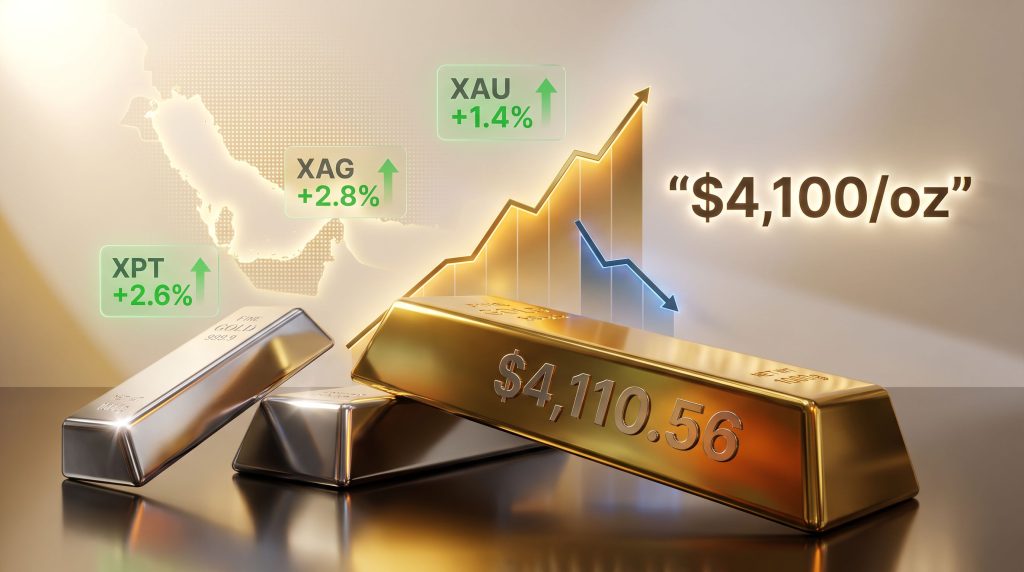
| Metal | Price | Session Move |
|---|---|---|
| Spot Gold (XAU) | $4,110.56/oz | +1.4% |
| Gold Futures (GC) | $4,112.10/oz | +1.0% |
| Spot Silver (XAG) | $59.81/oz | +2.8% |
| Platinum (XPT) | $1,629.15/oz | +2.6% |
| Palladium | $1,269.43/oz | +2.1% |
Spot gold climbed 1.4% to $4,110.56 per ounce by 0200 GMT, while US gold futures settled at $4,112.10, gaining 1.0% on the session. The convergence between spot and futures pricing suggested the move was orderly and broadly distributed across market participants rather than driven by speculative positioning alone.
Silver's outperformance at +2.8% deserves particular attention. Unlike gold, silver carries significant industrial demand, meaning its rally reflects optimism about economic activity normalising as conflict risk retreats, layered on top of safe-haven inflows. Furthermore, reviewing the gold-silver ratio analysis for this period highlights just how pronounced the relative shift between the two metals became. When silver substantially outperforms gold during a risk-off-to-risk-on transition, it frequently signals institutional investors rotating into the entire metals complex with confidence.
The Dual Catalyst: Oil and the Dollar Move Together
What made Monday's session analytically significant was the simultaneous decline in two of gold's most important inverse correlates — crude oil and the US dollar — within a single trading window.
Oil prices fell more than 4% in a single session following the ceasefire signals from Tehran. The scale of that decline reflected how much conflict risk premium had been baked into energy markets throughout the year. As that premium unwound, inflation expectations softened almost immediately, reducing the urgency for additional central bank tightening. According to reporting from Reuters, gold had previously hit a six-month low amid rate hike concerns during the peak of the conflict, making the subsequent rebound all the more striking.
Concurrently, the US Dollar Index fell 0.3%, a meaningful intraday move for a currency index that typically exhibits low volatility. Dollar weakness is mechanically bullish for gold because bullion is priced globally in USD. When the dollar softens, holders of other currencies can purchase the same ounce of gold for fewer units of their local currency, expanding the effective demand pool for the metal.
The simultaneous decline in crude oil and the US dollar created a compounding tailwind for gold — a rare convergence that amplified bullion's appeal across multiple investor cohorts at once, from inflation hedgers to currency diversifiers to momentum traders responding to technical breakouts.
Tim Waterer, chief market analyst at KCM Trade, noted that gold was "a clear beneficiary of the dual price action in oil and the US dollar, with both declining on de-escalation hopes between the US and Iran," and that "lower oil was easing inflation concerns." This framing captures the multi-channel nature of the catalyst precisely.
The Federal Reserve Dimension: What Traders Are Really Watching
Beyond the immediate geopolitical catalyst, precious metals markets were also positioning ahead of a significant macro event: the Federal Reserve's policy decision scheduled for later in the week. The near-universal expectation among economists and market participants was that rates would remain unchanged at this particular meeting.
However, the more consequential signal was embedded in the forward guidance rather than the immediate decision. According to the CME FedWatch Tool, traders were pricing in approximately 80% probability of a rate hike in September — a level of conviction that had been creating a persistent overhead ceiling for gold throughout the conflict period.
Why Does Federal Reserve Policy Move Gold Markets?
Gold pays no interest or dividends, making it a non-yielding asset. When rate hike expectations rise, yield-bearing alternatives such as Treasury bonds become comparatively more attractive. This raises the opportunity cost of gold ownership. Conversely, when rate hike expectations ease even marginally, the comparative attractiveness of non-yielding assets improves, providing price support for bullion.
The critical question for gold markets following the ceasefire pause was whether easing oil prices would be sufficient to shift the Fed's trajectory. In addition, central bank gold demand was already providing a structural demand floor beneath prices, meaning any softening in rate expectations would compound existing buying pressure. If the September hike probability erodes meaningfully in coming weeks, gold could receive a significant additional tailwind beyond the geopolitical catalyst already priced in.
Scenario Analysis: Where Gold Goes From Here
The sustainability of the rally depends heavily on how several key variables evolve over the coming weeks and months. Waterer noted that "gold's near-term fate remains closely tied to the direction of oil prices," with the path higher likely to remain volatile and heavily influenced by geopolitical headlines until a more durable peace emerges.
| Scenario | Primary Driver | Gold Outlook |
|---|---|---|
| Full and durable ceasefire agreement reached | Oil falls further, USD weakens, inflation cools | Strongly bullish |
| Ceasefire collapses, hostilities resume | Oil spikes, inflation fears return, rate bets rise | Near-term bearish |
| Fed holds in July, hikes as expected in September | Opportunity cost rises, dollar supported | Moderate headwind |
| Fed signals pause extending beyond September | Rate pressure eases materially | Additional bullish tailwind |
| Geopolitical deadlock with no clear resolution | Elevated volatility, range-bound pricing | Uncertain, headline-dependent |
The $4,100 per ounce level has emerged as a psychologically significant threshold for the gold market. A sustained close above this zone would likely attract momentum-driven buying from systematic strategies and technical traders, potentially accelerating the move toward higher price discovery.
The next major ASX story will hit our subscribers first
Structural vs. Cyclical Bullishness: The Longer-Term Case for Gold
Beyond the immediate geopolitical trigger, several structural factors continue to support elevated gold valuations in the current environment:
- Central bank accumulation has remained robust across emerging market economies seeking to diversify away from US dollar reserves, providing a consistent demand floor beneath spot prices
- Real interest rate dynamics remain the critical long-run variable, as the inflation-adjusted return on competing assets determines gold's relative attractiveness at a fundamental level
- Geopolitical fragmentation as a broader global trend increases the frequency and unpredictability of events that drive safe-haven demand spikes
- Currency instability in multiple emerging market economies has expanded the pool of investors treating gold as a monetary reserve rather than a speculative position
These forces underpin the gold safe-haven dynamics that have kept institutional interest in bullion elevated well beyond any single geopolitical episode. Waterer's characterisation of remaining "constructively bullish over the longer term" reflects a view that even if near-term price action remains volatile, the structural backdrop continues to favour gold as a multi-year asset allocation theme.
Platinum and Palladium: Reading the Industrial Signal
The strong gains in platinum (+2.6% to $1,629.15) and palladium (+2.1% to $1,269.43) carry a distinct analytical message from the gold and silver moves. Both platinum group metals have substantial industrial applications, particularly in automotive catalytic converters and hydrogen fuel cell technology, meaning their rallies reflect expectations of improved economic activity rather than pure safe-haven demand.
When the entire precious metals complex rallies in concert, as occurred on Monday, it typically signals a broad reassessment of risk conditions rather than a defensive rotation into gold specifically. This breadth is generally considered a more durable bullish signal than gold gains on pause in US-Iran fighting in isolation. For additional context on how this dynamic unfolded across broader markets, analysis from Investing.com provides further insight into how the Fed pause and Middle East tensions interacted during this period.
Frequently Asked Questions
Why did gold rise when a ceasefire pause was announced rather than falling?
The pause reduced oil prices, easing inflation fears and diminishing the urgency for additional central bank rate hikes. Since higher rates make non-yielding gold less competitive, anything that reduces rate hike expectations is structurally bullish for bullion.
How does dollar weakness amplify gold gains?
Gold is priced in US dollars globally. When the dollar weakens, international buyers can purchase gold more cheaply in their local currencies, expanding effective demand and supporting higher USD-denominated gold prices.
Could gold fall sharply if conflict resumes?
Yes. A resumption of hostilities would likely push oil prices sharply higher, rekindling inflation fears and central bank tightening expectations. This would raise gold's opportunity cost and could trigger a meaningful reversal, particularly if the September Fed hike probability increases materially from current levels.
Why did silver outperform gold during this session?
Silver's larger gain reflects its dual role as both a monetary metal and an industrial commodity. De-escalation improves economic growth expectations, boosting industrial demand signals for silver alongside the safe-haven repositioning that benefited gold.
This article is intended for informational purposes only and does not constitute financial advice. Precious metals markets are subject to significant price volatility, and past price movements are not indicative of future results. Readers should consult a qualified financial adviser before making any investment decisions.
Want to Stay Ahead of the Next Major Mineral Discovery on the ASX?
While geopolitical shifts are reshaping precious metals markets, Discovery Alert's proprietary Discovery IQ model scans daily ASX announcements in real time — instantly identifying significant mineral discoveries across gold, silver, and 30+ other commodities before the broader market catches on. Explore historic discoveries and their exceptional returns, then begin your 14-day free trial to position yourself at the forefront of the next major find.