
May 16, 2026
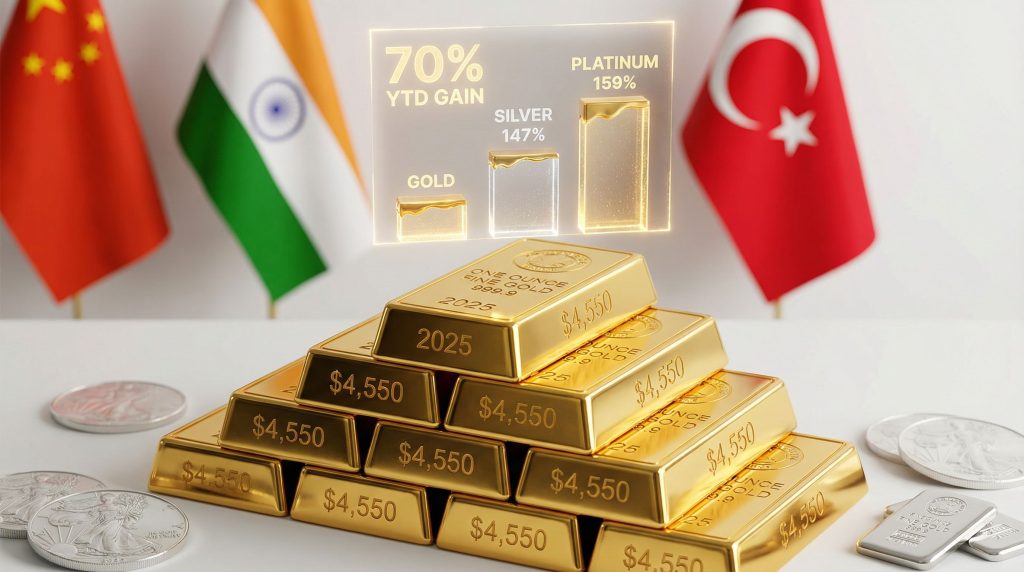
The global financial system stands at a crossroads where traditional monetary policy mechanisms face unprecedented stress testing. Central banks worldwide grapple with competing mandates of price stability and economic growth while managing historically elevated debt burdens. This environment has created structural support for hard assets, particularly precious metals, as gold hits all-time highs serving as a hedge against currency debasement and monetary instability.
As of late December 2025, gold reached approximately $4,550 per ounce, representing gains exceeding 70% year-to-date according to Trading Economics commodity data. This performance coincides with silver trading above $70 per ounce, indicating broad-based precious metals strength rather than gold-specific dynamics.
The Federal Reserve's December 2025 meeting produced three dissenting votes for the first time in over a decade, highlighting internal disagreement about monetary policy direction. Despite stronger-than-expected Q3 GDP growth of 4.3% versus consensus estimates of 3.3%, market expectations for at least two interest rate cuts in 2026 remained unchanged, suggesting institutional scepticism about data sustainability.
Key Economic Indicators Driving Gold Demand:
• GDP growth disconnect from monetary policy expectations
• Labour market moderation despite headline economic strength
• Persistent geopolitical uncertainty elevating safe-haven demand
• Central bank policy divergence creating currency volatility
How Global Reserve Composition Changes Drive Precious Metals Markets
Central banking institutions worldwide are reassessing reserve asset allocation strategies amid concerns about sovereign debt sustainability and currency stability. This institutional rebalancing represents a structural shift rather than cyclical positioning, as monetary authorities seek alternatives to traditional reserve currencies.
The World Gold Council tracks central bank purchasing patterns, though specific 2025 data requires verification from official sources. Historically, emerging market central banks have demonstrated consistent gold accumulation strategies, particularly during periods of geopolitical uncertainty and currency volatility.
Central Bank Strategic Considerations:
| Factor | Impact on Gold Demand | Policy Implications |
|---|---|---|
| Currency diversification | Increased allocation | Reduced dollar dependence |
| Inflation hedging | Portfolio rebalancing | Monetary stability focus |
| Geopolitical insurance | Safe-haven accumulation | Risk management priority |
| Domestic gold production | Strategic stockpiling | National security considerations |
Regional monetary authorities face unique challenges in reserve management. Asian central banks often balance domestic economic growth objectives with external stability requirements, while Middle Eastern institutions manage oil revenue volatility through diversified reserve strategies.
When big ASX news breaks, our subscribers know first
Why Conventional Economic Models Failed to Predict Gold's Breakout Performance
Traditional commodity pricing models assume inverse correlations between economic strength and safe-haven asset performance. However, the December 2025 market response to robust GDP data challenged these established relationships, with the record-high gold prices surging following positive economic releases.
According to GoldPrice.org analyst Matthew Bolden, professional traders and money managers appeared to distrust headline GDP figures despite the substantial beat versus consensus expectations. This scepticism reflects broader concerns about data quality and underlying economic fundamentals, particularly labour market conditions.
Market Response Analysis – December 23, 2025:
• Expected reaction: Risk assets rally, USD strengthens, gold weakens
• Actual outcome: Gold topped $4,475, silver exceeded $70 per ounce
• Professional interpretation: Data reliability questioned by institutional participants
• Policy implications: Rate cut expectations unchanged despite growth strength
The disconnect suggests markets are pricing scenarios beyond traditional economic cycle analysis. Institutional participants may be incorporating longer-term structural factors including fiscal sustainability, demographic trends, and geopolitical stability into precious metals positioning.
"Markets appear increasingly focused on structural rather than cyclical economic factors, with gold serving as insurance against monetary system instability rather than traditional inflation hedging."
What Escalating Geopolitical Tensions Mean for Safe-Haven Asset Pricing
The final week of December 2025 witnessed significant geopolitical developments that reinforced precious metals' safe-haven premium. These events created sustained demand for assets perceived as stores of value during periods of international instability, contributing to gold's 2025 price surge.
As reported by financial news outlets, the period included Venezuelan oil tanker seizures by U.S. military forces under disputed legal authority, presidential statements regarding potential blockade and ground operations against Venezuela. Furthermore, Christmas Day military strikes against ISIS groups in Nigeria added to market uncertainty.
Geopolitical Risk Assessment Framework:
• Immediate impact: Direct military action creates market uncertainty
• Medium-term implications: Trade route disruption and energy price volatility
• Long-term considerations: International law precedent and alliance stability
• Market psychology: Increased demand for politically neutral store of value assets
The concentration of geopolitical events during traditionally quiet year-end trading periods amplified market impact due to reduced liquidity and professional trading activity. This environment allowed relatively smaller investment flows to generate larger price movements in precious metals markets.
Historical analysis suggests geopolitical risk premiums in gold pricing tend to persist beyond immediate event resolution, particularly when incidents involve major powers or strategically important regions.
How Modern Portfolio Construction Incorporates Hard Asset Allocation
Contemporary investment management increasingly recognises precious metals as monetary assets rather than industrial commodities. This perspective shift reflects growing institutional awareness of fiat currency vulnerabilities and sovereign credit risks in developed markets.
Modern portfolio theory applications now consider gold's correlation characteristics during different market regimes. During periods of financial stress, traditional asset correlations often converge, reducing diversification benefits from conventional equity and bond allocations.
Portfolio Allocation Evolution:
• Traditional approach: 5-10% precious metals allocation for diversification
• Risk parity models: Dynamic allocation based on volatility-adjusted returns
• All-weather strategies: Permanent allocation to hedge monetary debasement
• Institutional endowments: Real asset exposure including gold, real estate, commodities
Hedge funds and family offices increasingly view gold as uncorrelated return source during periods when traditional asset classes exhibit synchronised volatility. This institutional recognition supports structural demand independent of retail investor sentiment, aligning with gold safe-haven insights regarding portfolio protection.
Where Federal Reserve Policy Intersects with Precious Metals Investment Demand
Interest rate policy traditionally influences precious metals through opportunity cost calculations, as gold provides no yield compared to interest-bearing alternatives. However, current market dynamics suggest this relationship has become more complex due to real interest rate considerations and policy credibility factors.
The Federal Reserve's December 2025 meeting minutes, scheduled for release following the holiday period, may provide insight into internal debate regarding policy direction. The unprecedented three dissenting votes indicate significant disagreement about appropriate monetary stance.
Rate Policy Matrix – 2026 Scenarios:
| Policy Stance | Rate Cuts | Gold Impact | Rationale |
|---|---|---|---|
| Base Case | 2 cuts | Supportive | Real rates remain negative |
| Hawkish Pivot | 1 cut maximum | Neutral to negative | Opportunity cost increases |
| Dovish Expansion | 3+ cuts | Highly bullish | Currency debasement concerns |
| Emergency Action | Aggressive cuts | Extremely bullish | Crisis psychology dominates |
Market expectations for accommodative policy persist despite economic strength, suggesting institutional participants anticipate underlying economic vulnerabilities that may require monetary support. Consequently, this expectation creates favourable conditions for non-yielding assets like precious metals.
Understanding Currency Debasement Theory and Gold's Monetary Role
The current rally where gold hits all-time highs reflects institutional recognition that major currencies face structural devaluation pressures from unsustainable fiscal dynamics and political constraints on policy normalisation. This monetary debasement thesis extends beyond traditional inflation concerns to encompass broader questions of purchasing power preservation.
Global debt-to-GDP ratios across developed economies have reached levels historically associated with currency crises or significant devaluations. Political resistance to fiscal austerity measures limits governments' ability to address these imbalances through spending reduction, creating pressure for monetary accommodation.
Currency Vulnerability Indicators:
• Fiscal metrics: Debt-to-GDP ratios exceeding sustainable thresholds
• Political constraints: Electoral pressure against austerity measures
• Demographic trends: Ageing populations increasing healthcare and pension obligations
• Monetary policy limits: Central bank balance sheets near practical constraints
The European Central Bank, Bank of Japan, and Federal Reserve all maintain historically elevated balance sheets relative to GDP, limiting their ability to respond to future crises through conventional quantitative easing programmes.
What Leading Financial Institutions Project for Gold's 2026 Performance
Professional forecasting for precious metals requires careful consideration of both fundamental and technical factors, with institutional price targets reflecting structural rather than cyclical market drivers. Major financial institutions base projections on assumptions about monetary policy, geopolitical stability, and central bank purchasing patterns.
Goldman Sachs and other leading investment banks have issued bullish precious metals forecasts based on expectations for continued central bank buying and lower interest rate environments. However, forecasting accuracy decreases significantly during periods of structural market transition, making the gold price forecast particularly challenging.
Institutional 2026 Price Projection Framework:
• Conservative case: $3,500-4,000 range assuming demand moderation
• Base case: $4,500-5,000 reflecting continued structural support
• Bullish scenario: Above $5,500 if monetary debasement accelerates
• Crisis scenario: Substantially higher if geopolitical or financial instability intensifies
Professional traders emphasise that precious metals markets can remain irrational longer than individual investors can maintain positions, particularly during periods of fundamental repricing. Risk management becomes crucial at elevated price levels.
The next major ASX story will hit our subscribers first
How Silver and Platinum Amplify Precious Metals Market Dynamics
The synchronised rally across precious metals suggests broad-based monetary concerns rather than gold-specific investment themes. Silver's performance exceeding 147% gains and platinum reaching historic levels indicates industrial demand complementing monetary premium, similar to the broader silver market squeeze dynamics.
Silver benefits from both investment demand and industrial applications in electronics, solar panels, and medical devices. This dual demand profile can create more volatile price action than gold, particularly during periods of economic uncertainty combined with supply constraints.
Cross-Metal Performance Analysis:
| Metal | 2025 Performance | Primary Drivers | Industrial vs. Monetary Demand |
|---|---|---|---|
| Gold | 70%+ | Monetary/geopolitical | Primarily monetary |
| Silver | 147%+ | Monetary + industrial | Mixed profile |
| Platinum | Record highs | Supply constraints | Primarily industrial |
| Palladium | Variable | Automotive demand | Industrial focus |
Supply-side factors influence precious metals pricing independently of monetary considerations. Mining production costs, geopolitical risks in producing regions, and environmental regulations all impact available supply for both investment and industrial applications.
Why This Precious Metals Rally Differs from Historical Bull Markets
Previous gold bull markets typically coincided with high inflation periods, currency crises, or major geopolitical conflicts. The current rally occurs amid relatively controlled inflation rates and stable currency markets, suggesting different underlying drivers.
Central bank purchasing represents the primary difference from retail-driven precious metals cycles of the past. Institutional demand provides more stable price support but may also create different volatility patterns compared to speculative retail buying.
Structural Differences from Previous Cycles:
• Demand composition: Central banks vs. retail speculation
• Market infrastructure: ETF availability vs. physical-only markets
• Information flow: Real-time data vs. delayed reporting
• Geographic distribution: Global vs. regional demand centres
The current environment features professional institutional participation rather than emotional retail speculation, potentially creating more sustained but less explosive price movements compared to historical precious metals bubbles.
What Advanced Risk Management Strategies Emerge at High Gold Prices
As gold approaches psychological levels above $5,000 per ounce, sophisticated investors develop strategies to maintain exposure while managing concentration and volatility risks. These approaches balance potential upside participation with downside protection.
Professional money management at elevated precious metals prices requires careful consideration of position sizing, diversification across metals, and geographic storage distribution. Options strategies can provide downside protection while maintaining upside participation.
Advanced Positioning Strategies:
• Dollar-cost averaging: Systematic accumulation during price weakness
• Options overlays: Put protection and covered call strategies
• Ratio trades: Silver-to-gold and platinum-to-gold relative value plays
• Storage diversification: Multiple jurisdiction physical holdings
• Mining equity exposure: Leveraged exposure through well-managed producers
Risk management becomes particularly important during parabolic price movements, as precious metals markets can experience sharp corrections even within longer-term bull market cycles.
How Strategic Positioning Differs from Tactical Trading in Precious Metals
The structural nature of current monetary imbalances suggests precious metals strength may persist beyond traditional cycle expectations, requiring strategic allocation approaches rather than short-term trading strategies.
Strategic precious metals positioning focuses on portfolio insurance and long-term wealth preservation rather than short-term profit maximisation. This approach emphasises physical ownership, storage security, and gradual accumulation over multiple time periods.
Strategic Investment Framework:
• Physical allocation: Core position in coins, bars, or allocated storage
• ETF positioning: Liquid exposure for trading around core positions
• Mining equity selection: Quality producers with strong balance sheets
• Geographic diversification: Storage across multiple stable jurisdictions
• Periodic rebalancing: Maintaining target allocation percentages
Long-term precious metals investors focus on purchasing power preservation and portfolio diversification rather than attempting to time market cycles. This patient approach aligns with gold's historical role as monetary insurance during periods of systemic uncertainty, as reported by Bloomberg's analysis of persistent market risks.
In addition, the phenomenon where gold hits all-time highs reflects fundamental shifts in global monetary architecture rather than temporary market dislocations. Therefore, investors must adapt their strategies to acknowledge these structural changes while maintaining appropriate risk management protocols.
Disclaimer: This analysis is for educational and informational purposes only and should not be considered investment advice. Precious metals investments carry significant risks including price volatility and potential loss of principal. Past performance does not guarantee future results. Investors should consult with qualified financial advisors before making investment decisions and should carefully consider their risk tolerance and investment objectives.
Ready to Capitalise on the Next Major Mineral Discovery?
Discovery Alert's proprietary Discovery IQ model delivers real-time notifications on significant ASX mineral discoveries, empowering subscribers to identify actionable opportunities ahead of the broader market during these unprecedented precious metals market conditions. Understand why major mineral discoveries can lead to substantial returns by exploring Discovery Alert's dedicated discoveries page, showcasing historic examples of exceptional outcomes, and begin your 30-day free trial today to position yourself advantageously in this dynamic market environment.