August 11, 2026
Scenario Projections: The Multi-Pathway Future of Gold Rally Strategies
Investor psychology drives recurring cycles in asset allocation, shaping market movements during both bull and bear phases. The current gold investors rally represents more than cyclical momentum—it reflects fundamental shifts in institutional thinking and risk management approaches. In turbulent times, gold stands as a psychological anchor: a tangible hedge against abstract systemic risks.
Such behavioural tendencies, when scaled up to the institutional level, underpin persistent surges in gold allocation and reinforce these long-term structural rallies. Furthermore, the emergence of record‑high gold prices has validated many institutional frameworks built around precious metals positioning.
Institutional investors are increasingly deploying scenario analysis, projecting diverse economic, geopolitical, and fiscal pathways. The result: broader conviction that volatility and regime change in global finance necessitate an ongoing reassessment of gold's place in portfolio construction—yielding robust, multi-pathway support for future gold rallies.
When big ASX news breaks, our subscribers know first
How Do Gold Investors Rally Behind Strategic Asset Allocation Models?
Strategic Portfolio Positioning in Multi-Asset Frameworks
Institutional portfolios have shifted from passive commodity allocations to more deliberate asset allocation models featuring gold as a core, evergreen holding. The evolution from a 60/40 mix (equities/bonds) to a 60/20/20 framework (equities/bonds/real assets) now represents best practice among many sophisticated asset managers.
Gold typically composes 15-20% of the real assets segment in these modern portfolios, driven by both performance metrics and risk management. According to leading strategists, such as Mike Wilson of Morgan Stanley, this shift directly addresses systemic currency debasement risks rather than serving merely as a classical inflation hedge.
Key Strategic Metrics:
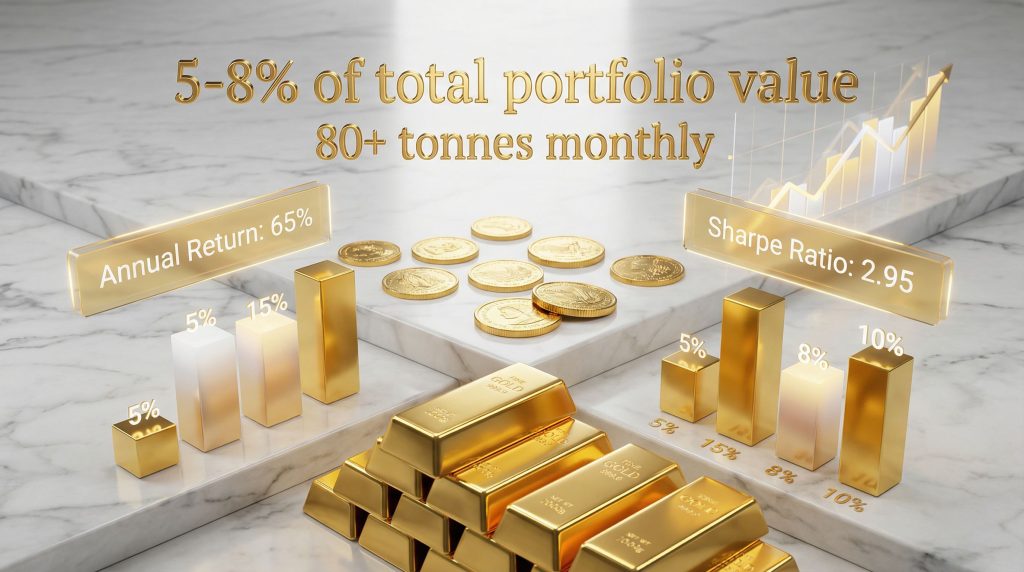
- Institutional gold allocation targets now range from 5-8% of total portfolio value
- Central banks have been accumulating more than 80 tonnes monthly since 2022, with expectations for similar momentum into 2026
- Despite record performance, US private portfolio ETF penetration remains just 0.17%, suggesting substantial further upside if US investors continue to rotate allocations
Real-World Strategy in Action
Portfolio managers at institutions such as Fidelity International have demonstrated this process in live markets—reducing gold positions during speculative spikes, then redeploying capital as technical and macroeconomic fundamentals reassert themselves. This approach confirms that sophisticated capital is tactically responsive but anchored by structural conviction.
Consequently, many analysts are revising their gold price forecast models to account for this sustained institutional interest.
Regulatory, Historical, and Tax Context
- Basel III regulations now recognise gold as a high-quality liquid asset, influencing institutional behaviour and central bank allocations
- The move from the 60/40 model, which dominated from the 1980s onward, reflects a dynamic response to multi-decade trends in asset correlation and risk management
- Investors increasingly evaluate physical vs. synthetic ETF vehicles for both cost-efficiency and regulatory compliance
What Drives Institutional Conviction in Extended Gold Positions?
Macro-Economic Structural Analysis
The mainstreaming of the debasement thesis has reframed gold as a portfolio mainstay against systemic currency devaluation, not just cyclical price instability. While previous bull markets were often reactive (to crises or inflation), current institutional conviction is grounded in observable fiscal policy trends and enduring government deficits.
Understanding the complex gold‑stock market relationship has become crucial for portfolio managers seeking optimal allocation strategies during this gold investors rally.
Institutional Demand Catalysts
- Central banks are projected to maintain monthly purchases near 80 tonnes, an acceleration that began after Russia's reserves were frozen in 2022
- Sovereign wealth funds and export-surplus nations are reallocating away from US Treasury securities in favour of physical gold
- Pension and insurance funds: 2025 saw first-time allocations to gold averaging 5%, representing genuine net new flows
Political Dynamics Amplify Currency Risks
Systematic fiscal deficits, absent clear prospects for global restraint, have increasingly defined the next phase for gold. As Morgan Stanley's Mike Wilson explains, "the political will to restore fiscal discipline is generally lacking across major economies", further anchoring gold's role as a protection mechanism.
Structural Effects
The immobilisation of Russia's foreign-exchange reserves has catalysed a permanent shift in asset allocation practices. Institutions now recognise that traditional reserve assets—particularly those within US or allied jurisdiction—carry meaningful seizure and sanction risks in periods of geopolitical conflict.
Geopolitical Risk Premium Modelling
The 2022 freeze of Russian reserves irrevocably highlighted the vulnerability of fiat reserves to geopolitical retaliation, leading central banks and asset managers to seek sovereignty-independent assets.
Key Model Inputs:
- Confiscation risk assessments have become standard in gold allocation frameworks
- Capital controls, payment system restrictions, and reserve currency volatility all play into premium modelling
- Nations such as China are optimising gold holdings as an alternative to Treasuries, creating new long-term baselines for demand
This reallocation reflects not only classic risk aversion but also the pursuit of liquidity and global transferability—traits gold offers without the direct oversight of any single political bloc.
How Are Professional Money Managers Structuring Gold Rally Strategies?
Dynamic Allocation Frameworks
Professional money managers are integrating gold through core-tactical overlays that adjust based on volatility, flow composition, and macro signals. Moreover, analysing the gold‑silver ratio analysis has become essential for timing optimal entry and exit points.
Key Features of Professional Management:
- Base allocation of 5-8% persists through the cycle
- Tactical position can expand up to 12% during volatility spikes (VIX >25 threshold)
- Systematic monthly rebalancing occurs using volatility and correlation-based triggers to optimise responses to shifting market risk
Tactical Adjustments and Speculative Flows
Managers monitor inflow sources: heavy speculative participation from hedge funds or fast-money providers may prompt a tactical reduction, while central bank accumulation encourages heavier positioning.
Example:
At Pictet Asset Management, allocations were trimmed during the October 2025 run-up as speculative money surged, then rebuilt as tactical traders exited and central banks continued steady buying.
What Investment Scenarios Support Continued Gold Accumulation?
Scenario-Based Portfolio Insurance
Successful gold investment frameworks, especially among institutional allocators, consider three major scenarios:
-
Fiscal Dominance Framework
Prolonged government deficits and accommodative central banks drive currency debasement. Gold acts as an essential risk-mitigant, offsetting the hidden costs of debased fiat currencies. -
Multipolar Reserve System Evolution
As alternative payment and reserve infrastructures mature—exemplified by BRICS initiatives—gold benefits from its universal neutrality and absence of direct sovereign control. -
Financial System Stress Testing
Periods of systemic financial stress, marked by liquidity crunches or credit malfunctions, reinforce gold's role as an insurance asset, encouraging stable or expanded allocation.
In addition, the broader gold market price surge has validated these scenario-based approaches, demonstrating their practical effectiveness.
How Do Risk-Adjusted Return Calculations Support Gold Rally Positioning?
Sharpe Ratio and Diversification Benefits
Performance Metrics Comparison (2025):
| Metric | Gold Performance | Traditional 60/40 | Enhanced 60/20/20 |
|---|---|---|---|
| Annual Return | 65% | 12% | 18% |
| Volatility | 22% | 14% | 16% |
| Sharpe Ratio | 2.95 | 0.86 | 1.13 |
| Maximum Drawdown | -8% | -12% | -9% |
Gold produced exceptional Sharpe ratios, vastly outpacing conventional portfolios in 2025. Critically, its correlation with equities tightens only during manic speculative phases; most of the time, it remains low or negative, making it a potent diversification lever.
Diversification Coefficient
In normal markets, gold's correlation to equities remains between 0.1 and 0.3; during periods of significant stress, it reliably turns negative, amplifying its insurance value. Thus, the risk-adjusted case for gold remains robust even as absolute returns normalise.
The next major ASX story will hit our subscribers first
What Technical and Fundamental Factors Support Rally Continuation?
Supply-Demand Imbalance Modelling
Annual Demand Projection for 2026:
- Central bank purchases: 755 tonnes
- ETF inflows: 250 tonnes
- Retail investment: 180 tonnes
- Total investment demand: 1,185 tonnes
Supply Dynamics:
- Mine output growth: <2% per year (limited due to declining grades, increased extraction costs, and regulatory permitting delays)
- Recycling: Stable near 1,200 tonnes, with further upside constrained by market saturation of easy-to-recycle material
- Net supply barely covers new demand, fueling both price support and upward momentum
Price Target Methodology
Banks and asset managers increasingly use discounted cash flow variants tuned for non-yielding assets. Input assumptions include real interest rate forecasts, sustained central bank demand, currency debasement estimates, and supply-demand imbalance scenarios.
Consensus 2026 Price Targets:
- Conservative: $4,450 – $4,800/oz
- Base Case: $5,000 – $5,200/oz
- Optimistic: $5,400+/oz
Disclaimer: All forward-looking price projections are speculative and should not be taken as investment advice. Forecasts are subject to uncertainty arising from market conditions, unforeseen geopolitical shifts, and regulatory changes.
How Do Institutional Investors Navigate Gold Rally Volatility?
Multi-Layered Risk Management
Professional institutions apply complex, multi-variable models to size positions and manage risk in volatile gold markets. However, recent market observations suggest that institutional gold investors rally sentiment remains remarkably resilient despite periodic volatility.
Principal Tactics Include:
- Position sizing adjusts for both overall portfolio risk and recent gold volatility. Maximum allocations are generally capped at 12%
- Core allocation is reduced if gold becomes highly correlated with equities during speculative spikes
- Tactical trading overlays:
- Momentum signals for trade entry and exit
- Options overlays for downside protection
- Futures for liquidity sourcing or controlled leverage
- Continuous monitoring of ETF and futures flows provides real-time signals of crowding or unwind risk
What Market Structure Changes Support Continued Gold Investment?
ETF Market and Retail Access
The rapid expansion of gold ETF vehicles has "democratised" access, fundamentally altering flow dynamics. Furthermore, professional fund managers increasingly view this accessibility as a structural shift supporting long-term demand.
- Global ETF assets under management now exceed $200 billion
- Daily trading volume averages $8-12 billion
- Enhanced market-maker inventory and tighter bid/ask spreads reflect sustained market depth
Each incremental increase of 0.01% in gold's portfolio share among US private investors adds approximately 1.4% to market price, according to Goldman Sachs analysis.
Digital Gold and Blockchain Integration
The merging of blockchain tech and gold—through tokenised gold and digital-backed certificates—is drawing new demographics, including tech-savvy investors who previously avoided physical metal.
This trend broadens the addressable market, complements institutional activity, and further supports the multi-pronged gold investors rally underway.
Conclusion: Structural Forces and Strategic Positioning for an Extended Gold Investors Rally
The convergence of persistent fiscal imbalances, accelerating geopolitical risk premia, and the ongoing optimisation of portfolio construction theory has produced a profound shift in the way investors and institutions approach gold.
Modern gold rally dynamics are less dependent on transient speculative waves. Professional managers treat gold as a mandatory component to hedge regime-change scenarios—political, fiscal, or monetary. Consequently, this gold investors rally appears to have deeper structural foundations than previous cycles.
The endurance of these strategies depends on continued fiscal dominance and the evolution of international reserve monetary frameworks, rather than on classic inflation cycles or short-term price surges. This underpins expectations that institutional conviction—and continued accumulation—will remain structurally stronger and more persistent than in any previous era.
Further Exploration:
Readers seeking greater depth on gold market structure, technical investment frameworks, or the impact of digital assets on precious metals can consult sector-specific educational publications and professional portfolio management research for advanced insights.
Disclaimer: Historical performance is not indicative of future results. Investment in gold and other commodities carries risk, including loss of principal. This article is for informational purposes only and does not constitute investment advice or an offer to buy or sell any security.
Ready to Capitalise on the Next Major Gold Discovery?
Discovery Alert's proprietary Discovery IQ model delivers instant notifications on significant ASX mineral discoveries, including gold exploration breakthroughs that could drive the next phase of this remarkable gold investors rally. Understand why major mineral discoveries can generate substantial returns by exploring Discovery Alert's dedicated discoveries page, then begin your 30-day free trial to position yourself ahead of the market with actionable insights powered by advanced AI technology.