June 22, 2026
Understanding Current Gold Market Dynamics Beyond Traditional Analysis
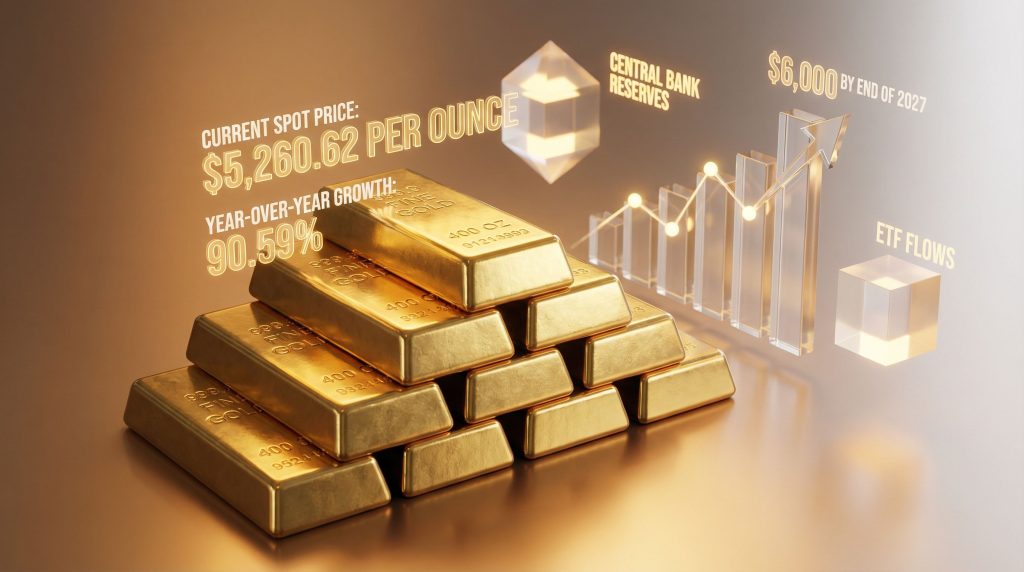
Gold markets have transcended conventional safe-haven trading patterns as the metal breaches $5,300 per ounce, establishing new benchmarks that challenge traditional valuation methodologies. Furthermore, current spot prices reached $5,305.65 per ounce as of January 28, 2026, after hitting an intraday record of $5,311.31, representing gains exceeding 20% since the beginning of 2026.
This price acceleration reflects more than cyclical demand fluctuations. The underlying market structure has shifted as central banks, sovereign wealth funds, and institutional asset managers fundamentally restructure their approach to portfolio diversification and currency exposure management.
Current Market Metrics:
- Spot gold: $5,305.65 per ounce
- Record intraday high: $5,311.31
- Year-to-date gains: Over 20%
- February gold futures: $5,301.90 per ounce (up 4.3%)
The simultaneous movement across spot and futures markets indicates broad-based institutional participation rather than speculative positioning. Consequently, this suggests sustainable demand fundamentals supporting current price levels, which aligns with the gold market surge patterns observed throughout the sector.
When big ASX news breaks, our subscribers know first
Monetary Policy Framework Driving Institutional Gold Allocation
Federal Reserve Policy Uncertainty
The Federal Reserve's monetary policy stance has created an environment particularly conducive to non-yielding asset appreciation. Gold traditionally performs well in low-interest-rate environments, and current policy expectations suggest continued accommodative conditions ahead.
Recent statements from the Trump administration indicate policy preferences for lower interest rates. In addition, predictions suggest that "interest rates would decline once the new Fed chair takes over". This forward guidance creates opportunity cost advantages for gold relative to interest-bearing alternatives.
The "tension between the Fed's mandates and the White House" has markets positioning defensively ahead of monetary policy announcements. However, this drives additional safe-haven demand beyond traditional economic fundamentals.
Currency Debasement Dynamics
The U.S. dollar has experienced what analysts describe as a "crisis of confidence," languishing near four-year lows while gold prices surge. This inverse correlation has intensified as markets interpret administration policy signals as supportive of dollar weakness.
Currency Market Indicators:
- Dollar index near four-year lows
- "Broad-based consensus within the White House to have a weaker greenback going forward"
- Accelerated overseas buyer interest due to favourable exchange rates
A weaker dollar mechanically makes "greenback-priced bullion more attractive to overseas buyers," creating a self-reinforcing cycle as international demand responds to favourable pricing dynamics.
Supply-Side Constraints Creating Long-Term Price Support
Mining Production Limitations
Gold mining faces structural constraints that traditional economic models often underestimate, with annual production growth capped at 1-2% despite rising prices. These limitations stem from geological realities rather than temporary operational challenges.
Key Production Constraints:
- Declining ore grades at existing operations
- Extended development timelines for new projects (7-10 years average)
- Environmental permitting delays in major producing regions
- Capital intensity requirements exceeding $1 billion for tier-one deposits
The combination of resource depletion at existing mines and regulatory hurdles for new developments creates persistent supply-demand imbalances. For instance, these factors support higher price floors regardless of short-term demand fluctuations.
Geographic Risk Factors
Gold production concentration in politically volatile regions adds additional supply vulnerability premiums to current pricing. Major producing countries face ongoing challenges including:
- Regulatory uncertainty in key mining jurisdictions
- Infrastructure limitations affecting transport and processing
- Labor disputes impacting production consistency
- Geopolitical tensions affecting cross-border commodity flows
These factors contribute to what industry analysts term "geological scarcity premiums" that elevate baseline price support levels above traditional cost-plus models.
Professional Investment Bank Forecasting Analysis
Deutsche Bank $6,000 Target
Deutsche Bank has established the most aggressive professional forecast, projecting gold could reach $6,000 per ounce in 2026 based on persistent investment demand patterns. Furthermore, their analysis emphasises "central banks and investors increase allocations to non-dollar and tangible assets" as the primary driver supporting higher prices.
This forecast methodology focuses on institutional flow analysis rather than traditional supply-demand modelling. Therefore, it reflects the evolving nature of gold market participation, particularly regarding record-high gold prices.
Institutional Consensus Formation
Professional forecasting has shifted from tactical price targets to strategic asset allocation frameworks. In addition, major investment banks increasingly treat gold as permanent portfolio infrastructure rather than cyclical commodity exposure.
Forecast Methodology Trends:
- Flow-based analysis replacing cost-curve modelling
- Institutional allocation models incorporating de-dollarisation trends
- Geopolitical risk premiums factored into baseline valuations
- Monetary policy divergence scenarios driving upside cases
The consensus formation around higher structural price levels represents a fundamental shift in how professional investors evaluate gold's role in modern portfolios.
Geopolitical Risk Premium Integration
Policy Uncertainty Impact
Current geopolitical dynamics extend beyond traditional conflict-driven safe-haven demand to encompass broader concerns about monetary system stability and international trade frameworks. These developments create sustained demand pressure that transcends typical economic cycles.
The administration's approach to international economic relationships has "markets getting defensive" as investors position for potential policy volatility. However, these concerns affect global trade and currency arrangements, making strategic gold investment increasingly attractive to institutional managers.
Safe-Haven Demand Evolution
Modern safe-haven investment patterns reflect institutional sophistication rather than emotional market reactions. Furthermore, professional asset managers systematically increase gold allocations as portfolio insurance against systemic risks.
Institutional Safe-Haven Characteristics:
- Systematic allocation increases rather than tactical positioning
- Long-term holding periods reducing price sensitivity
- Diversification mandates requiring non-correlated asset exposure
- Risk management frameworks treating gold as essential infrastructure
This evolution from reactive to proactive safe-haven positioning creates more stable demand foundations supporting sustained price appreciation.
Technical Market Structure Supporting Higher Prices
Interest Rate Arbitrage Advantages
Gold's technical performance characteristics have improved as real interest rates remain below historical norms. Consequently, this creates favourable opportunity cost calculations for institutional investors. The metal's "non-yielding" nature becomes advantageous when inflation-adjusted returns on traditional fixed-income instruments turn negative.
Current monetary policy expectations suggest "rates would decline" further. Therefore, this improves gold's relative attractiveness compared to nominal-yielding alternatives, as highlighted in recent gold market analysis.
Dollar Correlation Mechanics
The "very strong indirect correlation with the dollar" has intensified as currency policy becomes more explicitly accommodative. This relationship creates predictable investment flows as currency weakness translates directly into gold price appreciation through mechanical arbitrage opportunities.
Technical Trading Factors:
- Algorithmic trading systems responding to dollar weakness signals
- Momentum strategies capturing sustained trend movements
- Options market positioning amplifying directional moves
- ETF creation/redemption mechanisms transmitting institutional flows
The next major ASX story will hit our subscribers first
Investment Flow Analysis and Market Structure
Exchange-Traded Fund Dynamics
ETF investment patterns indicate institutional rather than retail driving current price movements. In addition, sophisticated investors use gold exposure for strategic asset allocation rather than speculative positioning.
ETF Market Indicators:
- Large block trading indicating institutional participation
- Low turnover rates suggesting long-term holding intentions
- Premium/discount stability reflecting efficient arbitrage mechanisms
- Global ETF coordination across multiple currency denominations
Physical Market Premiums
Physical gold markets show persistent premiums over spot prices, indicating genuine demand for tangible metal delivery rather than purely financial exposure. This phenomenon typically accompanies structural bull markets rather than speculative bubbles.
Physical Market Signals:
- Coin dealer premiums expanding across global markets
- Bullion vault storage reaching capacity constraints
- Delivery delays extending beyond normal timeframes
- Regional price disparities indicating supply chain stress
Scenario Analysis for $6,000 Gold Target
Base Case Projections
Professional analysis suggests gold reaching $6,000 per ounce by 2027 represents a reasonable base case scenario given current institutional demand patterns and supply constraints. This projection assumes continuation of existing monetary policy trends without major reversals.
Supporting Factors:
- Central bank accumulation continuing at elevated levels
- Institutional allocation increases following portfolio optimisation models
- Supply growth limitations constraining annual production increases
- Inflation hedge demand maintaining investment flow consistency
The current gold price forecast supports these projections based on fundamental analysis of market drivers.
Bull Case Scenarios
Historical cycle analysis suggests potential for gold prices reaching $8,700-$9,000 if current monetary conditions persist alongside accelerating geopolitical tensions. For instance, these scenarios assume amplification of existing trends rather than entirely new developments.
Bull Case Catalysts:
- Aggressive monetary easing beyond current expectations
- Currency crisis events affecting major economies
- Supply disruption incidents in key producing regions
- Institutional mandate changes requiring higher gold allocations
Risk Assessment and Downside Scenarios
Policy Reversal Risks
The primary downside risk involves significant monetary policy tightening that would reduce gold's appeal relative to yielding assets. However, current economic conditions make aggressive rate increases unlikely given debt service constraints and growth concerns.
Potential Policy Risks:
- Unexpected inflation control success reducing safe-haven demand
- Economic growth acceleration decreasing defensive positioning needs
- Dollar strength revival through external factors
- Alternative safe-haven emergence competing for institutional flows
Market Structure Vulnerabilities
Gold markets remain susceptible to technical corrections despite strong fundamentals. Furthermore, this is particularly true if leveraged positioning becomes excessive or liquidity conditions deteriorate during stress events.
Strategic Investment Framework Implications
Modern Portfolio Construction
Gold's role in institutional portfolios has evolved from tactical hedge to strategic allocation. In addition, asset managers treat precious metals exposure as essential infrastructure for risk management and diversification.
Strategic Allocation Trends:
- Permanent portfolio weights replacing cyclical positioning
- Risk parity frameworks increasing gold allocation requirements
- Liability matching strategies utilising gold for inflation protection
- Currency hedging applications through precious metals exposure
Professional Asset Management Evolution
Investment management practices have adapted to incorporate gold as core portfolio infrastructure rather than satellite positioning. This reflects institutional recognition of monetary system vulnerabilities and aligns with the broader gold market outlook.
Professional Management Changes:
- Benchmark inclusion in major index construction
- Fiduciary standards requiring diversification consideration
- Risk management mandates incorporating precious metals
- Performance measurement adjusting for correlation benefits
The current gold breaches $5300 record high environment represents structural changes in global monetary systems and investment management practices rather than cyclical speculation. Consequently, as institutional investors systematically increase precious metals allocations and central banks continue diversification strategies, traditional price forecasting models may underestimate gold's appreciation potential.
The path toward $6,000 per ounce appears increasingly supported by durable fundamental factors including supply constraints, institutional demand growth, and monetary policy accommodation. However, while short-term volatility remains inevitable, the convergence of professional forecasts around significantly higher price levels suggests a new equilibrium range for gold markets.
Investors and analysts must recalibrate their understanding of the gold breaches $5300 record high phenomenon as traditional valuation frameworks prove inadequate for current market dynamics. Furthermore, these dynamics are driven by institutional reallocation and monetary system evolution.
Could Gold Mining Discoveries Unlock Your Investment Portfolio's Potential?
Discovery Alert's proprietary Discovery IQ model delivers instant notifications on significant ASX mineral discoveries, enabling investors to capitalise on major opportunities before broader market recognition drives substantial price movements. With gold reaching unprecedented heights, identifying the next breakthrough discovery through Discovery Alert's advanced AI technology could provide the strategic advantage needed to maximise returns in today's evolving precious metals landscape.