
August 5, 2026
The Selective Nature of Gold Rally Profits: Why Not Every Miner Benefits Equally
Every sustained commodity rally produces two distinct groups of participants: those who convert price gains into compounding shareholder value, and those who consume that same windfall through operational inefficiency, balance sheet weakness, or promotional excess. Gold is no exception. With prices sustaining levels above US$4,000 per ounce, the instinct among retail investors to seek broad sector exposure is understandable but potentially costly. The mechanics of gold mining mean that gold mining quality in a gold rally determines outcomes far more decisively than the direction of the gold price itself.
Understanding why requires looking beneath the surface of the gold price narrative and into the structural realities of how mining economics actually function under elevated commodity conditions. Furthermore, how gold prices affect miners is more nuanced than headline figures suggest.
When big ASX news breaks, our subscribers know first
How Rising Gold Prices Create Winners and Losers Simultaneously
The popular assumption that a gold rally lifts all miners proportionally is one of the most persistent and expensive misconceptions in commodity investing. Operating leverage — the relationship between fixed cost structures and margin expansion — means that the percentage profit gain from a price increase varies dramatically depending on a miner's cost base.
Consider a straightforward illustration of how this plays out in practice:
| Miner Type | AISC (US$/oz) | Profit at US$2,000/oz | Profit at US$4,000/oz | Margin Increase |
|---|---|---|---|---|
| Low-cost producer | US$1,200/oz | US$800/oz | US$2,800/oz | +250% |
| Mid-cost producer | US$1,800/oz | US$200/oz | US$2,200/oz | +1,000% |
| High-cost producer | US$2,800/oz | Breakeven | US$1,200/oz | From loss to profit |
The mid-cost producer in this example technically generates the largest percentage margin increase, but that figure is distorted by how thin margins were at lower prices. The critical distinction is that the low-cost producer generates durable, large-scale profitability across a much wider range of gold price scenarios, while the high-cost operator's profitability is entirely contingent on the price holding at elevated levels.
The Promotional Cycle That Accompanies Every Gold Rally
Historically, when gold prices surge, a predictable wave of project re-evaluations follows. Deposits that were shelved during periods of lower prices are remodelled, repackaged, and re-presented to investors as newly viable opportunities. Some of these reassessments are legitimate. However, many are not.
The critical distinction that investors must internalise is that price-driven viability is fundamentally different from structural project quality. A deposit that only becomes economic above US$3,500/oz gold carries embedded fragility that no feasibility study headline can fully obscure. Projects requiring new processing infrastructure, multi-year permitting timelines, or complex metallurgical treatment carry risks that an elevated spot price does not neutralise.
A gold price above US$4,000/oz does not transform a marginal asset into a quality one. It extends the window of survivability for underperforming operations, often at the direct expense of shareholder capital deployed at the peak of promotional enthusiasm.
What Gold Mining Quality Actually Means When Prices Are Elevated
The concept of mining quality is frequently reduced to ore grade in investor communications, but this single-variable framing consistently misleads capital allocation decisions. Quality in a gold mining context encompasses four distinct and equally important pillars. In addition, investors exploring undervalued mining stocks will find that these same pillars determine which companies genuinely deserve a re-rating.
The Four Pillars of Gold Mining Quality
| Quality Pillar | What It Measures | Why It Matters in a Rally |
|---|---|---|
| All-In Sustaining Cost (AISC) | Total cost per ounce including sustaining capex | Determines margin capture as gold price rises |
| Balance Sheet Strength | Debt levels, liquidity, and financing flexibility | Protects against operational volatility and price reversals |
| Jurisdictional Stability | Political, regulatory, and legal operating environment | Reduces exogenous risk to project continuity |
| Management Execution | Delivery against guidance, cost control, capital discipline | Determines whether upside is actually realised |
Why Grade Is Only One Variable in a Multi-Factor Equation
A recurring insight among experienced mining analysts is that a lower-grade deposit with favourable project characteristics will routinely outperform a high-grade deposit burdened by structural challenges. Ryan Cunningham, CEO of American Mineral Resources, has noted that a one gram per tonne deposit with clean metallurgy, permitted water access, and existing road infrastructure will consistently outperform a five gram per tonne deposit requiring a new processing plant, a 90-kilometre haul road, and several additional years of permitting.
This reframing of the grade debate is important because it shifts the analytical focus toward a more complete quality equation:
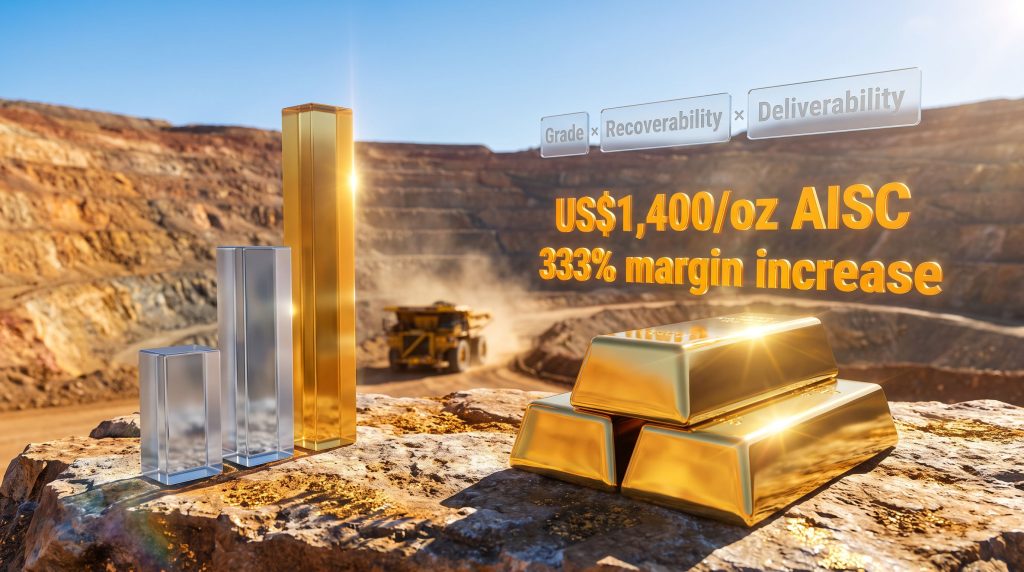
Grade × Recoverability × Deliverability = Actual Economic Value
Each component carries equal analytical weight:
- Grade establishes the theoretical resource base but tells investors nothing about extraction economics
- Recoverability reflects metallurgical complexity, processing efficiency, and the percentage of contained metal that can actually be captured economically
- Deliverability encompasses permitted infrastructure, community relations, logistics costs, workforce availability, and regulatory pathway clarity
The AISC Metric and Its Most Common Distortions
All-in sustaining cost per ounce, as defined under the World Gold Council reporting framework, is the industry's most widely referenced efficiency benchmark. However, its application across the sector varies considerably, and investors who rely on reported AISC figures without cross-referencing against actual free cash flow generation risk being misled.
The most prevalent distortions in AISC reporting include:
- Deferring sustaining capital expenditure to artificially suppress reported costs in a given reporting period
- Excluding site-level operational costs through selective expenditure categorisation
- Reporting AISC on a co-product credit basis without transparent disclosure of the commodity price assumptions underpinning those credits
A persistent divergence between a company's reported AISC and its actual free cash flow per ounce produced is one of the clearest signals of cost categorisation irregularities. Investors should treat this divergence as a due diligence red flag rather than a rounding difference.
How Institutional Capital Is Positioning Itself Across the Gold Mining Sector
The capital allocation patterns visible in the current gold cycle reveal a significant evolution in how sophisticated investors are screening mining opportunities. Generalist institutional funds — the category of capital that the mining sector most needs to attract for meaningful valuation re-ratings — now apply cross-sector reporting standards to their mining investments.
The expectation has moved beyond periodic project updates toward continuous, auditable operational disclosure. ESG metrics increasingly require third-party verification rather than self-assessment, and material deviations from disclosed targets carry the credible risk of capital withdrawal rather than just reputational friction. Understanding the types of gold mining stocks available is consequently more important than ever for investors navigating these dynamics.
Three Structural Preferences Driving Current Capital Flows
1. Jurisdictional Quality Over Raw Grade
Single-asset operations in politically unstable or regulatory unpredictable jurisdictions are being systematically discounted by institutional allocators, regardless of resource size or grade profile. Political risk has destroyed more shareholder value in mining over the long run than geological disappointment, and sophisticated capital has absorbed that historical lesson.
Stable mining jurisdictions characterised by transparent royalty and taxation frameworks, rule of law, and established permitting processes command structural valuation premiums that reflect genuinely lower risk profiles, not simply investor sentiment.
2. Multi-Asset and Multi-Metal Portfolio Construction
Operations that generate co-product revenue streams alongside gold — including copper, silver, or zinc production — provide natural economic diversification at the mine level. Portfolio operators across multiple stable jurisdictions reduce concentration risk in ways that structurally cannot be replicated by single-asset companies.
The valuation premium commanded by diversified operators relative to single-asset peers has expanded materially in the current cycle, reflecting both the demand for portfolio resilience and the scarcity of genuinely multi-jurisdictional operators with proven execution records.
3. Operational Transparency as a Structural Competitive Advantage
Companies that provide consistent, granular operational data rather than polished narrative reporting are achieving demonstrably lower costs of capital. In a capital-intensive sector where financing terms directly determine which projects proceed and on what timeline, this advantage compounds over time.
Operational credibility in the current cycle is functioning as a distinct valuation layer, separate from — and in some cases larger than — the premium attached to ore quality or resource grade alone.
As Cunningham has articulated, companies that meet this standard of disclosure will trade at a premium that is entirely disconnected from ore grade and entirely connected to the cost of capital they can access. In a sector where financing terms make or break project economics, that is a decisive competitive advantage.
Bullion Versus Miners Versus ETFs: Matching Exposure to Investment Objectives
Not all gold investment vehicles deliver equivalent risk-adjusted returns across different market conditions. Understanding the structural characteristics of each exposure type is essential for aligning investment strategy with specific risk tolerance and return objectives. For instance, VanEck notes that even brief pauses in a gold rally can expose meaningful divergences between physical and equity-based gold exposures.
| Exposure Type | Gold Price Sensitivity | Upside in a Rally | Key Risk Factors | Best Suited For |
|---|---|---|---|---|
| Physical Bullion / Bullion ETF | Direct (1:1) | Tracks gold price only | Storage, currency, liquidity | Pure gold price hedge |
| High-Quality Individual Miners | Leveraged (2x-4x) | Margin expansion amplifies returns | Operational, geological, management | Targeted upside capture |
| Broad Gold Miner ETFs | Blended across quality tiers | Diluted by weaker names | Sector-wide dilution, index rebalancing | Diversified sector exposure |
| Junior / Exploration Stocks | Highly speculative | Extreme upside possible | Capital raise risk, pre-revenue stage | High-risk, high-reward only |
Why the ETF Dilution Problem Matters in a Quality-Differentiated Market
Broad gold miner ETFs capture sector momentum efficiently but structurally include high-cost operators, jurisdictionally challenged assets, and management teams with poor execution track records. In a market where quality differentiation is the primary driver of outperformance, this inclusion of weaker names systematically erodes the returns that would otherwise accrue to selectivity.
Historical analysis of sustained gold rallies consistently shows that active selection of low-cost, well-managed, jurisdictionally stable producers outperforms passive miner ETF exposure during periods when gold price durability allows quality differentials to fully express themselves in market valuations. Global X ETFs has highlighted this structural dilution challenge in detail, noting that passive exposure to the broader sector often captures the upside of gold price momentum whilst also absorbing the full downside of operational underperformers.
The Macro Architecture Behind the Current Gold Price Cycle
The structural drivers sustaining gold above US$4,000/oz are meaningfully different from the sentiment-driven spikes that characterised previous price episodes. Three foundational demand dynamics are operating simultaneously:
- Central bank accumulation at historically elevated rates: Sovereign reserve managers, particularly across emerging market economies, have sustained net gold purchases at levels not previously observed over extended multi-year periods. This structural demand shift does not reverse on quarterly sentiment movements.
- De-dollarisation of global reserve assets: The gradual diversification of sovereign wealth away from US dollar-denominated instruments has created a persistent and growing bid for gold as a politically neutral reserve asset. This dynamic is structural rather than cyclical.
- Asian physical demand independence: Physical gold demand across Asian markets has demonstrated a notable decoupling from Western ETF sentiment cycles, creating a more diversified and structurally resilient demand base that does not require Western investor participation to sustain elevated price levels.
The Critical Distinction Between Price Durability and Asset Quality
Sustained elevated gold prices create a commercially dangerous environment where the line between genuinely value-creating operations and marginally survivable ones becomes harder for investors to identify. Marginal operations that cross into cash-flow-positive territory at elevated prices frequently consume capital through deferred maintenance, infrastructure catch-up investment, and persistent operational inefficiency.
The analytical divide that matters is not between profitable and unprofitable at current prices, but between operations that are genuinely value-creating across a range of price scenarios and those that are merely survivable under current conditions.
The next major ASX story will hit our subscribers first
A Practical Due Diligence Framework for Assessing Gold Mining Quality
Translating quality criteria into actionable investment screening requires a structured approach. The following six-step framework provides a systematic methodology for evaluating gold mining quality in a gold rally beyond surface-level metrics.
Step 1: Verify AISC Against Free Cash Flow
Compare reported AISC against actual free cash flow per ounce produced over multiple reporting periods. Persistent divergence signals cost categorisation irregularities.
Step 2: Assess Sustaining Capital Discipline
Review multi-year sustaining capital expenditure trends relative to production volumes. Declining sustaining capex in a growing operation is a warning indicator, not evidence of efficiency improvement.
Step 3: Evaluate Reserve and Resource Reporting Quality
Assess whether reserve updates reflect genuine geological confidence supported by independent technical reports, or whether they are modelled primarily to support capital raise valuations.
Step 4: Analyse Jurisdictional Risk Profile
Map operational assets against established mining jurisdiction risk assessments. Evaluate royalty and tax framework stability, the track record of regulatory permitting processes, and the quality of community and indigenous relations management.
Step 5: Scrutinise Management's Guidance Track Record
Compare historical production guidance against actual delivery across a minimum three-year period. Watching for management red flags is particularly important here, as consistent guidance misses are a leading indicator of structural operational problems rather than isolated events.
Step 6: Examine Balance Sheet and Financing Structure
Review net debt-to-EBITDA ratios, debt maturity profiles, hedging positions, and the long-term economic impact of any streaming or royalty agreements. These structural financing factors determine a company's capacity to capture upside during price rallies and survive intact during corrections.
Due Diligence Warning: During gold rallies, promotional activity intensifies significantly. Feasibility studies and investor presentations are marketing documents. Independent technical and financial verification is essential before any capital allocation decision.
Frequently Asked Questions: Gold Mining Quality in a Gold Rally
Does a Higher Gold Price Automatically Make Gold Miners Better Investments?
Not inherently. While rising gold prices expand margins for all producers to varying degrees, the extent of benefit depends entirely on cost structure, operational efficiency, and asset quality. High-cost operators may achieve marginal profitability at elevated prices without generating meaningful shareholder returns, particularly after accounting for capital maintenance requirements.
What Is the Single Most Important Metric for Evaluating a Gold Miner?
All-in sustaining cost per ounce is the most widely used benchmark, but it must always be evaluated alongside actual free cash flow generation to confirm that reported costs reflect genuine operational economics rather than accounting classifications that defer real costs to future periods.
How Does Jurisdictional Risk Affect Gold Mining Investments?
Political instability, regulatory unpredictability, and resource nationalism have historically caused more permanent capital loss in mining than commodity price cycle corrections. Operations in stable, transparent mining jurisdictions command structural valuation premiums that reflect genuinely lower risk profiles over the life of a project.
What Separates a Genuinely Economic Deposit From a Price-Dependent One?
A genuinely economic deposit generates attractive returns across a range of gold price scenarios, not exclusively at peak prices. Key differentiators include low AISC, straightforward metallurgy, existing permitted infrastructure, stable jurisdiction, and a management team with a demonstrated execution track record across multiple operational cycles.
Why Discipline and Transparency Define Long-Term Sector Winners
Elevated gold prices function as an industry quality filter rather than a universal gift to the sector. Companies that use price-driven revenue growth to strengthen balance sheets, invest in genuine reserve development, and maintain rigorous operational standards build durable competitive positions that persist beyond individual price cycles. Consequently, gold sector M&A activity tends to concentrate precisely on these operators during sustained rallies.
Companies that treat elevated prices as cover for deferred maintenance, aggressive capital raises on inflated resource claims, or reduced operational rigour create compounding liabilities that become fully visible when the price cycle eventually moderates. The current gold price environment, underpinned by structural macro drivers rather than speculative momentum alone, creates an extended window for quality operators to demonstrate the compounding value of disciplined execution.
For investors, the sustained rally above US$4,000/oz is not a signal to broaden sector exposure indiscriminately. It is a signal to concentrate exposure precisely in operators that have earned the right to capital through demonstrated quality, consistent transparency, and a track record of converting price upside into genuine shareholder value. That selectivity — not sector-wide participation — is where durable outperformance in gold mining quality in a gold rally is ultimately found.
Want to Know Which ASX Gold Discoveries Could Deliver Real Returns?
Discovery Alert's proprietary Discovery IQ model scans ASX announcements in real time, instantly identifying significant mineral discoveries and turning complex data into actionable opportunities — so investors can act before the broader market catches on. Explore historic examples of exceptional discovery returns and begin a 14-day free trial to position ahead of the next major find.