
August 6, 2026
When Commodity Markets Speak, Wars Are Already Being Priced
Commodity markets have always functioned as forward-looking instruments, embedding geopolitical risk into price signals long before diplomatic channels acknowledge the severity of a situation. The dynamics of gold and oil as war with Iran escalates represent one of the most complex pricing challenges in modern commodity history. Oil and gold, the two most closely watched hard assets during geopolitical crises, frequently diverge in ways that confuse even experienced investors. Understanding why they diverge, and under what conditions they converge, is essential for positioning in the current environment.
The Middle East conflict involving Iran, ongoing hostilities in Ukraine, and a deepening cold war between the United States and China are no longer isolated risk factors. According to strategic and military analysts, these three theatres are increasingly converging into a single, compounding macro event with direct implications for energy supply chains, currency credibility, and the long-term value of hard assets.
When big ASX news breaks, our subscribers know first
How Gold and Oil Actually Respond to War: The Divergence Problem
Why These Two Assets Don't Move Together
The common assumption that gold and oil both surge during conflict overlooks a critical distinction: oil responds to supply disruption directly, while gold responds to monetary and systemic stress indirectly. This asymmetry becomes especially pronounced when military escalation is accompanied by dollar strength and rising rate expectations, which is the precise environment that emerges when energy-driven inflation prompts central bank tightening.
During a sharp escalation event, oil benefits immediately from the physical threat to supply infrastructure. Gold, by contrast, must compete against a stronger U.S. dollar, which acts as its primary short-term headwind. The result is a pattern where oil surges decisively in the opening phase of conflict, while gold safe-haven demand experiences a more ambiguous initial response before reasserting itself as systemic stress compounds over time.
Key Variables That Determine Which Asset Leads
Several macro factors determine whether gold or oil takes the lead during a given escalation event:
- Dollar direction: A strengthening dollar suppresses gold's near-term appeal regardless of geopolitical severity
- Rate trajectory: Inflation from energy prices increases rate-hike expectations, which historically weighs on gold's spot price
- Supply disruption specificity: The more targeted the physical supply threat, the more direct and immediate oil's response
- Duration of conflict: Prolonged conflicts that generate debt monetisation and currency debasement ultimately benefit gold more than oil
- Monetary system fragility: Systemic financial stress, including sovereign debt concerns, amplifies gold's repricing far beyond any near-term war premium
Furthermore, as Reuters reported during the Iran war escalation, oil surged by as much as 25% whilst gold dropped — a real-world illustration of this divergence in action.
Gold's safe-haven appeal during geopolitical crises is frequently offset by a strengthening U.S. dollar and rising rate expectations triggered by energy-driven inflation. Oil benefits directly from supply disruption fears regardless of monetary policy direction, making it the cleaner short-term trade during active escalation phases.
The Strait of Hormuz: The World's Most Consequential Oil Chokepoint
Why Approximately 20% of Global Oil Supply Flows Through a Single Passage
The Strait of Hormuz, the narrow waterway separating Iran from the Arabian Peninsula, carries roughly one-fifth of the world's daily oil supply. No other single geographic feature exercises comparable leverage over global energy pricing. Any credible threat to transit through this passage, whether through Iranian military posturing, mining operations, or direct interdiction, translates almost instantaneously into crude price spikes across global benchmarks.
What makes this chokepoint particularly significant in the current environment is that Iran has already demonstrated both the capability and the willingness to treat the strait as a strategic instrument. Consequently, the question is no longer whether this leverage exists, but at what point it gets exercised at scale. The crude oil volatility trends emanating from this region are already influencing global benchmarks in measurable ways.
A Tiered Risk Framework for Crude Price Scenarios
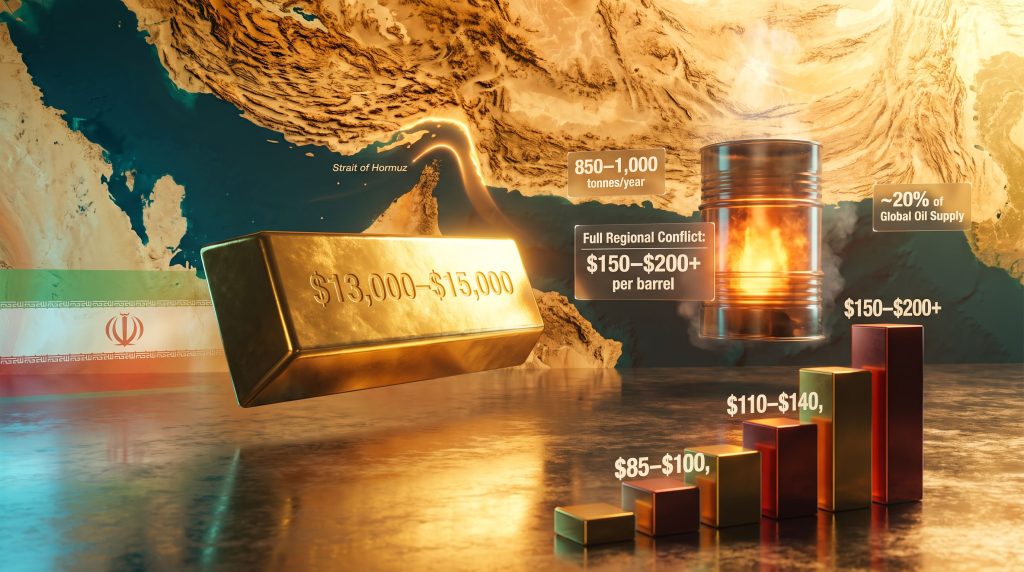
The following framework illustrates how different escalation outcomes translate into crude price ranges, Hormuz transit status, and corresponding gold market responses:
| Escalation Scenario | Estimated Brent Range | Strait of Hormuz Status | Gold Response |
|---|---|---|---|
| Diplomatic pause (current) | $85–$100 | Open but monitored | Mixed / flat |
| Limited strikes resume | $110–$140 | Partially disrupted | Moderate upside |
| Full regional conflict | $150–$200+ | Severely constrained | Strong safe-haven surge |
| Houthi blockade of Red Sea | $120–$160 | Red Sea closed | Elevated uncertainty premium |
A critical insight often missing from mainstream coverage is that the wholesale cost of a barrel of oil at the point of offloading is already estimated at approximately $140 per barrel, a figure that has not yet fully transmitted into consumer-facing prices. If active conflict resumes, independent analysts project a range of $150 to $200 per barrel, with cascading downstream effects across refining, transportation, and household energy costs. The lag between wholesale price shocks and their full economic impact is typically measured in quarters, not weeks.
The Three-Conflict Architecture Reshaping Commodity Markets
Conflict One: A Middle East War Already Regional in Character
The conflict involving Iran is frequently described as bilateral, but its actual structure is already regional. A recent meeting of Arab League-adjacent nations, including representatives from Saudi Arabia, the UAE, Turkey, Pakistan, Indonesia, and Malaysia, signalled a coordinated diplomatic realignment among Islamic states increasingly positioning themselves on the side of Iran rather than alongside Western powers.
This coalition-building dynamic, if it solidifies, creates a de facto geopolitical bloc that could redirect Persian Gulf energy flows away from Western markets entirely.
Conflict Two: Ukraine and the Refinery Destruction Problem
The war in Ukraine has introduced a dimension of commodity risk that is frequently underappreciated: systematic destruction of refining infrastructure. Ukrainian strikes on Russian refining assets, combined with broader operational stress on European refining capacity, have tightened the global supply of refined petroleum products independently of crude oil availability. This means the oil price story is not simply about crude benchmarks but about crack spreads, refined product scarcity, and the physical capacity to convert crude into usable fuel.
Conflict Three: The U.S.-China Cold War and Persian Gulf Supply Chains
The third and least-discussed conflict is the ongoing cold war between the United States and China, which carries significant implications for how Persian Gulf oil flows are ultimately priced and directed. China holds deep energy dependency ties with Iran and maintains substantial influence over the downstream movement of Persian Gulf output. If that influence is exercised in coordination with Iran during a period of active U.S. military engagement, the resulting supply chain reorientation would be both rapid and structurally permanent.
Supply chains, once reoriented away from conflict zones, do not typically reverse. Tariff-driven supply chain shifts have accelerated this dynamic, producing the very supply chain decoupling they were intended to prevent.
Why These Conflicts Are Converging
- Russia, Iran, and China have formed a de facto strategic alignment with compounding military and economic dimensions
- Islamic diplomatic coalitions are increasingly coalescing around Iran's position rather than Western frameworks
- BRICS-adjacent trade restructuring is redirecting energy flows toward non-dollar settlement systems
- The U.S. dollar's share of global reserve holdings has declined from a peak of approximately 72% in 2001 toward the mid-50s, with further erosion likely as energy trade increasingly bypasses dollar-denominated pricing
Is the Oil Market Underpricing the Risk?
The Lag Effect: What Hasn't Been Felt Yet
One of the most consequential insights from current military and macro analysis is that the economic effects of existing oil price stress have not yet fully materialised in consumer markets. Prices at the retail level have risen gradually, but the $140 per barrel wholesale reality has not yet been absorbed across refining margins, transport costs, and household energy bills. This lag effect means that the financial system is currently absorbing a shock whose full magnitude is still working its way through the pipeline.
Analysts including Jeff Curry, Ray Dalio, and Luke Gromen have independently flagged that strategic petroleum reserves across major consuming nations are approaching critically low levels, reducing the buffer available to absorb any fresh supply disruption.
Refining Capacity as a Hidden Bottleneck
| Risk Factor | Current Status | Near-Term Impact |
|---|---|---|
| Ukraine conflict refinery damage | Ongoing | Reduced European refined product supply |
| Middle East refinery operational stress | Elevated | Higher crack spreads, fuel cost increases |
| U.S. strategic petroleum reserve levels | Near multi-decade lows | Limited buffer for supply shock |
| Export halt probability | Rising | Domestic supply prioritisation likely |
Global refining capacity is operating near maximum utilisation. The compounding effect of infrastructure destruction in Ukraine, deferred maintenance from running at elevated throughput, and potential export restrictions in the United States creates a multi-vector supply constraint that crude price benchmarks alone do not fully capture.
Gold's Long-Term Structural Case: Beyond the War Premium
Central Bank Buying as a Structural Demand Floor
The transformation of central bank behaviour toward gold over the past four decades represents one of the most significant structural demand shifts in modern commodity history. Institutions that were net sellers throughout the 1980s transitioned to net buyers by approximately 2011. Furthermore, central bank gold buying accelerated to 850 to 1,000 tonnes per year through 2025, representing the most aggressive sovereign gold accumulation in the modern era.
| Period | Central Bank Posture | Approximate Annual Volume |
|---|---|---|
| 1980s | Net sellers | Negative (selling) |
| ~2011 | Transition to buying | ~450 tonnes/year |
| 2011–2025 | Aggressive accumulation | 850–1,000 tonnes/year |
| Post-2025 (projected) | Continued accumulation | Sustained or increasing |
This buying has continued regardless of price levels, suggesting it is driven by strategic reserve diversification and de-dollarisation objectives rather than price opportunism.
The Debt Arithmetic Behind $13,000 to $15,000 Gold
Technical analysts and macro economists have constructed arithmetic models projecting gold reaching $13,000 to $15,000 per ounce by 2031, based on sovereign debt expansion trajectories, currency debasement rates, and accelerating central bank accumulation. More aggressive scenarios, predicated on renewed military escalation and broader financial system stress, compress that timeline toward 2028 to 2029.
The arithmetic underpinning these projections connects directly to U.S. debt levels exceeding $39 trillion and the behaviour of the 10-year Treasury yield. As that yield approaches 5%, widely regarded as a critical threshold for debt serviceability, the pressure to monetise federal obligations through inflationary mechanisms intensifies — historically one of the most powerful structural drivers of gold repricing.
The U.S. 10-year Treasury yield approaching 5% is widely regarded by institutional analysts as a threshold indicator of debt serviceability stress. At current debt levels exceeding $39 trillion, a sustained yield above this level would render a meaningful portion of federal obligations economically unserviceable, a scenario that historically precedes aggressive monetary debasement and accelerates gold's repricing function.
The next major ASX story will hit our subscribers first
Gold vs. Oil Across Different War Scenarios
Comparative Asset Performance Framework
| Market Condition | Oil Performance | Gold Performance | Key Driver |
|---|---|---|---|
| Active escalation, dollar strengthens | Strong upside | Flat to negative | Rate expectations dominate |
| Active escalation, dollar weakens | Strong upside | Strong upside | Dual safe-haven demand |
| De-escalation signals | Pullback | Mild rebound | Inflation fears ease |
| Broad financial system stress | Moderate | Very strong | Currency debasement premium |
| Both assets rising simultaneously | Elevated | Elevated | Pure geopolitical risk premium |
The scenario where both assets rise simultaneously is the one that commodity strategists regard as most significant, as it signals that markets have shifted from pricing a localised supply disruption to pricing a broader erosion of monetary and systemic stability.
The De-Dollarisation Overlay: A Permanent Structural Tailwind for Gold
Why Supply Chain Reorientation Is Not Cyclical
A critical distinction often missed in commodity analysis is that current supply chain reorientation away from dollar-denominated systems is structural rather than cyclical. Unlike temporary disruptions that resolve when conflict ends, the diplomatic, trade, and financial infrastructure being built around BRICS-adjacent trade frameworks represents a durable shift in how cross-border commodity transactions are settled.
The declining trust in the US dollar, from approximately 72% in 2001 to the mid-50s today, reflects this structural erosion. Further decline appears likely as Persian Gulf states recalibrate their export relationships and as energy trade increasingly flows through non-dollar settlement mechanisms.
Tariff policy, rather than arresting this trend, has accelerated it. Countries that have restructured around sanctions have generally not returned to prior trade patterns, and the same dynamic applies to supply chains restructured around tariff avoidance.
What a Houthi Blockade of Saudi Oil Exports Would Mean
The Gulf Cooperation Council at Existential Risk
The strategic threat posed by Houthi forces to Saudi Arabian oil export routes through the Bab-el-Mandeb strait represents a scenario with existential implications for Gulf Cooperation Council states. A successful blockade of Saudi exports would effectively eliminate the primary revenue source for these states, threatening the economic foundation that sustains their current political arrangements.
If Houthi forces successfully constrain Saudi Arabian oil export routes through the Bab-el-Mandeb strait, the Gulf Cooperation Council states face an acute economic threat. China, which holds deep energy dependency ties with Iran, stands to benefit from redirected Persian Gulf flows through the Strait of Hormuz toward BRICS-aligned trade partners.
The near-term implication for Gulf states is stark: their long-term viability may ultimately require severing security dependencies on the United States and seeking accommodation with Iran and its regional allies. This would represent a fundamental geopolitical realignment with profound implications for how Persian Gulf energy is priced, directed, and settled.
How to Position Across Commodities in a Prolonged Escalation Environment
The Case for Physical Exposure Over Paper Instruments
In high-volatility regimes where the gap between financial instrument pricing and physical commodity reality widens, physical exposure to hard assets carries structural advantages over paper proxies. This is particularly relevant for gold, where the spread between spot pricing and physical acquisition costs can widen substantially during systemic stress events. As Barron's has noted, the interplay between gold, war risk, and haven demand has become increasingly nuanced in the current environment.
One historically validated capital preservation framework, associated with the approach employed by JD Rockefeller during periods of financial distress, prioritises large cash reserves combined with hard asset positions. During deflationary shocks, this combination allows capital to be deployed opportunistically when distressed sellers are forced to liquidate at suppressed prices.
Commodity Positioning Framework for Escalation Environments
| Asset Class | Bull Case Driver | Key Risk | Time Horizon |
|---|---|---|---|
| Gold | Debt debasement, central bank buying, dollar decline | Dollar strengthening, rate hikes | Medium to long-term |
| Oil | Supply disruption, refinery constraints, war premium | Demand destruction, EV adoption | Short to medium-term |
| Copper | Infrastructure demand, energy transition | China slowdown | Medium-term |
| Uranium | Energy sovereignty, nuclear renaissance | Policy reversal | Long-term |
| Agricultural inputs | Food security, fertiliser stockpiling | Weather, logistics | Near to medium-term |
It is worth noting that fertiliser stockpiling has emerged as a newly relevant strategic consideration, drawing comparisons to the decision to create strategic petroleum reserves after the 1970s oil crisis. Food security inputs, long ignored as a strategic reserve category, are attracting renewed attention as supply chain fragility becomes more broadly understood.
Could a Depression, Not Just a Recession, Be the Relevant Macro Framework?
Why Consensus Is Underpricing the Downside
Market consensus has largely priced in recession risk. What it has not priced is depression-level outcomes — a scenario that a minority of macro analysts regard as a genuine possibility given the combination of sovereign debt levels, refining capacity constraints, military expenditure trajectories, and financial system fragility.
The Japanese financial system provides one proximate example of systemic fragility: recent intervention using euro-denominated funds to stabilise yen-denominated bank positions represents a short-term expedient that postpones rather than resolves underlying structural imbalances. Bank run risk in multiple jurisdictions remains a non-negligible tail risk within this framework.
The combination of debt exceeding $39 trillion, a 10-year yield approaching the 5% stress threshold, strategic reserve depletion across energy and refining infrastructure, and three converging geopolitical conflicts creates a macro backdrop where depression-scenario modelling may be more appropriate than standard recessionary analysis for long-duration commodity positioning.
The potential for a depression rather than a severe recession is not widely accepted by consensus but is regarded as a plausible scenario by a minority of institutional analysts and military-strategic observers who assess the combination of debt arithmetic, financial system fragility, and geopolitical escalation risk in aggregate rather than in isolation.
Frequently Asked Questions: Gold and Oil During Iran Escalation
Does Gold Always Rise When War Breaks Out?
No. Gold's initial response to conflict is highly dependent on the dollar's concurrent direction and rate expectations. When conflict drives inflation expectations and central bank tightening, gold can initially decline even as oil surges. Its sustained upside requires either dollar weakness or a shift toward systemic financial stress.
Why Did Gold Fall While Oil Surged During Recent Escalation Events?
The divergence reflects the asymmetric response structure described above. Oil responded directly to supply disruption fears. Gold, facing a simultaneous dollar strengthening driven by inflation and rate-hike expectations, experienced net selling pressure in the near term despite underlying safe-haven demand.
What Oil Price Level Would Trigger a Global Recession?
Most institutional frameworks place the recessionary threshold for Brent crude in the range of $120 to $140 per barrel sustained over multiple quarters. Given that wholesale offloading costs are already estimated near $140, the question becomes one of timing rather than price level.
How Does a Strait of Hormuz Closure Affect Gold Indirectly?
A sustained Hormuz closure would drive oil to the $150 to $200+ range, generating energy-driven inflation that initially compresses gold through rate-hike expectations but ultimately benefits it as debt monetisation becomes the only available fiscal response to the resulting economic damage.
Is $13,000 Gold by 2031 Realistic or Extreme Speculation?
The projection is based on specific arithmetic models connecting debt levels, central bank accumulation trajectories, and dollar reserve share decline. It represents a considered analytical position rather than pure speculation, though it depends on assumptions regarding monetary policy, conflict duration, and financial system fragility that remain contested. More aggressive timelines of 2028 to 2029 incorporate active military re-escalation as an accelerating variable.
What Happens to Oil If the U.S. Halts Exports to Protect Strategic Reserves?
A U.S. export halt would remove meaningful supply from global markets, likely adding $10 to $30 per barrel to international benchmarks whilst insulating domestic consumers from the worst price effects. It would also signal to markets that strategic reserve levels have reached a critical threshold, itself a significant confidence signal.
How Are Chinese EV Adoption Rates Affecting Long-Term Oil Demand?
Chinese electric vehicle production has accelerated dramatically, with Chinese-manufactured EVs reportedly offering strong value propositions that are already affecting consumption patterns in markets where they are available. This demand-side development partially offsets supply disruption impacts on global oil pricing over the medium term, though the near-term supply shock thesis remains dominant as long as active conflict continues.
Key Takeaways: The Commodity Investor's Checklist
- Oil remains the cleaner near-term trade during active escalation phases due to its direct exposure to physical supply disruption
- Gold's war premium is real but conditional, competing against dollar strength and rate expectations in the short term before asserting dominance over longer timeframes driven by debt monetisation
- The $140 per barrel wholesale oil reality has not yet fully transmitted into consumer prices, meaning the economic impact of current conditions is still working through the system
- Central bank gold accumulation at 850 to 1,000 tonnes per year represents a structural demand floor that is independent of near-term geopolitical outcomes
- Three converging conflicts across the Middle East, Ukraine, and the U.S.-China cold war create a compounding commodity risk environment as gold and oil as war with Iran escalates continues to evolve
- Depression risk, not just recession, may be the appropriate framework for long-duration commodity positioning given the combination of sovereign debt levels, financial system fragility, and strategic reserve depletion
- De-dollarisation and BRICS trade restructuring represent permanent structural tailwinds for gold regardless of how near-term military escalation resolves
This article is intended for informational and educational purposes only and does not constitute investment advice, a solicitation, or a recommendation to buy or sell any security or commodity. All projections, scenario analyses, and price forecasts referenced represent the views of the analysts and commentators cited and involve material assumptions that may not prove correct. Commodity markets are subject to significant volatility, and past performance is not indicative of future results. Readers should conduct their own independent research and consult a licensed financial adviser before making any investment decisions.
Want to Stay Ahead of the Next Major Mineral Discovery Amid Market Volatility?
While gold and oil markets navigate the complex interplay of geopolitical escalation and monetary stress, Discovery Alert's proprietary Discovery IQ model delivers real-time alerts on significant ASX mineral discoveries — transforming complex commodity data into actionable investment insights for both short-term traders and long-term investors. Explore how major mineral discoveries have historically generated substantial returns and begin your 14-day free trial today to secure a market-leading edge before the next significant discovery is announced.