August 24, 2026
The Hidden Mechanics Behind Gold's Resilience When Energy Markets Crack
Commodity markets rarely move in isolation. When a single geopolitical development triggers a sharp repricing across oil, currencies, and precious metals simultaneously, it exposes the deeply interconnected architecture of modern financial markets. Understanding why gold firms as oil prices slump after Trump holds off on Iran attack requires unpacking a chain of cause-and-effect relationships that operate across monetary policy, energy economics, and currency dynamics all at once.
The session ending August 3, 2026 delivered a textbook illustration of this complexity. A diplomatic signal from Washington regarding Iran produced a cascade of reactions: oil fell sharply, the U.S. dollar softened following foreign exchange intervention to support the Japanese yen, and gold held firm with a measured but meaningful advance. To the casual observer, these movements might seem unrelated. To those who understand the underlying mechanics, they are part of the same story.
When big ASX news breaks, our subscribers know first
Key Market Snapshot: August 3, 2026
Before examining the drivers, it helps to anchor the analysis in the actual numbers recorded during the session.
| Asset | Price | Daily Change |
|---|---|---|
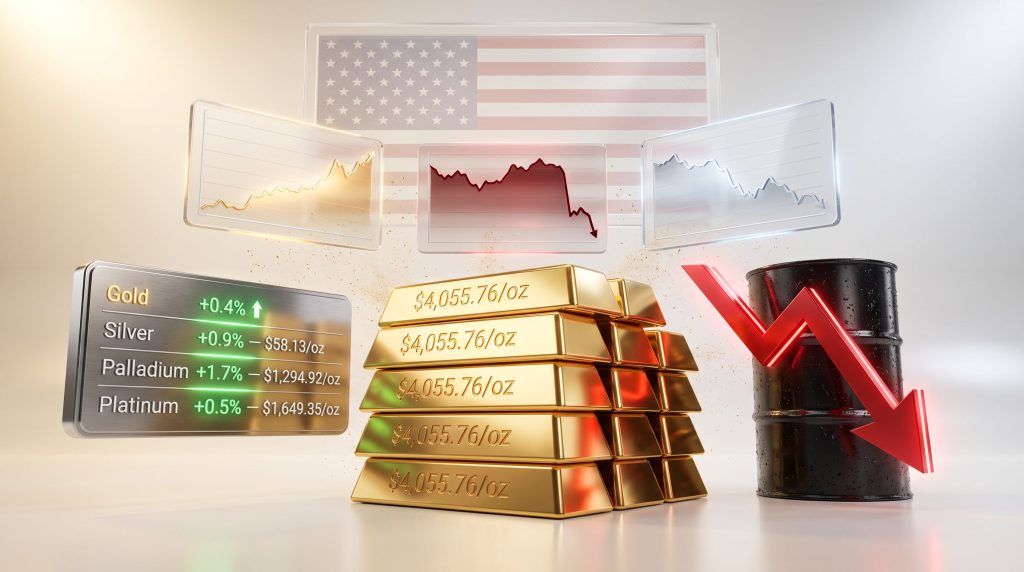
| Spot Gold | $4,055.76/oz | +0.4% |
| U.S. Gold Futures | $4,054.00 | +0.9% |
| Spot Silver | $58.13/oz | +0.9% |
| Platinum | $1,649.35/oz | +0.5% |
| Palladium | $1,294.92/oz | +1.7% |
| Oil | Multi-session low | -5.0%+ |
These figures tell a nuanced story. Gold's advance was modest in absolute terms, but its firmness against a backdrop of falling oil and a softer dollar revealed underlying structural support. Silver's outperformance relative to gold, and palladium's outsized gain, added further texture to the session's dynamics.
What "Price Firmness" Actually Signals in Precious Metals
There is an important distinction between a gold bull run and what analysts describe as gold firming. A bull run implies sustained momentum driven by a single dominant narrative. Firmness, by contrast, reflects a metal holding elevated levels against competing headwinds, supported by multiple reinforcing factors rather than one dominant theme.
On August 3, gold did not surge. It advanced cautiously, constrained by uncertainty but supported by at least three distinct variables operating simultaneously: easing oil-driven inflation pressure, yen intervention weakening the U.S. dollar, and residual geopolitical risk that kept safe-haven gold investing demand from unwinding completely.
Tim Waterer, Chief Market Analyst at KCM Trade, described the session as an upbeat but measured start for the metal, noting that limited gains reflected ongoing uncertainty in both oil markets and the broader Middle East situation rather than any fundamental weakness in gold's position. The caution embedded in that assessment is instructive for investors trying to frame gold's near-term trajectory.
The Oil-Gold Margin Relationship: A Mechanism Most Investors Miss
The relationship between falling oil prices and rising gold miner profitability is one of the least appreciated dynamics in the precious metals equity space. Most retail investors focus on the gold price alone when assessing mining stocks. Institutional investors, however, monitor energy input costs just as closely. Furthermore, understanding crude oil price trends is essential for building an accurate picture of where mining margins are headed.
Energy expenditure typically accounts for between 20% and 35% of a gold miner's all-in sustaining cost (AISC), depending on operational variables including:
- The depth and scale of underground versus open-cut operations
- Haulage distances and diesel consumption for ore transportation
- Processing methods, particularly whether operations rely on carbon-in-leach or heap-leach circuits
- Geographic location and access to grid electricity versus diesel generation
When oil prices fall more than 5% in a single session, as occurred on August 3, 2026, the downstream effect on diesel and electricity tariffs can materially reduce AISC within weeks for operations with short fuel supply contract cycles. For open-cut mines with high haulage requirements, this cost relief can be disproportionately large relative to the percentage move in crude.
According to reporting on the session, gold's gains were directly linked to the diplomatic pause from Washington, reinforcing how closely intertwined geopolitical signals and commodity pricing have become.
This creates a scenario where gold mining equity performance can outperform bullion itself. Even if the gold price moves only fractionally higher, a significant reduction in operating costs expands free cash flow margins, improves earnings per share projections, and can re-rate equity valuations independently of spot price action.
The table below illustrates how different geopolitical scenarios produce different outcomes for gold and gold mining margins simultaneously.
| Market Scenario | Oil Price Response | Gold Price Response | Miner Margin Impact |
|---|---|---|---|
| Active military escalation | Sharp spike (+5-8%) | Moderate safe-haven rise | Compressed by rising fuel costs |
| Diplomatic pause, no deal | Sharp decline (-5%+) | Mild firmness (+0.4-0.9%) | Expands as energy costs fall |
| Comprehensive deal confirmed | Further sustained decline | Safe-haven unwind risk | Mixed, dependent on gold price direction |
| Talks collapse, re-escalation | Rapid spike | Strong safe-haven bid | Cost pressure returns |
The Federal Reserve Variable: Why Rate Policy Sets the Ceiling
Gold's position heading into August 2026 was shaped as much by monetary policy as by geopolitics. The metal had faced persistent headwinds from the U.S.-Iran conflict because a war-driven inflation surge carries an implicit threat: central banks may respond with accelerated interest rate increases, which raises the opportunity cost of holding non-yielding bullion.
This creates a structural paradox that many investors find counterintuitive. Gold is widely regarded as an inflation hedge, yet in practice its price performance during inflationary periods depends heavily on whether the central bank response is aggressive or accommodative. In addition, central bank gold demand plays a significant role in setting the structural floor beneath bullion prices.
When inflation rises and central banks stay behind the curve, gold typically outperforms. When central banks respond decisively with rate hikes, the real yield on interest-bearing assets increases, making the zero-yield profile of physical gold comparatively less attractive.
The complexity deepened ahead of this session because three Federal Reserve officials who dissented at the most recent policy meeting had publicly expressed concern that inflation would remain above the Fed's 2% target without an immediate increase in short-term borrowing costs. This was not a minor technical disagreement. Three dissenting voices on a rate decision represents a meaningful fracture within the policy committee, and markets interpreted it as a signal that a September rate hike remained firmly on the table.
For gold investors, the Fed scenarios can be mapped against likely price outcomes as follows:
| Fed Scenario | Expected Gold Response | Net Outlook for Gold Miners |
|---|---|---|
| Rate hike confirmed (hawkish) | Capped upside or pullback | Margins improve but gold price headwind |
| Hold with dovish language | Moderate gold rally | Positive overall |
| Rate cut signal | Strong breakout potential | Highly bullish for miners |
| Prolonged hold, Middle East uncertainty | Elevated floor, range-bound | Stable with upside optionality |
How the Jobs Data Calendar Will Drive Gold's Next Move
Beyond the Fed's stated intentions, financial markets calibrate rate expectations in real time through economic data releases. For gold, the most consequential data sequence arriving in the week of August 3 included:
- Job Openings (JOLTS) – a measure of labour market tightness and forward wage inflation pressure
- ADP Employment Report – private sector payroll data used as a leading indicator ahead of the official count
- Weekly Jobless Claims – a real-time pulse on labour market conditions
- Nonfarm Payrolls (NFP) – the headline employment figure most directly tied to Federal Reserve rate expectations
The NFP report in particular carries outsized weight for precious metals pricing. A stronger-than-expected result would reinforce the case for a September rate hike, providing a ceiling on gold's upside and potentially strengthening the U.S. dollar. Conversely, a soft payrolls number would shift rate expectations toward a prolonged hold or eventual cut, removing a key structural headwind and potentially unlocking a more sustained gold advance.
Waterer specifically framed this duality, noting that a sustained move higher for gold would likely require a clearer decline in oil prices, a softer dollar, or a shift in Federal Reserve rate expectations toward accommodation. The downside risks, he noted, included renewed Middle East escalation pushing oil higher or a strong NFP print reinforcing September rate-hike odds.
The next major ASX story will hit our subscribers first
Currency Dynamics: How the Yen Intervention Amplified Gold's Gain
One of the less-discussed contributors to gold's August 3 firmness was an intervention in foreign exchange markets to support the Japanese yen. Understanding why this matters requires a working knowledge of gold's dollar-denominated pricing structure.
Because gold is priced in U.S. dollars in global spot markets, any weakening of the dollar has an automatic mechanical effect on the metal's accessibility for buyers transacting in other currencies. When the dollar falls relative to the yen, euro, or Australian dollar, gold effectively becomes cheaper for those buyers in their home currency terms, stimulating incremental demand that supports the dollar price.
This currency-channel effect operates entirely independently of geopolitical or monetary policy considerations. It means gold can receive a technical bid simply from foreign exchange market interventions that have no direct connection to inflation, interest rates, or Middle East tensions. On August 3, all three forces aligned simultaneously, which explains why gold firms as oil prices slump after Trump holds off on Iran attack, even as the safe-haven justification for owning it partially diminished with the diplomatic signal from Washington.
Is the Safe-Haven Premium at Risk If Iran Tensions Fully Resolve?
This is a legitimate concern for investors who have positioned in gold partly on the basis of geopolitical risk. The answer requires separating two different components embedded in the current gold price: the safe-haven premium and the fundamental monetary value floor.
The safe-haven premium is the portion of gold's price that reflects heightened demand from investors seeking protection against conflict-driven economic disruption. This component is, by definition, at risk if tensions de-escalate. However, the fundamental floor is supported by long-term factors including real interest rates, central bank reserve accumulation, and structural demand from technology, jewellery, and emerging market wealth accumulation.
The scenario table below maps the likely outcomes across different de-escalation depths:
| De-escalation Stage | Safe-Haven Unwind | Oil Trajectory | Net Gold Position |
|---|---|---|---|
| Talks announced, no deal | Minimal | Moderate decline | Mildly bullish |
| Framework agreement | Partial unwind | Significant decline | Neutral to slightly bearish |
| Comprehensive deal | Full safe-haven unwind | Sharp sustained decline | Bearish short-term, miners benefit |
| Talks collapse, re-escalation | Safe-haven bid fully returns | Sharp spike | Bullish gold, bearish miners |
Importantly, even in a full de-escalation scenario, gold mining equity performance may hold up better than bullion itself. The cost relief from sustained lower oil prices can expand operating margins enough to partially offset the loss of safe-haven premium in the bullion price, creating a divergence between miner equity performance and spot gold that sophisticated investors can exploit.
The Broader Precious Metals Complex: Reading Palladium and Silver as Confirmation Signals
Silver's outperformance relative to gold during the August 3 session, gaining 0.9% against gold's 0.4%, was not coincidental. Silver occupies a hybrid position in commodity markets, functioning simultaneously as a monetary metal and an industrial input. Its use in solar panel manufacturing, electronics, and medical applications means it is sensitive to global economic growth expectations in a way that gold is not.
When geopolitical risk partially eases and investor sentiment stabilises, silver tends to attract incremental buying from participants who value both its safe-haven characteristics and its industrial demand profile. Consequently, the metal's larger percentage gain on a day when risk sentiment improved slightly is consistent with this dual-demand dynamic. For a deeper view on the relationship between the two metals, gold-silver ratio analysis provides a useful framework for interpreting these divergences.
Palladium's 1.7% surge deserves separate analysis. Palladium's primary demand driver is catalytic converter manufacturing for internal combustion engine vehicles, and its price is structurally sensitive to automotive production volumes and the ongoing energy transition debate. Its outsized gain on the same session suggests that easing Middle East tensions were interpreted as a net positive for global manufacturing activity and automotive sector supply chains.
Platinum's more modest 0.5% gain reflected its position at the intersection of traditional industrial demand and emerging hydrogen economy applications, with fuel cell technology representing a growing but still speculative demand pathway for the metal.
As reported across major financial outlets, the interplay between gold, oil, and geopolitical risk has become one of the defining investment narratives of 2026, with commodities markets pricing in every diplomatic development with remarkable speed.
FAQ: Gold, Oil, and Geopolitical Risk Premiums
Why does gold firm when oil prices fall sharply?
When an oil price decline reflects reduced geopolitical risk rather than demand destruction, gold benefits from two simultaneous forces: softening inflation pressure, which reduces the urgency for rate hikes, and improved mining margins from lower energy input costs. Both effects support gold and gold mining equities without requiring any change in the underlying bullion demand picture.
How much of a gold miner's cost structure is tied to energy?
Energy typically represents between 20% and 35% of all-in sustaining costs, depending on operational depth, processing method, and geographic location. Open-cut operations with significant haulage requirements tend to sit at the higher end of this range, making them the primary beneficiaries of sustained oil price declines.
Does a diplomatic pause between the U.S. and Iran automatically reduce gold's price?
Not necessarily. A diplomatic pause without a confirmed deal tends to produce only a modest adjustment in gold's safe-haven premium. The metal's fundamental floor remains supported by broader factors including Federal Reserve policy, real interest rates, and structural reserve demand from central banks globally.
What data point matters most for gold investors in the near term?
The U.S. Nonfarm Payrolls report carries the greatest near-term weight because it most directly influences Federal Reserve rate expectations. A stronger-than-expected result could reinforce the case for a September rate hike and cap gold's upside. A weaker result could remove a key structural headwind and open the door to a more sustained advance.
Why did silver gain more than gold on the same session?
Silver's hybrid status as both a monetary metal and an industrial commodity means it is sensitive to improvements in global risk sentiment. When geopolitical tensions ease and manufacturing activity expectations improve, silver attracts buying from investors who value its industrial demand profile in addition to its safe-haven characteristics, producing a larger percentage gain relative to gold on risk-positive days.
Building an Investment Framework Across Three Variables
For investors trying to position thoughtfully in gold and gold mining equities, the current environment requires simultaneous monitoring of three distinct variable clusters:
- Geopolitical risk premiums – specifically the trajectory of U.S.-Iran diplomatic engagement and whether talks produce a framework agreement, a collapse, or a prolonged state of uncertainty
- Federal Reserve policy signals – including the tone of FOMC communications, the voting record of dissenting members, and the evolution of labour market and inflation data
- U.S. dollar dynamics – including foreign exchange interventions by major central banks, relative interest rate differentials, and safe-haven currency flows that can amplify or dampen gold's price independent of the first two factors
Gold mining equity investors should add a fourth variable to this framework: oil price trends as a direct margin input. The potential for miners to outperform bullion in a declining oil, flat gold price environment is real and historically documented, but it requires active monitoring of energy cost exposure across individual producers. Ultimately, the moment gold firms as oil prices slump after Trump holds off on Iran attack is not simply a headline event — it is a window into the sophisticated mechanics that connect energy markets, currency policy, and precious metals valuations.
Disclaimer: This article is intended for informational and educational purposes only. It does not constitute financial advice or a recommendation to buy or sell any financial instrument. Precious metals prices, currency values, and equity valuations are subject to significant volatility and uncertainty. Past performance is not indicative of future results. Readers should conduct their own due diligence and consult a qualified financial adviser before making any investment decisions.
Want to Capitalise on the Next Major ASX Mineral Discovery Before the Broader Market?
Discovery Alert's proprietary Discovery IQ model scans ASX announcements in real time, instantly identifying high-potential mineral discoveries across gold, silver, and more than 30 other commodities — turning complex market data into clear, actionable investment insights. Explore how historic discoveries have generated substantial returns on Discovery Alert's dedicated discoveries page, and begin your 14-day free trial today to secure a market-leading edge.