June 6, 2026
The Monetary System's Quiet Revolution: Understanding Why Gold Overtakes US Treasuries as Central Bank Reserve Asset
For most of the past half century, the architecture of global reserve management rested on a single, largely unquestioned foundation: US Treasury securities. The depth of American bond markets, the liquidity of dollar instruments, and the geopolitical alignment of Western-bloc economies created what many analysts described as an irreplaceable structural moat around the dollar-denominated system. Central banks from Tokyo to Riyadh accumulated Treasuries not simply as a financial preference, but as an institutional imperative embedded in decades of monetary orthodoxy.
That orthodoxy is now being empirically challenged. The milestone that gold overtakes US Treasuries as central bank reserve asset marks one of the most structurally significant shifts in global monetary management since the Nixon shock of 1971. Yet understanding why this has happened, and what it actually means, requires peeling back several layers of data, regulatory change, and geopolitical catalyst that mainstream commentary often glosses over.
When big ASX news breaks, our subscribers know first
Measuring the Shift: What the Reserve Data Actually Shows
Before drawing conclusions from headline figures, it is essential to understand how reserve asset shares are calculated. The IMF's Currency Composition of Official Foreign Exchange Reserves (COFER) database values holdings at end-of-quarter market prices. This means that an asset class rising sharply in value will automatically increase its percentage share of total reserves, even without additional purchases. This distinction between price-driven appreciation and active policy-driven accumulation is not merely academic; it fundamentally shapes how the data should be interpreted.
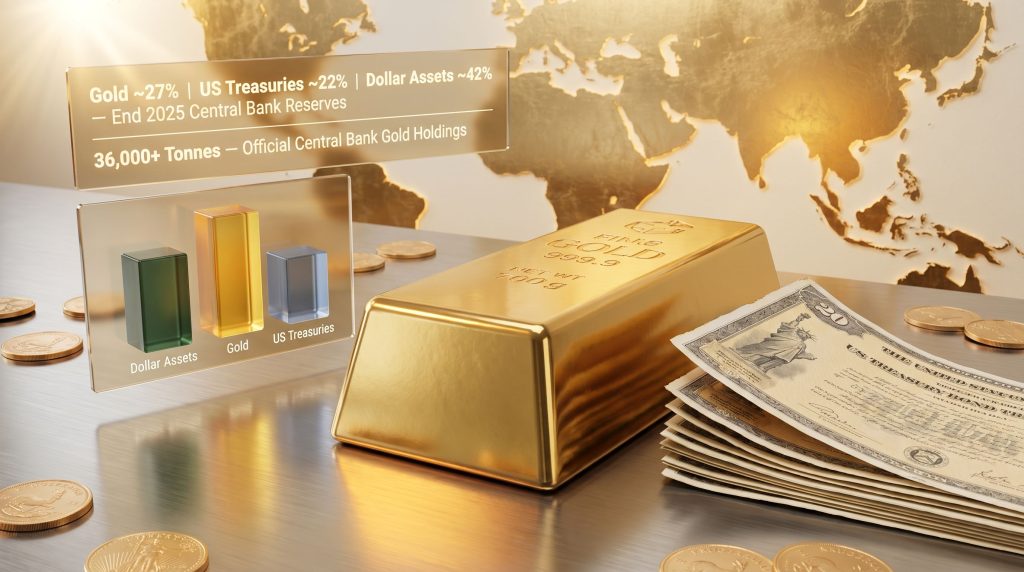
With that context established, the numbers are still striking. According to reserve composition data tracked by analysts, the breakdown of global central bank reserve assets is as follows:
| Reserve Asset | Estimated Share of Global Central Bank Reserves (End 2025) |
|---|---|
| Dollar-Denominated Assets (total) | ~42% |
| Gold | ~27% |
| US Treasuries (standalone) | ~22% |
| Other Assets | ~9% |
Gold reaching approximately 27% of global central bank reserve assets while US Treasuries sit at roughly 22% as a standalone class represents a genuine structural realignment, even after accounting for the gold price appreciation component. It is important to note, however, that the European Central Bank has flagged that if holdings were valued at 2023 gold prices rather than current elevated levels, US Treasuries would still rank above gold by aggregate value. Both the policy shift and the price movement are real and compounding, and neither can be dismissed in isolation.
Two Catalysts That Changed Everything
The 2022 Sanctions Event and Reserve Vulnerability
The single most consequential event in the modern history of central bank reserve management may have been a decision made in the spring of 2022 that received surprisingly little sustained analytical attention given its magnitude. When Western institutions collectively froze approximately $300 billion in Russian sovereign dollar reserves following the invasion of Ukraine, the geopolitical calculus governing reserve management was transformed overnight.
Prior to this event, the primary risks associated with dollar reserves were understood as financial: inflation, interest rate movements, and dollar depreciation. The 2022 freeze introduced a fundamentally different category of risk, specifically geopolitical counterparty risk — the possibility that a sovereign's reserve assets could be rendered inaccessible as an instrument of statecraft.
For non-Western central banks, this event functioned as an irreversible proof of concept. Dollar-denominated assets, regardless of their financial quality, carry an embedded political risk that physical gold simply does not. Gold is a bearer asset with no issuer, no counterparty, and no sanctions mechanism.
The behavioural response was not immediate panic, but rather a gradual and sustained acceleration of diversification toward assets that cannot be frozen, blocked, or redirected by any external authority. Gold is the only reserve-quality asset that meets this criterion at scale. Furthermore, central bank gold buying accelerated noticeably in the years that followed, reinforcing this structural shift in reserve strategy.
Basel 3: The Regulatory Architecture That Amplified Demand
The second structural catalyst operated through an entirely different mechanism. The Basel 3 gold rules, developed in response to the 2008 financial crisis, reclassified physical gold as a Tier 1 zero-risk-weight asset, placing it on equal regulatory footing with cash and high-quality sovereign bonds on bank balance sheets.
The 2023 implementation phase of these rules introduced a financially material distinction between two forms of gold exposure that had previously been treated similarly by many institutions:
- Allocated physical gold: Gold held in a specific, identifiable form with direct legal ownership, now classified as a high-quality liquid asset under Basel 3 frameworks.
- Unallocated or paper gold: Contractual claims on gold that may be pooled or leveraged, now carrying higher capital requirements and less favourable regulatory treatment.
This reclassification removed a long-standing institutional disincentive for banks and sovereign wealth vehicles to hold physical gold on balance sheets. The practical effect was to open the door for significantly larger formal accumulation by institutions that previously avoided gold precisely because of its less favourable regulatory standing. When policy diversification incentives combine with regulatory tail winds at the institutional level, the compounding effect on demand is substantial.
How Much Gold Are Central Banks Actually Holding?
Official figures place total central bank gold reserves at more than 36,000 tonnes as of recent reporting periods. To contextualise that figure, consider that during the Bretton Woods era, at the precise moment when President Nixon suspended the convertibility of dollars into gold in August 1971, central banks collectively held approximately 38,000 tonnes. That was the period of formal gold-backed monetary architecture.
The current total sits within 2,000 tonnes of that historical peak. If accumulation continues at the pace observed since 2022, official holdings could surpass the Bretton Woods peak within this decade. The symbolic weight of that milestone should not be underestimated: the last time central banks held this volume of gold collectively, it served as the literal anchor of the global monetary system.
The Unreported Accumulation Problem
A critical and frequently overlooked dimension of central bank gold accumulation is the systematic gap between officially reported holdings and estimated actual sovereign gold stocks. Official reporting frameworks capture monetary gold held by central banks in formal reserve accounts, but they do not capture gold held through sovereign wealth funds, state-owned financial institutions, or informal accumulation programmes that are not disclosed on a timely basis.
Countries with known or suspected non-disclosed accumulation programmes include several Asian and Middle Eastern sovereign institutions where reporting lags, opaque institutional structures, or deliberate non-disclosure create systematic undercounting. Physical import flow data, refinery throughput statistics, and central bank balance sheet disclosures observed by specialist analysts have repeatedly identified gaps between officially reported and estimated actual holdings.
This means the 36,000-tonne figure almost certainly understates total sovereign gold exposure. The true trajectory of official-sector accumulation is likely steeper than headline figures suggest.
The Paper Gold Problem: Why Physical Demand Is Different
One of the most technically significant and least discussed aspects of the current gold market dynamic relates to the structural architecture of gold derivatives markets. The global paper gold market — encompassing futures contracts, unallocated accounts, exchange-traded products backed by less than full physical reserves, and over-the-counter derivatives — operates at an estimated leverage ratio of approximately 100 to 1 relative to available physical gold.
This means that for every tonne of physical gold underlying the derivatives ecosystem, there exist contractual claims on approximately 100 tonnes' worth of gold exposure. In normal market conditions, this leverage functions smoothly because the vast majority of paper gold positions are closed out without ever demanding physical delivery.
Central bank buying operates on an entirely different basis. Sovereigns acquiring gold for reserve purposes take physical delivery of allocated bars. This demand does not interact with or offset against the paper gold market in the way that speculative or institutional financial positions do. Each tonne acquired by a central bank permanently removes that physical gold from the tradeable pool available to underpin the much larger derivatives superstructure.
When price-insensitive sovereign buyers systematically withdraw physical metal from a market where paper claims already exceed physical supply by an estimated hundredfold, the conditions for structural price dislocations become increasingly plausible, particularly if a catalytic event forces physical delivery demands at scale.
This is not speculative noise. It reflects a genuine structural imbalance that has been building over the multi-year accumulation cycle, and it represents a dynamic with no direct historical precedent at this scale.
Is This De-Dollarisation? A More Nuanced Reading
The narrative that gold's ascent signals the imminent death of dollar hegemony is seductive but analytically imprecise. The US dollar, across all dollar-denominated asset classes combined, still accounts for approximately 42% of global reserve assets, maintaining its position as the dominant reserve currency by a substantial margin. No other currency comes close to challenging dollar primacy in trade invoicing, swap line networks, or cross-border lending markets.
What the milestone that gold overtakes US Treasuries as central bank reserve asset represents is better described as marginal reallocation within a dollar-dominant system rather than systemic de-dollarisation. The distinction matters enormously for investors and policymakers attempting to forecast the trajectory of these trends. In addition, understanding gold in the monetary system more broadly helps contextualise why this reallocation is structurally meaningful even without implying a dollar collapse.
Three plausible scenarios frame the outlook through 2030:
Scenario 1: Gradual Rebalancing (Base Case)
Central banks continue modest gold accumulation at current pace, dollar share declines slowly, gold stabilises at 28 to 30% of reserves, and no systemic rupture occurs in Treasury market demand.
Scenario 2: Accelerated Diversification (Stress Case)
Renewed geopolitical escalation or additional sanctions events trigger faster reallocation, gold demand from the official sector outpaces mine supply growth, and Treasury yields face structural upward pressure from reduced sovereign demand.
Scenario 3: Monetary System Reconfiguration (Tail Risk)
Multilateral reserve frameworks emerge, gold plays an anchor or reference role in new bilateral trade arrangements, and the dollar's share of reserves falls below 35% within a decade.
The base case remains the most probable path, but the stress case has become meaningfully more likely than it was prior to 2022. The tail risk scenario, while low probability, is no longer analytically dismissible.
The next major ASX story will hit our subscribers first
Supply Constraints in a Demand-Surge Environment
Global gold mine production has remained relatively flat for several years, constrained by geological depletion of high-grade deposits, rising input costs, extended permitting timelines, and the substantial lag between exploration investment and new supply reaching production. The structural supply situation for gold is therefore characterised by inelasticity in the near to medium term.
Central banks represent a qualitatively distinct buyer class compared to retail investors or financial institutions. A pension fund or hedge fund will reduce gold purchases when prices rise sharply. A central bank accumulating physical gold for reserve diversification purposes is largely price-insensitive within reasonable ranges, because the motivation is geopolitical risk management rather than return optimisation.
When price-inelastic official sector buyers compete for a physically constrained asset within a derivatives market already operating at extreme leverage ratios, the fundamental supply-demand dynamic differs materially from historical gold bull markets that were primarily driven by financial investor sentiment.
Portfolio Implications Across Asset Classes
The structural shift in reserve asset allocation carries distinct implications for multiple asset classes simultaneously:
| Asset Class | Implication of Gold's Reserve Ascent |
|---|---|
| Physical Gold | Structural demand floor from sovereign buyers provides persistent price support |
| Gold Equities (Major Producers) | Earnings leverage to a sustained high gold price environment enhances valuation |
| US Treasuries | Reduced marginal demand from official sector creates structural yield pressure |
| Emerging Market Currencies | Potential strengthening where central banks back currencies with growing gold reserves |
| Dollar-Denominated Assets (broadly) | Long-term headwind from ongoing diversification trend |
The critical distinction for investors is between a cyclical gold bull market driven by financial sentiment and a structurally driven price environment supported by sovereign accumulation. Cyclical bull markets reverse when sentiment shifts. Structural demand floors built on geopolitical risk management and regulatory frameworks are far more durable and less susceptible to short-term risk-off rotation.
For gold equity investors specifically, sustained physical demand from price-insensitive sovereign buyers translates into a higher long-run gold price floor, which has compounding effects on producer margins, reserve valuations, and project economics across the major and mid-tier producer universe.
Frequently Asked Questions
Has Gold Officially Replaced the US Dollar as the World's Reserve Currency?
No. The US dollar remains the world's dominant reserve currency, accounting for approximately 42% of total global reserves across all dollar-denominated asset classes. What has occurred is that gold has surpassed US Treasuries specifically as a standalone asset class, which is analytically distinct from any challenge to dollar reserve currency status overall. Confusing these two claims significantly overstates the nature of the structural shift.
Why Did Central Banks Begin Accelerating Gold Purchases After 2022?
The 2022 freezing of approximately $300 billion in Russian sovereign dollar reserves demonstrated to non-Western central banks that dollar-denominated assets carry embedded geopolitical counterparty risk. Gold, as a bearer asset with no issuer and no sanctions mechanism, offers reserve-quality stores of value that cannot be blocked, frozen, or redirected by any external authority. This realisation fundamentally altered the risk calculus of reserve management for a significant cohort of sovereign institutions.
How Much of Gold's Rising Reserve Share Reflects Price Appreciation Versus New Purchases?
Both factors are operative and compounding. Central banks have been consistent net purchasers of gold for more than a decade, and the gold price has risen significantly over the same period. The ECB has noted that at 2023 gold price levels, US Treasuries would still rank above gold by aggregate reserve value, which indicates that price appreciation has been a meaningful component of the observed share increase. This does not diminish the policy significance of the trend but does require careful interpretation of percentage figures.
What Is Basel 3 and Why Does It Matter for Gold Markets?
Basel 3 is the international banking regulatory framework that emerged from the 2008 financial crisis. Its reclassification of physical gold as a Tier 1 zero-risk-weight asset placed allocated physical gold on the same balance sheet standing as cash and high-quality sovereign bonds. The 2023 implementation phase sharpened the regulatory distinction between allocated physical gold and unallocated or paper gold instruments, creating meaningful institutional incentives for holding the former over the latter. This regulatory architecture change acted as an amplifier for the sovereign accumulation trend already in motion.
Are Central Banks Still Actively Buying Gold in 2025?
Yes. The ECB and other reporting institutions have confirmed that geopolitical tensions continue to drive strong official sector demand for physical gold as of 2025. Emerging market central banks, particularly across Asia and the Middle East, have been the most consistent and active accumulators throughout this period, with patterns consistent with long-term strategic reserve diversification rather than tactical or cyclical positioning. Furthermore, discussions across financial communities reflect growing awareness of this trend among informed investors globally.
Gold's Re-Emergence as a Monetary Instrument
For decades, the dominant narrative in mainstream monetary economics described gold as a barbarous relic — a phrase attributed to Keynes — representing an archaic constraint on modern monetary flexibility. The empirical record of the past several years is systematically dismantling that narrative.
The combination of regulatory reclassification under Basel 3, accelerated sovereign accumulation following the 2022 sanctions episode, and the arithmetic proximity of current holdings to the 38,000-tonne Bretton Woods peak collectively paint a picture of gold not merely as a cyclical safe-haven asset but as a re-emergent monetary instrument being actively rehabilitated by the same institutional actors who shape the architecture of global finance.
It is worth reflecting on the structural significance of that Bretton Woods parallel. The last time central banks collectively held gold at this scale, it served as the formal anchor of the international monetary system. Today's accumulation is occurring without any formal monetary framework requiring it, which in some ways makes the signal stronger rather than weaker. Sovereigns are choosing gold voluntarily, as a risk management response to a fracturing geopolitical environment, rather than holding it as an institutional obligation.
Whether the decade ahead brings gradual rebalancing, accelerated diversification, or more fundamental monetary system reconfiguration, the data is unambiguous on one point: the era in which gold could be dismissed as irrelevant to modern monetary architecture has ended. The question now is not whether gold matters in the global reserve system, but how much it will matter, and what structural consequences flow from its continued ascent.
Disclaimer: This article is intended for informational purposes only and does not constitute financial advice. Statistics and projections discussed are based on available data and analytical frameworks; forward-looking scenarios involve inherent uncertainty and should not be treated as predictions of future outcomes. Readers should consult qualified financial advisers before making investment decisions based on macroeconomic themes discussed herein.
Want to Identify ASX Gold Discoveries Before the Broader Market Does?
Discovery Alert's proprietary Discovery IQ model delivers real-time alerts on significant ASX mineral discoveries, instantly translating complex geological and commodity data into actionable investment insights — precisely the kind of edge that matters in a structurally shifting gold market. Explore historic examples of major mineral discoveries and their extraordinary returns, then begin your 14-day free trial to position yourself ahead of the market.