
June 19, 2026
When Portfolio Insurance Stops Working: The Case for Rethinking Gold Allocation
Every investment framework contains a hidden assumption. For the classic 60/40 portfolio, that assumption was straightforward: when equities fall, bonds rise. For roughly two decades, this relationship held with enough consistency that it became embedded in retirement plans, institutional mandates, and financial planning software worldwide. The logic was clean, the backtests were convincing, and the math worked.
Then the economic regime shifted, and the math stopped working.
Understanding why that correlation broke, what it means for portfolio construction, and how gold portfolio allocation has moved from contrarian fringe to institutional consensus is now one of the most practically important questions facing investors at every wealth level.
When big ASX news breaks, our subscribers know first
Why the 60/40 Portfolio's Core Mechanism Has Been Compromised
The Correlation That Built an Industry
The 60/40 portfolio was not designed around a guess. It was engineered around a specific, empirically observed pattern: during periods of economic stress driven by growth fears, capital would systematically rotate out of equities and into sovereign debt instruments.
The mechanics were reliable. When recession fears dominated market psychology, investors sold stocks and bought government bonds, pushing bond prices up and yields down simultaneously. This "flight to safety" dynamic meant a 40% bond allocation functioned as automatic portfolio insurance, cushioning equity losses during the downturns that mattered most.
From approximately 1998 through 2021, this negative stock-bond correlation held with sufficient consistency that it became the foundational premise of mainstream portfolio theory. (Incrementum AG, In Gold We Trust 2025)
The problem is not that the 60/40 framework was wrong. It was right for the conditions that produced it. The problem is that those conditions were regime-specific, not permanent.
2022: The Year the Model Revealed Its Limitation
The Federal Reserve's 2022 rate-hiking cycle, the most aggressive monetary tightening in approximately four decades, produced an outcome that exposed the central fragility of traditional portfolio construction. Stocks and bonds fell simultaneously. The S&P 500 declined approximately 19.4%. Long-duration US Treasuries dropped more than 30% over the same period.
For investors holding a classic 60/40 allocation, it represented the worst simultaneous drawdown for that construction in modern financial history. (Incrementum AG, In Gold We Trust 2025)
The critical insight — one frequently underappreciated in post-mortem analyses — is that 2022 was not an anomaly produced by unusual circumstances. It was the entirely predictable outcome of a specific type of economic shock: an inflation-driven event rather than a pure growth shock.
The distinction matters enormously for gold portfolio allocation decisions:
| Shock Type | Equities | Bonds | 60/40 Outcome | Gold Behaviour |
|---|---|---|---|---|
| Pure Growth Shock (recession, no inflation) | Fall | Rise | Works as designed | Moderate positive |
| Inflation Shock (rising rates + persistent inflation) | Fall | Fall | Fails: both sleeves decline | Historically positive |
| Stagflation (slow growth + high inflation) | Volatile | Fall | Fails structurally | Strong historical outperformance |
| Deflation Shock | Fall sharply | Rise sharply | Works well | Mixed |
The current macroeconomic environment, characterised by above-target inflation, elevated fiscal deficits, and structurally higher interest rate sensitivity, increases the probability that inflation shocks rather than pure growth shocks will dominate the coming decade. In that environment, the 40% bond allocation does not provide the insurance it was designed to deliver.
Portfolio diversification is not a permanent feature of any asset class. It is a function of the economic regime those assets inhabit. An allocation that provided genuine risk management in 2010 may provide false security in 2026 if the underlying conditions have changed materially.
How Inflation Destroys the Risk-Management Function of Bonds
The Double-Erosion Mechanism
A bond is, at its core, a nominal promise. A fixed cash flow delivered over a predetermined period, with no adjustment for changes in purchasing power. When inflation runs persistently above a bond's yield, the real return turns negative regardless of what happens to the bond's market price. The investor receives their nominal coupon payments while the purchasing power of those payments quietly erodes.
Add rising interest rates to that picture, and the problem compounds. When central banks respond to inflation by increasing policy rates, newly issued bonds offer higher yields, making existing lower-yield instruments worth less on the secondary market. The result is a simultaneous loss on two fronts: purchasing power erosion from inflation and price decline from rate increases.
This double-erosion dynamic occurred precisely in 2022, and it occurred during the last comparable inflationary regime in the 1970s. Neither episode was accidental. Both were the predictable consequence of an inflation shock hitting a portfolio construction that was only designed to withstand growth shocks. Furthermore, understanding the gold and bonds dynamics across economic cycles helps clarify why this distinction is so consequential for modern investors.
Why This Time Has a Structural Dimension
What distinguishes the current environment from a typical inflationary episode is the fiscal backdrop against which it is occurring. The US federal government was running an annual deficit of approximately $1.8 trillion in fiscal year 2024, according to the US Congressional Budget Office. Persistent deficit spending at this scale creates ongoing competition between government borrowing and private capital, with structural implications for inflation that extend well beyond a standard monetary policy cycle. (US Congressional Budget Office, FY2024)
The International Monetary Fund's Fiscal Monitor has separately flagged elevated sovereign debt trajectories across major economies as a medium-term risk to monetary stability. When the institution that assesses global financial stability raises concerns about the fiscal trajectories of bond-issuing governments, it introduces a paradox at the heart of traditional portfolio theory.
Long-duration government bonds carry the classification of risk-free assets, yet they are issued by governments whose fiscal paths create the very inflationary conditions that erode bond values most severely. (International Monetary Fund, Fiscal Monitor)
The question facing portfolio constructors in 2026 is not whether bonds have any value. They do, under specific conditions. The question is whether a 40% bond allocation accurately reflects the risk-management function bonds can realistically deliver when fiscal deficits are structurally embedded and inflation remains above target.
What Major Institutional Research Now Concludes About Gold Portfolio Allocation
Three Independent Research Desks, One Directional Conclusion
The most significant development in portfolio theory over the past eighteen months is not any single institutional recommendation. It is the convergence of three entirely independent analytical processes arriving at the same conclusion about gold portfolio allocation.
Morgan Stanley, BlackRock Investment Institute, and Goldman Sachs have each published research recommending gold allocations materially above the 2-5% strategic hedge range that defined mainstream financial planning for the prior two decades. (Morgan Stanley; BlackRock Investment Institute; Goldman Sachs)
When research desks that operate independently, compete commercially, and serve different institutional mandates arrive at the same directional finding, the underlying data has shifted in a way that transcends any single institution's analytical framework. Consequently, the case for strategic gold investment has strengthened considerably across the institutional landscape.
The specifics of each institution's position reveal different but complementary dimensions of the case:
-
Morgan Stanley proposed a modified 60/20/20 model allocating 60% to equities, 20% to short-duration bonds (explicitly excluding long-duration to limit rate sensitivity), and 20% to gold. The rationale centred on gold's near-zero correlation with both equities and short-duration bonds, as well as gold's demonstrated performance track record during prior inflationary periods. (Morgan Stanley)
-
BlackRock Investment Institute went beyond a specific allocation number and classified gold as a structural holding. In institutional portfolio theory, this distinction is significant: a structural allocation belongs in a portfolio based on the asset's inherent properties, not because of timing, price momentum, or tactical opportunity. It is permanent by design, not conditional on market conditions. (BlackRock Investment Institute)
-
Goldman Sachs built its case on three independent pillars: a persistent demand floor created by central bank gold accumulation, favourable real yield dynamics in high-deficit environments, and a diversification premium that no other asset class replicates when stock-bond correlation is positive. (Goldman Sachs)
What BlackRock's Structural Classification Actually Means
The distinction between a tactical gold position and a structural one is more consequential than it may appear. A tactical allocation is conditional and time-bound: the investor buys when conditions favour gold and reduces exposure when they do not. This framing keeps gold in the same category as sector rotations or thematic trades.
A structural allocation removes gold from the tactical bucket entirely and places it alongside equities and bonds as a permanent portfolio constituent. This means the case for holding gold does not depend on predicting the next crisis, timing a price move, or maintaining a bullish view on the metal's near-term trajectory.
Gold earns its place through what it is, not through what it is doing in any particular quarter. BlackRock's categorical upgrade of gold from opportunistic trade to permanent holding represents a significant shift in how the world's largest asset manager conceptualises portfolio construction. According to the World Gold Council's research on gold as a strategic asset, this kind of long-term structural thinking reflects a broader evolution in how institutional investors view gold's role.
How Much Gold Should a Diversified Portfolio Actually Hold?
The Evolving Institutional Consensus: From 2-5% to 10-20%
The traditional 2-5% gold allocation was calibrated for a specific set of conditions that no longer reliably hold: low and stable inflation, dependable negative stock-bond correlation, and a monetary environment where long-duration government bonds could genuinely function as risk-free instruments. The institutional consensus published through 2025 and into 2026 has shifted significantly.
How much gold should be in a portfolio? Research published through 2025-2026 by Morgan Stanley, BlackRock Investment Institute, and Goldman Sachs collectively supports a gold portfolio allocation of 10-20% in diversified long-term portfolios. Morgan Stanley has explicitly recommended 20%. Historical portfolio optimisation research supports ranges of 12-27% depending on whether the objective is Sharpe ratio maximisation or drawdown minimisation. The traditional 2-5% figure was designed for a low-inflation, negative-correlation environment that no longer reliably exists. (Morgan Stanley; BlackRock Investment Institute; Goldman Sachs)
Matching Gold Weight to Investor Objectives
The appropriate gold portfolio allocation varies meaningfully depending on what the investor is trying to achieve. The following framework aligns allocation ranges with specific portfolio objectives:
| Investor Objective | Suggested Gold Range | Rationale |
|---|---|---|
| Inflation hedge within conservative portfolio | 10-15% | Replaces portion of long-duration bond exposure; limits rate sensitivity |
| Balanced growth with real asset diversification | 15-20% | Aligns with the 60/20/20 model; captures diversification premium |
| Maximum drawdown reduction | 20-27% | Supported by portfolio optimisation research targeting worst-case 12-month performance |
| Sharpe ratio optimisation (historical backtests) | 12-19% | Optimal range for risk-adjusted return across bootstrapped historical studies |
| Explicit inflation and debasement positioning | 20-35% | Historical reviews found allocations up to 35% improved risk-adjusted returns vs. traditional balanced portfolios |
Important disclaimer: These ranges reflect published research frameworks and historical optimisation outputs. They are not universal prescriptions. Individual time horizon, liquidity requirements, income needs, and risk tolerance all materially affect the appropriate allocation. Investors should consult a qualified financial adviser before making allocation decisions.
What the Performance Data Actually Shows
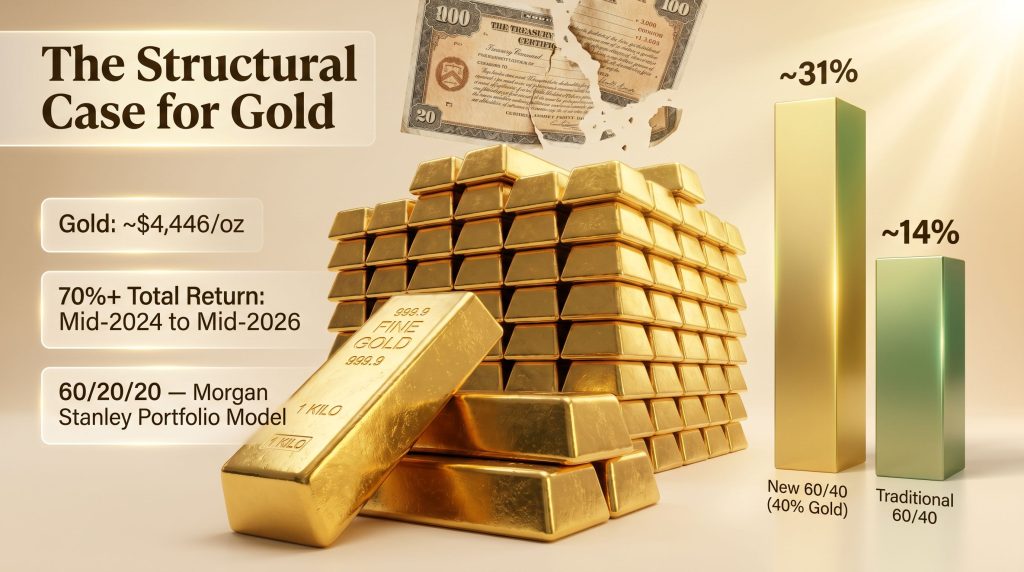
The performance differential between traditional and gold-enhanced portfolio constructions over the period from May 2024 through mid-2026 has been substantial. According to Incrementum AG's In Gold We Trust 2025 report, a portfolio construction replacing the traditional 40% bond allocation with 40% gold outperformed the classic 60/40 model by approximately 17 percentage points on a total return basis over this window. (Incrementum AG, In Gold We Trust 2025)
The underlying arithmetic is straightforward rather than mysterious:
| Portfolio Construction | Non-Equity Sleeve | Approx. Return (May 2024-May 2026) | Primary Risk |
|---|---|---|---|
| Traditional 60/40 | 40% investment-grade bonds | ~14% total return | Inflation erosion; rate sensitivity |
| Morgan Stanley 60/20/20 | 20% short bonds + 20% gold | Intermediate | Balanced; limits duration risk |
| New 60/40 (Incrementum model) | 40% gold | ~31% total return | Gold price volatility; no income generation |
Gold delivered approximately 70%+ in total return from mid-2024 to mid-2026, compared to roughly 2-4% in nominal terms for investment-grade bonds over the same period. Gold was trading at approximately $4,446 per ounce as of late May 2026, representing approximately 35% year-over-year appreciation. (Incrementum AG, In Gold We Trust 2025)
The counter-argument that gold's recent performance represents an exceptional run unlikely to repeat deserves serious consideration. The institutional rebuttal is equally serious: the structural conditions behind gold's performance — specifically fiscal deficits, above-target inflation, positive stock-bond correlation, and sustained central bank accumulation — remain in place with no credible near-term reversal mechanism currently visible. (Goldman Sachs; Incrementum AG, In Gold We Trust 2025)
The Long-Range Scenario: Gold Allocation 2045
Incrementum AG's In Gold We Trust 2025 report also includes a long-range projection called the Gold Allocation 2045. Under a base-case debasement scenario, it models gold prices of up to $20,800 per ounce by 2045 if current trends — including dollar debasement, central bank accumulation, and de-dollarisation — continue at their present pace.
This is a scenario model, not a price forecast. Whether the specific figure proves accurate is less important than the directional logic it encodes, which is consistent with the broader institutional research consensus. Investors should treat long-range commodity price projections as illustrative scenarios rather than predictive targets.
What Role Does Central Bank Demand Play in Gold's Portfolio Case?
A Structural Demand Floor Independent of Investor Sentiment
One dimension of the gold portfolio allocation case that receives less attention than price performance is the demand architecture that now underpins the gold market. Central bank gold demand has been a defining feature of the post-2020 monetary landscape, with emerging market central banks in particular accelerating reserve diversification away from US dollar-denominated assets.
Goldman Sachs identified central bank accumulation as one of three independent structural pillars supporting gold's role in diversified portfolios. (Goldman Sachs) This matters for portfolio construction because it creates a persistent bid beneath the gold market that is not correlated with Western retail investor sentiment, ETF flows, or speculative positioning.
Even during periods when Western investors reduce gold exposure, sovereign demand from emerging market central banks provides structural support that did not exist at comparable scale in prior decades.
The De-Dollarisation Vector
The gradual multi-polar shift in global reserve composition documented by the IMF Fiscal Monitor and independent macroeconomic research reinforces this demand floor through a distinct mechanism. Central banks seeking to reduce exposure to assets that can be frozen, sanctioned, or otherwise subject to political intervention are systematically adding gold to reserves precisely because gold is the only reserve asset that exists entirely outside any nation's financial system.
Gold carries no counterparty risk, cannot be sanctioned, is not a liability of any government, and requires no bilateral trust relationship to store value across jurisdictions. These properties make it uniquely suited to the reserve management needs of central banks navigating an increasingly multipolar geopolitical environment. Furthermore, gold's gold safe-haven role during periods of systemic stress reinforces why both institutions and individuals continue to increase their holdings.
The next major ASX story will hit our subscribers first
Physical Gold vs. Gold ETFs: The Distinction Most Allocation Research Glosses Over
Why Implementation Method Matters
Virtually all institutional research on gold portfolio allocation — including the models published by Morgan Stanley, BlackRock Investment Institute, and Goldman Sachs — references ETF or futures-based exposure as the assumed implementation vehicle. This is understandable from an institutional perspective: ETFs offer liquidity, scale, and ease of integration into existing portfolio management systems.
However, comparing physical gold vs ETFs reveals meaningful differences from a risk perspective. A gold ETF provides exposure to gold's price performance, but the underlying asset sits on a third-party custodian's balance sheet. The investor holds a financial claim on gold, not gold itself. This introduces counterparty risk at the custodian level and, in the case of unallocated gold products, potential systemic exposure during periods of financial stress.
Physical gold eliminates this intermediary layer entirely. The investor owns the asset directly, with no institution standing between them and the underlying value. This distinction is most consequential precisely when gold's protective properties are most needed — during periods of financial system stress when counterparty risk across the institutional landscape is elevated.
Comparing Implementation Options
| Ownership Method | Counterparty Risk | Liquidity | Storage Cost | Best Use Case |
|---|---|---|---|---|
| Physical gold (direct) | None | Moderate | Yes (vault or secure storage) | Long-term wealth preservation; maximum protection |
| Gold ETF (allocated) | Low (custodian) | High | Embedded in management fees | Liquid tactical or structural exposure |
| Gold ETF (unallocated) | Moderate | High | Embedded in management fees | Short-term trading; not ideal for structural allocation |
| Gold futures | High (exchange + margin) | Very high | None | Institutional hedging; unsuitable for most individuals |
| Gold mining equities | High (operational + market) | High | None | Leveraged gold price exposure; substantially higher volatility |
The institutional models recommend exposure to the price of gold. Physical ownership delivers the asset itself. For investors whose motivation for holding gold includes protection against scenarios of broader financial system dysfunction, that is not a trivial distinction. For a more detailed comparison across gold ownership structures, VanEck's analysis of gold's role in portfolio allocation provides useful additional context.
How Gold Portfolio Allocation Fits Different Investor Profiles
Three Scenarios for Three Different Circumstances
Scenario A: The Conservative Retiree (60+ years, capital preservation priority)
The primary risk for this investor is sustained inflation eroding the purchasing power of fixed-income holdings over a 20-30 year retirement horizon. A gold portfolio allocation of 10-15%, replacing a portion of long-duration bond exposure, limits rate sensitivity while introducing a real asset hedge against persistent inflation. This range aligns with guidance that gold exposure for conservative profiles should remain at or below 15% of total assets.
Scenario B: The Mid-Career Accumulator (35-55 years, balanced growth and protection)
The primary risk for this investor is a prolonged inflationary decade eroding the real value of a 60/40 portfolio during peak accumulation years, when compounding losses have the greatest long-term impact. A gold portfolio allocation of 15-20% within a modified 60/20/20 structure captures the diversification premium that research demonstrates across multiple gold weighting levels while remaining within the upper bound of mainstream institutional consensus. (Morgan Stanley)
Scenario C: The Macro-Aware Investor (any age, explicit inflation or debasement thesis)
The primary risk for this investor is currency debasement and fiscal deterioration eroding the real value of nominal financial assets over a multi-decade horizon. A gold portfolio allocation of 20-35%, potentially centred on physical gold as the primary implementation vehicle, reflects historical evidence that allocations in this range have improved risk-adjusted returns relative to traditional balanced portfolios. Portfolio optimisation research targeting worst-case drawdown minimisation has identified weights approaching 27% as optimal under certain methodological frameworks. In addition, Sprott's research on how much gold to own offers further quantitative grounding for investors building a longer-term debasement thesis.
Frequently Asked Questions: Gold Portfolio Allocation
Is the 60/40 Portfolio Still Relevant in 2026?
The 60/40 portfolio retains value in specific economic regimes, particularly pure growth shocks where recession occurs without significant inflation. In those environments, the negative stock-bond correlation that the model depends on can re-emerge, and the 40% bond allocation functions as intended. The model is not obsolete. However, its reliability is regime-dependent, and the current regime is characterised by the conditions under which it is least likely to perform its intended function.
Why Are Major Financial Institutions Recommending More Gold Now?
The institutional shift toward higher gold portfolio allocation is not primarily a bullish call on gold prices. It is a reassessment of long-duration government bonds as portfolio insurance. When the traditional hedge becomes exposed to the same macroeconomic forces that threaten equities, portfolio theory requires a replacement.
Gold's near-zero correlation with both equities and bonds under current conditions, its track record in inflationary regimes, and the structural demand floor created by central bank accumulation make it the most credible candidate. The recommendation is, at its core, a judgement about fiscal trajectories more than a commodity price call. (Morgan Stanley; Goldman Sachs)
What Is the Difference Between a Tactical and a Structural Gold Allocation?
A tactical allocation is conditional: the investor holds gold when conditions favour it and reduces exposure when they do not. A structural allocation is permanent: gold earns its position based on inherent properties — including real asset status, zero counterparty risk, and near-zero correlation with financial assets during systemic stress — regardless of current price levels or market conditions.
BlackRock Investment Institute's classification of gold as a structural holding represents a categorical upgrade from the tactical framing that dominated institutional thinking for the prior two decades. (BlackRock Investment Institute)
How Has Gold Performed Relative to Bonds Since 2024?
Gold delivered approximately 70%+ in total return from mid-2024 to mid-2026, compared to roughly 2-4% in nominal terms for investment-grade bonds over the same period. According to Incrementum AG's In Gold We Trust 2025 report, a portfolio construction replacing the traditional 40% bond sleeve with 40% gold outperformed the classic 60/40 model by approximately 17 percentage points on a total return basis over this window. (Incrementum AG, In Gold We Trust 2025)
Does the Case for Gold Depend on the Price Continuing to Rise?
This is the most important question for investors considering gold portfolio allocation for the first time. The institutional case does not depend on gold's price continuing to appreciate. It depends on gold maintaining its near-zero correlation with equities and bonds during drawdowns, which is a property of what gold is rather than what it is priced at.
A gold allocation at any price level delivers the diversification benefit if the correlation structure holds. The price performance adds return; the correlation structure provides the risk management. These are separate properties, and the second does not require the first.
This article is for informational and educational purposes only. It does not constitute financial or investment advice. Past performance is not indicative of future results. All investments involve risk, including the potential loss of capital. Readers should consult a qualified financial adviser before making any investment decisions.
Want to Spot the Next Major ASX Mineral Discovery Before the Broader Market Does?
While portfolio construction debates continue around gold and inflation hedging, Discovery Alert's proprietary Discovery IQ model delivers real-time alerts on significant ASX mineral discoveries — instantly translating complex data across 30+ commodities into actionable insights for both short-term traders and long-term investors. Explore historic discoveries and their returns to see what early positioning in transformative finds like De Grey Mining and WA1 Resources has meant for investors, and begin your 14-day free trial today to secure your market-leading edge.