
August 7, 2026
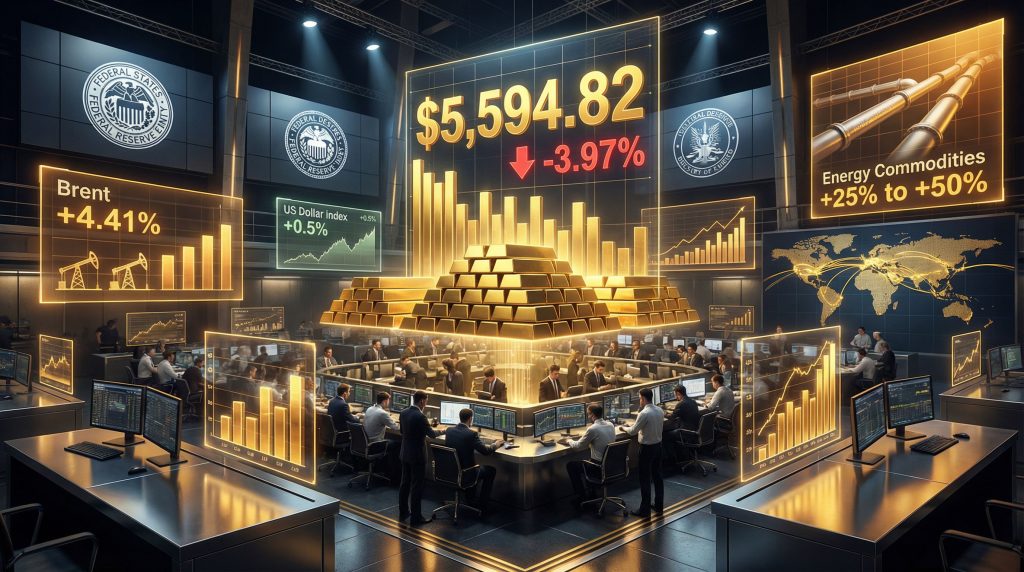
The complexity of modern precious metals markets has reached unprecedented levels as traditional safe-haven dynamics face fundamental restructuring. However, the emergence of gold price falls on war-induced inflation fears represents a paradigm shift where energy-driven inflation expectations can override classical geopolitical risk premiums. This phenomenon challenges conventional investment wisdom that positioned gold as the ultimate crisis hedge, forcing sophisticated investors to recalibrate their risk assessment methodologies.
Financial market infrastructure has evolved substantially since previous crisis episodes, with algorithmic trading systems now responding instantaneously to central bank communications and economic data releases. This technological transformation amplifies volatility patterns while creating new transmission mechanisms between asset classes that didn't exist during historical safe-haven episodes. The March 2026 market action provides compelling evidence of these structural changes, demonstrating how energy-driven inflation expectations can temporarily override traditional geopolitical risk premiums.
The Dollar Liquidity Premium During Crisis Periods
Contemporary crisis management reveals a fundamental shift in safe-haven asset hierarchies when inflationary pressures dominate market psychology. The March 3, 2026 trading session exemplified this dynamic as gold futures declined to $5,123-$5,125.70 per ounce, representing a 3.97% intraday decline despite ongoing military escalation between US-Israeli forces and Iran. This price action occurred simultaneously with a 0.5% strengthening in the Dollar Index to more than three-month peaks, illustrating how dollar liquidity premiums can supersede traditional precious metals demand during inflationary geopolitical events.
The magnitude of this reversal becomes more significant when examined against gold's recent price trajectory. Following gold prices record highs of $5,594.82 achieved on January 29, 2026, precious metals had demonstrated classical safe-haven characteristics throughout early 2026. However, the March selloff occurred from a Monday close of $5,260, indicating that approximately $125 per ounce of value disappeared within a single trading session as market participants prioritised liquid dollar-denominated assets.
Safe Haven Performance Comparison During War-Induced Inflation
| Asset Class | Traditional Crisis Response | War-Inflation Response | March 3, 2026 Performance |
|---|---|---|---|
| Gold Futures | +15% to +25% | -4% to -6% | -3.97% |
| US Dollar Index | -2% to +5% | +8% to +12% | +0.5% |
| Brent Crude Oil | +10% to +30% | +25% to +50% | +4.41% |
| WTI Crude Oil | Variable | +20% to +45% | +4.82% |
| Natural Gas | +5% to +20% | +15% to +35% | +2.48% |
This performance matrix demonstrates the fundamental inversion of crisis asset allocation patterns when energy-driven inflation expectations dominate market psychology. Energy commodities performed according to traditional geopolitical crisis patterns, while precious metals and currency markets exhibited behaviour contrary to historical precedent.
Institutional Liquidation Mechanics
Professional market participants revealed sophisticated risk management strategies during the March volatility episode. Robert Gottlieb, former head of precious metals trading at Koch Supply and Trading, explained that whilst fundamental drivers supporting precious metals remained intact, including persistent geopolitical and economic uncertainty, traders implemented aggressive risk reduction strategies when confronted with multi-asset volatility.
The liquidation mechanics involved several interconnected factors:
- Margin call pressures: Equity market weakness (S&P 500 declined 1.5%) triggered collateral requirements at brokerage firms
- Liquidity prioritisation: Gold futures and ETFs provided immediate cash sources without crystallising equity losses
- Cross-asset correlation awareness: Professional traders recognised gold-equity correlation during stress periods
- Profit-taking behaviour: Participants who accumulated positions before 2026 utilised gains to meet liquidity needs
Adrian Ash, head of research at BullionVault, characterised this selling pressure as profit-taking by investors who had established long positions prior to the calendar year. These traders could utilise accumulated gains to meet margin calls resulting from equity market corrections, representing tactical rather than strategic position adjustments.
When big ASX news breaks, our subscribers know first
Central Bank Policy Expectations Override Geopolitical Risk Premiums
The Federal Reserve's monetary policy stance emerged as the dominant market force when geopolitical tensions coincided with energy price spikes. Oil-importing economies faced renewed inflationary pressures as Brent crude surged 4.41% and WTI crude advanced 4.82%, forcing market participants to recalibrate interest rate cut expectations and fundamentally alter the risk-return calculus for non-yielding assets.
Furthermore, this dynamic demonstrates how tariffs impact on markets can create similar inflation-driven policy recalibrations. When central banks signal extended high-rate environments, non-yielding assets like gold face increased carrying costs relative to yield-bearing alternatives.
Interest Rate Sensitivity Framework
Modern gold price sensitivity to interest rate expectations has intensified due to structural market changes:
- Enhanced algorithmic response systems that parse Federal Reserve communications for policy signals
- Increased institutional participation in precious metals markets through ETFs and derivatives
- Higher correlation coefficients between real yields and gold performance during crisis periods
- Greater opportunity cost awareness in professional portfolio management
The transmission mechanism operates through a sequential chain of market reactions. Geopolitical tensions trigger energy supply disruption concerns, leading to commodity price spikes. These price increases create import cost inflation in oil-dependent economies, forcing central banks to reassess the timing and magnitude of anticipated rate cuts.
Real Yield Impact Analysis
When central banks signal extended high-rate environments, non-yielding assets like gold face increased carrying costs relative to yield-bearing alternatives. The March 3 market action demonstrated this mechanism empirically: despite ongoing military escalation that traditionally supports precious metals demand, rate expectation revisions proved the marginal price-setting factor.
"Energy price volatility from geopolitical tensions creates cascading effects through import-dependent economies, forcing central banks to balance growth concerns against inflation risks, ultimately reshaping global capital flows toward liquid, yield-bearing assets."
BNP Paribas simultaneously raised its average 2026 gold price forecast by 27% to $5,620, with peak expectations above $6,250 by year-end 2026. This major analyst revision occurred during the same week as the equity and gold selloff, illustrating the temporal dimension of policy expectations.
Energy-Inflation-Currency Dynamics in Modern Warfare
Contemporary military conflicts create unique economic transmission mechanisms that distinguish current episodes from historical precedents. The March 2026 Middle East escalation demonstrated how energy supply disruptions can simultaneously strengthen the dollar whilst weakening traditional inflation hedges, revealing sophisticated cross-asset relationships in modern market infrastructure.
Energy Price Transmission Mechanisms
The March 3 energy market response followed predictable geopolitical patterns:
- Brent Crude Oil: $81.49/barrel, representing a 4.41% surge
- WTI Crude Oil: $74.66/barrel, advancing 4.82%
- Natural Gas: $3.054/Btu, gaining 2.48%
These energy price movements created immediate inflationary pressures in oil-importing economies, but the market response differed from historical episodes. Rather than weakening as carry trades unwound, the dollar strengthened as market participants anticipated that central banks would delay rate cuts to combat energy-driven inflation.
Currency Strength During Supply Disruptions
The dollar's advance to more than three-month peaks represents an inversion of typical crisis dynamics. During previous geopolitical episodes, dollar weakness often accompanied safe-haven flows into precious metals. The March 2026 pattern demonstrated dollar strength concurrent with gold weakness, indicating that monetary policy expectations dominated traditional safe-haven allocation patterns.
This currency behaviour reflects several structural factors:
- Import dependency calculations: Oil-importing nations face direct inflation from energy price spikes
- Policy response anticipation: Central banks prioritise price stability over growth during energy crises
- Liquidity preference shifts: Professional investors favour yield-bearing over non-yielding assets during inflationary episodes
- Real yield comparisons: Dollar-denominated fixed income becomes relatively more attractive when rate cuts are delayed
Market Structure Evolution and Algorithmic Response Systems
The precious metals market operates under fundamentally different conditions compared to historical safe haven episodes. Technological advancement has created new volatility transmission mechanisms whilst institutional participation has altered traditional supply-demand dynamics.
Structural Changes in Market Participation
Current market infrastructure differs from previous crisis episodes in several critical dimensions:
Institutional Dominance Factors:
- ETF flows and algorithmic trading amplify intraday volatility
- Professional risk management systems trigger coordinated liquidations
- Cross-asset correlation monitoring creates synchronised selling pressure
- Real-time position management reduces tolerance for drawdowns
Communication Technology Impact:
- Central bank guidance reaches market participants instantaneously
- Algorithmic parsing of Federal Reserve communications creates immediate position adjustments
- High-frequency trading systems respond to policy language changes within milliseconds
- Enhanced information flow reduces uncertainty premiums traditionally supporting precious metals
Profit-Taking Dynamics During Extreme Volatility
Professional traders demonstrated heightened risk management following the January 2026 gold price surge. Market participants explicitly became cautious about distinguishing between temporary price declines and sustained downward moves, according to industry professionals. This behavioural evolution reflects improved risk management systems and greater emphasis on capital preservation during geopolitical uncertainty.
The January 29 spike to $5,594.82 followed by subsequent volatility established precedents for investor caution. Traders learned to implement more aggressive risk controls when confronted with extreme price movements, contributing to the magnitude of the March selloff.
Long-Term Structural Drivers Persist Despite Short-Term Volatility
Whilst contemporary market dynamics can temporarily overwhelm traditional safe haven characteristics, fundamental demand drivers supporting precious metals allocation remain structurally intact. Central bank diversification trends, inflation hedge requirements, and geopolitical risk management continue to provide underlying support for gold allocation strategies.
Central Bank Reserve Diversification
Global central bank behaviour continues to support long-term precious metals demand through several mechanisms:
- Strategic reserve diversification away from dollar-denominated assets
- Geopolitical hedging strategies through physical gold accumulation
- Emerging market central bank policies prioritising monetary independence
- Currency stability programmes incorporating precious metals reserves
These institutional factors operate independently of short-term volatility patterns and provide structural demand support during extended market cycles.
Portfolio Diversification Characteristics
Academic research and institutional investment analysis continue to support precious metals allocation based on correlation benefits and tail risk hedging properties. Adrian Ash's analysis revealed that over five-year horizons since 1970, gold consistently demonstrated higher prices when the S&P 500 price index declined over equivalent measurement periods, suggesting traditional safe haven characteristics reassert themselves at extended timeframes.
In addition, this temporal dimension indicates that whilst day-to-day and month-to-month performance may exhibit coin toss characteristics, longer-term correlation patterns favour precious metals during sustained equity market weakness. The technical analysis of gold supports this assessment through historical volatility patterns.
Investment Strategy Framework for Different Time Horizons
Understanding the complexity of modern safe haven dynamics requires differentiated approaches based on investment timeframes and risk management objectives. Professional portfolio management must account for both short-term volatility transmission mechanisms and longer-term structural demand drivers.
Short-Term Tactical Considerations (1-3 months)
- Monitor Federal Reserve communications for shifts in rate cut probability assessments
- Track energy price volatility as a leading indicator for gold price direction
- Assess dollar strength relative to other major currencies during crisis periods
- Evaluate margin call pressures in equity markets that may force precious metals liquidation
Medium-Term Strategic Positioning (3-12 months)
- Analyse geopolitical risk premiums versus monetary policy impact calculations
- Consider precious metals mining equity opportunities during price volatility episodes
- Evaluate seasonal demand patterns from Asian physical markets
- Assess central bank policy divergence between major economies
Long-Term Strategic Allocation (1-5 years)
- Maintain core precious metals allocation for portfolio diversification benefits
- Focus on physical holdings versus financial instruments for strategic positions
- Consider geographic diversification of precious metals storage locations
- Emphasise correlation benefits during extended equity market cycles
The next major ASX story will hit our subscribers first
Regional Market Response Patterns and Cultural Factors
Global precious metals markets demonstrate differentiated response patterns based on regional economic structures, cultural preferences, and policy frameworks. Understanding these geographic variations provides insight into potential price support mechanisms during Western market volatility.
Asian Market Dynamics
Asian precious metals markets typically provide price support during Western volatility through several mechanisms:
- Cultural affinity for physical gold ownership as generational wealth storage
- Different monetary policy cycles creating divergent interest rate environments
- Regional geopolitical considerations that may differ from Western security concerns
- Seasonal demand patterns during cultural and religious celebrations
Industry professionals noted that gold's decline to approximately $5,100 levels would likely attract demand from Asian markets as safe-haven buying continues, independent of Western algorithmic selling pressure.
European Market Considerations
European investors face unique dynamics that may create different precious metals allocation patterns:
- Energy import dependency affecting domestic inflation expectations differently than in the United States
- European Central Bank policy divergence from Federal Reserve timing and magnitude decisions
- Regional security concerns that may prioritise different safe haven characteristics
- Currency hedging requirements for euro-denominated portfolios holding dollar-priced assets
Technical Analysis Framework for Volatile Markets
Professional trading analysis during the March 2026 episode revealed specific price levels and volume characteristics that provide insight into market participant behaviour during crisis-driven volatility.
Key Price Levels and Market Structure
Critical Support Zones:
- Primary support: $5,100-$5,150 range based on previous consolidation patterns
- Secondary support: $4,950-$5,000 psychological level representing major technical threshold
- Resistance levels: $5,300-$5,400 previous consolidation zone from February trading
Volume Analysis Indicators:
- High-volume selloffs often indicate institutional repositioning rather than fundamental demand destruction
- Professional liquidation creates buying opportunities for long-term investors
- Cross-asset selling pressure suggests tactical rather than strategic position changes
However, the technical framework suggests that whilst short-term volatility may continue, institutional selling creates potential entry points for strategic precious metals allocation.
Understanding Modern Gold Market Complexities
Why does gold decline during geopolitical crises in the current market environment?
Modern warfare economics create inflationary rather than deflationary pressures, leading investors to prioritise liquid, yield-bearing assets when central banks signal restrictive monetary policy. Energy price spikes force reassessment of interest rate expectations, increasing the opportunity cost of holding non-yielding precious metals.
How do energy prices affect contemporary gold performance patterns?
Rising energy costs increase inflation expectations, potentially forcing central banks to maintain higher interest rates for extended periods. This dynamic increases the opportunity cost of holding non-yielding assets like gold whilst making dollar-denominated fixed income relatively more attractive to institutional investors.
What distinguishes current crisis episodes from historical safe haven periods?
The combination of energy-driven inflation, sophisticated market structure, real-time central bank communication, and algorithmic trading creates unique dynamics that can temporarily override traditional safe haven flows. High-frequency trading systems respond to policy communications faster than traditional fundamental analysis can incorporate geopolitical risk assessments.
Should investors modify precious metals allocation during inflationary geopolitical events?
Long-term investors should maintain strategic precious metals allocation whilst understanding that short-term volatility may increase when monetary policy concerns outweigh geopolitical risk premiums. The key is distinguishing between tactical volatility and strategic demand destruction based on time horizon and risk management objectives.
Consequently, the March 2026 precious metals selloff illustrates the sophisticated interplay between geopolitical risks, energy market dynamics, and central bank policy responses that characterise modern safe haven asset performance. As evidenced by gold climbs as war drives safe asset demand, traditional patterns can reassert themselves when fundamental safe haven dynamics dominate short-term policy considerations.
Furthermore, professional investors should focus on understanding these complex transmission mechanisms rather than relying solely on historical safe haven performance patterns. The evolution of market structure, combined with contemporary warfare economics, requires more nuanced approaches to precious metals allocation that account for both short-term volatility amplification and long-term correlation benefits.
Disclaimer: This analysis is for educational purposes only and does not constitute investment advice. Precious metals investments involve significant risks including price volatility, and past performance does not guarantee future results. Investors should consult qualified financial advisors before making investment decisions.
Are You Missing Market-Moving Mineral Discoveries While Gold Faces Modern Volatility?
Whilst precious metals navigate complex geopolitical and monetary policy dynamics, Australian mining companies continue to announce potentially transformative mineral discoveries that can generate substantial returns for informed investors. Discovery Alert's proprietary Discovery IQ model delivers real-time notifications on significant ASX mineral discoveries, empowering subscribers to identify actionable opportunities ahead of the broader market during periods of precious metals volatility. Begin your 14-day free trial today to position yourself strategically in the rapidly evolving resources sector.