
June 11, 2026
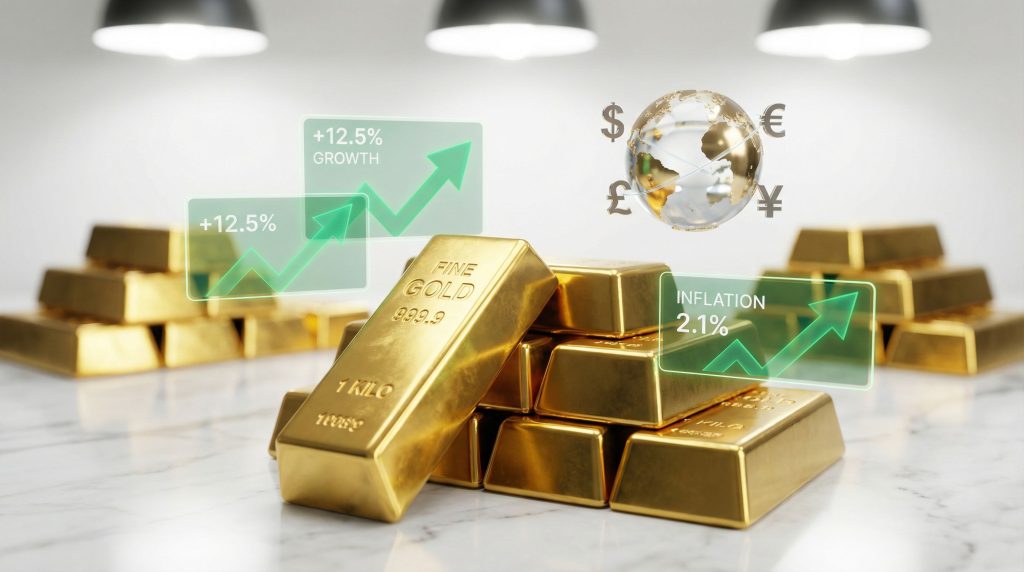
What Economic Forces Will Shape Gold's 2026 Performance?
The precious metals landscape continues to evolve through a complex web of monetary policy decisions, currency fluctuations, and geopolitical tensions that collectively determine gold's trajectory. Understanding these interconnected forces provides crucial insight into the gold price outlook 2026 and the structural factors likely to influence precious metals markets over the coming year.
Central Bank Monetary Policy Divergence
Federal Reserve policy trajectory remains the cornerstone of global precious metals pricing, as interest rate adjustments directly impact the opportunity cost of holding non-yielding assets. Following a year of monetary accommodation in 2025, the central bank's future stance will significantly influence real yields and dollar strength, both critical determinants of gold's performance.
European Central Bank policy divergence creates additional complexity, as differing monetary approaches between major economies generate currency volatility that ripples through precious metals markets. When central banks pursue contrasting policies, the resulting exchange rate movements can amplify or dampen gold's appeal across different regions.
Emerging market central banks have demonstrated consistent gold accumulation patterns, with official sector purchases providing structural demand support independent of speculative positioning. This gold price forecast factor represents a stabilising force that operates regardless of short-term market sentiment or tactical investor flows.
Inflation Dynamics and Real Interest Rate Environment
Real interest rates, calculated as nominal yields minus inflation expectations, serve as a fundamental driver of precious metals demand. When real yields turn negative or remain exceptionally low, gold's relative attractiveness increases as investors seek purchasing power protection against currency debasement.
Core inflation expectations across major economies continue to influence investor allocation decisions, with persistent above-target inflation creating conditions that historically favour hard assets. Furthermore, the relationship between inflation reality and central bank targets creates policy tension that often manifests in precious metals price movements.
Currency debasement concerns extend beyond traditional inflation metrics, encompassing broader questions about monetary system stability and the long-term purchasing power of fiat currencies. These structural concerns support gold's role as a store of value independent of cyclical economic conditions.
Geopolitical Risk Premium Quantification
The World Gold Council's 2026 outlook identified geopolitical risk as contributing approximately 16 percentage points to gold's 2025 performance, demonstrating the quantifiable impact of political uncertainty on precious metals pricing. This attribution model reveals how market participants price political risk into commodity valuations.
Trade tension escalation and regional conflicts create persistent safe-haven flows that support gold prices even during periods of economic growth. However, the gold price outlook 2026 must account for ongoing geopolitical fragmentation and its implications for investor risk appetite.
Supply chain disruption effects extend beyond immediate logistical challenges, influencing longer-term strategic thinking about resource security and currency diversification. Consequently, these considerations drive both official sector and institutional demand for physical assets.
When big ASX news breaks, our subscribers know first
How Do Structural Demand Shifts Support Gold's Long-Term Trajectory?
Institutional portfolio rebalancing represents a powerful structural force reshaping precious metals demand patterns. Unlike speculative trading activity, these allocation adjustments reflect strategic decisions based on long-term risk management objectives and regulatory requirements.
Institutional Portfolio Rebalancing Trends
Sovereign wealth funds increasingly view precious metals allocation as a strategic necessity rather than tactical opportunity. These institutions manage multi-generational wealth preservation mandates that prioritise capital protection over short-term returns, creating consistent demand regardless of market cycles.
Pension fund precious metals exposure has expanded as plan sponsors recognise gold's portfolio diversification benefits and inflation hedging characteristics. Demographic trends toward retirement create structural demand for assets that preserve purchasing power across extended time horizons.
Insurance company reserve diversification reflects regulatory changes and internal risk management evolution. In addition, these institutions require assets that maintain value during financial system stress, positioning precious metals as essential portfolio components rather than speculative investments.
Central Bank Reserve Composition Evolution
De-dollarisation trends among emerging economies represent perhaps the most significant structural shift affecting gold prices record highs. Central banks seeking to reduce single-currency exposure naturally gravitate toward gold as the only reserve asset with no counterparty credit risk.
The World Gold Council's 2026 outlook noted that central banks "continued their gold-buying spree" throughout 2025, indicating sustained official sector demand independent of price levels. This purchasing pattern creates a price floor effect that supports valuations during market stress.
Reserve adequacy metrics increasingly incorporate precious metals holdings as stabilising portfolio components. For instance, modern central banking theory recognises gold's unique characteristics as both a confidence-building measure and practical hedge against currency instability.
Technology Sector Gold Consumption Patterns
Electronics industry demand continues expanding through digitalisation trends and technological advancement. Consumer electronics, data centres, and telecommunications infrastructure require gold's superior conductivity and corrosion resistance properties, creating steady industrial demand.
Renewable energy infrastructure development generates additional gold consumption through solar panel manufacturing and electrical connectivity requirements. The global transition toward clean energy creates a structural demand increment that supports long-term pricing.
Medical and aerospace sector applications represent specialised but growing consumption categories. These industries value gold's biocompatibility and reliability characteristics, creating price-inelastic demand that persists regardless of broader market conditions.
What Are the Three Primary 2026 Gold Price Scenarios?
The World Gold Council's 2026 outlook framework provides a structured approach to understanding potential price trajectories based on macroeconomic scenario development. Each scenario incorporates specific assumptions about economic growth, monetary policy, and geopolitical conditions.
Moderate Growth Scenario: "Shallow Slip" (5-15% Appreciation)
This scenario assumes mild economic deceleration combined with accommodative monetary policy and moderate geopolitical tension. Under these conditions, the World Gold Council projects gold appreciation of 5-15 per cent driven by lower interest rates and sustained risk aversion.
Key characteristics include:
• Economic soft landing with controlled slowdown
• Gradual monetary policy normalisation
• Balanced risk sentiment without extreme movements
• Currency stability with modest dollar weakness
The moderate scenario reflects market expectations for policy effectiveness in managing economic transitions without triggering severe disruption or excessive stimulus response.
Economic Stress Scenario: "Doom Loop" (15-30% Rally)
The stress scenario anticipates deeper economic contraction accompanied by falling bond yields and elevated geopolitical tensions. Under these conditions, gold market performance could appreciate 15-30 per cent as safe-haven flows accelerate and real yields compress further.
This outcome depends on:
• Recession probability materialisation
• Financial system stability concerns
• Currency crisis potential in vulnerable economies
• Central bank emergency policy responses
Historical precedent suggests that severe economic stress creates non-linear precious metals demand as investors prioritise capital preservation over return generation.
Reflation Risk Scenario: "Reflation Return" (5-20% Correction)
The reflation scenario assumes economic growth acceleration driven by fiscal stimulus and productivity improvements. This environment could generate 5-20 per cent gold depreciation as rising real yields increase the opportunity cost of holding non-yielding assets.
Critical factors include:
• Infrastructure investment-led growth acceleration
• Interest rate normalisation timeline advancement
• Dollar strength cycle resumption
• Risk appetite recovery reducing safe-haven demand
Bank of America suggests gold could reach $5,000 per ounce by 2026, representing a dramatically more bullish outlook than the World Gold Council's scenario framework. This projection reflects "persistent debt, resilient physical demand and a shifting monetary landscape" as structural drivers supporting extreme appreciation.
The World Gold Council's overall assessment indicates that "softer growth, accommodative policy and ongoing geopolitical risks are more likely to support gold than not," suggesting probability-weighted expectations favour appreciation scenarios over depreciation outcomes.
Which Technical and Fundamental Indicators Signal 2026 Direction?
Technical analysis of precious metals markets requires understanding the distinction between momentum-driven price movements and fundamental value adjustments. The World Gold Council's return attribution model provides quantitative insight into these dynamics.
Price Momentum Attribution Analysis
The World Gold Council's analysis revealed that price momentum and economic growth factors contributed 19 percentage points to gold's 2025 performance, representing nearly one-third of the total 60 per cent appreciation. This momentum component suggests self-reinforcing buying patterns that extended beyond fundamental justifications.
Momentum attribution breakdown shows:
• Geopolitical risk and USD weakness: ~16 percentage points
• Price momentum and economic growth: 19 percentage points
• Other factors: ~25 percentage points (representing 42% of total returns)
This analysis indicates that roughly 58 per cent of gold's 2025 performance was attributable to identifiable macro factors, whilst the remaining portion derived from structural demand sources including central bank purchases and physical market dynamics.
Supply-Side Constraints and Production Economics
Mining industry fundamentals continue to support pricing through cost inflation and resource depletion trends. Energy price volatility directly impacts extraction costs, while declining ore grades at mature operations require increased processing volumes to maintain output levels.
Production cost pressures manifest through:
• Labour cost escalation in major producing regions
• Environmental compliance expense increases
• Technology requirements for deeper, lower-grade deposits
• Infrastructure development needs in remote locations
These structural cost increases create a rising floor price below which marginal producers cannot operate profitably, supporting long-term price stability regardless of demand fluctuations.
Exchange-Traded Fund Flow Patterns
Institutional versus retail investor positioning creates distinct flow patterns that influence market liquidity and price discovery. Professional investors typically demonstrate less price sensitivity and longer holding periods compared to retail participants.
ETF demand patterns reflect:
• Geographic distribution of investor interest
• Liquidity conditions in underlying physical markets
• Arbitrage mechanisms between paper and physical gold
• Regulatory frameworks affecting institutional participation
Understanding these flow dynamics provides insight into potential volatility patterns and liquidity constraints that could affect the gold price outlook 2026.
How Do Currency Dynamics Affect Gold's 2026 Outlook?
Currency relationships represent one of the most significant drivers of precious metals performance, with the World Gold Council attributing approximately 16 percentage points of 2025's returns to US dollar weakness combined with geopolitical risk premiums.
US Dollar Index Trajectory Analysis
The inverse correlation between dollar strength and gold prices operates through multiple transmission mechanisms. When the dollar weakens, gold becomes less expensive for holders of foreign currencies, expanding the global demand base and supporting price appreciation.
Dollar-gold relationship factors include:
• Trade-weighted dollar performance versus major currencies
• Federal Reserve balance sheet normalisation impacts
• International reserve currency competition dynamics
• Capital flow patterns between dollar and alternative assets
Federal Reserve monetary policy transmission affects dollar strength through interest rate differentials and perceived policy credibility. Accommodative policy typically weakens the dollar whilst restrictive policy strengthens it, creating predictable precious metals price responses.
Emerging Market Currency Stability
Currency instability in emerging markets traditionally drives precious metals demand as investors seek hard asset protection against devaluation risk. Capital flow volatility and external debt burdens create vulnerability to currency crises that support gold demand.
Emerging market considerations include:
• Capital flow reversals during risk-off periods
• Commodity currency performance correlations
• Regional currency union developments
• Central bank intervention capacity limitations
These factors create regional demand surges that can significantly impact global precious metals pricing, particularly during periods of coordinated emerging market stress.
Digital Currency Integration Effects
Central bank digital currency development and cryptocurrency market evolution create new dynamics in monetary system architecture. However, whilst these technologies may compete with gold for certain store-of-value functions, they also highlight the unique characteristics of physical assets.
Digital currency implications encompass:
• Payment system modernisation and efficiency improvements
• Store-of-value preference evolution amongst investors
• Monetary sovereignty considerations for central banks
• Technology risk associated with digital asset storage
The gold price outlook 2026 must consider how digital currency adoption affects traditional safe-haven asset demand and whether technological solutions complement or compete with precious metals holdings.
What Investment Strategies Optimise Gold Exposure for 2026?
Strategic precious metals allocation requires understanding the distinct risk-return characteristics of different investment vehicles and their appropriateness for various portfolio objectives.
Portfolio Allocation Framework Development
Modern portfolio theory applications to precious metals suggest optimal allocation ranges of 5-15 per cent for most institutional portfolios, depending on risk tolerance and return objectives. These allocations provide diversification benefits whilst limiting portfolio volatility.
Allocation considerations include:
• Risk parity strategies incorporating precious metals positions
• Tactical versus strategic allocation timing decisions
• Correlation stability with traditional asset classes
• Rebalancing frequency and transaction cost implications
Strategic allocations typically remain constant regardless of short-term price movements, while tactical adjustments respond to changing market conditions and relative valuations.
Derivative Instruments and Hedging Strategies
Options strategies provide sophisticated approaches to precious metals exposure that can enhance returns or reduce risk depending on implementation. Covered call writing generates income during sideways price action, whilst protective puts provide downside protection.
Derivative strategies encompass:
• Volatility management through options positioning
• Futures market roll yield considerations
• Currency hedging for international investors
• Spread trading between different precious metals
Professional investors often prefer derivative instruments for their liquidity and cost efficiency, whilst retail investors typically favour physical or ETF exposure for simplicity and transparency.
Physical versus Paper Gold Investment Analysis
Investment vehicle selection depends on specific objectives, storage capabilities, and liquidity requirements. Physical gold provides direct ownership and counterparty risk elimination, whilst paper alternatives offer convenience and cost efficiency.
Vehicle comparison factors include:
| Investment Type | Liquidity | Storage Costs | Counterparty Risk | Tax Treatment |
|---|---|---|---|---|
| Physical Gold | Moderate | High | None | Varies by jurisdiction |
| Gold ETFs | High | Low | Present | Generally favourable |
| Gold Futures | Very High | None | Present | Mark-to-market |
| Gold Mining Stocks | High | None | High | Dividend/capital gains |
Furthermore, strategic gold investment affects all investment vehicles, but exposure mechanisms create different risk-return profiles that suit different investor preferences and constraints.
The next major ASX story will hit our subscribers first
How Do Mining Sector Fundamentals Impact 2026 Gold Prices?
Supply-side analysis provides crucial context for understanding price sustainability and the structural factors supporting long-term precious metals valuations.
Production Cost Inflation Analysis
Mining operations face persistent cost pressures across multiple input categories, creating upward pressure on the minimum price required for profitable production. These costs establish effective floor prices below which marginal operations cannot continue.
Cost inflation sources include:
• Energy price volatility affecting extraction and processing
• Labour cost escalation in mining-intensive regions
• Environmental compliance regulatory expense increases
• Transportation infrastructure development requirements
Industry analysis suggests that all-in sustaining costs for gold production have increased significantly over the past decade, supporting higher floor prices and reducing downside price risk.
Exploration and Development Pipeline Assessment
New mine development requires extensive lead times and capital investment, creating supply constraints that support pricing during demand growth periods. The exploration-to-production timeline typically spans 7-15 years for major deposits.
Pipeline considerations encompass:
• Resource depletion rates at existing operations
• Discovery success rates for new deposits
• Permitting timeline and regulatory complexity
• Capital availability for development projects
Limited new supply development creates structural support for precious metals pricing, particularly as existing mines approach depletion phases.
Mining Company Financial Health Evaluation
Producer financial condition affects both current production decisions and future development capacity. Strong balance sheets enable investment in new projects and operational optimisation, whilst financial stress leads to production curtailment.
Financial health indicators include:
• Debt-to-equity ratios and refinancing requirements
• Free cash flow generation and reinvestment capacity
• Dividend sustainability and shareholder return policies
• Acquisition activity and industry consolidation trends
The gold driving highs analysis partly depends on industry financial health and producers' ability to maintain and expand output in response to price signals.
What Are the Key Risk Factors for Gold's 2026 Performance?
Risk assessment requires understanding potential scenario outcomes that could significantly alter precious metals price trajectories from current expectations.
Monetary Policy Surprise Scenarios
Central bank policy communications and actual decisions sometimes diverge, creating market volatility when investor expectations prove incorrect. Surprise policy changes generate immediate precious metals price responses that can persist for extended periods.
Policy risk factors include:
• Interest rate trajectory changes from market expectations
• Quantitative policy acceleration or reversal
• Communication strategy effectiveness and clarity
• Coordination failures between major central banks
Historical analysis shows that monetary policy surprises create some of the largest single-day precious metals price movements, emphasising the importance of policy uncertainty in risk management.
Economic Growth Acceleration Risks
Unexpectedly strong economic performance could reduce precious metals demand by increasing opportunity costs and diminishing safe-haven appeal. Productivity growth surges and technological breakthroughs represent potential catalysts for such scenarios.
Growth acceleration risks encompass:
• Technology sector disruption improving productivity
• Infrastructure investment programmes exceeding expectations
• Demographic dividend effects in emerging markets
• Energy transition economic benefits materialisation
Whilst economic strength typically pressures precious metals prices, the gold price outlook 2026 must balance growth scenarios against persistent structural demand factors.
Market Structure and Liquidity Considerations
Trading technology and market participant composition changes affect price discovery mechanisms and volatility patterns. High-frequency trading and algorithmic strategies can amplify price movements during stress periods.
Market structure concerns include:
• Electronic trading impact on price discovery
• Market maker concentration and liquidity provision
• Regulatory changes affecting trading practices
• Cross-market arbitrage efficiency and stability
Understanding these structural factors helps investors anticipate potential liquidity constraints and volatility patterns that could affect position management strategies.
Frequently Asked Questions About Gold Price Outlook 2026
What Price Range Do Major Financial Institutions Predict?
Financial institution forecasts vary significantly based on methodology and scenario assumptions. The World Gold Council's three-scenario framework provides ranges from 5-20 per cent depreciation to 15-30 per cent appreciation, whilst wealth management firms suggest potential appreciation to $5,000 per ounce.
Forecast considerations include:
• Consensus methodologies and model limitations
• Historical accuracy of institutional predictions
• Confidence intervals around central estimates
• Scenario probability weighting approaches
Professional forecasts typically incorporate multiple scenarios with probability weightings rather than single-point predictions, reflecting the inherent uncertainty in commodity price projections.
How Does Gold Compare to Other Safe-Haven Assets?
Safe-haven asset performance depends on the specific type of stress affecting markets. Gold typically outperforms during currency crises and inflation concerns, whilst government bonds excel during deflationary periods and credit stress.
Safe-haven comparison factors include:
| Asset Class | Inflation Protection | Liquidity | Volatility | Counterparty Risk |
|---|---|---|---|---|
| Gold | High | High | Moderate | None |
| Treasury Bonds | Low | Very High | Low | Government Credit |
| Swiss Franc | Moderate | High | Low | Currency Risk |
| Real Estate | High | Low | Moderate | Market/Credit Risk |
The gold price outlook 2026 relative to alternatives depends on the specific stress scenarios that materialise and their implications for different asset characteristics.
What Economic Indicators Should Investors Monitor?
Leading indicators for precious metals performance span multiple economic and financial domains. Real interest rates, currency volatility, and geopolitical tension measures provide the most reliable signals for directional price movements.
Critical monitoring indicators include:
• Real yield calculations across major economies
• Currency volatility indices and central bank interventions
• Geopolitical risk indices and conflict probability measures
• Central bank gold purchases and reserve composition changes
• ETF flow patterns and institutional positioning data
• Mining production and cost inflation metrics
Regular monitoring of these indicators provides early warning signals for significant precious metals price movements and helps inform tactical allocation decisions.
Disclaimer: This analysis contains forward-looking statements and price projections that involve significant uncertainty. Precious metals investments carry substantial risk, including the potential for significant losses. Past performance does not guarantee future results. Investors should conduct thorough due diligence and consider consulting with qualified financial advisors before making investment decisions. The scenarios and price targets mentioned reflect current market analysis but may prove inaccurate due to changing economic, political, or market conditions.
Looking to Position Yourself Ahead of Gold's 2026 Performance?
Discovery Alert's proprietary Discovery IQ model delivers real-time notifications on significant ASX mineral discoveries, transforming complex geological data into actionable insights for both short-term traders and long-term investors. Begin your 30-day free trial today to gain immediate access to AI-powered morning trade alerts and understand why major mineral discoveries generate substantial returns by exploring our dedicated discoveries showcase.