
June 23, 2026
Global financial markets operate through cycles of monetary expansion and contraction that fundamentally alter asset valuations across extended timeframes. Contemporary monetary systems face structural pressures reminiscent of historical transitions where confidence in currency arrangements deteriorated, triggering systematic repricing of alternative stores of value. These macro-economic dynamics create environments where traditional portfolio allocation models require recalibration to address currency debasement risks and fiscal sustainability concerns.
The current intersection of persistent fiscal deficits, accommodative monetary policies, and geopolitical fragmentation establishes conditions similar to previous periods where gold experienced sustained appreciation cycles. Understanding institutional perspectives on gold price predictions requires examining the analytical frameworks major financial institutions employ when evaluating precious metals within broader economic transition scenarios.
Investment Bank Consensus Formation and Analytical Convergence
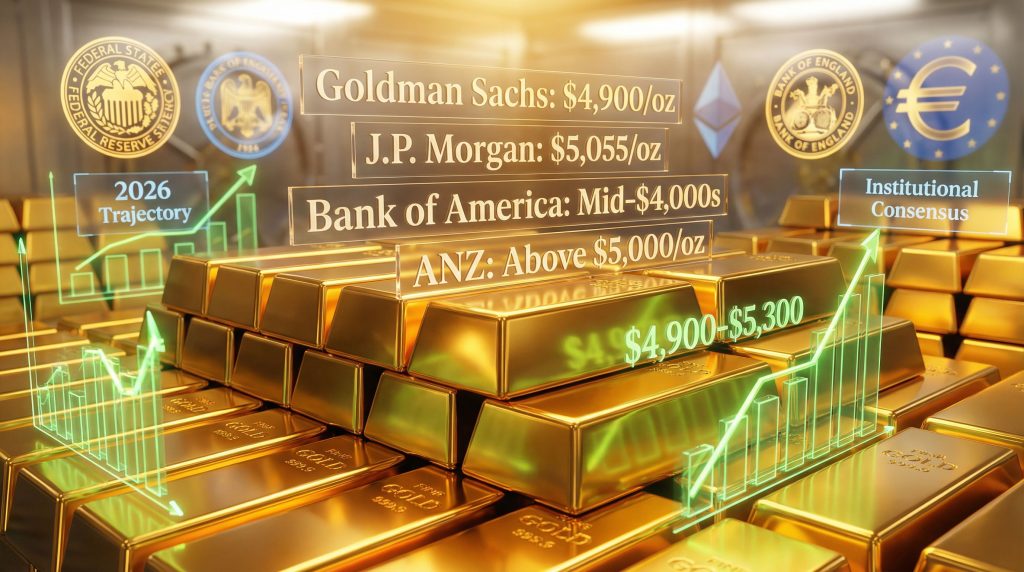
Major investment banking institutions have established remarkably similar gold price predictions for 2026, with forecasting ranges clustering between $4,900 and $5,300 per ounce. This convergence reflects shared analytical methodologies rather than coordinated positioning, suggesting institutional confidence in underlying structural drivers supporting precious metals valuations.
JPMorgan's commodity research division projects gold potentially reaching $5,000 per ounce by the December quarter of 2026, with extended scenarios indicating possible movement toward $6,000 per ounce if structural monetary trends persist. Goldman Sachs maintains similar positioning with base case expectations of approximately $4,900 per ounce by December 2026, reinforcing the institutional narrative around sustained upward pressure.
Furthermore, the methodological sophistication behind these gold price predictions incorporates multi-dimensional modeling approaches that evaluate:
- Central bank purchasing behaviour patterns
- Real interest rate trajectory calculations
- Currency debasement velocity measurements
- Geopolitical risk premium assessments
- Supply-demand equilibrium projections
Quantitative Framework Development
Investment banks construct gold price predictions using econometric models that weight various macro-economic inputs according to historical correlation strengths. Real interest rate frameworks represent particularly critical components, as negative real rates below -1.0% typically generate 150-300 basis points of additional upside in institutional gold price targets due to reduced opportunity costs of holding non-yielding assets.
Current real interest rate calculations based on 10-Year US Treasury yields (approximately 3.8-4.2%) adjusted for medium-term inflation expectations (2.1-2.5%) produce real rates in the 1.3-2.1% range. While moderately restrictive, institutional models anticipate monetary accommodation pressures as fiscal sustainability concerns intensify throughout 2026.
When big ASX news breaks, our subscribers know first
Central Bank Gold Accumulation as Structural Market Architecture
Emerging market central banks have fundamentally altered gold market performance through sustained accumulation strategies that establish price-inelastic demand floors. Unlike consumer demand that responds to price movements, strategic reserve diversification continues regardless of prevailing gold valuations because underlying rationales remain independent of short-term price fluctuations.
Global official gold reserves currently exceed 51,183 tonnes as documented by World Gold Council holdings databases, with emerging market central banks controlling approximately 30-35% of total reserves, representing substantial growth from roughly 15% in 2000. This systematic reallocation reflects strategic positioning rather than tactical trading behaviour.
Central bank gold purchases maintained remarkable consistency with approximately 1,037 tonnes acquired during 2024, continuing a 15+ year consecutive net purchasing trend that creates persistent bid pressure regardless of market conditions. China's People's Bank exemplifies this pattern, expanding official reserves from approximately 600 tonnes (2000) to over 2,000 tonnes (2024-2025) while simultaneously reducing USD reserve concentrations.
Reserve Diversification Mechanics
The fundamental driver behind central bank gold accumulation stems from monetary system risk management rather than return maximisation. Traditional reserve assets concentrated in USD-denominated securities face currency devaluation risks as fiscal deficits require sustained Treasury issuance, creating monetary expansion pressures that erode purchasing power over extended periods.
Table: Central Bank Gold Accumulation Impact Factors
| Factor | Mechanism | Strategic Relevance |
|---|---|---|
| USD Reserve Concentration | Currency risk exposure | Still represents 50-55% of global reserves |
| Monetary System Fragmentation | De-dollarisation initiatives | Creates multi-decadal structural support |
| Geopolitical Risk Management | Non-counterparty asset demand | Ongoing tensions drive diversification |
| Fiscal Sustainability Concerns | Alternative store of value | Persistent deficit spending pressures |
In addition, current emerging market central bank accumulation patterns suggest continued annual purchases of approximately 70-100 tonnes, establishing a fundamental demand floor that supports institutional gold price predictions regardless of cyclical market variations.
Monetary Policy Transmission Effects on Precious Metals Valuations
The relationship between monetary policy settings and gold valuations operates through opportunity cost calculations that influence institutional capital allocation decisions. When real returns on government securities become insufficient to compensate for inflation and currency debasement risks, capital systematically rotates toward assets that preserve purchasing power rather than generate nominal yield.
Central bank policy frameworks face inherent contradictions between inflation management mandates and debt sustainability requirements. Aggressive interest rate increases to combat inflation escalate sovereign debt service costs unsustainably, particularly for governments maintaining high debt-to-GDP ratios. This constraint prevents normal monetary policy normalisation, keeping real rates suppressed and enhancing gold's relative attractiveness.
Currency Debasement Quantification
Fiscal deficits financed through central bank monetary expansion increase money supply growth beyond real economic growth rates, systematically eroding currency purchasing power. Gold price predictions incorporate this debasement mechanism as investors demand additional currency units to purchase equivalent quantities of the precious metal.
Current US Federal deficit projections approximate 6.8% of GDP for FY 2025 according to Office of Management and Budget estimates, requiring sustained Treasury issuance that creates monetary expansion pressures. Historical analysis indicates periods with persistent deficits exceeding 4% of GDP typically coincide with sustained gold outperformance relative to financial assets.
Transmission Mechanism Analysis:
- Accommodative policy maintenance to support debt serviceability
- Real interest rate compression toward negative territory
- Opportunity cost reduction for non-yielding gold holdings
- Institutional demand acceleration through portfolio reallocation
- Systematic upward price pressure across precious metals complex
Historical Precedent Analysis for Current Gold Price Predictions
The 1970s monetary system transition provides the most relevant historical framework for understanding contemporary gold price dynamics. When President Nixon announced the suspension of dollar convertibility into gold in August 1971, the action reflected structural insolvency where paper currency claims exceeded physical gold backing capacity.
US gold reserves of approximately 8,100 tonnes in 1971 could not sustain global redemption obligations as dollar holdings had expanded far beyond available metal backing. This recognition triggered simultaneous capital flight from dollar-denominated assets and demand surge for physical gold, creating confidence collapse conditions that drove gold prices from the official $35 per ounce peg to $850 by January 1980.
The 2,328% appreciation over nine years represented an annual compound growth rate exceeding 40% during peak accumulation periods, demonstrating gold's repricing potential during monetary system transitions. For instance, this historic historic price surge provides valuable insights into current market conditions.
Post-2000 Quantitative Easing Response Patterns
Following the dot-com collapse and September 11 attacks, Federal Reserve policy responses created similar monetary expansion dynamics. Gold prices appreciated from approximately $250-$280 per ounce (2000) to peaks near $1,920 per ounce (September 2011), representing 125% appreciation during the most intensive quantitative easing phases.
The Federal Reserve balance sheet expansion from roughly $900 billion (2007) to $4.5 trillion (2015) coincided with US Money Supply (M2) increases from approximately $7.6 trillion (2008) to $13+ trillion (2015), representing 70%+ monetary base expansion that supported sustained gold price appreciation.
Contemporary Parallel Recognition
Current conditions exhibit structural similarities to both historical episodes:
- Fiat currency systems lack physical commodity backing (analogous to 1971 conditions)
- Fiscal deficits and monetary expansion exceed economic growth (similar mechanism)
- Reserve currency status faces systematic challenges (structural parallel)
- Real interest rates remain suppressed (policy constraint recognition)
Technical Price Target Analysis and Institutional Confidence Levels
Investment bank gold price predictions for 2026 demonstrate remarkable clustering around specific valuation ranges that reflect sophisticated analytical confidence rather than speculative positioning. The convergence between $4,900-$5,300 per ounce suggests institutional models identify similar structural support mechanisms across different analytical frameworks.
Institutional Forecast Compilation:
- JPMorgan: $5,000/oz by Q4 2026, with $6,000/oz extended scenario
- Goldman Sachs: $4,900/oz base case by December 2026
- Industry consensus range: $4,900-$5,300/oz clustering
- Upside scenarios: Potential $5,400/oz under stress conditions
- Extended timeline projections: Multi-year appreciation cycles anticipated
From current spot price ranges around $4,605-$4,639 per ounce, institutional targets imply potential appreciation of 6-15% based on consensus forecasting. However, substantially larger gains remain possible under geopolitical stress or monetary accommodation scenarios, particularly given record-high gold prices already observed in recent periods.
Risk-Adjusted Scenario Modelling
Institutional gold price predictions incorporate multiple scenario pathways that account for varying macro-economic developments. Base case scenarios assume continuation of current fiscal and monetary policy trends, while upside modelling incorporates escalation factors including:
- Geopolitical tension intensification creating safe haven demand surges
- Monetary policy becoming more accommodative than currently anticipated
- Fiscal sustainability concerns accelerating currency debasement
- Central bank accumulation acceleration beyond current pace expectations
Downside risk factors that could impact gold price predictions include stronger-than-expected US dollar performance, successful fiscal consolidation reducing debasement concerns, resolution of major geopolitical tensions, or demand destruction at elevated price levels.
What Investment Strategies Are Institutional Banks Recommending?
The convergence of major financial institution gold price predictions around similar valuation ranges creates investment framework implications that extend beyond specific price targets. Institutional confidence in sustained precious metals appreciation reflects broader portfolio construction considerations during periods of monetary system uncertainty.
Portfolio Allocation Strategy Considerations
Gold's portfolio role evolves from tactical positioning to strategic allocation when institutional forecasts align with historical precedents of monetary system stress. The clustering of bank predictions around $4,900-$5,300 per ounce reduces forecast risk compared to single-source projections while providing both capital preservation and appreciation potential.
Strategic Allocation Framework:
- Wealth preservation function during currency instability periods
- Inflation hedge characteristics against persistent price pressures
- Portfolio diversification benefits through non-correlated asset exposure
- Systematic risk mitigation during financial system stress
- Long-term purchasing power maintenance across economic cycles
Timing and Entry Considerations
Current market positioning relative to institutional gold price predictions suggests tactical entry opportunities exist within strategic allocation frameworks. The differential between present spot prices and year-end institutional targets provides measurable upside potential, whilst extended scenario modelling indicates multi-year appreciation cycles.
Entry Strategy Analysis:
- Dollar-cost averaging approaches to reduce timing risk during accumulation
- Position sizing based on portfolio percentage rather than absolute amounts
- Rebalancing triggers tied to institutional forecast ranges
- Extended timeline perspective aligning with structural trend recognition
- Risk management protocols incorporating scenario-based position adjustments
The next major ASX story will hit our subscribers first
How Do Central Banks View Gold Investment Strategies for 2025-2026?
The institutional focus on gold price predictions reflects recognition of structural monetary system changes that extend far beyond short-term price movements. Major financial institutions identify persistent trends including fiscal sustainability concerns, monetary policy constraints, and geopolitical fragmentation that support sustained precious metals demand regardless of specific valuation targets.
Consequently, central banks continue to implement sophisticated gold investment strategies that acknowledge these macro-economic realities whilst positioning for extended appreciation cycles.
Structural Trend Assessment Beyond 2026
Investment bank analytical frameworks suggest gold price appreciation represents systematic repricing rather than cyclical commodity price movements. The underlying drivers supporting institutional predictions operate across multi-year timeframes where traditional monetary arrangements face increasing stress from:
- Persistent fiscal imbalances requiring sustained monetary accommodation
- Currency debasement acceleration through continued money supply expansion
- Geopolitical system fragmentation reducing confidence in reserve currency stability
- Central bank behaviour changes prioritising alternative reserve asset accumulation
- Inflation persistence maintaining negative real interest rate environments
Furthermore, recent economic forecasting suggests these trends will continue influencing precious metals markets well beyond current prediction horizons.
Investment Paradigm Evolution
Major banks' gold price predictions indicate fundamental shifts in institutional thinking about portfolio construction methodologies during periods of monetary uncertainty. Traditional asset allocation models require adaptation when currency systems face structural pressures that historical precedent suggests resolve through precious metals repricing events.
The convergence of institutional gold forecasting around similar analytical frameworks and price ranges suggests broad recognition of monetary system transition dynamics. These conditions historically create extended appreciation cycles for alternative stores of value that preserve purchasing power when confidence in traditional monetary arrangements deteriorates.
Investment Framework Evolution Indicators:
- Institutional allocation increases toward precious metals exposure
- Central bank behaviour normalisation around gold accumulation strategies
- Portfolio theory adaptation incorporating monetary system risk factors
- Risk management protocol updates reflecting currency debasement scenarios
- Long-term wealth preservation strategies emphasising non-counterparty assets
What Does the Gold Price Forecast Look Like for Extended Scenarios?
Understanding institutional gold price predictions within broader macro-economic transition contexts provides investment framework guidance that extends beyond specific valuation targets toward strategic portfolio positioning during periods of systemic monetary evolution. The gold price forecast for extended scenarios suggests multi-year appreciation cycles driven by structural monetary system changes.
Moreover, institutional models increasingly incorporate scenario planning that recognises the potential for sustained precious metals appreciation extending well beyond 2026 timeframes, reflecting fundamental shifts in global monetary architecture rather than temporary market dislocations.
Ready to Capitalise on the Next Major Gold Discovery?
Discovery Alert instantly identifies significant ASX mineral discoveries using its proprietary Discovery IQ model, transforming complex mining data into actionable investment insights for traders seeking exposure to gold and precious metals exploration companies. Begin your 30-day free trial today and gain immediate access to real-time discovery alerts that could position you ahead of institutional investors in Australia's dynamic precious metals sector.