
June 12, 2026
Understanding the Global Forces Driving Modern Precious Metals Markets
Modern economies operate within interconnected frameworks where traditional asset relationships face unprecedented disruption. The convergence of monetary policy experimentation, geopolitical realignments, and structural supply constraints has created conditions reminiscent of historical periods when hard assets experienced profound revaluation cycles. These macro forces extend beyond typical market cycles, representing fundamental shifts in how institutions, governments, and investors approach portfolio construction and wealth preservation strategies.
The current precious metals environment reflects these broader systemic pressures. When examining gold price prediction 2026 scenarios, analysis must account for supply-demand imbalances that have developed over decades, not quarters. Mining operations face geological constraints that prevent rapid production increases, while demand sources have diversified beyond traditional patterns. Understanding these dynamics provides insight into why conventional forecasting models struggle to capture the magnitude of price movements during periods of monetary and political instability.
The Structural Foundation of Supply-Demand Imbalances
Global gold mine production operates under geological and economic constraints that limit rapid supply responses to price signals. Annual production growth typically ranges between 1-2%, reflecting the capital-intensive nature of mining operations and the time required to develop new deposits. This growth rate has remained relatively consistent even during periods of significant price appreciation, highlighting the inelastic nature of gold supply.
The development timeline for new mining projects presents a critical bottleneck in supply responsiveness. Major gold deposits require 8-15 years from initial exploration to commercial production, with some projects extending beyond two decades due to permitting, environmental assessments, and infrastructure development. This extended timeline means that current production capacity reflects investment decisions made when gold prices were substantially lower than today's levels.
Mining companies face additional constraints beyond time lags. Ore grades at existing mines continue declining, requiring processing of larger volumes of material to maintain output levels. The average gold grade at major mining operations has decreased by approximately 30-40% over the past two decades, increasing extraction costs and environmental impact per ounce produced. These factors compound supply constraints even when companies attempt to increase production at existing facilities.
Infrastructure limitations further restrict rapid production scaling. Many mining regions lack adequate power generation, transportation networks, and processing facilities to support expanded operations. The capital requirements for developing this infrastructure often exceed individual project budgets, requiring regional coordination and multi-year construction timelines that delay supply responses to market signals.
Why Traditional Forecasting Models Are Failing
Conventional precious metals forecasting relies heavily on technical analysis and historical price correlations that may not capture current market dynamics. Bank research departments typically focus on short-term price movements driven by currency fluctuations, interest rate expectations, and momentum indicators. These models assume market behaviour patterns established during periods of relative monetary stability and conventional central bank policies.
The limitations of correlation-based forecasting become apparent during periods of structural change. When fundamental relationships between assets break down, historical correlations lose predictive power. The traditional inverse relationship between gold prices and real interest rates, while generally valid, fails to account for scenarios where investors question the sustainability of government bond markets themselves.
Geopolitical factors increasingly drive precious metals demand in ways that technical models cannot quantify. The weaponisation of currency reserves, sanctions implementation, and trade relationship deterioration create demand impulses that operate independently of traditional financial metrics. These factors influence central bank purchasing decisions and institutional allocation strategies in ways that purely technical analysis cannot capture.
Current forecasting challenges also stem from the unprecedented nature of global monetary policies. Quantitative easing programmes, negative interest rates, and direct government bond purchases by central banks have created market conditions without historical precedent. Models calibrated to previous decades may underestimate the impact of these policies on precious metals demand, particularly during periods when their effectiveness comes into question.
When big ASX news breaks, our subscribers know first
How Institutional Policies Are Transforming Precious Metals Demand
The most significant shift in precious metals markets involves central bank purchasing patterns that began approximately fifteen years ago. After decades of being net sellers during the 1980s and 1990s, central banks became consistent net buyers starting around 2010. This transition reflected changing perspectives on reserve diversification and the role of gold in monetary systems.
The Acceleration of Official Sector Buying
Central bank gold purchases averaged approximately 500 tons annually during the decade following 2010, representing a substantial shift from previous selling patterns. However, starting in 2022, these purchases more than doubled to exceed 1,000 tons per year, marking the highest levels of official sector buying since the formation of modern central banking systems.
Regional Distribution of Central Bank Gold Purchases (2020-2025)
| Region | 2020-2021 Average | 2022-2025 Average | Growth Rate |
|---|---|---|---|
| Asia-Pacific | 180 tons | 420 tons | +133% |
| Emerging Markets | 150 tons | 380 tons | +153% |
| Developed Markets | 80 tons | 140 tons | +75% |
The catalyst for accelerated purchasing became clear following the February 2022 sanctions imposed on Russian foreign currency reserves. Western governments froze significant portions of Russia's reserves held in U.S. dollars and euros, demonstrating how foreign currency assets could become inaccessible during geopolitical conflicts. This action sent a clear message to central banks worldwide about the potential risks of holding reserves in assets subject to foreign jurisdiction.
Reserve Diversification as Strategic Policy
Central banks increasingly recognise that reserves held in other nations' currencies carry counterparty risks that gold does not. Traditional reserve assets like U.S. Treasury bonds, while highly liquid, remain subject to the policies and potential sanctions of the issuing government. Gold provides a reserve asset with no counterparty risk, making it attractive for institutions seeking true asset diversification.
The concept of reserve adequacy has evolved beyond simple import coverage or debt service ratios. Modern central banks consider geopolitical stability, currency volatility, and potential sanctions exposure when determining optimal reserve composition. Gold's characteristics as a non-yielding but politically neutral asset become more valuable as global tensions increase and monetary policies create uncertainty about bond market stability.
Regional variations in diversification strategies reflect different geopolitical positions and economic relationships. Emerging market central banks tend to increase gold allocations more aggressively than developed market institutions, partly due to their desire to reduce dependence on major reserve currencies and partly due to domestic political considerations that favour tangible assets.
Quantifying Monetary Policy Transmission Effects
The relationship between interest rates and gold prices operates through real yield calculations that account for inflation expectations. When nominal interest rates fail to keep pace with inflation, real yields turn negative, reducing the opportunity cost of holding non-yielding assets like gold. Current monetary policy frameworks in major economies create conditions where maintaining positive real yields becomes politically and economically difficult.
Central bank policies that explicitly target higher inflation rates while maintaining low nominal interest rates create structural conditions favourable to precious metals. The Federal Reserve's shift to "average inflation targeting" and similar policies by other major central banks suggest that periods of negative real yields may become more frequent and persistent than in previous decades.
Currency debasement concerns drive institutional allocation toward hard assets when money supply growth significantly exceeds economic output. Furthermore, modern monetary policy tools allow central banks to expand money supplies rapidly, while gold supply remains constrained by physical and economic factors. This divergence creates long-term trends that favour precious metals regardless of short-term price volatility.
What Investment Flows Reveal About Market Psychology
Exchange-traded fund flows provide insight into investor sentiment and institutional allocation decisions that traditional market indicators may not capture. ETF creation and redemption patterns reflect both tactical positioning and strategic asset allocation shifts among professional investors and institutional portfolio managers.
Crisis-Level Demand Indicators
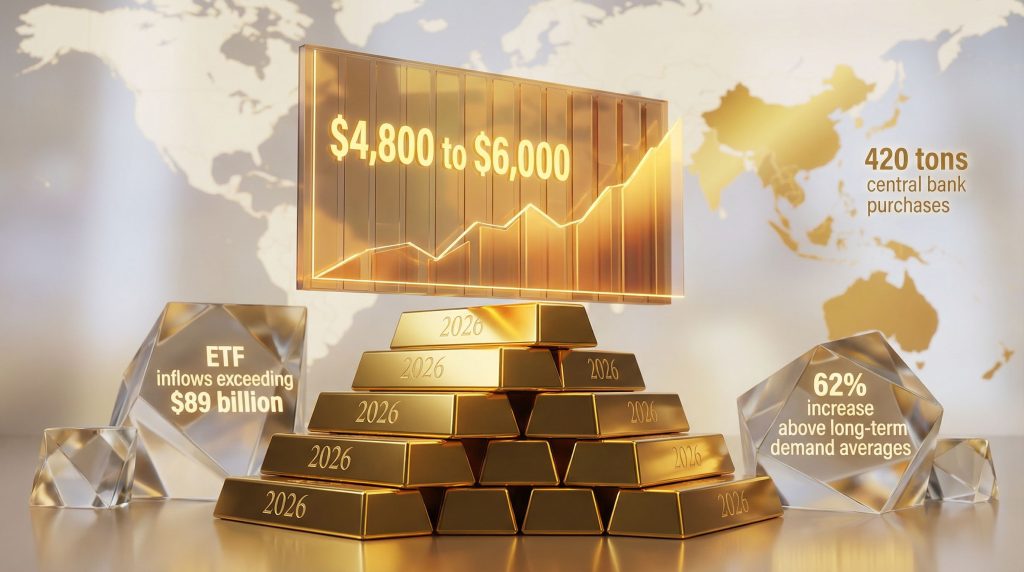
ETF inflows during 2025 reached levels comparable to the 2008 financial crisis and 2020 pandemic, with total inflows exceeding $89 billion. This represents a 62% increase above long-term demand averages, signalling institutional recognition of systemic risks that may not be apparent in other financial markets. The magnitude of these flows suggests professional investors are positioning for scenarios beyond normal economic cycles.
The composition of ETF flows reveals important distinctions between different types of institutional demand. Physical gold ETFs that hold actual bullion experienced the largest inflows, while gold mining equity ETFs saw more modest increases. This pattern suggests investors specifically seek exposure to the metal itself rather than companies that produce it, indicating concerns about operational risks or preferences for direct commodity exposure.
Timing patterns within ETF flows also provide psychological insights. Rather than gradual accumulation over extended periods, flows often spike during specific events or announcements, suggesting that institutional investors respond to catalysts rather than implementing predetermined allocation strategies. This behaviour indicates that much institutional demand remains reactive rather than proactive.
Physical Precious Metals Accumulation Patterns
Retail investor behaviour in physical precious metals markets differs significantly from institutional ETF flows. Physical purchases tend to be more consistent over time, less sensitive to short-term price movements, and driven by different motivations than professional investment strategies. These purchases often reflect wealth preservation concerns rather than tactical investment positioning.
Supply chain concerns increasingly influence physical precious metals demand as retail investors seek assets they can store directly rather than depending on financial institutions or custody arrangements. This trend accelerated during periods of banking instability and reflects broader concerns about counterparty risks in financial systems.
Wealth preservation strategies in high-inflation environments favour physical assets that maintain purchasing power independently of currency stability. Retail investors often view precious metals purchases as insurance against monetary policy mistakes rather than speculative investments, creating demand patterns that persist even during periods of price volatility.
Institutional Portfolio Allocation Trends
Sovereign wealth funds have increased precious metals allocations as part of broader diversification strategies that reduce dependence on traditional financial markets. These institutions manage multi-generational timeframes and seek assets that preserve purchasing power across economic cycles and political changes. Their allocation decisions influence market dynamics due to the scale of assets under management.
Pension fund diversification into alternatives includes increasing allocations to precious metals, both directly and through specialised investment vehicles. These institutions face long-term liability obligations that require protection against inflation and currency debasement, making hard assets strategically attractive regardless of short-term performance considerations.
Family office allocation strategies reflect concerns about preserving wealth across generations and political systems. These institutions increasingly view precious metals as portfolio stabilisers that provide protection against systemic risks that could affect traditional financial assets. Their allocation decisions often influence broader institutional trends due to their relationships with other high-net-worth investors.
Historical Patterns and Future Price Trajectory Analysis
Examining precious metals cycles through historical frameworks provides context for understanding current market dynamics and potential future developments. The 1970s bull market remains the most relevant comparison for current conditions due to similar combinations of monetary policy experimentation, geopolitical tensions, and inflation concerns.
Comparing Current Dynamics to Historical Precedent
Bull Market Comparison Analysis
| Metric | 1970s Cycle | Current Cycle (2019-2026) |
|---|---|---|
| Peak Annual Gain | 120% (1979) | 68% (2025) |
| Duration to Peak | 9 years | 7 years (projected) |
| Inflation Environment | 14.8% peak CPI | 9.1% peak CPI |
| Real Yield Trough | -8.2% | -6.8% |
The 1970s cycle demonstrated how precious metals prices can accelerate dramatically during the final phases of bull markets. Gold experienced its largest annual gains not at the beginning of the cycle but during its concluding phases, when monetary policy credibility came into question and alternative assets gained widespread institutional acceptance. Understanding this historic price surge explanation helps contextualise current market movements.
Current cycle characteristics suggest similar dynamics may be developing. The duration of the current bull market, inflation levels, and real yield environment all align with patterns observed during the 1970s, though the magnitude of moves remains more modest to date. This comparison suggests that the most significant price appreciation may occur during later phases rather than early stages of the cycle.
Mathematical Models for Exponential Price Progression
Logarithmic price progression models provide frameworks for understanding how precious metals prices behave during extended bull markets. Linear projections typically underestimate the magnitude of moves during periods when monetary systems face fundamental challenges, while exponential models better capture the acceleration that occurs when institutional demand exceeds available supply.
Fibonacci retracement levels in precious metals cycles often correspond to significant psychological resistance and support levels that influence investor behaviour. These technical levels gain importance during bull markets because they provide reference points for institutional traders and momentum-based allocation strategies.
Mathematical analysis suggests that when supply constraints combine with institutional demand acceleration, price movements tend to follow exponential rather than linear patterns. In addition, this occurs because each price level increase attracts additional institutional attention, creating feedback loops that amplify underlying supply-demand imbalances.
The Role of Silver as a Leading Indicator
Silver markets often provide advance signals about precious metals cycle development due to the metal's smaller market size and industrial demand characteristics. During the 1970s cycle, silver outperformed gold significantly, rising over 400% during its peak year, compared to gold's 120% maximum annual gain.
Industrial demand factors can amplify precious metals cycles when investment demand combines with supply constraints in manufacturing applications. Silver's dual role as both a monetary metal and industrial commodity creates additional demand pressure during periods when both investment and manufacturing demand increase simultaneously.
Supply deficit conditions in silver markets may indicate broader precious metals sector dynamics that eventually affect gold prices. Silver's smaller market size means that supply-demand imbalances create price volatility that can precede similar dynamics in larger gold markets, making silver prices valuable indicators for precious metals cycle timing.
Economic Scenarios That Could Drive Extreme Price Movements
Multiple economic pathways could create conditions supporting gold price prediction 2026 scenarios that exceed conventional forecasts. These scenarios involve combinations of fiscal, monetary, and geopolitical factors that have precedent in economic history but would represent significant departures from current policy frameworks.
Debt Crisis Escalation Pathways
Sovereign debt sustainability faces challenges when debt service costs consume increasing portions of government budgets, particularly if interest rates rise faster than economic growth rates. Major economies currently maintain debt-to-GDP ratios that exceed levels historically associated with financial stability, creating vulnerability to interest rate increases or economic growth slowdowns.
Currency crisis contagion effects could develop if investors lose confidence in major reserve currencies simultaneously rather than sequentially. This scenario would differ from previous currency crises that typically affected individual countries or regions, potentially creating global demand for assets that exist outside traditional monetary systems.
Financial repression policies represent potential government responses to debt sustainability challenges. These policies typically involve maintaining interest rates below inflation rates while using regulatory pressure to ensure captive demand for government bonds. Such policies historically drive investor demand toward assets that provide protection against purchasing power erosion.
Geopolitical Risk Premium Calculations
Conflict zones and international tensions create safe-haven demand that extends beyond directly affected regions. Modern economic interconnectedness means that regional conflicts can disrupt global supply chains, energy markets, and financial systems, creating widespread demand for politically neutral assets.
Trade war escalation affects reserve asset preferences as countries seek to reduce dependence on currencies and financial systems of potential economic adversaries. This dynamic extends beyond bilateral trade disputes to encompass technology competition, resource access, and financial system integration.
Technology competition effects on monetary systems include developments in digital currencies, payment systems, and financial infrastructure that could alter traditional currency relationships. These changes may increase demand for assets that maintain value independently of specific technological or political systems.
Inflation Resurgence and Policy Response Scenarios
When real interest rates turn deeply negative, gold becomes one of the few assets that maintains purchasing power while providing portfolio insurance against systemic risks that could affect traditional financial markets and currency stability.
Inflation resurgence scenarios involve conditions where price increases exceed central bank target ranges persistently rather than temporarily. This could occur due to supply chain disruptions, energy price increases, or wage-price spiral dynamics that prove difficult to control through monetary policy alone.
Central bank policy responses to persistent inflation face political and economic constraints that may limit their effectiveness. Raising interest rates sufficiently to control inflation could create debt service problems for governments, businesses, and consumers, forcing central banks to choose between price stability and financial system stability.
Alternative asset allocation strategies may emerge if traditional bonds fail to provide real returns during inflationary periods. This could create structural shifts in institutional portfolio construction that favour hard assets over financial assets as core holdings rather than portfolio diversifiers.
Key Risks to Bullish Precious Metals Scenarios
Several factors could limit or reverse precious metals price appreciation, creating conditions where gold price prediction 2026 scenarios fail to materialise. Understanding these risks provides perspective on the range of potential outcomes and helps investors develop appropriate risk management strategies.
Dollar Strength Scenarios
Federal Reserve policy normalisation could create conditions where U.S. dollar strength limits precious metals appreciation. If the Fed successfully reduces inflation while maintaining economic growth, dollar-denominated assets could regain attractiveness relative to non-yielding alternatives like gold.
U.S. economic exceptionalism relative to other major economies could maintain dollar demand even during periods of monetary policy uncertainty. Strong U.S. economic performance compared to Europe, Asia, or emerging markets would support dollar strength and potentially pressure precious metals prices.
International capital flow reversals could occur if global investors perceive better risk-adjusted returns in U.S. financial markets than in alternative assets. This could happen if geopolitical tensions decrease or if other economies face more severe challenges than the United States.
Supply Response Mechanisms and Timing
Recycling market activation at higher price levels could increase available supply without requiring new mine production. Historical data shows that scrap gold supply increases significantly when prices reach levels that make recycling economically attractive for consumers and small holders.
Technology improvements in extraction efficiency may allow existing mines to increase production or access previously uneconomic ore bodies. Advances in processing technology, energy efficiency, or environmental management could reduce production costs and increase supply responsiveness to price signals.
Previously uneconomic gold deposits could become viable at higher price levels, potentially increasing supply over multi-year timeframes. Many known deposits remain undeveloped due to cost considerations that could change if prices rise sufficiently to justify development investments.
Alternative Asset Competition
Digital asset adoption in institutional portfolios could compete with precious metals for safe-haven allocation. If digital assets gain acceptance as portfolio diversifiers or inflation hedges, they could reduce institutional demand for traditional hard assets.
Real estate market dynamics during inflationary periods often favour property investments over precious metals among retail investors. Real estate provides both inflation protection and income generation, potentially making it more attractive than non-yielding assets like gold.
Commodity diversification strategies might spread institutional demand across multiple hard assets rather than concentrating in precious metals. This could limit price appreciation in gold and silver while supporting broader commodity complex performance.
The next major ASX story will hit our subscribers first
Investment Positioning Strategies for Various Market Scenarios
Developing appropriate precious metals exposure requires consideration of individual risk tolerance, investment timeline, and portfolio objectives. Different investor profiles benefit from distinct allocation approaches and implementation strategies based on their specific circumstances and market outlook.
Portfolio Allocation Framework by Risk Profile
Suggested Gold Allocation by Investor Type
| Investor Profile | Conservative | Moderate | Aggressive |
|---|---|---|---|
| Portfolio % | 5-10% | 10-20% | 20-35% |
| Physical vs. Paper | 70/30 | 60/40 | 50/50 |
| Dollar-Cost Average | Monthly | Quarterly | Opportunistic |
Conservative investors typically benefit from modest allocations that provide portfolio insurance without creating excessive volatility. These investors often prefer physical precious metals or physically-backed ETFs that minimise counterparty risks while providing liquidity for rebalancing purposes.
Moderate risk investors can accommodate larger allocations and may benefit from combining physical holdings with paper investments to optimise liquidity and storage costs. These investors often use systematic accumulation strategies that reduce timing risk while building positions over extended periods.
Aggressive investors may justify substantial precious metals allocations based on their assessment of systemic risks and potential returns. These investors often use opportunistic timing strategies and may include mining equities or options strategies to enhance potential returns from precious metals exposure.
Physical Versus Paper Gold Considerations
Storage and insurance costs for physical precious metals vary significantly based on quantity, location, and security requirements. Home storage may be appropriate for small quantities but becomes impractical and risky for substantial holdings. Professional storage facilities offer security and insurance but involve ongoing costs that affect net returns.
Liquidity differences during market stress periods favour different approaches depending on individual circumstances. Physical precious metals provide ultimate liquidity independence but require time and effort to convert to cash. ETFs offer instant liquidity but depend on financial system functionality and market maker operations.
Counterparty risk assessment involves evaluating the reliability of institutions involved in paper precious metals investments. Furthermore, physically-backed ETFs depend on custodian reliability and regulatory protection, while mining companies face operational and financial risks that affect their ability to provide precious metals exposure.
Market Entry Timing and Position Management
Technical indicators for accumulation phases include momentum measurements, volume analysis, and trend identification tools that help investors time their entry and exit decisions. However, these tools work better for trading strategies than long-term accumulation approaches focused on portfolio protection.
Seasonal patterns in precious metals markets reflect supply and demand factors that create predictable price tendencies during specific periods. These patterns may provide timing guidance but should not override fundamental analysis or long-term strategic considerations.
Volatility-based position sizing approaches adjust investment amounts based on market conditions and price stability. Higher volatility periods may favour smaller position sizes or more systematic accumulation strategies, while stable periods might support larger position increases.
Institutional Perspectives and Market Outlook
Major financial institutions are increasingly recognising the structural changes driving precious metals demand. JPMorgan's research on commodities highlights how central bank buying patterns and monetary policy frameworks create conditions supportive of higher gold prices.
The gold market performance through 2025 demonstrates institutional demand acceleration that exceeds traditional seasonal patterns. This performance reflects broader recognition that current economic conditions favour hard assets over traditional financial investments.
Analysts examining the record-high gold prices increasingly view precious metals as essential portfolio components rather than speculative assets. This shift in institutional perspective supports sustained demand that operates independently of short-term trading patterns.
Understanding the relationship between different asset classes becomes crucial during periods of market volatility. For instance, the gold-stock market guide demonstrates how precious metals provide portfolio protection during equity market stress periods.
Recent market developments suggest that professional investors are positioning for scenarios that extend beyond normal economic cycles. Goldman Sachs forecasts indicate potential for significant price appreciation based on supply-demand fundamentals rather than speculative momentum.
Frequently Asked Questions About Gold Price Predictions
What Price Targets Are Most Realistic for 2026?
Based on supply-demand fundamentals and historical precedent, institutional forecasts for gold price prediction 2026 range from $4,800 to $6,000 per ounce. Some analytical models suggest potential for $8,700-$9,000 if current bull market dynamics accelerate similar to 1970s cycle patterns, though these higher targets depend on specific economic and political developments that remain uncertain.
Conservative estimates focus on continuation of current central bank buying patterns and gradual institutional allocation increases. More aggressive projections incorporate scenarios involving currency crisis, debt sustainability concerns, or significant geopolitical disruptions that could accelerate institutional demand beyond current trends. The gold price forecast through 2025 provides baseline expectations for continued appreciation.
How Reliable Are Bank Forecasts for Precious Metals?
Traditional bank forecasts often underestimate precious metals bull markets because they focus on technical factors rather than fundamental supply-demand imbalances and monetary policy transmission effects. Bank research departments typically use models calibrated to previous decades that may not capture the magnitude of current structural changes.
Historical analysis shows that major financial institutions consistently underestimated price movements during the 1970s precious metals cycle and other periods of monetary system stress. Their forecasts tend to be more accurate during stable economic periods but lose predictive power when fundamental relationships change.
Should Investors Wait for a Pullback Before Buying?
Historical data suggests that attempting to time precious metals markets during bull phases often results in missing significant portions of the overall trend. Corrections during bull markets tend to be brief and shallow relative to overall price appreciation, making systematic accumulation strategies more effective than tactical timing approaches.
Market timing strategies work better in range-bound or bear market conditions than during trending bull markets. Investors focused on portfolio protection rather than speculation typically benefit more from consistent accumulation than from waiting for optimal entry points that may not materialise.
What Would End the Current Gold Bull Market?
A sustained period of positive real interest rates combined with resolution of major geopolitical tensions and central bank policy normalisation would be required to end the structural bull market. None of these conditions appear likely in the current macro environment, though unexpected economic or political developments could alter this assessment.
Additional factors that could pressure precious metals include significant technological breakthroughs in mining or recycling, major central bank gold sales, or alternative asset development that provides superior inflation protection and portfolio diversification characteristics.
Disclaimer: This analysis is for educational purposes only and should not be considered personal investment advice. Precious metals investments involve risks including price volatility, storage costs, and liquidity considerations. Past performance does not guarantee future results. Investors should conduct their own research and consult with qualified financial professionals before making investment decisions. The scenarios and price targets discussed represent analytical possibilities rather than predictions, and actual outcomes may differ significantly from any projections presented.
Ready to Capitalise on the Next Major Mineral Discovery?
Discovery Alert instantly alerts investors to significant ASX mineral discoveries using its proprietary Discovery IQ model, transforming complex mining data into actionable insights within minutes of market announcements. Begin your 30-day free trial today to position yourself ahead of the broader market and access the same opportunities that have historically driven substantial returns for early investors.