
July 27, 2026
Understanding Gold Price Volatility in Modern Geopolitical Contexts
Financial markets operate under complex interconnected systems where traditional investment theories face unprecedented challenges. The relationship between warfare and precious metal valuations has evolved substantially beyond historical precedents, revealing how modern market structures respond to geopolitical shocks in ways that contradict established economic wisdom.
Contemporary commodity markets demonstrate intricate relationships where energy price movements create cascading effects through global economic systems. When military conflicts disrupt regional stability, the resulting market dynamics often produce counterintuitive outcomes that challenge investor assumptions about safe-haven asset behavior during crisis periods.
The interconnected nature of global financial systems means that geopolitical events trigger multiple simultaneous market reactions. Currency movements, monetary policy expectations, and commodity price fluctuations interact in ways that can overwhelm traditional risk management approaches, forcing investors to reassess fundamental assumptions about portfolio protection during uncertain times.
When big ASX news breaks, our subscribers know first
The Iran War's Revolutionary Impact on Precious Metal Markets
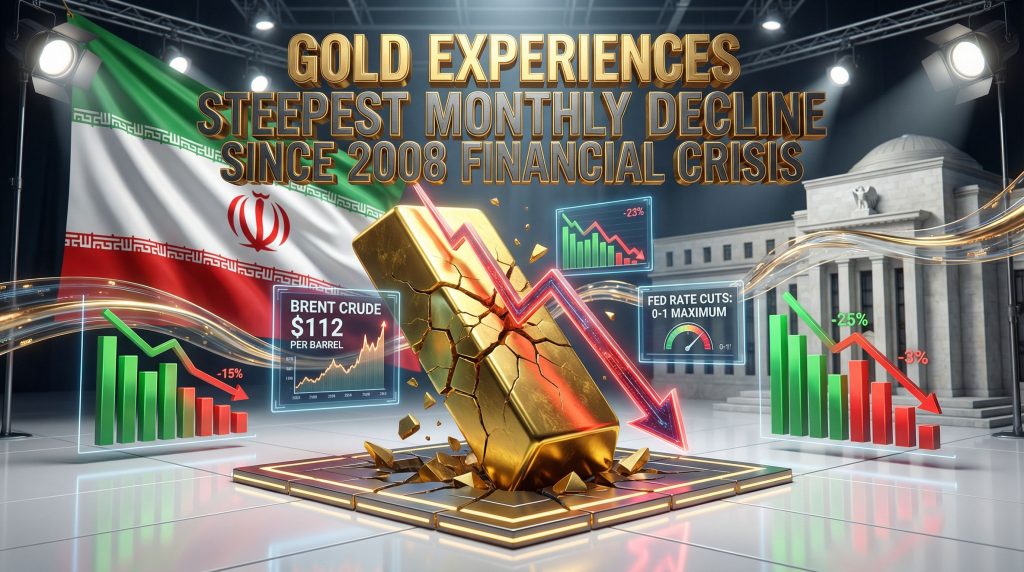
The February 2026 military engagement between the United States and Iran created unprecedented market conditions that fundamentally altered precious metal pricing dynamics. The gold price decline Iran war phenomenon demonstrated how traditional safe-haven theories could fail during modern conflicts. Gold experienced its steepest monthly decline since June 2013, falling more than 10% during March 2026 as traditional safe-haven demand mechanisms failed to materialise despite escalating military conflict.
This dramatic reversal represented a 25% decline from gold's all-time peak of $5,602 per ounce recorded in January 2026, effectively erasing months of gains within weeks. The metal closed March at $4,668.06 per ounce despite late-session recovery attempts when peace negotiations showed preliminary promise.
Silver markets experienced even more severe volatility, posting their worst monthly performance since 2011 with a 19% decline despite reaching historical highs of $121 per ounce just two months earlier. This parallel decline across precious metals revealed systematic market forces that transcended individual commodity fundamentals.
The Oil-Inflation Transmission Mechanism
The conflict's initial impact manifested through energy markets, where Brent crude surged past $112 per barrel, creating immediate inflationary pressures that rippled through global financial systems. This oil price surge triggered a fundamental recalculation of monetary policy expectations rather than driving traditional flight-to-safety behaviours.
Market participants rapidly recognised that energy-driven inflation would force central banks to maintain restrictive monetary policies longer than previously anticipated. This realisation shifted investment flows away from non-yielding precious metals toward interest-bearing alternatives that could provide real returns in a higher-rate environment.
Federal Reserve rate cut expectations collapsed from 3-4 anticipated reductions to potentially zero cuts during 2026, fundamentally altering the opportunity cost calculation for holding gold. When real interest rates rise due to higher nominal rates combined with persistent inflation expectations, precious metals lose their comparative appeal versus cash and bond alternatives.
Market Structure Amplification Effects
Modern precious metals markets feature unprecedented levels of financial engineering through derivatives, exchange-traded funds, and structured products. This complexity created vulnerability during liquidity crunches, as forced selling amplified price movements beyond what fundamental supply-demand dynamics would justify.
The March 2026 liquidation cascade demonstrated how leveraged positions accumulated during 2025's bull market became liability when margin calls emerged. Algorithmic trading systems accelerated downward momentum as technical support levels broke, triggering additional automated selling that overwhelmed any stabilising demand.
ETF redemption pressures added another layer of selling pressure because redemptions require actual gold delivery or cash settlement. This mechanism forced fund managers to liquidate physical holdings or futures positions even when they maintained long-term bullish outlooks, creating artificial supply pressures during the crisis period.
Why Traditional Safe-Haven Theories Failed During Military Conflict
The textbook assumption that geopolitical conflicts automatically trigger safe-haven asset appreciation requires substantial revision in contemporary financial markets. Traditional theory assumes investors prioritise capital preservation over return optimisation when military uncertainty emerges, yet the Iran conflict revealed more complex decision-making processes.
The Real Interest Rate Paradigm Shift
Precious metals investors traditionally focus on real interest rates (nominal yields minus inflation expectations) as the primary determinant of demand. When conflicts drive inflation fears, conventional wisdom suggests gold should rally as protection against currency debasement and economic uncertainty.
However, when central banks respond to inflation threats with tighter monetary policy expectations, real yields can actually rise despite higher inflation assumptions. This dynamic occurred during the Iran conflict when nominal rate expectations increased faster than inflation premium adjustments, making cash and bonds more attractive than non-yielding gold.
The monetary policy recalibration served as the critical transmission mechanism. Market participants recognised that Federal Reserve officials would prioritise inflation control over economic growth support, eliminating the accommodative policies that had supported precious metals during 2025.
Liquidity-Driven Investment Priorities
Expert analysis reveals that the conflict created conditions where institutional investors prioritised absolute liquidity generation over traditional risk-management protocols. When margin calls emerge and cash becomes scarce, even fundamentally sound assets get liquidated to meet immediate requirements.
This explains the apparent contradiction where central bank demand continued even as financial investors sold aggressively. Sovereign institutions maintained strategic accumulation programmes for long-term reserve diversification whilst private investors faced short-term liquidity constraints that forced position closures regardless of fundamental outlook.
The volatility amplification reached approximately double historical averages due to increased participation from financial investors rather than traditional commodity users. This shift in market participant composition created new transmission mechanisms for geopolitical shocks that overwhelmed conventional safe-haven demand patterns.
Structural Vulnerabilities in Modern Precious Metal Markets
Contemporary gold markets demonstrate critical vulnerabilities that emerge during crisis periods, revealing how financial engineering creates systematic risks that transcend individual investment decisions. The Iran conflict served as a natural stress test for these modern market structures.
Derivative Market Cascade Effects
Gold futures and options markets reached unprecedented scale by early 2026, with leveraged long positions estimated in billions of dollars based on regulatory filings and market data. When technical support levels broke during the conflict, these positions faced margin calls that triggered automatic liquidation sequences.
The forced unwinding process occurred with particular intensity during specific trading sessions when algorithmic systems recognised breach of predetermined risk parameters. This created cascading selling pressure that fed on itself, with each wave of liquidation triggering additional margin calls for remaining leveraged positions.
Cross-asset correlation increased dramatically during the stress period, as investors holding diversified portfolios found their hedging strategies failing simultaneously. Traditional portfolio theory assumes low correlation between asset classes, yet modern market structure creates interconnected vulnerabilities that emerge during crisis periods.
Exchange-Traded Fund Structural Pressures
ETF redemption mechanisms created additional systematic selling pressure beyond direct futures liquidation. When investors sought to exit precious metals positions through ETF sales, fund managers faced requirements to deliver underlying gold or cash equivalents to authorised participants.
This process forced physical gold liquidation or futures position closure even when fund managers maintained positive long-term outlooks. The mechanical nature of these transactions meant that redemption pressures continued regardless of fundamental value considerations or strategic investment perspectives.
The late-March rebound of 3.5% on peace signals suggested that forced liquidation had largely exhausted itself by month-end. This technical recovery pattern indicated that much of the selling pressure stemmed from systematic factors rather than fundamental reassessment of precious metals' long-term value proposition.
Institutional Portfolio Rebalancing Pressures
Large-scale institutional investors face systematic constraints during geopolitical crises that override traditional safe-haven demand calculations. Risk management protocols often require immediate liquidity generation, forcing sales of appreciating assets to maintain overall portfolio balance.
Pension funds and insurance companies operate under regulatory requirements that mandate specific asset allocation ranges. When equity markets decline and currency volatility increases, these institutions may need to reduce commodity exposure to maintain compliance with fiduciary obligations.
The opportunity cost calculation becomes particularly relevant when interest rates rise rapidly. Institutional investors managing hundreds of billions in assets must consider whether precious metals exposure justifies the foregone income from higher-yielding alternatives during periods of monetary policy uncertainty.
Central Bank Demand Versus Financial Market Dynamics
The Iran conflict created a fascinating divergence between sovereign institutional demand and private financial market behaviour, revealing different time horizons and strategic objectives that drive precious metals markets during crisis periods. Furthermore, geopolitical gold trends continued to influence central bank decision-making despite short-term volatility.
Emerging Market Reserve Diversification
Central bank gold purchases continued throughout the March 2026 decline, with emerging market institutions maintaining strategic accumulation programmes despite price volatility. These purchases represented approximately 70% of total official sector demand, demonstrating sustained appetite for gold as a reserve diversification tool.
Sovereign institutions view precious metals through multi-decade strategic frameworks rather than quarterly performance metrics that influence private investors. This creates a stabilising demand base that persists during short-term market dislocations, providing eventual price support once financial selling pressure exhausts itself.
Geopolitical hedging motives became more pronounced during the Iran conflict, as central banks recognised potential vulnerabilities in dollar-dominated reserve systems. Military conflicts involving major powers highlight the strategic importance of assets that exist outside traditional banking networks and currency systems.
Western Financial System Stress Testing
The Iran conflict served as an inadvertent stress test for Western financial market resilience, revealing how modern market structure responds to traditional geopolitical shocks. Gold's performance during this period provided valuable data about systematic vulnerabilities in crisis scenarios.
Dollar strength dynamics played a crucial role, as the US currency rallied on expectations of higher interest rates and relative economic stability compared to other regions. This dollar appreciation created direct headwinds for precious metals priced in US currency terms.
The bond market response demonstrated how investors prioritised yield generation over traditional safe-haven characteristics. When government bond yields rose sharply, the opportunity cost of holding non-yielding gold increased substantially, redirecting investment flows toward interest-bearing alternatives.
Regional Economic Implications for Resource-Dependent Economies
The gold price decline Iran war dynamic created immediate challenges for economies dependent on precious metal exports, revealing how geopolitical conflicts can paradoxically harm the very nations that should benefit from safe-haven demand during uncertainty. In addition, these effects contrasted sharply with record‑high gold prices witnessed earlier in the year.
Mining Sector Revenue Pressures
Gold-producing nations faced immediate revenue pressures as the 25% price decline from January peaks affected export earnings and fiscal planning. Mining companies operating on tight margins experienced compressed profitability that threatened employment and capital investment programmes.
Production cost analysis revealed that many mining operations maintain break-even points between $1,800-$2,200 per ounce in inflation-adjusted terms. While March 2026 prices remained well above these thresholds, the rapid volatility created uncertainty about future revenue streams that affected project financing and expansion decisions.
Employment implications became particularly relevant in mining-dependent regions where precious metal extraction provides primary economic activity. Rapid price movements create boom-bust cycles that destabilise local economies and complicate long-term community development planning.
Currency and Trade Balance Effects
Commodity-dependent economies experienced dual pressures from both gold price declines and broader geopolitical uncertainty that affected exchange rates and international trade relationships. These nations found their fiscal positions deteriorating precisely when global uncertainty should theoretically improve their export competitiveness.
Exchange rate volatility compounded the challenge for resource exporters managing international trade relationships. When precious metal prices decline in dollar terms whilst local currencies also weaken, the net effect on domestic revenue can be severe enough to trigger fiscal crises.
The trade balance impact extended beyond direct precious metal exports to affect broader commodity sectors that correlate with gold price movements. Nations dependent on multiple commodity exports faced synchronised revenue pressures that overwhelmed traditional economic diversification strategies.
The next major ASX story will hit our subscribers first
Investment Strategy Evolution During Geopolitical Uncertainty
The Iran conflict fundamentally challenged traditional portfolio construction theories, forcing investors to reassess correlation assumptions and diversification strategies that had provided protection during previous crisis periods. However, comprehensive technical gold analysis revealed underlying patterns that could inform future investment approaches.
Portfolio Allocation Framework Updates
Modern portfolio theory assumptions about asset class correlations proved inadequate during the Iran conflict, as traditional hedging relationships broke down under systematic market stress. Investors holding diversified portfolios discovered that their risk management strategies failed simultaneously across multiple asset classes.
Safe-haven asset reliability came under scrutiny as gold's decline during military conflict contradicted decades of investment education and historical precedent. This experience forced reassessment of fundamental assumptions about crisis-period asset behaviour and portfolio protection strategies.
Liquidity considerations gained prominence as investors recognised that asset quality matters less than market accessibility during crisis periods. The ability to quickly convert positions to cash became more valuable than theoretical diversification benefits that might not materialise when needed most.
Risk Management Protocol Revisions
Financial institutions began reassessing risk models based on the unexpected gold market behaviour during the Iran conflict, with implications for bank capital requirements, pension fund asset allocation, and insurance company reserve calculations.
Stress testing methodologies required updates to incorporate scenarios where traditional safe-haven assets decline during geopolitical crises. This represents a fundamental shift in risk management thinking that affects everything from individual retirement planning to sovereign wealth fund strategies.
Dynamic hedging strategies gained attention as static portfolio allocations proved inadequate during rapid market regime changes. Investors began exploring tactical approaches that could adjust exposure based on real-time assessment of market conditions rather than predetermined asset allocation formulas.
Long-Term Structural Changes in Precious Metal Markets
The Iran conflict accelerated existing trends toward monetary system fragmentation that transcend short-term price volatility considerations. These structural shifts carry implications that extend far beyond immediate investment returns or portfolio performance metrics.
Technology and Market Access Evolution
Modern precious metal markets feature dramatically different participant structures compared to historical periods, with high-frequency trading, ETF proliferation, and derivative complexity creating new transmission mechanisms for geopolitical shocks that amplify volatility beyond fundamental justification.
Algorithmic trading systems now account for substantial portions of daily trading volume, creating price discovery mechanisms that respond to technical indicators and momentum signals rather than fundamental supply-demand analysis. This technological evolution changes how geopolitical events translate into price movements.
Market microstructure changes affect everything from bid-ask spreads to liquidity provision during stress periods. Understanding these technological influences becomes crucial for investors seeking to navigate modern precious metal markets during crisis scenarios.
Monetary System Fragmentation Implications
The Iran conflict highlighted existing trends toward monetary system diversification that may override short-term price volatility considerations. Central banks worldwide continue evaluating alternatives to dollar-dominated reserve systems, with precious metals representing one potential diversification option.
International payment system evolution affects how nations conduct trade and manage reserves, with implications for gold's role in global commerce that transcend traditional investment considerations. Military conflicts involving major powers accelerate these structural trends by highlighting systematic vulnerabilities.
Sovereign wealth fund strategies increasingly incorporate geopolitical risk management considerations that prioritise long-term strategic positioning over short-term performance optimisation. This institutional evolution creates persistent demand dynamics that may provide price support despite periodic financial market volatility.
Future Price Trajectory and Market Outlook
Despite March 2026's dramatic volatility, major investment institutions maintain constructive long-term precious metal outlooks based on fundamental drivers that transcend short-term geopolitical developments and financial market technical factors. Meanwhile, gold market performance indicators suggest underlying strength despite temporary setbacks.
Investment Bank Forecasting Frameworks
Goldman Sachs maintains year-end targets of $5,400 per ounce for gold despite recent volatility, citing continued central bank diversification, currently subdued speculative positioning, and expected Federal Reserve rate cuts as key supporting factors for precious metal appreciation over intermediate time horizons.
Fundamental analysis suggests that current price levels reflect temporary financial market dislocations rather than permanent changes in underlying supply-demand relationships that determine long-term precious metal valuations. However, analysts caution that the gold price forecast requires careful consideration of multiple variables.
Central bank demand patterns continue supporting price floors even during periods of financial market stress, as sovereign institutions maintain strategic accumulation programmes based on multi-decade planning horizons that remain unaffected by short-term volatility.
Scenario Planning for Market Participants
The Iran conflict provides valuable empirical data for scenario planning across different geopolitical outcomes, allowing market participants to model potential responses to future international crises with greater accuracy and strategic preparation.
Peace negotiation outcomes would likely trigger sharp precious metal rallies as financial markets reverse crisis-period positioning, whilst escalation scenarios might extend current volatility patterns until systematic pressures fully resolve through market clearing mechanisms.
Policy normalisation timelines remain critical variables affecting precious metal attractiveness relative to interest-bearing alternatives. The Federal Reserve's ultimate response to inflation pressures will largely determine whether current market dynamics persist or reverse over coming quarters.
Global Financial Market Interconnectedness
The Iran conflict highlighted the profound interconnectedness of global financial markets, where regional conflicts can trigger cascading effects across seemingly unrelated asset classes. This interconnectedness challenges traditional diversification strategies that assume independent asset movements during crisis periods.
Currency Market Implications
Dollar strength during the conflict reflected investor preference for the most liquid global reserve currency despite ongoing geopolitical tensions. This dynamic contradicted historical patterns where international uncertainty typically weakened the currency of nations involved in military conflicts.
Emerging market currencies faced dual pressures from both risk aversion and commodity price declines, creating particular challenges for nations that depend on precious metal exports for foreign exchange earnings. These currency movements amplified the domestic impact of falling gold prices.
According to Morningstar's analysis, the disconnect between traditional safe-haven expectations and actual market performance reflected sophisticated investor understanding of modern monetary policy transmission mechanisms.
Cross-Asset Volatility Transmission
Bond market reactions demonstrated how fixed-income securities became preferred safe-haven assets when yields rose sufficiently to compensate for inflation risks. Government bonds provided both capital preservation and income generation, advantages that gold could not match during the crisis period.
Equity market responses varied significantly by sector, with energy companies benefiting from higher oil prices whilst precious metal miners suffered from declining commodity values. This sectoral divergence illustrated how modern conflicts create complex winner-loser dynamics across investment categories.
The Financial Times reported that traditional safe-haven demand patterns had fundamentally shifted due to changed monetary policy expectations and market structure evolution.
Redefining Crisis-Period Asset Behaviour
The gold price decline Iran war experience fundamentally challenges traditional safe-haven asset theory, revealing how modern financial market structure, central bank policy coordination, and global economic interconnectedness create complex dynamics that override historical precedents.
Understanding these evolving relationships becomes crucial for investors, policymakers, and market participants navigating an increasingly complex geopolitical landscape where conventional wisdom about crisis-period asset behaviour may no longer provide reliable guidance for strategic decision-making.
Modern market dynamics require sophisticated analysis that incorporates technological influences, institutional constraints, and systematic vulnerabilities that did not exist during previous historical periods that form the basis for traditional investment theory and risk management approaches.
The Iran conflict serves as a critical case study for future crisis preparedness, providing insights into how geopolitical shocks transmit through contemporary financial systems and affect asset valuations in ways that transcend simple supply-demand analysis or historical precedent extrapolation.
Investment decisions should always consider multiple perspectives and professional guidance. Precious metal markets carry substantial risks including price volatility, liquidity constraints, and regulatory changes that may affect investment outcomes.
Ready to Capitalise on ASX Mineral Discovery Opportunities?
Discovery Alert's proprietary Discovery IQ model delivers instant notifications on significant ASX mineral discoveries, transforming complex geological announcements into actionable investment insights that help subscribers identify opportunities before broader market recognition. Whether you're interested in gold exploration prospects or other commodities, explore Discovery Alert's discoveries page to understand how major mineral discoveries can generate substantial returns, then begin your 14-day free trial to position yourself ahead of market movements.