June 19, 2026
When Monetary Policy Overrides Everything: Understanding Gold's Retreat
Gold prices fall on firm dollar and hawkish Fed signals for a third straight week, challenging the persistent misconception among newer investors that gold rises and falls primarily on fear. While crisis-driven demand certainly plays a role, the more durable and measurable force governing gold's price direction is the interaction between monetary policy expectations, interest rate differentials, and currency valuations. When those three variables align against bullion simultaneously, no amount of geopolitical anxiety sustains the bid for long.
When big ASX news breaks, our subscribers know first
The Mechanics of the Dollar-Gold Relationship
Why Currency Strength Acts as a Structural Tax on Gold Demand
Gold occupies a unique position in global financial markets. It is priced and settled universally in U.S. dollars, which means the greenback's relative strength directly determines how expensive bullion is for buyers operating in other currencies. When the dollar strengthens against a broad basket of peers, the same ounce of gold costs more in euros, yen, yuan, and emerging market currencies.
The natural response is demand compression from international buyers, and that reduced appetite feeds directly into the spot price. This is not a theoretical relationship — it is structural and has been consistently observable across multiple rate cycles. The dollar hovering near a one-year high during this reporting period translated almost mechanically into selling pressure across the precious metals complex.
Furthermore, understanding gold and bonds dynamics helps clarify why the dollar-gold inverse relationship functions as a real purchasing power adjustment. It affects institutional buying programmes, central bank reserve accumulation decisions, and retail demand across Asia and the Middle East simultaneously.
Quantifying the Current Price Damage
The numbers from the most recent session illustrate the extent of the repricing:
| Metal | Price Movement | Spot Price |
|---|---|---|
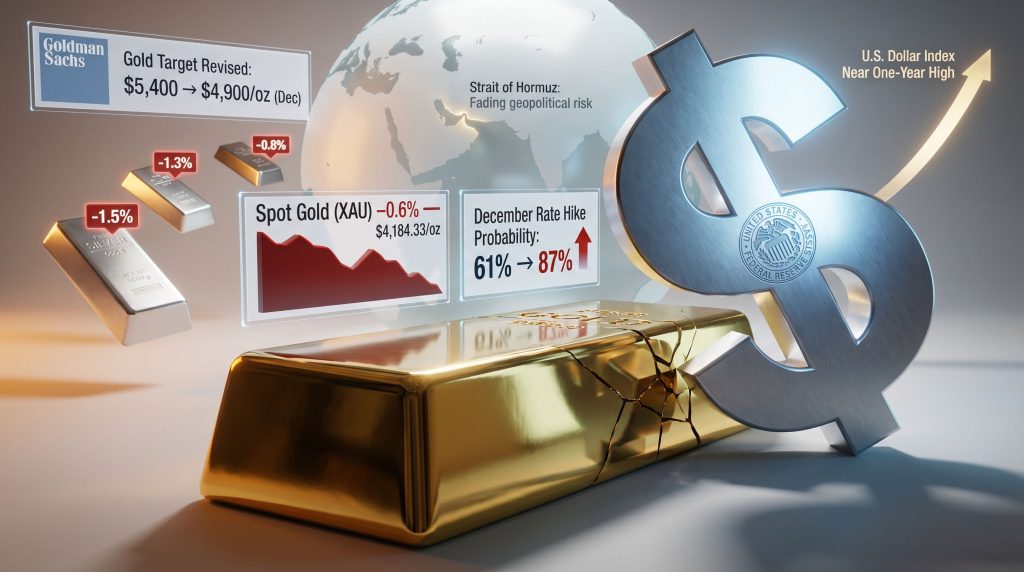
| Gold (XAU) | -0.6% | $4,184.33/oz |
| Silver (XAG) | -1.5% | $64.83/oz |
| Platinum (XPT) | -1.3% | $1,674.47/oz |
| Palladium | -0.8% | $1,268.65/oz |
| Gold Futures (Aug) | -1.0% | $4,202.10/oz |
Gold's weekly loss of approximately 0.9% marks the third consecutive week of declines, a pattern that moves well beyond technical noise and into the territory of a confirmed directional shift. Silver's sharper decline of 1.5% reflects its dual exposure as both a monetary metal and an industrial commodity, making it more vulnerable when risk sentiment deteriorates alongside dollar appreciation.
How the Federal Reserve's Hawkish Pivot Is Reshaping Gold Valuations
The Opportunity Cost Mechanism That Moves Precious Metals
Gold generates no income. It pays no dividend and carries no coupon. In a low-rate environment, this characteristic barely registers as a disadvantage because competing yield-bearing assets offer minimal returns. However, when interest rates rise, or when the market believes they will rise, the calculus changes sharply.
Capital migrates toward assets that compensate investors for the time value of money, and gold's zero-yield profile becomes a genuine liability. This is the core transmission mechanism through which Federal Reserve policy influences gold pricing — it is about measurable return differentials between holding gold and holding U.S. Treasury instruments. The current gold price forecast reflects these shifting dynamics directly.
Kevin Warsh's Debut and the Dot Plot Shock
The Fed's most recent policy meeting marked the debut of Chairman Kevin Warsh, and the institution held its benchmark rate unchanged. However, the accompanying Summary of Economic Projections, known informally as the dot plot, delivered a clear hawkish signal that markets immediately absorbed. According to CNBC's coverage of the event, gold fell sharply as rate cut hopes faded following these hawkish Fed comments.
- 9 out of 19 Fed policymakers now project that at least one rate increase will be required this year
- Prior to the meeting, market-implied probability of a December rate hike sat at 61%
- Following the updated projections, that probability jumped to 87% according to the CME FedWatch Tool
- The shift represents one of the more dramatic single-meeting repricing events in recent memory
| Metric | Pre-Meeting | Post-Meeting |
|---|---|---|
| December Hike Probability | 61% | 87% |
| Policymakers Projecting a Hike | Minority view | 9 of 19 |
| Spot Gold Direction | Neutral | Declining |
| U.S. Dollar Index Level | Elevated | Near one-year high |
Inflationary pressures stemming from the Iran conflict have been a contributing factor, prompting not only the Fed but a growing number of central banks and gold reserve strategies to shift. This synchronised global tightening bias creates a particularly difficult macro environment for non-yielding assets.
What Three Consecutive Weekly Losses Actually Signal
A single week of gold weakness is often dismissed as positioning noise or end-of-month rebalancing. Two weeks begins to attract attention. Three consecutive weekly declines, however, is a meaningful statistical signal that analysts treat as confirmation of a structural narrative shift rather than a temporary correction.
The three compounding forces responsible in this case are:
- A persistently strong U.S. dollar approaching a one-year high
- A hawkish pivot in Fed communication with Warsh's first meeting setting an unexpectedly firm tone
- A fading geopolitical risk premium following diplomatic de-escalation in the Middle East
Each of these individually would create headwinds. Together, they constitute a compounding bearish environment that requires a meaningful reversal in at least one driver before gold can establish a credible recovery.
The Geopolitical Premium: Understanding Its Rise and Rapid Dissolution
How Safe-Haven Demand Forms and Fades
The gold safe-haven dynamics observed during recent Middle Eastern tensions are well established in market history. During periods of acute geopolitical uncertainty, capital flows into gold as investors seek assets uncorrelated with the financial system and resistant to sovereign default risk. This generates what traders call a geopolitical risk premium embedded in the spot price.
The recent tension surrounding Iran and its effects on Middle Eastern energy infrastructure had been a meaningful source of that premium. The rally gold experienced in the wake of those developments was genuine but, as is characteristic of geopolitically-driven moves, inherently fragile.
When oil tankers resumed transit through the Strait of Hormuz and the U.S. confirmed it had lifted its blockade on Iran, the diplomatic de-escalation rapidly unwound the safe-haven bid. Tim Waterer, chief market analyst at KCM Trade, noted that the gold rally tied to U.S.-Iran diplomatic progress proved short-lived, with the resurgent dollar powered by the Fed's newly hawkish stance effectively erasing the geopolitical tailwind.
Why Geopolitical Premiums Are Poor Long-Term Gold Supports
The gold market's recent experience illustrates a pattern that repeats across cycles. In addition, the recession impact on gold during previous tightening episodes demonstrates how quickly safe-haven premiums dissolve once diplomatic resolution begins. Specifically:
- Geopolitical events inject immediate safe-haven demand and spike the spot price
- The premium is priced on uncertainty; once diplomatic resolution begins, it dissipates faster than it accumulated
- Structural drivers like rate differentials and currency strength persist long after the geopolitical catalyst fades
- Investors who buy gold purely on crisis headlines routinely find the trade has reversed before they exit
Consequently, this does not diminish gold's safe-haven credentials. It simply clarifies the timeframe over which geopolitical catalysts influence pricing versus the deeper and more durable influence of monetary policy. The recession impact on gold follows a similar pattern of short-term spikes giving way to structural fundamentals.
Goldman Sachs Revises Its Gold Forecast: What the Numbers Reveal
A $500 Per Ounce Reduction in Target Price
Institutional price forecasts function as anchors for professional positioning. When a major bank revises its gold outlook materially, it reflects not merely a change in price target but a fundamental reassessment of the macroeconomic assumptions underpinning the model.
Goldman Sachs has revised its December gold price target downward from $5,400 per ounce to $4,900 per ounce. The single driving factor behind the revision is the bank's updated assessment that the Federal Reserve will not deliver a rate cut within the current calendar year. The prior bullish target had embedded monetary easing as a second-half tailwind — removing that assumption alone accounts for the entire $500/oz reduction.
As Reuters reported, broader market sentiment around gold remains sensitive to dollar movements and Fed guidance, reinforcing the significance of Goldman's revised outlook.
| Institution | Prior Target | Revised Target | Driver of Change |
|---|---|---|---|
| Goldman Sachs | $5,400/oz (Dec) | $4,900/oz (Dec) | No Fed rate cut expected in 2026 |
| Market Consensus | Broadly bullish | Reassessing | Hawkish dot plot surprise |
| CME FedWatch (Dec Hike) | 61% implied | 87% implied | Post-meeting projection update |
Key Variables Investors Should Be Tracking Right Now
A Three-Factor Framework for Monitoring Gold's Next Move
Gold's near-term direction will not be determined by any single data point. It will be shaped by the interaction between monetary policy communication, currency dynamics, and geopolitical developments. Tracking all three systematically is more useful than relying on price momentum signals alone.
Federal Reserve Communication and Inflation Data
- Upcoming CPI and PCE prints will either validate or challenge the hawkish dot plot projections
- Any deterioration in labour market conditions could prompt a reassessment of rate hike probability, which would be gold-supportive
- Speeches and public appearances by Chairman Warsh will be scrutinised for signals of flexibility or continued firmness
U.S. Dollar Index Trajectory
- Consolidation or weakness from the current one-year high would strengthen gold's price floor
- Divergence in other central banks' policy paths relative to the Fed influences relative dollar strength
- If eurozone, Japanese, or Chinese monetary conditions tighten faster than expected, dollar dominance could moderate
Geopolitical Re-Escalation Potential
- Middle Eastern dynamics remain fluid; any reversal in Iran-related diplomacy could quickly reinstate safe-haven demand
- Energy market disruptions tied to geopolitical flare-ups simultaneously fuel inflation and safe-haven buying, two forces that historically support gold
- Monitoring Strait of Hormuz transit data provides one of the earliest available signals of renewed regional tension
The next major ASX story will hit our subscribers first
Frequently Asked Questions About Gold, the Dollar, and Fed Policy
Why do gold prices fall when the U.S. dollar gets stronger?
Gold is priced globally in U.S. dollars. When the dollar appreciates against other currencies, the effective cost of purchasing gold rises for international buyers. This reduces demand from non-U.S. markets and places consistent downward pressure on the spot price. The relationship is structural and has been reliably observable across multiple decades of market data.
What does a hawkish Federal Reserve mean for gold investors?
A hawkish Fed signals a preference for higher interest rates to control inflation. Higher rates increase the yield available on competing assets like government bonds, raising the opportunity cost of holding gold, which generates no income. Capital tends to rotate from gold toward yield-bearing instruments when this happens, creating sustained selling pressure on bullion.
Can gold recover in a high-rate environment?
Yes, but the conditions required are specific. Gold has historically recovered during high-rate periods when currency debasement fears, systemic financial stress, or sustained geopolitical instability override the opportunity cost dynamic. Without at least one of those catalysts operating at meaningful intensity, a high-rate and strong-dollar environment is structurally challenging for gold to sustain upward momentum through.
Why does silver fall harder than gold in these conditions?
Silver carries a dual identity as both a monetary metal and an industrial commodity. When risk sentiment deteriorates and the dollar strengthens simultaneously, silver faces pressure from two directions: the same opportunity cost dynamics that weigh on gold, plus reduced industrial demand expectations if global growth concerns are present. This dual exposure explains silver's 1.5% decline compared to gold's 0.6% move during the same session.
Key Takeaways for Positioning in the Current Environment
- Spot gold fell to $4,184.33/oz, with August futures declining to $4,202.10/oz, as the dollar hovered near a one-year high
- 87% market-implied probability of a December rate hike, up sharply from 61% pre-meeting, has materially shifted the investment calculus for non-yielding assets
- 9 of 19 Fed policymakers now project at least one rate increase is needed this year, a hawkish signal that proved sufficient to override existing geopolitical support for gold
- The geopolitical risk premium associated with Iran-related tensions has largely unwound following diplomatic progress and the resumption of Strait of Hormuz shipping
- Goldman Sachs revised its December gold target down by $500/oz to $4,900, citing the complete removal of rate cut assumptions from its base case model
- Sector-wide selling across silver (-1.5%), platinum (-1.3%), and palladium (-0.8%) confirms that macro forces, not gold-specific dynamics, are driving the current episode where gold prices fall on firm dollar and hawkish Fed signals
This article is intended for informational purposes only and does not constitute financial advice. Precious metals markets are subject to rapid and unpredictable price movements. Past performance is not indicative of future results. Readers should conduct their own due diligence or consult a licensed financial adviser before making investment decisions based on the information presented here.
Want to Stay Ahead of the Next Major Mineral Discovery Whilst Navigating Shifting Markets?
Whilst monetary policy continues to reshape precious metals valuations, Discovery Alert's proprietary Discovery IQ model scans ASX announcements in real time, instantly notifying subscribers of significant mineral discoveries across gold, silver, and 30+ other commodities — turning complex market data into actionable investment insights. Explore historic discoveries and their returns to understand the potential, then begin your 14-day free trial at Discovery Alert to position yourself ahead of the broader market.